Date
Author
Олеся Павленко, Дата-отдел «Новой газеты»
Source

Preserved copy
Translated material
Crimes against history
How in Russia a monopoly is established on the "right" past
The number of laws punishing for alternative points of view on the Soviet period, and pressure on independent historians, human rights activists and journalists has been growing steadily since 2012. The International Human Rights Federation (FIDH) has analyzed how they are fighting in Russia with historians and organizations who explore the theme inconvenient for the authorities.
The International Human Rights Federation (FIDH) has been working in the field of protecting human rights since 1922, now it includes more than 190 independent organizations from most countries of the world. FIDH can file complaints with the European Committee on Social Laws and advise the Economic and Social Council (Ecosos) of the UN. In June, FIDH published a report on crimes against history in Russia, in which she examined the cases of persecution for scientific work on the crimes of the Soviet regime.
The main conclusions of the report are that
The “correct history” of the USSR is increasingly used by the Russian authorities for its own legitimation.
For this, officials are gradually creating pseudo -public organizations to protect historical memory, adopt laws that allow me to put pressure on independent researchers, and monopolize the discussion of the past. The official position of the inviolability of the Soviet past was finally strengthened in 2020, after the adoption of amendments to the Constitution. So, Russia recognized itself as an successor of the USSR and a defender of memory of the exploits of the Second World War. However, the course on the Gosmonopoly on history began almost a decade earlier.
The Date Department has collected the most important from the report of the International Federation for Human Rights on Crimes against History in Russia.
Institutional pressure
The Law on NPO-Inoacers, adopted in 2012, became one of the pressure tools for independent organizations engaged in historical research and archival business.
First of all, we are talking about the “memorial”*, which is engaged in the work of preserving the memory of the victims of political repression in the USSR. The register of foreign agents includes the international "memorial"* and its seven regional branches - the Ministry of Justice considered that the network is engaged in political activities. Thus, the Yekaterinburg Memorial* in Yekaterinburg fell into the register for memorial events, at which the organizers announced a list of victims of political repression and who condemned them state bodies. In 2020, the department was fined for the lack of marking on the poster, which was not listed on its balance sheet, but hung on a private action, where the memorials worked as volunteers.
In the register of foreign agents in 2015-2016 there was also the Perm-36 museum*, whose owners were about to develop museums of memory throughout the country. This idea had to be abandoned due to the conflict with the administration of the Perm governor Viktor Basargin on the museum. Now the previously controlled museum is an independent ANO eliminated.
The pressure on historians is also individual. Among those who encountered repression or threats, Yuri Dmitriev, the head of the Karelian Memorial*, David Feldman, Professor of the Russian State Humanitarian University, Alexander Guryanov, the head of the Polish program in the international Memorial*, Kirill Aleksandrov and others.
How the authorities pursued historians for work
Who: Kirill Alexandrov
Location: St. Petersburg Institute of History of the Russian Academy of Sciences (Holy Filaret Orthodox-Christian Institute since 2019)
For what: a dissertation about the Soviet military
As: refusal to award a doctoral degree
Who: Alexander Gogun
Location: Gumboldt Berlin University
For what: a comparison of members of United Russia with Ukrainian collaborators in one of the books
How: Removing a book from sale
Who: Alexander Guryanov
Location: Polish commission of the human rights company "Memorial"*
For what: the study of Soviet repressions of 1930-1940, including Katyn execution
How: The threat of criminal proceedings
Who: Yuri Dmitriev
Location: Karelian branch of the Memorial Society*
For what: Work on perpetuating the memory of the victims of repression in Karelia
How: Criminal prosecution
Who: Andrey Zhukov
Location: FSB
For what: I shared in a chat with military historians the results of a study of the names and locations of military units
How: Criminal prosecution
Who: Andrey Zubov
Location: MGIMO (until 2014), free researcher
For what: comparison of the annexation of Crimea with Austria Anschlus in 1938
How: Dismissal from MGIMO
Who: Sergey Koltyrin
Location: Medvezhyegorsk City Museum
For what: criticism of the work of the Russian Military Historical Society
How: Criminal prosecution
Who: Andrey Petrov
Location: Irkutsk State University
For what: the organization of historical walks in Irkutsk
How: dismissal from ISU
Who: Yuri Pivovarov
Location: Institute of Scientific Information on Social Sciences
For what: research on the political system of Russia
How: Criminal prosecution
Who: Mikhail Suprun
Location: Northern Arctic Federal University named after M.V. Lomonosov
For what: a study of the deportation of Germans from the USSR
How: Criminal prosecution
Who: David Feldman
Location: RSU
For what: performance on TV about Katyn execution
How: The threat of criminal proceedings
Who: Irina Fliga
Location: St. Petersburg "Memorial"*
For what: Work in the "Memorial"*
As: the exclusion from the presidential working group to perpetuate the memory of victims of political repression
Who: Sebastian Stopper
Location: Gumboldt Berlin University
For what: publications about the Bryansk partisans
How: Making extremist materials
Censorship control
In Russia, one of the censorship tools over historians was the federal list of extremist materials, which appeared in 2007. Now it has about 5100 materials, successfully challenge the inclusion in the list 106 times.
The international "Agora" found among extremist materials at least 41 publications on a historical topic. So the Bryansk court recognized 6 posts in the “live magazine” of the German historian Sebastian Stopper about the Bryansk partisans. In the list you can also find a study by the historian A.V. Zorokova about the connections of Russian emigration with the Nazis; The book of G. Picker, translated into Russian, Hitler's Great Talks; Books and research on the organization of Ukrainian nationalists, Ukrainian rebel army and Stepan Bandera and collections of their internal documents.
According to the international Federation for human rights, the scale of hidden censorship in Russia is difficult to assess. The historian Nikolai Koposov in an interview for a report noted that since 2002, publications on the controversial issues of World War II have disappeared from the leading scientific journals, including the fault of the political elite of the USSR in inciting war.
In 2014, an “memorial” article 354.1 on the rehabilitation of Nazism appeared in the Criminal Code of the Criminal Code.
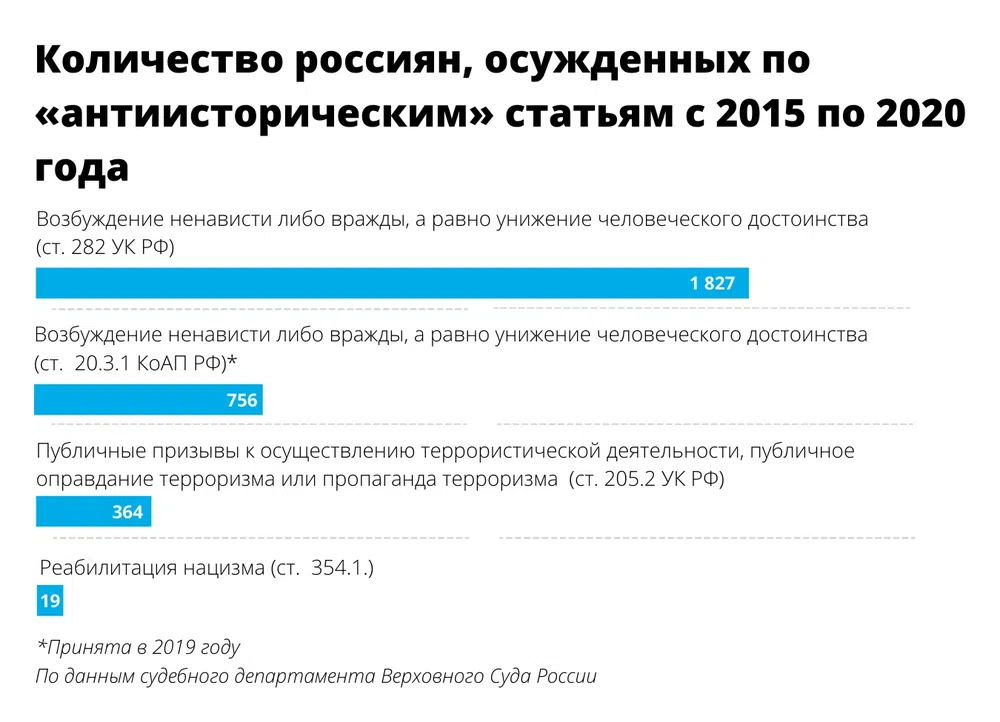
In two cases, the investigation saw a distortion of the memory of the Second World War in publications about the involvement of the Soviet Army in war crimes. Auto mechanic from Perm Vladimir Luzgin received a fine of 200,000 rubles for a link to an article on the history of the Ukrainian rebel army, which he shared in 2014, the author of the article claimed that the USSR and Germany attacked Poland together and unleashed the Second World War. Now the complaint of Luzgin is in the ECHR. In 2018, in Magadan, a case was opened against a local resident for a series of posts about the war crimes of the Soviet elite.
Another thing was aroused in 2020 due to the satirical story of Nikolai Gorelov, a blogger from Kaliningrad, written in 2014-2015, but after a couple of months they closed due to the expired duration. The story included fragments about the crimes of the Red Army against the civilian population, monologues on the influence of victory in the Second World War on the Stalinist regime and reasoning on other themes painful for the current government.
Two historians were threatened with criminal cases of rehabilitation of Nazism for historical statements. In 2015, the grandson of Joseph Stalin Yevgeny Dzhugashvili asked to initiate a criminal case against David Feldman for a speech on Russian TV about the Katyn execution in 1940. Alexander Guryanov, the head of the Polish program in the international Memorial, in an interview with FIDH reported that he also regularly received threats to initiate proceedings under Article 354.1 for publications about Katin. He received one of them from an unnamed State Duma deputy after saying against a conference, the organizers of which denied the guilt of the NKVD in massacres in Poland.
From 2014 BC, under article 354.1, 26 cases have reached, only one defendant received an acquittal for the denial of the Holocaust.
Among the public court decisions available, the authors of the report found several accusations for publications on international crimes of the USSR during World War II.
In the spring of 2021, the State Duma adopted a number of amendments to this law: criminalized an insult to the feelings of the WWII veterans, including the dead, introduced civil liability for companies for the justification of Nazism and equated the rehabilitation of Nazism on the Internet with crimes with aggravating circumstances. These amendments entered into force on April 5.
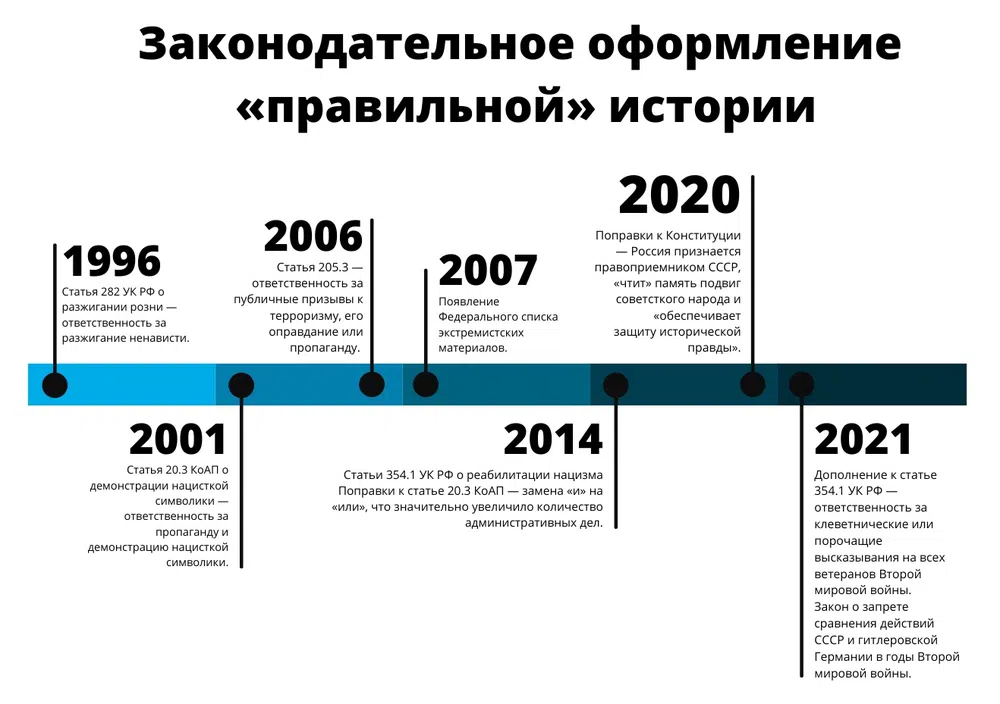
According to a similar article of the Code of Administrative Offenses 20.3, 9771 people received administrative penalties on the public demonstration of Nazi symbols from 2014 to 2019. In addition to a fine or arrest from some of the convicts by court decision, the equipment was seized on which the offense was committed. The authors of the report found in open court decisions of the case, initiated due to publications about German and Soviet propaganda of wartime, comparing Putin with Hitler and texts about the history of Nazi Germany.
For statements about the history of the Soviet period, they are also persecuted under the 282nd article of the Criminal Code on inciting hatred or enmity. From 2012 to 2019, more than 1,500 people received convictions under this article, some of the cases were excited due to historical statements. For example, in 2009, the Tatar activist Rafis Kashapov was sentenced to 18 months in prison for the publication of the violent circulation of Muslims to Christianity. In 2015, he received three years in colony for posts in which he accused Putin of interfering with Ukraine and the annexation of Crimea. Now this case is in the ECHR.
In 2019, an amendment entered into force, which deduced the incitement of hatred, committed for the first time, from criminal liability and transferred to the category of administrative offenses. In 2020, 757 people received administrative punishments under this article.
Against historians can also be used by article 205.2 (“Public calls for terrorist activity, a public justification for terrorism or propaganda of terrorism”). According to Alexander Verkhovsky, director of the SOVA information and analytical center*, this composition can be used against researchers of the events of the Chechen wars.
Gongo historians
To designate organizations that are created under the guise of NPOs, but actually pursue the goals described by the government, the term GOVOGO (Government Non-Government Organizations) is widely used. In some cases, gongo-organization is masked for fully private initiatives; In today's Russia, they quite often do not hesitate to have a government or president among the founders, and therefore directly pump out budget money.
According to the FIDH report,
The Russian authorities actively use nominally non-state or “socially-state”, or organized by high-ranking officials of the association to monopolize historical discourse.
One of the first Gongo to establish the state historical course was the “Commission on Combating attempts to falsify history to the detriment of the interests of Russia” created in 2009. It included officials and employees of the FSB and foreign intelligence services, there were few historians there. The commission worked until 2012.
Then Vladimir Putin signed a decree on the creation of an all-Russian public-state organization “Russian Military Historical Society” (RVIO), whose chairman was Vladimir Medinsky, who at that time held the position of Minister of Culture. In 2016–2017, historians Vyacheslav Kozlyakov and Konstantin Yerusalimsky and philologist Ivan Babitsky tried to deprive Medinsky doctoral degree on the basis of his unscientific nature, a set of actual and methodological errors, forgery with a dissertation of monographs and articles, as well as ex-minister of references to non-existent work and false bibliographic data of sources. The expert Council of the Higher Attestation Commission supported the statement, but thanks to the unprecedented administrative pressure on the Presidium of the Higher Attestation Commission by his former chairman Vladimir Filippov and the official historian Alexander Chubaryan (contrary to the existing practice, admitted to the case in the case, the side of which he was not), the ex-minister of culture retained.
It was RVIO who initiated excavations in Sandarmokh in 2018 and 2019 to search for the remains of supposedly Soviet prisoners of war, executed during the Soviet-Finnish war. At the same time, there were trials against Yuri Dmitriev. The descendants of the victims of repression buried in Sandarmokh opposed excavations, but the courts did not satisfy the claims for the termination of work.
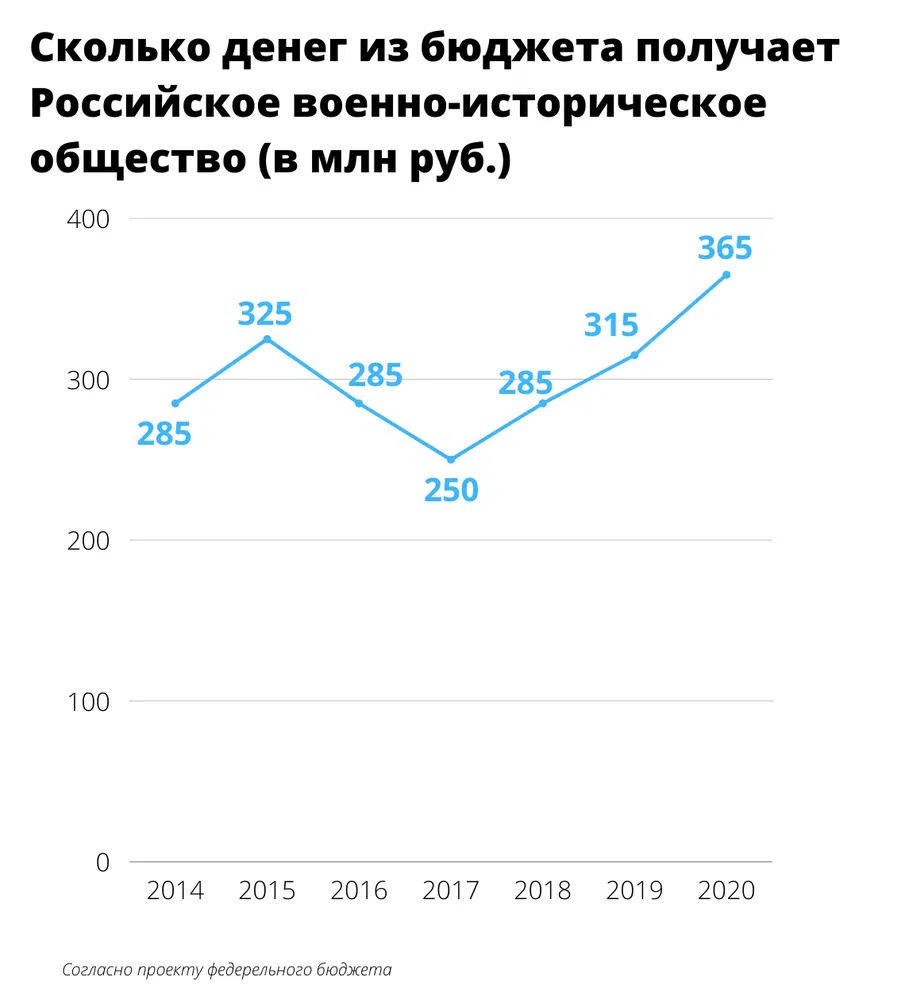
In the same 2012, state universities, academic institutions, museums and media companies recreated the Russian historical society that existed in tsarist times. Rio is engaged in the popularization of history, the patriotic education of youth. The chairman of the company was Sergey Naryshkin, Anatoly Torkunov, Rector of MGIMO, and Alexander Chubaryan, and the supervisor of the Institute of General History of the Russian Academy of Sciences are also sitting on the presidium.
One of the projects of Rio is the History of the Soviet Atomic Project, its authors emphasized the role of Lavrenty Beria in the formation of the country's nuclear system. In addition, society oversees a single historical and cultural standard, introduced in 2016, conducts Dictation of Victory, it also monitored the installation of the monument to Alexander III, which was opened by Vladimir Putin in early June.
The company is financed from the state and private sponsors.
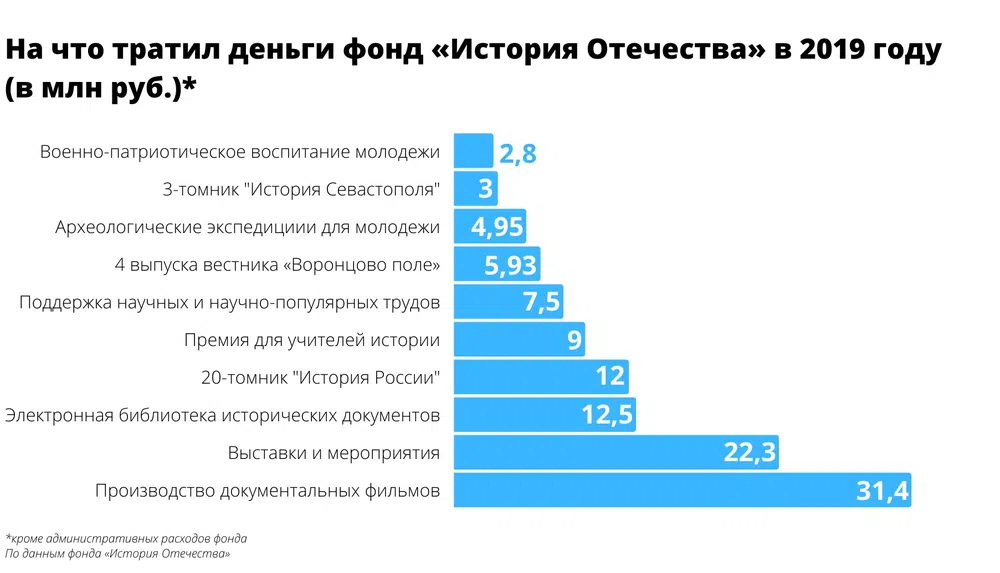
In 2016, by decree of Vladimir Putin, the Fund of the Fatherland Foundation was created, which works in conjunction with the Russian historical society. The chairman of the fund was also appointed Sergey Naryshkin.
The History of the Fatherland Foundation is funded from the federal budget. In 2019, the fund spent 180 million rubles on its projects, the organization did not publish financial statements for the 2020th.
In 2021, at a round table in the Federation Council, Vladimir Medinsky proposed officially establishing a “state historical policy”, continuing Putin’s idea about the transition to unified history textbooks. Since 2016, despite the protests of the scientific community, only three series of textbooks have been used in Russian schools that approved the Russian Historical Society that oversee the project. At the same event, Vladimir Medinsky expressed the idea of regulating a higher historical education so that "the students of the Estabrics did not listen to the" wrong "programs at the" relevant radio stations ".
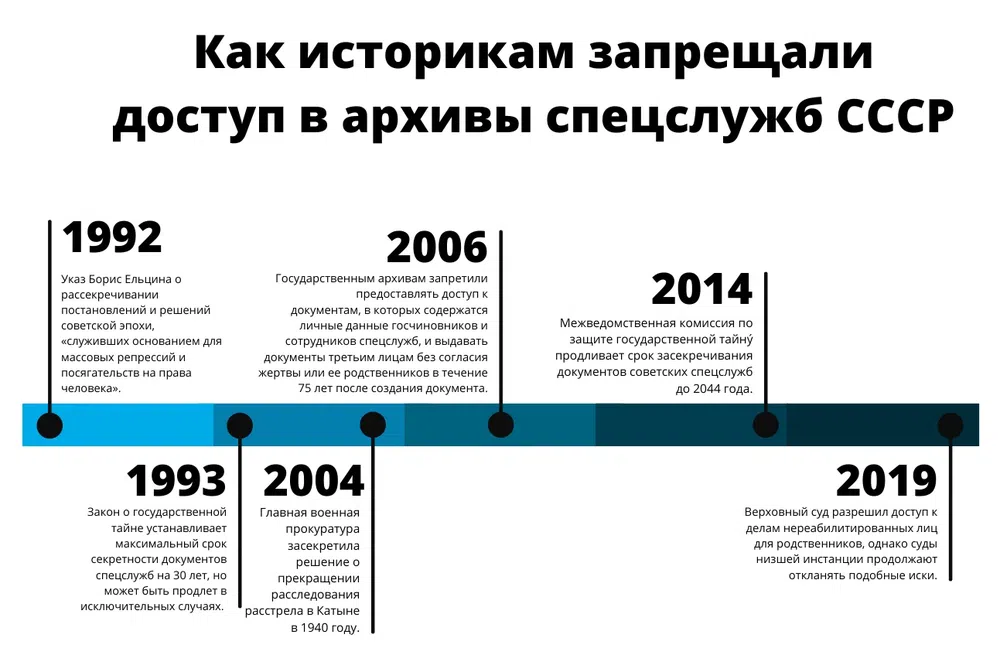
Along with this, the archives of the Soviet special services are still classified in Russia, which prevents historians from studying international crimes of the communist regime. In 2014, the period of classification of the archives was extended for another thirty years - for the maximum possible period by law. Historians have to seek admission to archives through courts that rarely take their side.
Despite the initiative approved by the state about perpetuating the memory of the victims of the Soviet regime, pressure is on the organizers of memorial events.
“The authorities are not trying to work with the victims of the crimes of the USSR, that’s the point. Crimes are not investigated, the guilty are not named, the archives are classified. The state puts nameless monuments, while the victims of the terror are in the mass graves, and we do not know either them, nor their numbers. Those who survived did not receive any real compensation, ”says Grigory Weipan, the author of the FIDH report and a lawyer working with children of victims of political repression. - For the month of the Gulag, a shameful lump -sum payment of 75 rubles is entitled. For all the property taken, including real estate, up to 10 thousand rubles. The right of victims to return to where their families lived to repressions remains an empty sound, and one and a half thousand elderly “children of the Gulag” continue to live in exile. The authorities are simply waiting for them to die. ”
In 2019, the Saratov authorities reduced the program of the Moscow Museum of the Gulag, removing lectures from it on the history of Soviet repressions, master classes on working with information about victims of repression and showing a documentary film, agreeing only one theatrical performance.
Institutional pressure on independent historians will continue to grow after the adoption of the law on the prohibition of comparing roles of the USSR and Nazi Germany in the Second World War.
«Будут новые уголовные дела за высказывания о прошлом, будет еще меньше независимых исследований об истории Второй мировой войны, будет еще больше цензуры», — считает автор доклада Григорий Вайпан.
*Организации включены Минюстом в перечень НКО, выполняющих функцию иностранного агента