
Translated material
There is no kurshi. The story of the burnt mushroom village, from which logs were evacuated instead of people
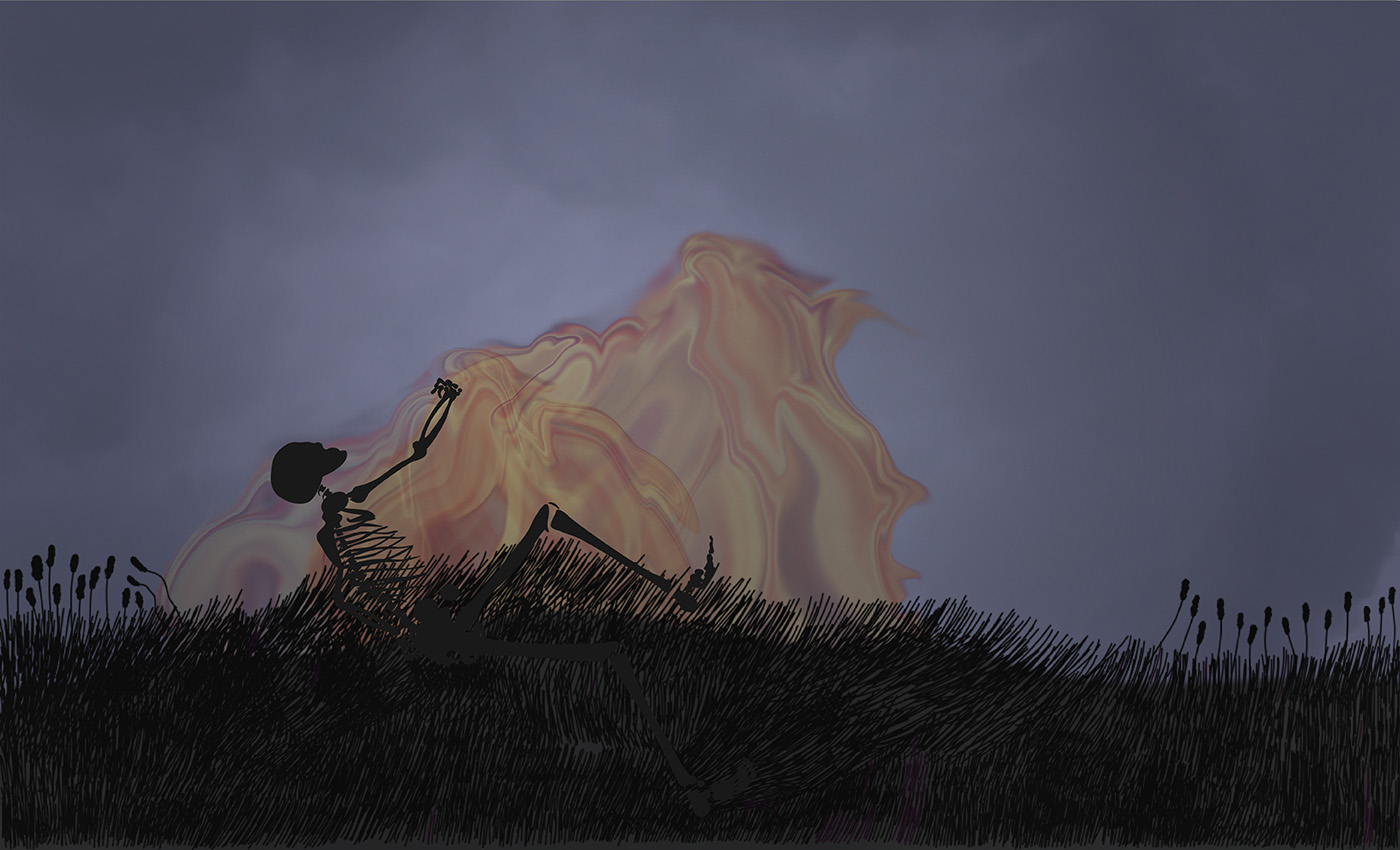
Illustration: Varvara is a good / mediazone
The Lithuanian traveler, a motorist and researcher of Stalinist repressions Anton Pustovalov found in the Ryazan Meshchere a place where Kursha-2 stood a forest village, which burned together with residents in 1936.
Not far from the Spas-caps in the Ryazan Meshchera there is a small town of Tuma: a beautiful ampir church, a museum of a narrow-fly, which has not been operating for more than ten years, and its own history, almost no one is not known outside the area. In 1936, a terrible fire occurred in Tumsky forest production in the village of Cour, in which more than a thousand people died. I tried to find everything that they wrote about this fire; It turned out that they wrote not so much. The Ryazan edition of Komsomolskaya Pravda conducted their own investigation, travelers mentioned the fire several times, rewriting the article from Wikipedia. I tried to figure out this story on my own, and this is what happened.
It owes its appearance to a forest fire. In 1893, in the vicinity of the village of Kriush, a large lower fire was held, and the government declared a trading damaged forest for 10 kopecks per. At first, the burning forest was cleared with the help of horses, but it soon became clear that it was impossible to take out so many wood with a horse -drawn transport; So the project of the Ryazan-Tuma narrow-hot railway appeared, the construction of which was entrusted with the Moscow company for the construction and operation of access roads.
Who are curses
The history of the village of Courch is connected with immigrants from the Grand Duchy of Lithuania. As a couch is mentioned in 1620-1630, but people settled here much earlier-they were called Kurshaki, “Lithuania Golovy” and “Lithuanian Lithuania”.
The Ryazan historian Boris Gorbunov wrote that these were the descendants of the captured warriors captured during one of the Lithuanian-Moskovsky wars. He was echoed by Irina Krasnogorskaya in the article “The Secret of the Kurshatsky People”, published in the newspaper “New Meshchera” in 1991.
Lithuanian historians suggest that Kurshaki is a retinue, at the end of the 14th century, sent to the Ryazan principality with Euphrosyne, the daughter of the great prince of Lithuania Olgerd, who married the prince of Ryazan Oleg. One way or another, all researchers, including ethnographer Natalya Lebedev, connect the inhabitants of the medieval curses with the same Baltic nationality. The echoes of her names are heard in such toponyms as the Curonian Spit, Courland and Kurzem.
The working village of Kursha-2 was founded on logging a few kilometers from the old village of Kursh in 1924. In 1927, the narrow gauge branch extended here to take out the forest. By the beginning of 1936, more than a thousand people lived in Kursh-2. There was a railway station in the village, an electric sawmill, a woodworking enterprise, a school, a store, a medical center and a newly built culture house, which was planned to open on November 7.
The summer of 1936 turned out to be a record hot. By the end of July, the air temperature reached 37 °. Orders received orders to check fire equipment from the district center, smelled of smoke from burning peat bogs, a forest was burning in the area of the village of Lesomashinin.
The immediate cause of the fire is the spark from the steam locomotive, which fell in the village of Charus. The fire arose on August 1, it was not possible to immediately localize the fire, and by the evening of August 2, about 1,000 hectares of forest were already burning. They could not cope with the fire on their own in Kurche-2. On the same day, another truck from the tuma came to the village - to export the prepared wood. The train brigade proposed to pick up women and children from Kurshi, but the dispatcher ordered the wagons to the dead end and start loading the forest.
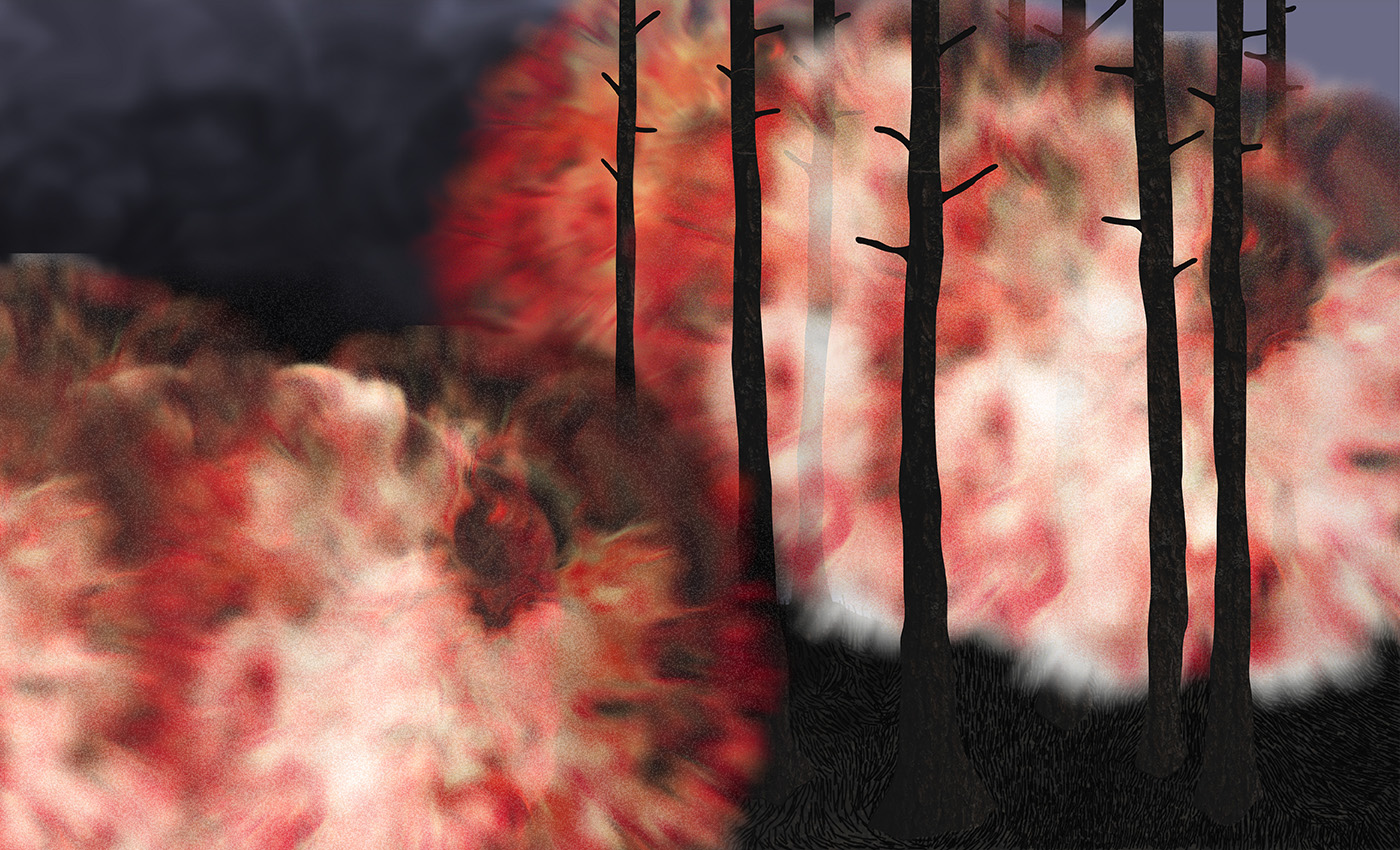
Illustration: Varvara is a good / mediazone
Lidia Smirnova, one of the survivors in the disaster, recalled in an interview with New Meshchera: “On the morning of August 3, a telephone message came from the tumes - to take measures to evacuate the disabled population. However, with the evacuation, a delay occurred, the train was loading and at the station arrived only for dinner. The wagons were loaded with a circle so that there were gaps in which people sat down. Despite attempts to stop the composition, realizing that there may no longer be the road, the train still started. At that moment, when the composition departed from the station, the fire was already close to the village. It was windy that day, and the bottom fire turned to Verkhova. Fire speed 30 km/h (about a kilometer in two minutes). Only a few minutes passed when the train reached one of the bridges across the Kad River. By that time, the bridge had already burned and, unable to withstand the weight of the loaded composition, collapsed under a steam locomotive, after which the composition came off the paths. Some of the people turned out to be clamped and died on the spot, many rushed to run away from the fire or tried to hide in a roadside ditch - their fire was overtaken literally 200 meters from the scene of the accident. It was possible to survive only those who ran towards the fire and, despite the burns, managed to slip through the fire wall. The rest suffered and burned alive. " Of those who went by train to the darkness, 29 people survived.
In the village, meanwhile, people were looking for salvation from fire. According to the memoirs of Iraida Runova, someone buried himself in the sand, turning around with a wet towel, someone dived into the pond and waited on a small island in the middle, others took refuge in the ditches and cesspools. Those who jumped into the wells died - they were covered with collapsed log cabins. After the fire in the village, only the store survived. By evening, the fire band stretched 40 kilometers in length and 20 in width. 78 people survived in Kurche-2, 75 of whom received burns. The survivors were gathered in the village of Vereya.
The fire ended as quickly as it began. On the night of August 4, strong rains went, the wind verse, and the fire reached the fields. By August 6, only a few peat bogs burned, on the extinguishing of which the Red Army soldiers were sent. Some foci were smoldered to the spring flood.
The newspaper New Meshchera, the next morning, released a small note, which stated that 250 people were killed. A little later, on August 16, at a meeting of the party committee, 313 dead were announced. According to the registry office archives, 264 people died from among the inhabitants of Kursh. The exact number of victims is unknown - in addition to the free villages, the repressed ones worked on logging. I sent a request to the FSB in the Ryazan region with a request to clarify how many prisoners were at the time of the fire in a curder and the surroundings, and received the answer that the special service did not have such data.
But the head of Ryazan Andrei Blinushov suggested that in the archive of the human rights organization there are certificates of the OGPU and the CPSU (b) in the Tumsky district. According to these documents, the forced labor of clergy and believers was widely used in logging.
Here is what the head of the Ryakokrotdel OGPU wrote in the OPERPPROP: “Due to the overflow of shipping (shipping prisons) in Ryazan, it was decided to leave fists and clergymen in the field for work on peat and logging.” The words of Izvekov are confirmed by the note by the secretary of the Tumsky district committee of the Begishev party: “For our area, a religious order is characteristic; In all other respects, we are similar to other areas. The events that I will tell about were played around the Tuma Church, and the greatest mistake was made on our part. At a solemn meeting dedicated , a decree was made to close the Tuma Church. (I was not there). A lot of different decisions were made on this score, but the church remained open. The workers at the meeting decided to close the church. We say that we have nothing to wait, we will close it ourselves and put the believers in front of the fact. And this church serves 14 villages, and only four of them issued a decision to close and caused other villages. Additionally committed even stupidity; It was announced at the meeting - "Tomorrow at 9 o’clock in the morning we will close the church, come to closing all." And “all” came: who wants to close, and who does not want. The crowd gathered. Those who did not want the closure remained near the Church to make noise, and those who were for the closure went to the People’s House to choose a commission to accept the church. There were more the latter in the tube itself, but the fact is that a lot of dissatisfied was flickering from the surrounding villages. Believers began to ask that on this day they would let them serve the ass. Pop went out and said that he could not serve. The audience dispersed. The next day, they agreed to send the priest for logging. (He has labor, and first of all, it falls on the kulak elements). ”
Why, not only priests, but also former peasants from neighboring villages, explains the circular No. 612 dated January 30, 1930, signed by Timofeev and Volkov, “numbers and pace of collectivization of the district” over the past 10 days “by no means” by January 20 by January 20, only 21% of farms, explains. The local authorities were “categorically proposed”: “Maximize the pace of work”, to discard the conversations “still have time”, “take all measures and mobilize all your strength” so that by the first March 1930 to involve at least 75% of farms in collective farms. ”
By February 16, 1930, the percentage of collectivization in the Tumsky district reached 95% - primarily due to the mass eviction of the "kulaks". According to the instructions of the Ryazan district committee, the wealthy peasants should have removed allotments, horses, houses and a working equipment.
But back to the history of the fire.
This is how his resident of the village of Koltuki recalled Grigory Efimovich Kleimenov: “He was rushing through the forest with a terrible roar. And his speed was such that few people managed to escape from the forest that day. Fire covered mows, mushroom pickers, lumberjacks. The carts of the forest, as it turned out later, straightened their horses and tried to jump away from the fire. All living things died: cows, horses, moose, small animals and birds. Karasi was welded in forest barrels. The wall of fire walked along the bora with roar and frantic speed. It seemed that the forest did not burn, but exploded. The whirlwinds of fire and black smoke rose high up. Fires from the fiery "hats" falling from above began in different places. It seemed to me then: the whole world is busy with fire. Our village, separated from the forest with a swamp and a strip of field, suffocated in smoke. From all the houses, they brought up the junk, waited, was about to flare up somewhere. Rye burned, dry meadows smoked. The fire of the fire passed - the field stopped the fire, it went through the forest, to the left of us. And then we came to our senses: and Curses? She is three kilometers in the forest. Just through the curses, fire passed. Throwing ... there is no kurshi! The village of Lesorubov Kurshu-2, the fire was pulled out aside. And people? Indeed, every day trains walked along a narrow gauge plane, a hundred cubic meters dragged a forest to the central highway. And on that day at the station there was another steamh, waited for him to be loaded with wood. Was it really impossible to put people on the platforms instead of pine trunks, even women and children, take them away until the danger passes? It turned out that it was impossible! The plan must be completed. It turns out that folk good, these are not people, these are already sawn wood trunks, and they must be saved in the first place. So said the station manager - the official representative of the Soviet power in the village, and people obeyed, and began to load the platforms with forest. When even it came to the dispatcher that the fire was going directly to the village and not to stop it, it was too late. Women with the small guys with clusters climbed directly to the platforms with logs, the train gave a beep, went, slowly gaining speed, but you won’t accelerate much along the narrow gaugee, and the fire turned out to be faster. When a steamer reached the bridge over the river, everything was burning there. The driver tried to slip through the bridge, the steam locomotive caught fire, the flame spread to the platforms with the forest ... ".
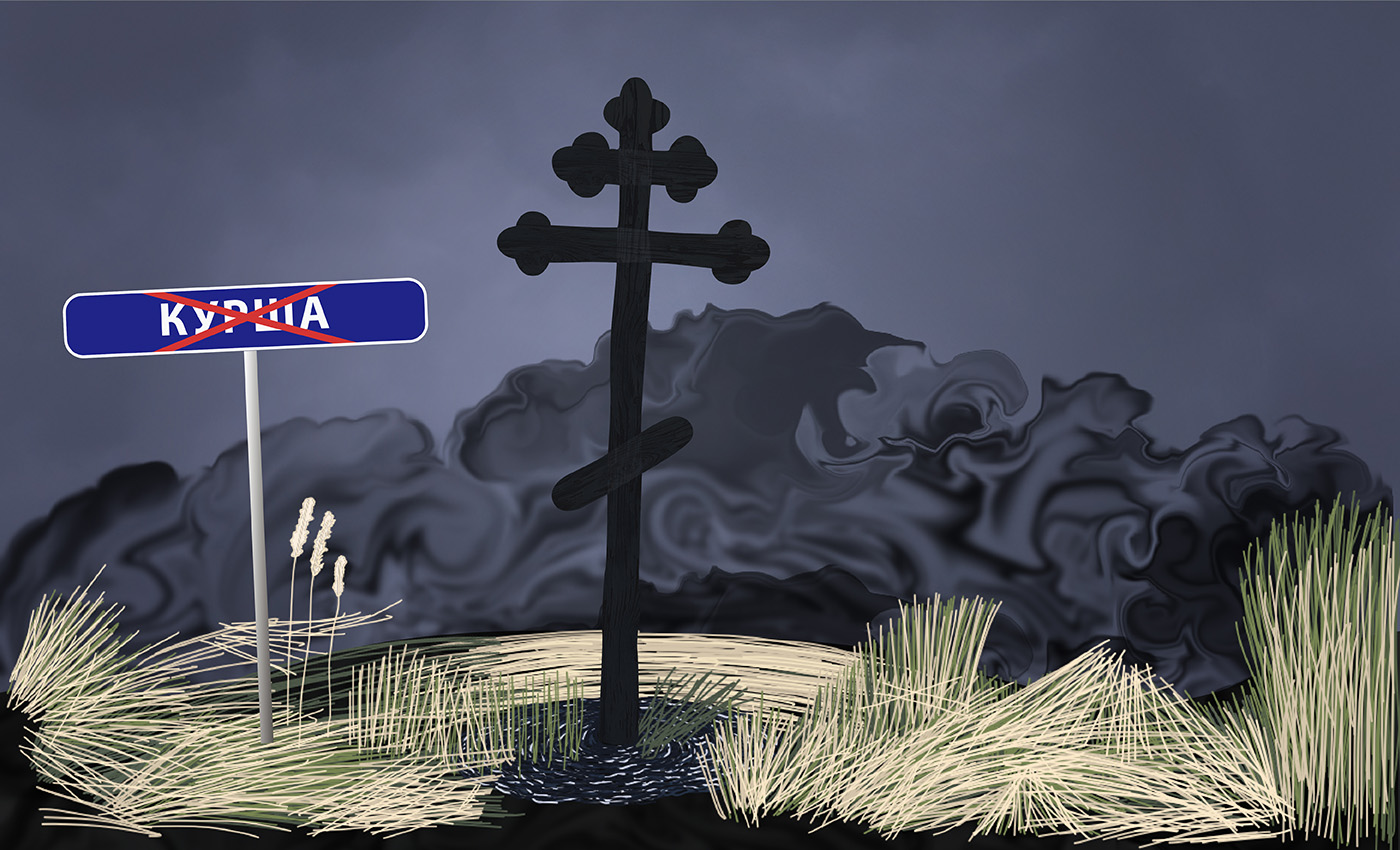
Illustration: Varvara is a good / mediazone
But the memoirs of Ivan Alekseevich Kudryashev: “Then we lived in Ivankovo. In the village, chests were buried in the ground, they were afraid that a fire would come here. Aunt - Father Sister went to fight with fire. They got out of the forest to the Kultukovo field, and the authorities are towards, they say: "What is it all on the fire, and you are from the fire?" They returned and burned. ”
Akim Petrovich Khrapchikov in those days worked on the Vorontsovsky forest in the Tumsky district, and his family lived in a curder: “The summer was dry. Forest fires began. All were thrown to fight fire. At that time, a military unit from the Kovrov garrison arrived at that time. On August 3, there was a very strong wind that threw the fire ten meters forward. Well, the forest is dry - flashed like gunpowder, and no force could stop the fire. We were given a team to export all the disabled population from the Vorontsov village to the Dubrovka station. At 12:00 they gave me a telegram that all relatives and relatives burned in a fire on a bursh. With the permission of the boss, I went to the curses. There was no village left, everything burned out. I tried to find my relatives on the charred corpses, but one of them could not be recognized. There were only bones from the children. In this fire, my mother Anna Nikolaevna, Brother George Seven years old, sister Nastya nine years old, my grandfather Nikolai Fedotych, grandmother Alena, wife of my mother with two children, burned out in this fire. My mother’s brother, Dmitry Nikolaevich, greatly burned, whom I found in the Snokhino hospital. All the soles of his legs were burned, his arms, face, and head were burned. For one year and six months he lay in Moscow at the institute. He recovered. "
When the information about the fire in the curder reached Moscow, the deputy Nikita Khrushchev arrived at the place of the tragedy, at that time - the secretary of the Moscow Regional Committee of the CPSU (b). Kulkov was entrusted with the organization of the funeral. The search for volunteers for the funeral team began. 1,000 coffins were ordered in the tube, but they quickly ended. In the center of the village, a moat was dug at the former steam locomotive depot, and fighters of the Red Army were sent to help the funeral team. For the graves, they brought a “barrel of wine” - “drink how much it will fit, just bury people”; The men got out of the ditch, took a sip or two and went back. At the end of the work on the mass grave, a cross was installed, in the post -war years the cross was replaced with a reinforced concrete monument, but after the devastating fire of 2010, only a skeleton remained from it. At a mourning rally, Khrushchev read out. Mikhail Kalinin also came to chat with firecrackers.
The victims received free of charge for wood to restore housing, but soon the authorities changed their minds, and the Tumsky district executive committee decided "to oblige the Tuman Ryleskhoz and recover the root value of the free forest in late 1937 from collective farms and collective farmers."
This is not to say that the fire that destroyed hundreds of people was a surprise. Six years before the disaster, the regional authorities reported on constant fires along the narrow gauge. The reason is the neglect of the requirements of fire safety when servicing steam locomotives. In the information summary No. 10 of the administrative department of the Ryazan Oblast Executive Committee of June 18, 1930 it was said: “Secret. Chairman of the Ryazhramr Executive Committee. With the onset of the spring period, frequent cases of fires near the forestry branch of Curses-Cheris are observed. Fires are destroyed by saw-lezomaterial and firewood, belonging to the Moscow Tuma region, as well as timber. (Export.) The reason for the occurrence of fires is that the branches of the branch are not protected in fire, as expected, and are heated by firewood, why from sparks of passing steam locomotives and fires arise that have recently brought losses of 20,000 rubles. Gosfontovsky forests are also burning. The administration of the forest branch and its business executives do not take any measures and do not inform anyone about what happened. On this case, a criminal case was instituted on charges of Officials of the forestry branch of the software , but the district committee in the person of the secretary Begishev proposed to be terminated in criminal order, and the situation on the branch remains the same, which is why losses are obtained. ”
It is known that after a fire in a curder, the director of the forestry department Gabriel Subbotin, his deputy Peter Zakurdaev, as well as the technical director, chief engineer, chairman of the Tuma district executive committee, secretary of the district committee Begishev and the head of the forestry; By a court decision, they were transferred to other areas of work with an obligation.
After the war, the village was restored, however, he had no such size as before. The railway line to Kurshi-2 was dismantled in 1956. Logos -procurers were still working here, there was a sawmill, but after the fires of 1972 the village was disbanded, and people were resettled - whom to the neighboring stolences, and whom in the ham. The last houses of Kurshi-2 destroyed forest fires in 2010; Then the memorial died at the entrance to the village, today only a metal skeleton has been preserved from it.
On August 3, 2011, on the day of the 75th anniversary of the tragedy, in the presence of the last of the living witnesses of the fire, Lidia Danilovna Smirnova (Ablova) at the place where Cursha-2 was once located, a memorial cross and a memorial plate were installed.
Although the circumstances of the fire were never classified, the authorities recalled the catastrophe in the curder extremely reluctantly. In the central press about the Meshchersky tragedy, Komsomolskaya Pravda wrote for the first time - in 1970, the newspaper released an article by Vasily Peskov “The Summer was dry”.
It is quite difficult to get into the curses today. The only bus goes to Vetchans (this is about nine kilometers from the curses) from the tuma on Thursdays, then the primer, passing only on the SUV. I managed to be here in early November. Мы оставили автомобиль в Колтуках и пошли по лесной дороге в сторону . На половине пути нам встретились егеря; убедившись, что у нас с собой нет ни оружия, ни средств, при помощи которых можно было бы разжечь костер, они потеряли к нам интерес.
В паре километров от Колтуков становятся заметны следы пожара 2010 года. Проходим еще немного и видим обугленные стволы деревьев.
Первое, что встречает нас у погоста — остов старого памятника погибшим, разрушенная железобетонная пирамидка. Еще есть дорожный знак с перечеркнутым названием «Курша», его заказали рязанские активисты и внуки тех, кто помнил пожар 1936-го. Рядом — безымянная могила с яркими искуственными цветами: одна из последних жительниц Курши завещала похоронить ее на родине.
Это все, что осталось от бывшего поселка.
Bibliography
Артур Берзин, Владимир Миронов, «Мещерская магистраль». Издательство «Посад», Владимир, 2005
Владимир Буракшаев, «Мещерская узкоколейка». Альманах «Железнодорожное дело». Издательство «Железнодорожное дело», 2007
Борис Горбунов, «Куришки ("Литва", "Литва головастая", "Литва некрещеная")». «Рязанская энциклопедия», том 1, стр. 546-547. Издательство «Пресса», 2000
Ирина Красногорская, «Тайна куршацкого народа». «Новая Мещера», 1991
Наталья Лебедева, «Изучение Рязанской области в этнографическом отношении после Октябрьской революции». «Краеведческие записки», Рязань, 1959
Соколов Д., «Туман над Мещерой». «Рязанские ведомости», 26 июля 2002
Немченко В.А, «Лесные пожары и схема выбора решений по отношению к пожарам на территории национального парка "Мещера"». «Мониторинг сообществ на гарях и управление пожарами в заповедниках». Издательство ВНИИ Природы, 2002
Мельник А.Н., Пономаренко Н.В., «Из истории противопожарной службы Рязанской области. Сборник документов и статей». Издательство ИЦИОМП «М-Пресс», Рязань, 1999
Государственный архив Рязанской области, фонд Р-5, опись 2, дело 5
Василий Песков, «Лето было сухое». «Комсомольская правда», 11 мая 1970
Василий Песков, «Окно в природу: мещерская драма» . «Комсомольская правда», 7 августа 2008
Евгений Баранцев, Александр Ефанов, «Трагедия на Курше-2» . «Комсомольская правда» (Рязань), 7 августа 2015
Евгений Баранцев, «"Комсомолка" публикует первый официальный список жертв трагедии на Курше-2» . «Комсомольская правда» (Рязань), 4 августа 2017
Лидия Смирнова-Аблова, «Куршинская трагедия». «Новая Мещера», 28 июля 2009
Лада Петрова, «Уроки скорбной даты» . «Рязанские ведомости», 29 августа 2016
«По огненному следу» . «Рязанские ведомости», 8 августа 2014
Editor: Dmitry Tkachev