
Translated material
The story of one self-taught, or a journey from Tutaev to Romanov-Borisoglebsk
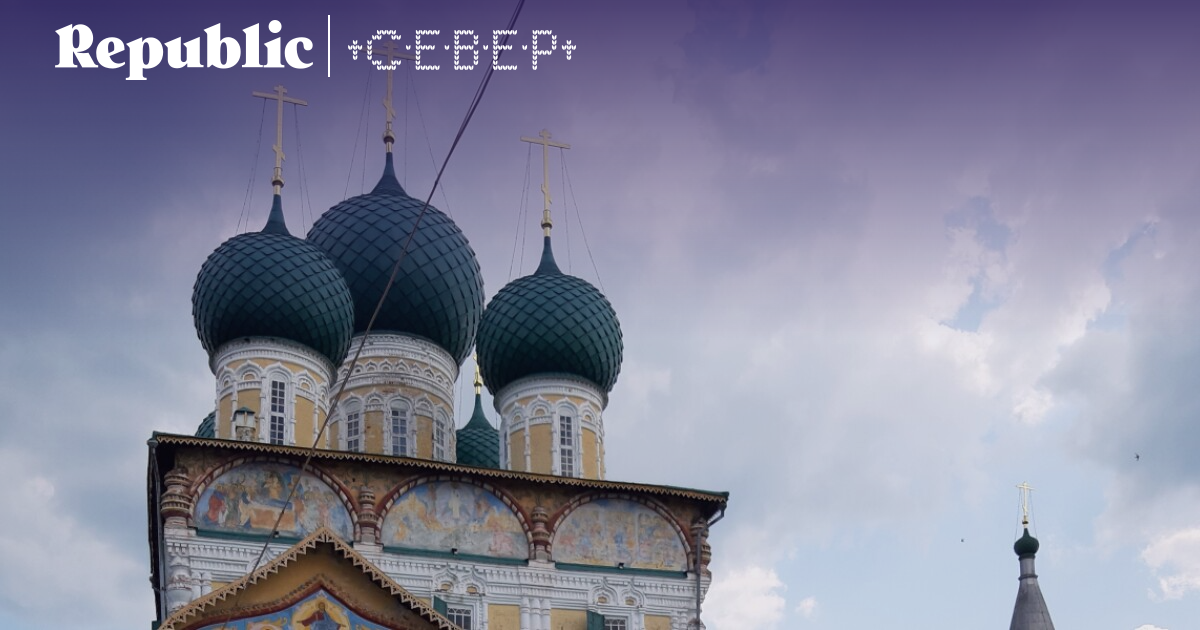
You never know where to start, if you need to talk about love. Well, I could start with Kustodiev. Kustodiev loved to draw-invent-this city and this world, with its provincial laziness, burly beauties and bright joy, which does not want to go anywhere. Not without good mockery, all this was done, of course. And now it also makes you smile.
He continued his philistine paradise, resisting the obvious, to create in the twenties, when it ended, but Romanov-Borisoglebsk wrote a lot from nature-even before the First World War. Romanov-Borisoglebsk is an ideal decoration for his utopia: the churches go to the shore to meet the steamboats, they climb the mountains at home to make them better. Here, for example, “walk” (it is now in Kostroma, in the Art Museum), 1910. The Romanov side of the city, cut by the river in two. A merchant with a discharged wife and daughter for a marriage, flirty ladies, gallant employees of shipping in uniforms and uniform caps, an orchestra in a gazebo. On the other side are the community of the Voskresensky Cathedral. The picture is warm, like summer, the heroes, perhaps slightly empty, are lightweight, without tearing and without searches, but everything is in front of them. True, they do not know what they have ahead, but we know.
Boris Kustodiev. "Walking", 1910
But Kustodiev’s glory is enough without me, so I’ll start differently.
***
The Great Roland Bart has a small book - "Fragments of the speech of a lover." Already in the name - impeccable accuracy: one cannot coherently, consistently, calmly, developing thought, talk about love. There is no thought, there is a ragged rhythm, a difficult breathing, the interweaving of random shreds, unexpected memories, words that may not mean anything for others.
What am I going to? Well, I just want to be honest: if you are waiting for a story about the history of the Old City on the Volga with a detailed listing of all surviving sights, then in vain. He will not be. Buy better a guide. The guide is published and even tolerable, although the text, of course, is not without cranberries. So that you understand: “The Earth of the Upper Volga is beautiful. On the blue tape of the Great River, the precious beads of ancient Russian cities are strung on the blue ribbon. Each of them is beautiful in its own way. ” And so on. He sniffed, in general, the old Romaldych his footcloth and was already enchanted.
Okay, it's time to start.
***
Suppose, so. On April 15, 1848, a big trouble happened in Romanovo-Borisoglebsk. “On the roof of the house of the philistine of Fiona Laskina, smoke and flame appeared, which, with a strong impulsive wind, instantly spilled into the nearby buildings of the neighboring inhabitants. Despite the actions of the arrived fire brigade and the efforts of the gathered people, the fire increased more and more, because burning fragments scattered in different directions over the distant distance, and in the nearby time suddenly caught fire in several places; Then most of the inhabitants, affected by the horror of the fire disaster, turned to their homes to save families and property. The fire continued all night with extraordinary power and only the next day was stopped by the evening. ” So about a sad event were notified by subscribers a week later the "Yaroslavl provincial gazes."
On the Romanov side they burned houses, temples, barns. The frightened inhabitants rushed along the shore on Borisoglebskaya, waved their hands, tried to say something to each other. Crowded boats rushed along the Volga.
Ivan Belonogov. "The poor fire of the city of Romanov-Borisoglebsk, which happened on April 15, 1848."
We can still see all this now, because among the universal throwing there was one person who retained calm and trying to capture what was happening with extreme accuracy - local artist Ivan Belonogov.
By the way, his house also burned out then.
***
On the watercolors of Belonogov - the Romanov side, we will go there soon, but first we will go to the Voskresensky Cathedral of the Borisoglebsky side. The same, from the picture of Kustodiev. Belonogov also painted him, of course. He generally painted a lot of his hometown.
Ivan Belonogov. "Voskresensky Cathedral." 1844.
Subscribe to read the whole
Make a subscription Redefine.media to read Republic
Subscribe [you can pay for a Russian or foreign card. The subscription is extended automatically. You can unsubscribe at any time.]
Where are the money subscribers going