
Translated material
"Power of Human", or Homo Sacer in Russian culture
The article was prepared during the research/work (No. 20–01–024) as part of the program “Scientific Fund of the National Research University“ Higher School of Economics ”(Higher School of Economics” ”in 2020–2021.
All reasonable divine
And everything divine is reasonable.
"Animal Book"
The name of the article connects two symbolic expressions of what a person can be. “Human power” is a capacious formulation of the essence of a believer given in the “Animal Book” of Russian Dukhobors at the beginning of the 20th century; Homo Sacer is an equally capacious concept that Georgio Agamben uses to talk about a person who is devoid of a state of any essence.
The modern state assigns a person to itself at the first stage of its existence: at the time of birth (or even conception), self -defiantly defining his national and social identity, putting his future life in full depending on the place and circumstances in which he appeared. About this fact of the assignment by the state of man already at the stage of its emergence V.V. Rozanov wrote not just as an extraordinary phenomenon, but as a whole philosophy, in which the human right to his private life and the thirst for the state of the state is faced with the seizure of his body and life as property. The philosopher - the only one in Russia at the beginning of the 20th century - defended the rights of illegitimate children and their mothers, pointing out the monstrousness of the expression - an “illegally born person”, emphasizing that it is as monstrous as the expression “illegally dead”. (If its absurdity was obvious in relation to the second phrase to the then society, then in the XX and XXI centuries the “illegal people” become a reality; this phrase marks the banal fact of the omnipotence of the system. It is the authorities in many cases where and how a person should die, giving “the right” or “prohibiting” to die. In a terrible Shalam of prose, this fact of the inhumanity of the system is reflected, this fact of the inhumanity of the system, this fact of the inhumanity of the system. which does not allow to die “illegally”, “without permission”, first curing, and then shooting for hunger strikes, unsuccessful attempts of suicide and so on. systems.)
It is the state that affirms a person as a full member of society or, on the contrary, makes him an outcast, sometimes from the very moment of birth. Rozanov insisted that it was not in the power of people or political sovereign to dispose of the right of a person to be or not to be part of the people. He receives this right from his parents and from God by the very fact of his birth. God himself sanctifies the conception and birth of a child, and this fact makes him much more free and right than endowing him with civil rights by the authorities or spiritual - from the church.
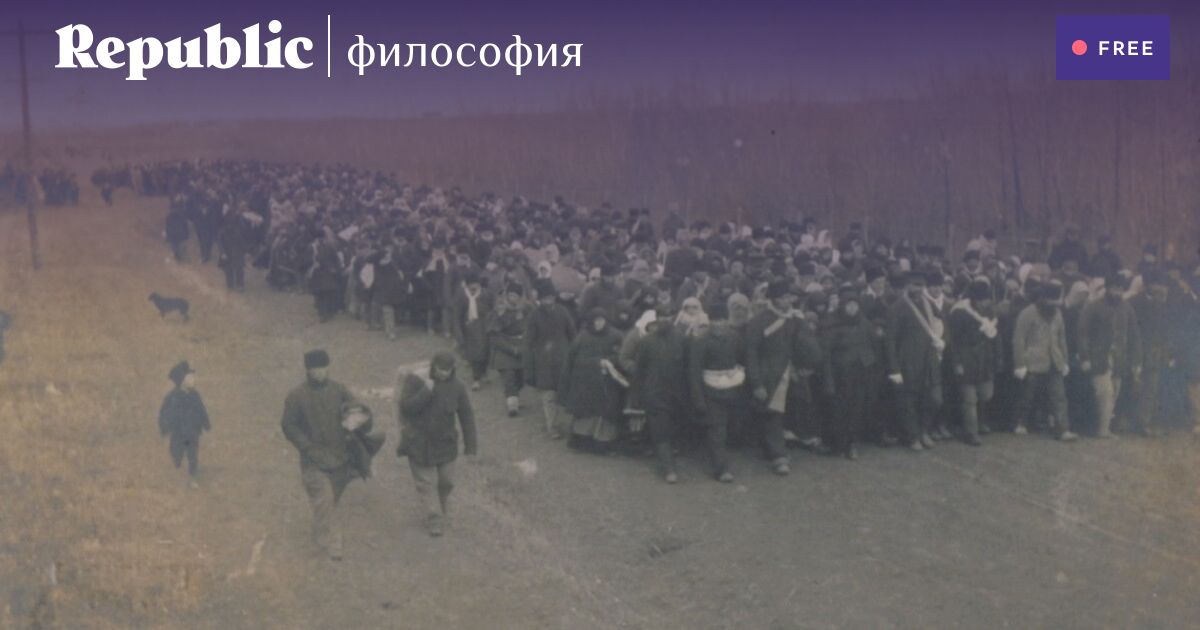
Similar ideas were the basis of the teachings of Russian spirit-workers who were repressed in tsarist Russia in the middle of the 19th century-the beginning of the XX, who became forced refugees in their country. “The history of spirit -fabric is a history of persecution, links, suffering and exile - and what is wonderful, the stamina of the human spirit. Their peaceful principles are associated with the refusal of the use of weapons, from the proclamation of oaths of loyalty to Alexander III, when Russian troops entered the Caucasus in 1877. In 1895, the famous weapon burned in three separate regions of the Caucasus. ... As a result of endless persecutions, the Dukhobors were forced to emigrate to Canada in 1899, ”wrote the famous Canadian scientist A.A. Donskov, one of the modern descendants of Russian spirit -workers. Emigration was also possible thanks to the active assistance of L.N. Tolstoy and his like -minded people (see the appeal “Help!” Published in London in 1897). The choice of Canada was fraught with the desire of the ducchers not to dissolve in a foreign country, but to be able to maintain faith and the way that they were guaranteed by the country's authorities.
The ducchers, whom the authorities and the Church were considered “illiterate sectarians”, like a philosopher Rosanov wrote: “All children from the Spirit of God are born, and come true from man” (see “Execution. The story of Vanya Baeva from the village of Kamenka”). By the way, the Dukhobors themselves called themselves Christians: "We did not want us to be called sectarians, because during the time of Peter the Great, if anyone knows the story, there were many divisions, there were whips, there were stunters, they were malevin, and then they called the sects in contempt." Archpriest Timofei Butkevich, emphasizing the ignorance of the Dukhobors, at the same time pointed out that the foundations of their teachings reflected in the “Animal Book” were initially compiled for them by the “Little Russian philosopher”. The psalome 43 of this book speaks of the original - natural - essence of man: “The first thing is flesh from the earth. The second thing is the bone from the stone. The third thing is the veins from the root. The fourth thing is blood from water. The fifth thing is the hair from the grass. The sixth thing is the eyes of the dew. The seventh thing is a soul, there is an image of God. ”
Russian philosophical and religious thought did not formally, legalized the natural human rights, but exclusively spiritually, mating phenomenal (natural) and noumenal into a whole-human freedom. Tolstoy, like Rozanov, defended not only certain categories of the population, but all people, proving their natural/religious right to freedom and autonomous life in God. At the same time, his logic is as similar to Rozanovskaya as possible: a person is sacred in the fact of his birth, for in every person there is one and the same divine core (he calls him differently: the strength of life, the consciousness of life or a religious feeling- a life-life ). Since a person is the result of a combination of flesh and divine will, he realizes in private life some higher, unknown to him the common goal. To do this, he must naturally submit to the highest principle, consciously living according to the commandments of Christ and thereby fulfilling his own purpose.
The state cannot replace the will of God. But it can take freedom as a natural given, capture a person, from birth to death, into its vise. To demonstrate this fact, Tolstoy took up the deconstruction of the world of culture in order to find the primaryism of human in man, the nature of life, hidden behind politics, social roles, science, stereotypes, empty words and so on. For liberation, it is necessary to have “courage to use your mind on your own”, rely on your mind, will, duty, and not on the automatic acceptance of the world, words, ideas as a priori true and not subjected to understanding/discussion or doubt. It is in the person he has lived and experienced by a person himself that his personality is manifested: thinking and independent understanding of the world; Life -vital route and magical authority of power are only able to consolidate the automatism and hypnosis of Leviathan over a person.
In the 20th century, a conversation about the sovereign nature of man was associated with the fact of biopolitics, a state when the state is engaged in regulation of childbearing, reducing mortality, migration problems, and so on, or, as Michelle Foucault said, becomes the master of the human body. Pressure on a modern person only intensifies in the 20th century: the authorities take care of human health under its total control, controlling his physical body as social, and his life (and death) as his property. J. Agamben said about this phenomenon as a paradox “including exceptions” - when a naked life (ZOE) is included in the political space through its exclusion. Agamben shows that the authorities themselves decide who belongs to her people, and who can easily be expelled or even killed, that is, autocraticly excludes people from society.
It seems to me that the modern concepts of biopolitics and biovence can be in demand in a retrospective conversation about Russian spirit -assemblies, which stubbornly defended their right to autonomous from the state, the life of the “primary Christian”, defining it as a natural state of a person who believes in God as a single spiritual principle present in each and in all people, regardless of secular power and its laws. The third psalm says: “Where does God are? In the souls and hearts of human (italics mine - S.K.) ; If we love each other, God is in us. ”
The fate of the Dukhobors in Russia indicates another ideological substantiation of the state of the state to human life, dominated by the imperial consciousness of the 19th century. In Russia, to be a people, it is possible to belong to the Russian nation when you are born on its territory, but when you become the bearer of its religious substrate - that is, the Orthodox belonging to the Orthodox Church in the fact of the tribal baptism. Formally and at the level of declarations, we know that Russia is a multinational and multi -confessional country. In fact, since 1833 - starting with the official consolidation of the political triad: autocracy, Orthodoxy, nationality - not just the idea of identifying private human rights and the right to be part of their own people, but the idea of being a Russian person, belonging to this people and being Orthodox is the same thing. At the level of ideology and even philosophy of a certain type, the principle of the equivalent of national and religious is enshrined, while at the level of a person’s private life is far from the same thing. At least, the dunctors, being Russian people by birth, never put a sign of equality between their ethnic roots and their faith. Moreover, they did not use the word “Russian” in self -determination, but so designated the Orthodox. The dunctors were also called the “sons of God”, “Christians of the World Brotherhood”, “Post -in -law” and so on, not attached to any faith.
For them, as for L.N. Tolstoy, life should live only in accordance with the genuine - natural nature of man, which is determined by one for everyone - the spiritual divine core. It is the general in all of us “I-Consciousness”, or “Lryever”-as a priori sense of life-makes us all children of one father and allows us to practically realize the commandments of the Nagorno-to-be preaching-the love of people to each other (universal fraternity as its basis), non-resistance to evil by violence (pacifism as a natural-only foundation of a person) and non-union as an environmental concept of unity of all creatures on earth. The fact that they associate their life with the name of Christ does not mean their rejection of other faith or other way of life. There is much in common duccums with Tolstoy, who defined Christ as the best of the sons of God, as a man who realized the main principles of religious hostel in his righteous life: the principle of love, non -resistance to evil, the autonomy of a person’s life, not subject to the framework of worldly courts, and so on. One of the leaders of the Dukhobors - Savely Kapustin - developed this thought as the idea of embodiment of God first into the Body of Christ, and then into the body of every person. In this sense, to be a Christian is just another name "to be a man." However, in order to live as a person, it is necessary to be free, which means to change your attitude to the system of domination and submission. Dukhobors wanted the impossible: to be free inside the state from himself. Even such a biased antisectant researcher as Archpriest Butkevich described their structure as "life on a communist basis ... as an imitation of the life of primary Christians."
Duchobors appreciate freedom and non -violence so that even the words “mother”, “father”, “son”, “daughter” seem to them by a manifestation of inequality and human power over a person. They prefer the words “parent”, “old man”, “parent”, “nanny”, “mistress”, use personal names for both large and small ones. The abandonment of familiar names in the family is associated with the reluctance of "the power of the big over the smaller."
That is, the Dukhobors determined their citizenship not through the concept of a people or a nation - that is, by the place of birth, and not through belonging to the official church - faith, and not even by family foundations, but through belonging to Christ and Christianity - that is, through the religious identity that they considered the universal, including allowing them to be absolutely the same citizens of their country as officially believers - Russian Orthodox.
The state and the church rejected the ducers only because they chose the priority of a natural person over the artificial - cultivated world of conventions, automatisms, bureaucratic laws. In political categories, this choice can probably be called anarchist, opposing the authorities of Caesar. However, their anarchy is strictly religious in the nature of submission to a single beginning - Christ or life in the Spirit, and in this sense this term does not have the slightest political or nihilistic shade. For example, they never denied the power of their spiritual leader and voluntarily obeyed him in the community. Moreover, the idea of reincarnating Christ into their leaders was widespread. In this sense, they were very far from the Tolstoyes. (See Inikova S.A. The role of “Tolstoy” and the Tolstovites in the movement of the Caucasian fools of the 1890s // Tolstoy collection, 2000.) on the other hand, and Tolstoyites are difficult to identify with the anarchists. For example, Chertkov repeatedly emphasized the “monarchical power” of God over man and voluntary free submission to her. We read the same thing among the spiritualists. "Question. Which king will you go to? Answer. The king is our god, who deeds salvation before the century in the middle of the earth in sayings and reasoning. Almighty, he saved his people; returned not with the bribe to the gifts with gifts; Our chapters are leaned to the king, and the earthly king, is only the bribes of this century ”(Psalm 57).
The lifestyle of spirit -workers raised the question of political laws that contradict God's commandments, from which they sought to leave quite consciously. It was possible to do this only in a certain way organizing your private life. This life, as Tolstoy showed theoretically, and the ducchers practically could be based only on a reasonable consciousness, that is, on the clear understanding of what a person is and why he lives, that is, what is the meaning of life.
The persecution of the sectarians and their spiritual resistance showed that the deprivation of the spirit -workers of the free right to faith meant in essence the automatic deprivation of their civil rights. Therefore, there were constantly situations when a person of the world - in this case, in a true Christian who, in essence, is free from national borders, refuses to recognize the priority of the Caesar’s power over the power of God - does not turn out to be any civil rights and he becomes almost completely invalid/defenseless in his state, and is automatically excluded from the people. This condition is Homo Sacer - that is, the complete defenselessness of people; People are sacred as outcasts, as a caste of untouchables in India, with whom you can do anything - up to killing - absolutely impunity, that is, legally.
Dukhobors were put in the position of non -citizens and eventually found themselves in the status of refugees in their country. The story of the arena put forward autonomous, simple and nameless people. Arendt called refugees the “vanguard” of its people, showing how, expelling certain groups of their own people from their country, the state does not doomed to such exile and the whole people in the future. After the expulsion and persecution of the spiritualists in the Caucasus and their subsequent migration in Canada in 1895-1896, terrible times came for the whole of Russia, when 1.5 million Russian people were abroad after the revolutionary events of 1917. (Agamben gives impressive figures: “In a short time, 1.5 million Russian white emigrants, 700 thousand Armenians, 500 thousand Bulgarians, 1 million Greeks, hundreds of thousands of Germans, Hungarians and Romanians fled from its countries. See“ remedy without a goal. Notes about politics. ”)
The XX century recreates political philosophy, based on the image of a refugee, a migrant that every person can become in the 21st century, regardless of his belief and lifestyle. Such a story happened with our peoples after the signing of the Belovezhsky Treaty on the collapse of the USSR in 1991. Millions of Russians, Tajiks, Georgians, Armenians, and so on, turned out to be illiterate their country, refugees from nowhere to nowhere. The country has lost its status, “faded in one day”, and there was a massive movement of peoples, who lost not only their civil, but also personal rights. For the right to identify yourself with a Soviet person born in the USSR, you now need to pay the status of a scoop - homo soveeticus, to be doomed to universal contempt and spiritual shame.
As Agamben correctly noted, the refugee destroys the identity between his statuses of a person and citizen, and it is the refugee that becomes clear evidence of the crisis of state sovereignty.