
Translated material
Minotaurs and children's coffins. How British anti-Vaxers of the XVIII-XIX centuries fought vaccinations
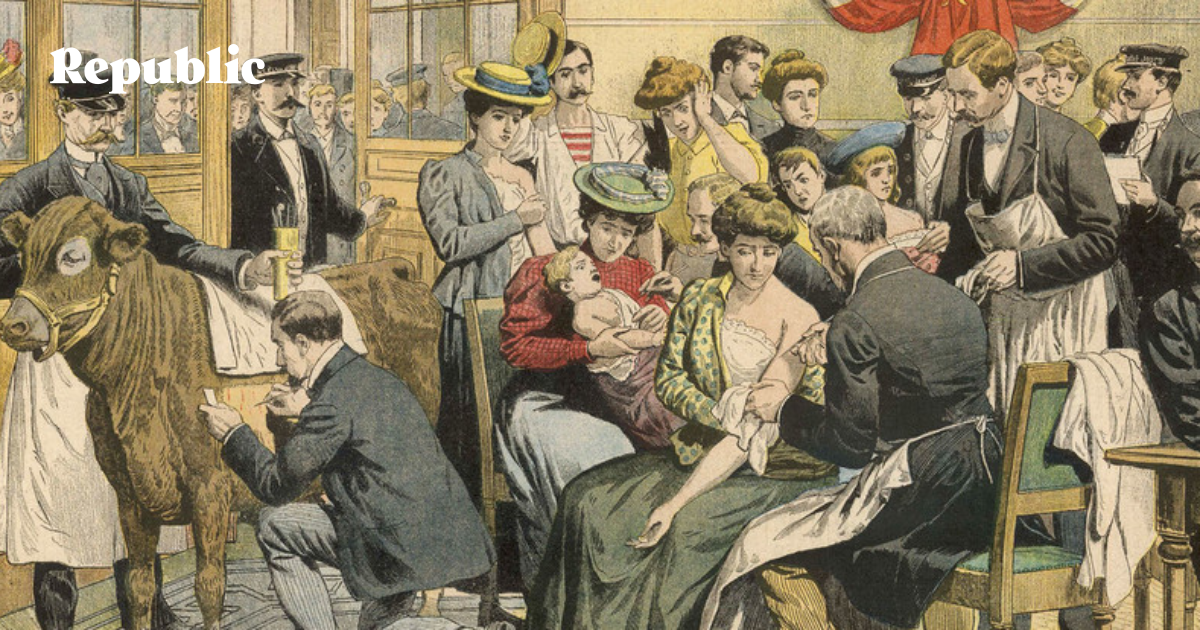
The anti -Wax movement appeared in Europe in the 18th century - almost immediately after the vaccinations themselves. It was in that era that the ethical arguments of modern opponents of the vaccines and their main theories of conspiracy were formulated. The vaccinations of the XVIII-XIX centuries were to be afraid of why, but this did not prevent the anti-Vaxes from composing fables, no less absurd than modern stories about the chipping of earthlings by Bill Gates and 5G tower, spreading Covid.
English diet and "ignorant women of the East"
Osopa is a terrible disease that has been a scourge of mankind since ancient times and is finally defeated by vaccination only in the 1970s. Before the appearance of modern medicine, the mortality from smallpox reached 15-60%. Those who recovered, often casily, or received ugly Ospins on the skin. However, they have always developed lifelong immunity.
This observation prompted people to the idea of vaccination. If you infect a person with a light shape of the smallpox and let him get sick, he will receive lifelong protection. Thus, variration, or monocation appeared - the first form of vaccination in the history of mankind.
Varilation suggested that a person would come into contact with the contents of the pustule (abscess) of the patient with smallpox. The oldest known variration was carried out in China in the X century. N.E. The sophisticated Chinese doctors collected liquid, dried, plugs into powder and allowed people to inhale. In other countries, pus was more often placed in an incision on the arm.
In most cases, the disease proceeded with weak symptoms, the vaccinated recovered, and in the same way as any overgrown, received lifelong immunity. On average, in 2-3 cases out of 100, people were seriously ill and dying.
Sometimes variration caused an outbreak of smallpox - the entourage of the vaccinated infected from it. In other cases, variration was useless because there was no infection. In general, it was an effective, but rather dangerous way to protect against smallpox.
The first certificates of variration were in the hands of European scientists at the end of the 17th century. However, interest in the method arose only in 1714, when the letter of the Italian doctor Emmanuel Timoni, who worked in Constantinople, began to spread among the British doctors. He spoke about variration among the peoples of the Caucasus and Transcaucasia - Circassians, Georgians and other “Asians”. He argued that the method is absolutely safe for anyone, and all patients are easily sick and get effective immunity.
The text of the letter of Timoni was published in the "Philosophical works of the Royal Society." Soon, a priest from Massachusetts named Cotton Masze (30 years before he participated in the processes over the Salem witches) answered him. He spoke about the tradition of variration in Africa, about which Onisima, a native of the rather developed Berberian people, learned from his slave, from South Libya.
After Europe began to discuss variration, it turned out that in some areas of Wales it was practiced at least from 1600, but it never went outside the region. Probably, several peoples invented their own vaccination.
In the XVIII century in Europe, movement began in support of variration. His pioneer was the aristocrat Mary Wordy Montegu. In 1715-1716, she was ill with smallpox, as a result of which she was covered with numerous ugly dispins. A few months later, Mary’s wife was appointed British ambassador to Turkey, where Mary found out about variration. In 1718, she successfully instilled her five -year -old son. Soon the family returned to London, where Mary began to promote vaccinations.
In 1721, an epidemic of smallpox, which strengthened the arguments of Lady Worzy, once again hit London. She quickly gathered many influential supporters around her, among whom was the Princess of Wales and the Hans Sloan doctor, a few years later replaced Isaac Newton as president of the London Royal Society. They conducted successful clinical trials of vaccines for prisoners and proved the safety of variration.
For some time, among the nobility of Western Europe and the American colonies, the vaccine was even fashionable. The scar on his shoulder became a symbol of a person’s readiness to take a chance in the name of protecting society from the epidemic.
Among the doctors, the opinions of both for and against variration arose. One of the first anti -Vaxes was the influential London doctor William Vagstaff. In his open letter of 1722, he criticized variration from the position of “that Circassian is good, then the British is death”: “Those from whom we borrowed this have an advantage in the form of a warm climate; They live on a modest diet and in general a very simple life, and sometimes almost devoid of means for the fulfillment of the basic needs of a person <...> Our national blood is a product of a richest diet <...> Therefore, there is no reason to believe that if the vaccine has worked in Georgia and Cherkessia, then it can be used with us, with success adapted to our features. "
At the same time, Vagstaff wrote that even in the East only “few ignorant women” are engaged in variration, which are addressed by “illiterate and near -thawed people”. This letter turned into a small book, which was reprinted seven times and translated into French.
Subscribe to read the whole
Make a subscription Redefine.media to read Republic
Subscribe [you can pay for a Russian or foreign card. The subscription is extended automatically. You can unsubscribe at any time.]
Where are the money subscribers going