
Translated material
Gorbachev: The coup of 1991 and Yeltsin's actions led to the collapse of the USSR
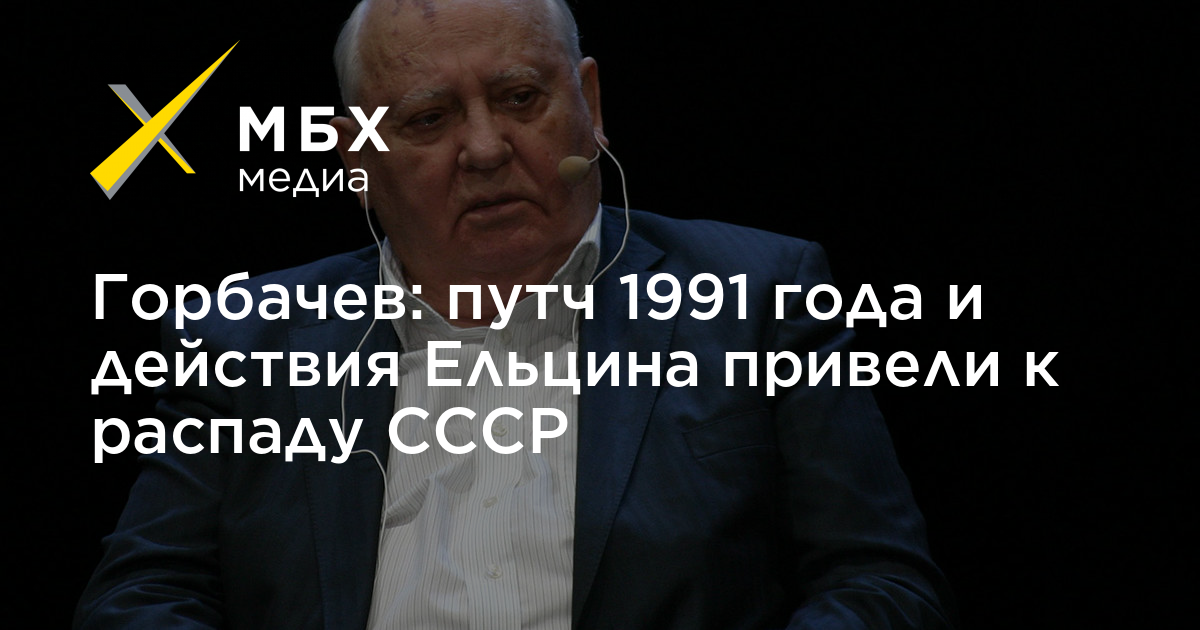
The first president of the USSR Mikhail Gorbachev published a column in the journal “Russia in Global Policy” entitled “Understand Perestroika, Defend New Thinking”. In his article, he talked about why the Soviet Union collapsed, and also recalled what, in his opinion, the achievements of perestroika are. MBH Media publishes the main thing from this material.
The meaning of perestroika
Perestroika became necessary because the Soviet Union ceased to develop, Gorbachev explains. This was due to a number of reasons, including the lack of democracy and a market economy. “The country plunged deeper into stagnation. In fact, economic growth has ceased. Ideological dogma kept an intellectual, cultural life in a vice. The bureaucratic machine claimed the total control of society, but could not ensure the satisfaction of the elementary needs of people, ”recalls the first president of the USSR about the conditions in which the idea of perestroika arose.
That is why with the advent of Gorbachev was followed by the rejection of the totalitarian system and the transition to a new, democratic one. “Perestroika was addressed to people. Her goal was to liberate a person, make him the master of his fate, his country, ”Gorbachev writes.
In addition, the country lived in constant fear of a nuclear war, which could not be allowed. In this regard, Gorbachev realized the need to reorient both the country's domestic policy - that is, democratize it, and external - that is, in fact, to abandon the confrontation with the West and begin the disarmament policy.
Perestroika errors and what destroyed the Soviet Union
The main mistake that Gorbachev made during perestroika, as he himself claims, was economic. It consisted in the fact that Gorbachev did not “let go of the prices, because of the pressure of populists, that is, did not provide the opportunity for manufacturers to independently set the price of goods and left state regulation.
“I think if I then took a firm position [to refuse to regulate prices. - “MBH Media”], the case could turn differently. <...> People would understand us. Radical economic reforms, the transition to a market economy demanded a whole revolution in the minds of both managers and ordinary citizens, ”Gorbachev writes. In his opinion, the transition to the market system had to be carried out even then, in the late 80s.
Gorbachev indicates two key reasons for the collapse of the USSR. One of them is a putsch in August 1991.
“The attempt of the coup weakened the position of the President of the USSR, tore off the process of the formation of new union relations between the sovereign states, and spurred disintegration. One after another, the republics adopted declarations of independence, ”he recalls.
The second reason is the “December conspiracy of the leaders of Russia, Ukraine and Belarus”, that is, in Belovezhsky agreements [on the formation of the CIS]. Initially, Gorbachev resembles, [instead of the USSR in its usual form], a confederate allied state should have arisen. “In mid -October, eight republics signed an agreement on the economic community, the inter -republican economic committee began to operate,” he recalled. But these plans were not destined to come true: the President of the RSFSR Boris Yeltsin, based on the desire to “remove Gorbachev”, signed [together with the leaders of Ukraine and Belarus] on December 8, 1991 in the Belovezhskaya Pushcha Treaty on the creation of the CIS and, accordingly, the liquidation of the Soviet Union.
Achievements of perestroika
However, Gorbachev also recalls the achievements of perestroika. As a result of democratic reforms in 1989, elections were held at the congress of people's deputies, the delegates of which subsequently chose the new Supreme Council. The first democratic Soviet parliament, in turn, had a positive impact on the history of the country, having adopted a number of necessary laws. “These, in particular, are the laws on the press and other media, on public associations of citizens, on the rights of trade unions, on freedom of conscience and religious organizations, on local self -government, on entry and exit from the country.”
“The results of perestroika: the termination of the Cold War, unprecedented agreements on nuclear disarmament, the acquisition by people of rights and freedoms of speech, meetings, religion, freedom of departure from the country, alternative elections, multi -partyism,” says Gorbachev.