
Translated material
Planting Middle Ages
Russia entered in the period of neoplasm. Will you now have to answer the law for the outline of Ivan the Terrible?
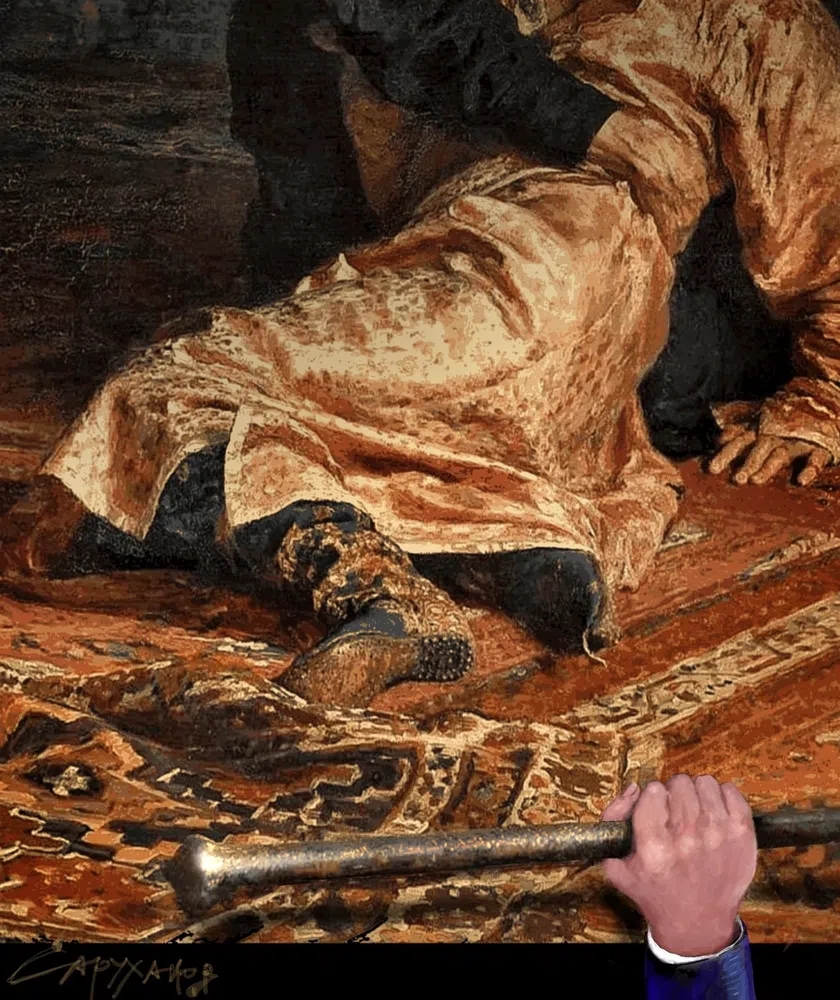
The Decree of President Vladimir Putin on the creation of an interdepartmental commission on historical education shall be rewarded with the “preservation of historical memory” to the “national interests” of the Russian Federation. All law enforcement agencies - representatives of the Office of the Security Council, the Prosecutor General, the Investigative Committee, the Ministry of Foreign Affairs, the Ministry of Defense and even the Ministry of Internal Affairs were included in the formidable commission for memory supervision. It is clear that with such a composition, historical memory will protect “offensive”, “with the prevention of attempts to falsify history”.
The decree does not say that the falsification of which events concerns the president. But it is not difficult to guess about this. Obviously, this is the second world, about which a commission with a similar name was already created in 2009. Regarding the new commission, it can be assumed that it will fight not only those who do not share the official interpretation of the war. Along with her
The memory of the Russian Middle Ages - and above all, about Ivan the Terrible and the oprichnin - may well fall into the circle of historical events subject to state protection and censorship.
This is not the first time Putin shows concern for the Middle Ages. He began his recent article about Ukraine with a long excursion into history. He needed the Middle Ages to explain that Russia and Ukraine are “one people”. However, medieval allusions come to his mind even in connection with coronavirus.
At the head of the commission, V. Medinsky, a great fan of Ivan IV, was staged. The author of the infamous dissertation, he claims that the insidious West already in the 16th century launched a powerful “information war” against Russia. Contrary to historical sources, including chronicles and synodics (the memorial lists of victims), and the entire preceding historiographical tradition of an unprecedented scale of the oprichniper terror, Medinsky and other lovers of Ivan say that the Western contemporaries of the formidable, who visited Russia and left their testimonies, slandered all sorts of non -fables about Oprichnin, distorting the image of his rule. In his dissertation, Medinsky assured that "most of the notes were written by authors, as a rule, by order of the ruling circles [West]."
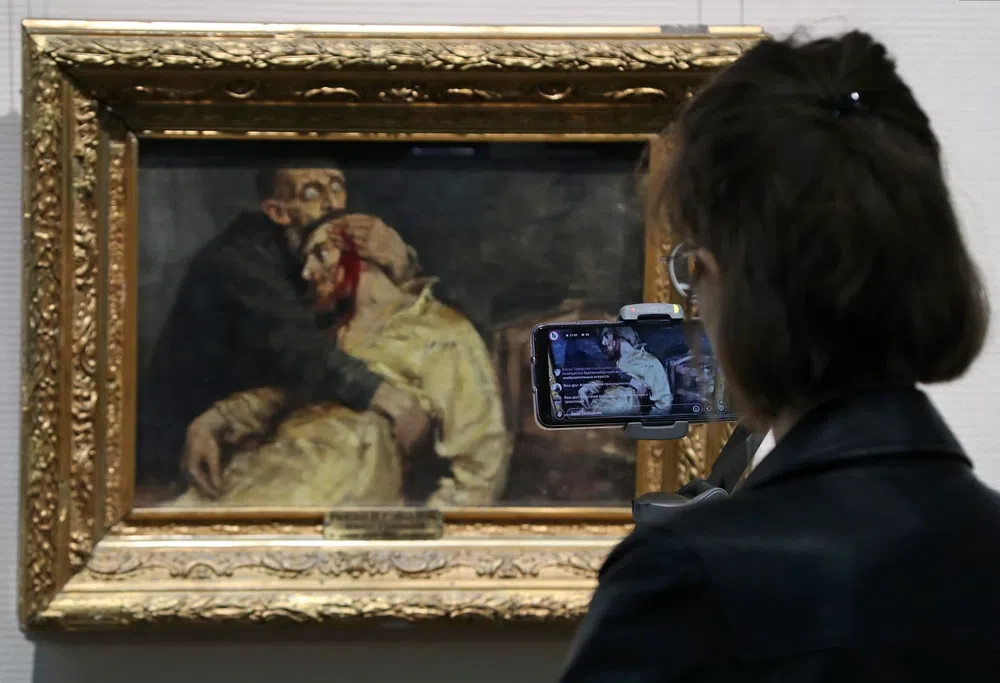
The purpose of this "information war" was to denigrate the Russian king, whom nationalists declare the ancestor of the Russian Empire. Return the country in the Middle Ages and restore the empire is an important part of their political program. The glorification of Ivan as its creator allows them to avoid references to the Western Petra, to give the empire a “original-praise” spirit and “root” it in ancient Russian history. From their point of view, “to denigrate Grozny means to question the legality of its territorial acquisitions and the desire of the current authorities of Russia to protect its sovereignty.” Therefore, for them, the modern policy of the West in relation to Russia is the continuation of this five hundred years of war. Even in connection with the Malaysian Boeing, Medinsky reminded: "The origins of this information war we see with you, alas, during the time of Ivan the Terrible." Well, the information war is certainly under the jurisdiction of the law enforcement agencies.
Of course, not Medinsky invented to turn Grozny into the “best of people”. And not even Tikhon Shevkunov, who also made a lot for his justification in the historical park “Russia is my story”. The modern popularity of Ivan the Terrible began with the works of the Metropolitan of St. Petersburg and Ladoga John (Ivan Snychev), in particular from his book “Autocracy of the Spirit” (1994). Based on his “true Orthodox faith”, Metropolitan John claimed that the Terrible was a virtuous and wise ruler: “Soft and non -sounding in nature, the king suffered and tormented, forced to use harsh measures.” Metropolitan John, like Medinsky, unreasonably denied historical evidence of the atrocities of the oprichnina and Ivan himself. According to Metropolitan John, Ivan IV, the exemplary king and the defender of the “Holy Rus' from the Antichrist” became a victim of the Western enemies and the “Secto of the Judaizers” (he calls the Jews “the“ people-bogoast people ”), who were the sources of the“ forming a sustainable Russophobic legend of Ivan the Terrible ”.
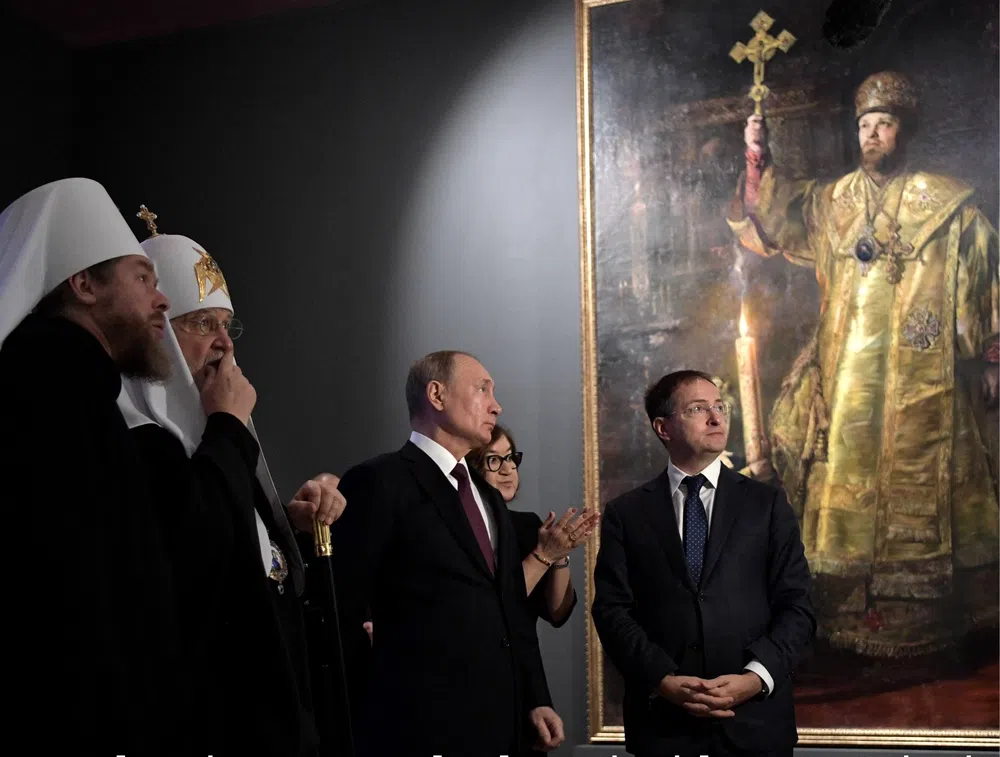
The unproven denial of the murder of the formidable of his son Ivan is an important point of the pseudo -historical Metropolitan John. The assertion that Antoniyo Sosevino, “Monk-Jesuit”, “One of the authors of the myth of“ Sonubic ”, simply invented the murder of the prince, was reproduced by Putin in 2017.
True, the struggle of the followers of Metropolitan John for the canonization of Ivan as an Orthodox saint, the founder of the Third Rome, and the Orthodox king-Katehon (“holding the Antichrist”) is still unsuccessful. The reason is the murder authorized by Metropolitan Philip, which, however, Metropolitan John also denied the murder of Metropolitan.
Under the pen of Metropolitan John Oprichnina, she turned into “the logical completion of the long process of searching by John the formidable of the best, smallest path of solving the solutions to him as an anointed of God's tasks” in order to “maintain the harmony of folk life”. The lawlessness and violence of the oprichnina caused a deep approval of this clergyman: "Having assumed the most ungrateful work, as a surgeon, by the surgeon, as necessary, cut off rotting, useless members from the body of Russia."
My assumption that the Middle Ages will be taken under protection, is based on the analysis of the previous policy of the memory of the Russian state aimed at glorifying the Russian Middle Ages.
This policy includes a set of various measures that have been systematically carried out for two decades. She began in 2004 by the celebration of a medieval victory over the Poles. Its culmination was the emergence of a “millennial history of Russia” and God in the amendments to the 2020 Constitution and the construction of monuments to medieval despots: Ivan the Terrible (in Orel in 2016, in Alexander - Alexandrovo in 2017-2019, in Cheboksary in 2019) and his grandfather Ivan (in Kaluga in 2017). This is not counting the plans not yet implemented to erect monuments in Kazan, Astrakhan and Ruse and rename Leninsky Avenue in Moscow in the highway of Ivan the Terrible. And the enthusiastic celebration of the “Return of the Holy Korsun” (Sirek of Crimea) was crowned by the construction opposite the Kremlin in 2016 of the giant statue of Vladimir I.
The monumental component of this memory policy is combined with the large -scale propaganda of the Middle Ages in films shot with the support of the state. I will give only a few of the most significant examples. The film "Viking" (Andrey Kravchuk, 2016), created with the support of the Film Fund, was released in the year of the installation of the monument to Vladimir. He tells about the capture of Korsuni. Refrain of the film "We go to Korsun!" Very reminiscent of "Our Crimea!".
The television series “Ivan the Terrible” (Andrei Eshpay, 2009) on the First Channel announced the “innovative” concept of the oprichnina: the terror was imposed on Russia and Ivan - the pious monarch - Europeans with their brutal morals. The series “The Terrible Time” (Alexander Daruga, 2010), shot by order of the Moscow government, depicted Ivan by the pious ruler, or did not know about the crimes of the guardsmen, or to be punished for them. About the last television series Moskino “Grozny” (Alexei Adrianov, 2020) everything is said in its announcement. The initiator of the first mass state terror in the history of Russia in it is described as follows:
“The king, born of rule, grew up an orphan, suffering oppression and humiliation from the near boyars. The king, striving to affirm in Rus' a single and indestructible power, was repeatedly devoted to the nearest associates, and gaining great love, lost it in the darkness of conspiracies and intrigues. “The Terrible” is the story of a ruler who survived great victories and great defeats. ”
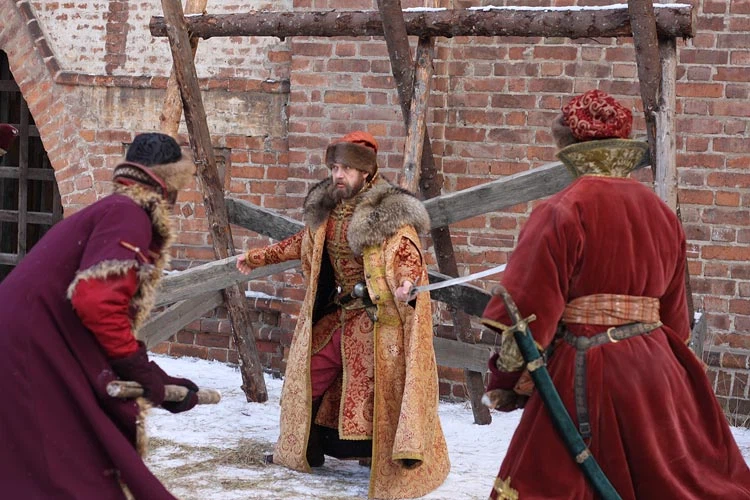
Another dimension of this memory policy, which is also mentioned in the decree on the creation of the commission, is “Education”. Numerous “scientific conferences” and exhibitions are already telling the Russians how to correctly remember and love Ivan and the oprichnina. It is likely that it will be such a memory of tyrant and his terror that the commission from the encroachments of independent historians, writers and journalists will be protected.
Now you should ask the question of what is the reason for the relevance of the Middle Ages. Attempts to explain it often suggest the return of the past and the onset of the "new Middle Ages." The press is full of reports that Russia "is returning to the Middle Ages" and that the feudal society is "being built in it." For a long time they have been talking about "new feudalism" in relation to the modern Russian economic and political situation.
Of course, it is difficult to resist the temptation to call the Kremlin proteges “governors”, “feudal lords” or “boyars with flashing lights”. But there can be no “return to the Middle Ages”, as in any other historical period, as a dead person cannot be born again.
It is impossible to recreate the unique constellation of factors, the joint action of which gives rise to historical phenomena. The Middle Ages cannot become our reality again - neither in Russia, nor in the West, nor even in the Taliban ( prohibited in Russia ).
On the contrary, cliches and stamps with which certain eras are associated are fertile material for political manipulations and falsifications. I call this method of exploitation of medieval by those political neoprospectalism. Political neo-Medievalism is not a domestic invention, but a world trend that is refracted in different ways in the performances of the ultra-right. His example in the United States is the rhetoric of Trump and his supporters. In Russia, this trend is manifested in extreme forms because it enjoys solid state support.
The most important task of non -mass policy is to give legitimacy to the anti -democratic social projects of the transformation of Russia, which, in fact, has nothing to do with the Middle Ages. Manipulating ideas about the past, its creators strive to convince the Russians that the Russian Middle Ages was an excellent society and is a wonderful alternative to modern democracy. The neoprative of memory is aimed at undermining democracy, denying human rights and legitimization in the eyes of citizens of existing legal lawlessness and social inequality.
The non -massive memory policy is widely used by the Kremlin to form an anti -democratic public opinion. Since independent sociological surveys regarding Ivan and oprichnins have not been published since 2016, it is difficult to say what the Russians actually think about this. But the well-known successes in the field of “corrections” of the memory of Ivan, apparently, were still achieved. According to polls, until the mid-1990s, Ivan the Terrible did not fall into the lists of outstanding historical figures. In the 2000s, he confidently enters the top ten. And in 2016, half of the respondents agreed that Ivan “made more good than the country for the country”, and 53% approved the installation of the monument to him in Orel (in connection with which the “Levada Center” ( the organization was included in the list of NPOs performing the function of a foreign agent ), recognized by a foreign agent, and conducted a survey). It is even more indicative that 60% of Russians remembered Grozny as the first Russian tsar, and only 20% as a “cruel tyrant”. Judging by requests at Yandex, information about Grozny is looking for 208 thousand times a month. Stalin, of course, remains more popular - information about him is looking for 980 thousand times. But these numbers are comparable.
Russian political neoplasm is based on ultra -right movements. The glorification of Ivan (as well as Stalin, his historical double, on the restoration of the cult of which I will not stay here), has no other purpose, except to impose an idea of the benefit of a repressive regime. And this is precisely this is one of the tasks of the Russian neotyeval memory policy.
Russian reality is interpreted in the terms of the oprichnina as often as in the terms of return to the Middle Ages. Opponents of authoritarianism refer to the oprichnina to condemn terror, but their voices are drowning in the choir of theorists of “new” or “neo -instruments”. The Izborsk club argues that the oprichnina “embodies the image of Russian democracy” and “creativity” and proclaim the terror of the “secret code of the Russian nation” and “virtuoso policy”, as a result of which Russia is “cleansed of badge”. Oprichnina for them is a “unique experience” of building a “Russian civil society”, the path to which is blocking “30 million degradants”. The new oprichnina for its adheres is not a one -time measure, but a systemic element of their project of a society built on oppression and inequality.
The belief that “history is repeated” obscures the essence of the changes that are taking place. Analogies with the Middle Ages are not able to explain what is happening in Russia today. But they are able to write out a noble letter to the brother, who really want to become “sovereign columns and barons”.
Longing for serfdom and normalization of slavery are important manifestations of this trend, although the real forms of inequality and exploitation on which the current regime is based are of no relation to feudalism and the Middle Ages. The elevating medieval metaphors serve in order to present terror in an inevitable mechanism for managing society. The neoprospinal memory policy hides the formation of an authoritarian regime of a new type, based on lovers of old -style terror.
Therefore, the protective language of the decree should not mislead: “protect” the desired memory from the “inappropriate” story for him. From the images of the bloody past, ideologists actively sculpt “genuine memory”. And since this memorial prosthesis is still not firmly embedded in the consciousness of citizens, now a special commission will protect it from any “falsifications”.