Date
Author
Анна Капитонова представительница ВООПИиК
Source

Preserved copy
Translated material
A historical paving was discovered in the courtyard on Marat Street
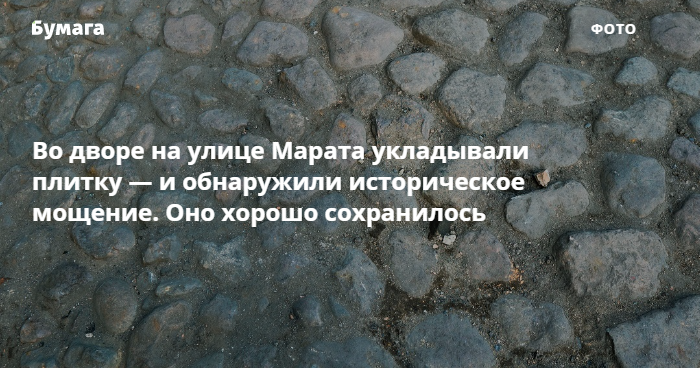
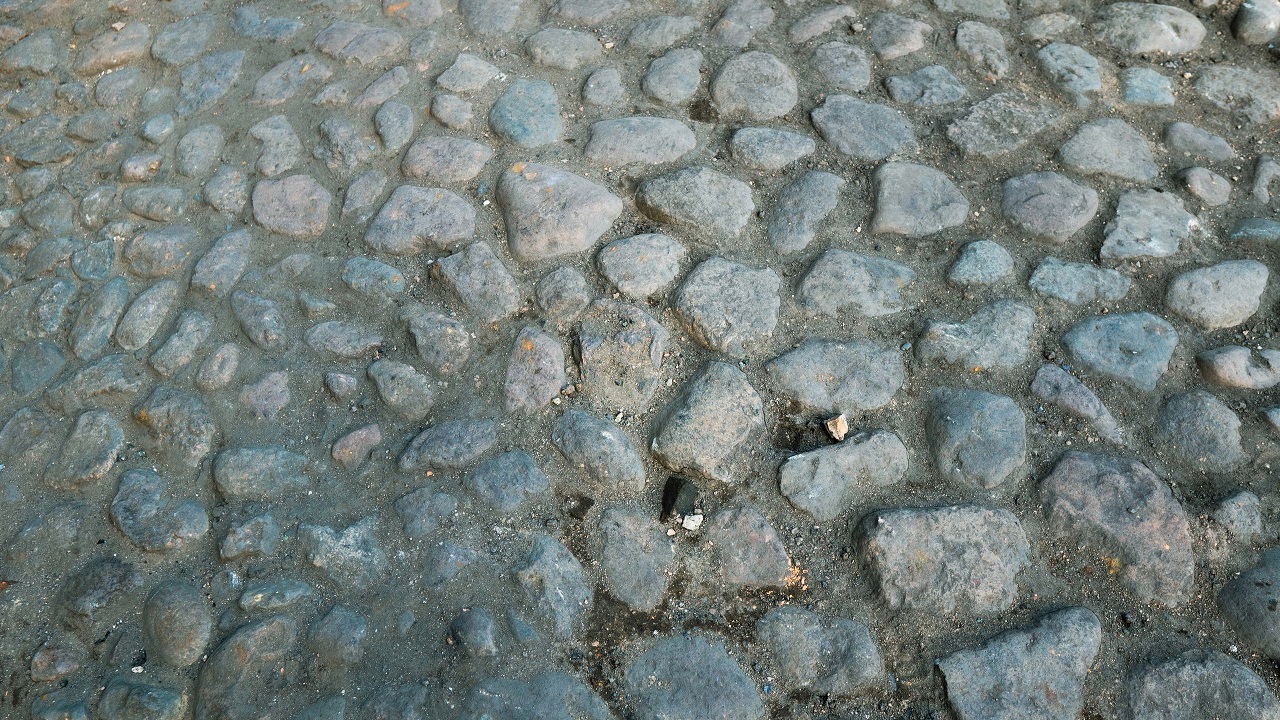
During the improvement of the courtyard of the house on Marata Street, 46 discovered a large whole section of pre -revolutionary pavement, the St. Petersburg branch of Vodopiik reports. In the courtyard they changed asphalt to tiles.
Historical paving is well preserved under layers of asphalt. As Anna Kapitonova, a representative of VOOPIIK, told Paper , such finds allow citywords to get new knowledge about the previous improvement of St. Petersburg.
- With each find, we will learn more and more about the pre -revolutionary improvement of the courtyards of St. Petersburg. The discovered paving is located in the backyard of Semenov’s house, that is, even the second and third household yards are also fashionable! There was no paving only on the streets.
Power was discovered during improvement works, which are ordered by the Vladimir District MO. The find interested municipal deputies - they themselves took part in clearing.
City defenders recall that in the courtyards of the historical center they regularly find a historical paving. In their opinion, this requires a revision of the work methodology. In particular, the asphalt device can be considered more gentle than the tile device - during these works you do not need to deepen into the ground.
Earlier, the Vodopiik has repeatedly faced the pressure of municipalities when historical power detection. For example, in 2020, a historical prayer at Rimsky-Korsakov was dismantled with the participation of the Admiralty District MO-they did not give the object to protective status.
MO “Vladimir”, whose deputies took part in clearing the tiles, is known as a district in which not a single deputy from United Russia has passed in the 2019 elections. Most of the places there are Yabloko representatives.
All -Russian Society for the Protection of Monuments of History and Culture
Earlier, city defenders discovered the pre -revolutionary paving of the court in the Petrograd district and in Dmitrovsky Lane .