
Translated material
Green in red
Middle Eastern conflict: with the new government, Israel returns to the formula "two states for two peoples"
This means that within the boundaries of 1967 two states recognizing each other may appear - Israel and Palestine, Jerusalem will be divided into two cities. Between Israel and Palestine will exchange territories. Some refugees will be able to return. Utopia? Not everyone thinks so.
- Now we are standing on the "green line." She crosses the country from north to south, turns to the east, dissects Latrun and leaves abruptly west. All that is Israel here. All that is occupied territories.
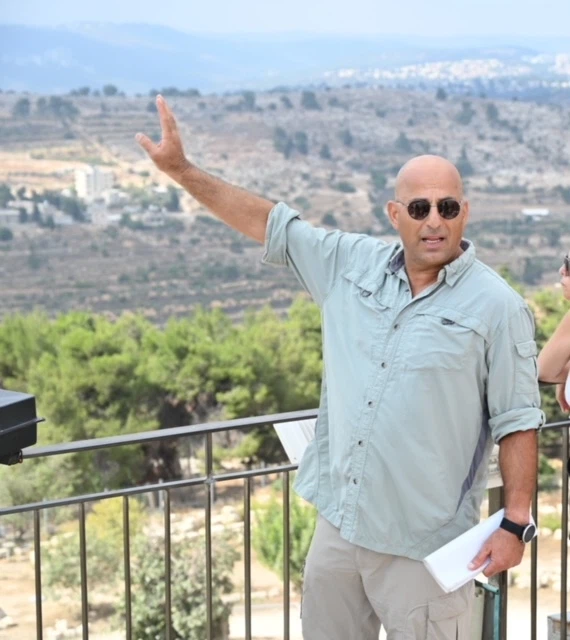
The colonel of the reserve of the Israeli defense army, a participant in Gaza Operations, Shaul Arieli devoted his life to the “peace process”, followed by a lot of blood. Hundreds of articles and nine books. Lectures at Israeli universities and around the world. Five routes along which he spent tens of thousands of people: Jerusalem, the border with gas, Hebron, Gush-Etzia, settlements from the Green Line to the Jordan River, a protective wall separating Israel and Pa, the north of the western bank of the Jordan River.
“My goal,” he says, “to show that there is a solution to.”
We have a gravel under our feet. Around the field. A hot wind tears from the hands of the map that Arieli gave me before we stood on this reference point at the “green line”.
According to the string
The Green Line is a ceasefire in the war for independence, drawn in 1949 by a green pencil on the map of the battlefield for a new state of Israel. She was the first attempt in resolving the Arab-Israeli conflict. After the Six Day War of 1967, everything that is located on TURNA, according to the UN resolution, is considered the occupied territory.
- Today, 670,000 Israelis lives on the western bank: 450,000 in 127 settlements and 86 in advance, another 220,000 in 12 quarters of Eastern Jerusalem. 3.1 million Palestinians live on the western bank, of which 350,000 in East Jerusalem.
Numbers, dates. My guide operates with them no worse than Google, explaining that the material is not easy for memorization the first time. But I'm ready. I was warned that Shaul Arieli is a “walking encyclopedia”. One of the world's largest experts of the Arab-Israeli conflict. And on any question on this topic he always has an answer.
- So why Israel is a new Palestine?
- We cannot continue to rule the other, disenfranchised people. There is not just poverty. There is everywhere in the world. This is something else. Suppose we will leave everything as it is.
Suppose we can handle international pressure, close our eyes to the consequences, to the changing Arab world, and so on. But is this the Israeli society in which we want to live?
The first highway, the main artery of Israel, connecting the two main cities-Tel Aviv and Jerusalem-crosses the "green line" in the Latrun area. Pastoral silence in the place of fierce battles, the Franciscan monastery, tanks in the museum-reserve, the proximity of Jerusalem create an unusual and serene landscape “after the battle”.
But the battle here continues every day, and if rockets do not fly, the world does not know about it. Samaria and Judea - the western bank of the Jordan River is one of the hottest points on the planet. It burns so long that the world is tired of this conflict. Novostnikov no longer excite daily reports: “And what is there in Samaria? A terrorist attack again? No, let's miss today. We’ll relax. " Only the Israeli army does not rest. Terrorist attacks, attacks, arrests, confiscation of weapons, terror - day after day. Service in combat units on the border and in the z zone is not a chic photo shoot of Israeli beauties in Khaki's color overalls.
“The conflict is more than a hundred years,” says Shaul Arieli. - But in the days of the Balfur declaration, the place where the national center for the Jewish people was to create no clear boundaries. Since 1884, all this area was divided into administrative units of the Ottoman Empire, and this redistribution was completely different from the picture that we know today. The boundaries of Palestine or Earth of Israel were determined only a few years later, when Britain received a mandate from the League of Nations. It was supposed to create two states: Jewish and Arabic.
Finally, I cope with my card and try to add up what and I see, with colored contours on paper. These cards of Shaul Arieli are many years, considering them the best visual actual material. In one of the last works-the Atlas of the Arab-Israeli Conflict-he collected them together. For us, Atlas is also valuable by the fact that for the first time the material from first -hand and this kind is translated into Russian. A brief reference - in a turn the map and a description of key events. 35 cards and a hundred years of history, events that influenced the boundaries. Palestine - Israel from the British mandate to the deal of Trump's Age. In addition to the Russian, Atlas came to Hebrew, English, French, German. The Spanish -speaking version is prepared.
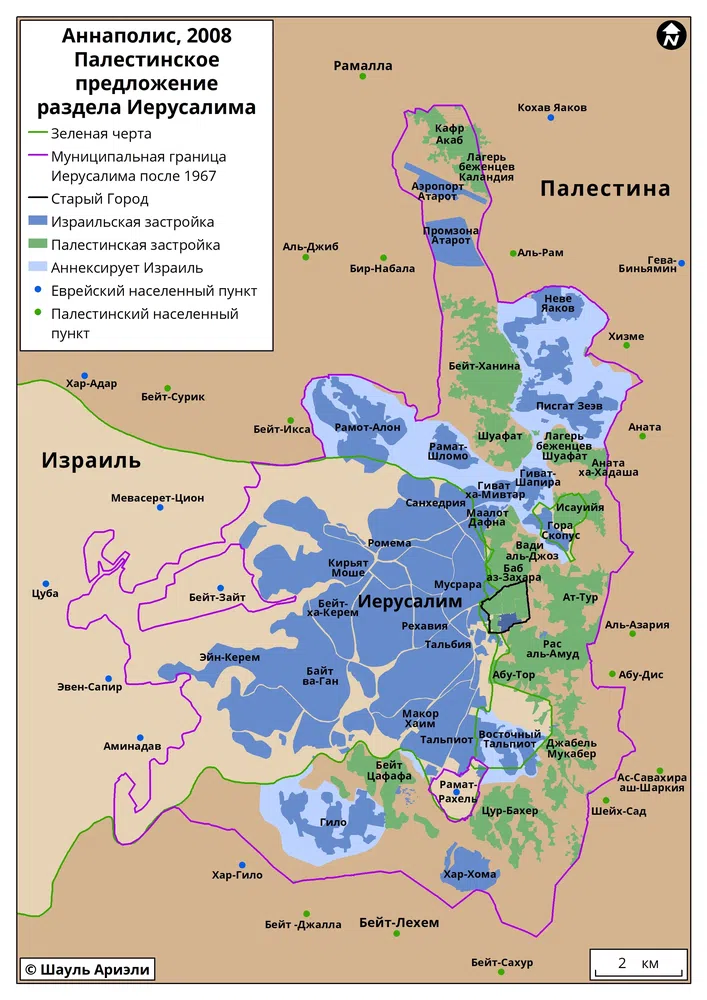
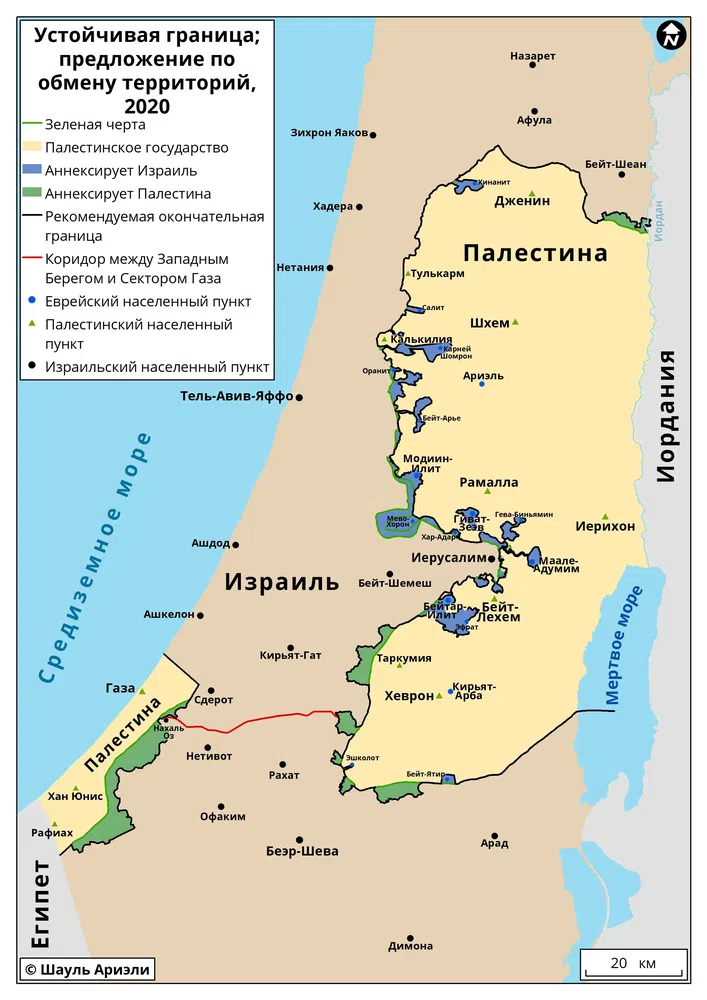
- I wanted to state a large amount of information very clearly and clearly. My goal is to help those who are ready to better understand the history of the conflict, in the prospects of its resolution, issues of borders, territories, security, refugees and Jerusalem.
One prophet - two graves
Our next point is Nabi Shmuel. In a straight line on the map from here to Jerusalem 500 meters. From a height of 900 meters, a fantastically beautiful panorama in an unreal biblical style opens. This is the burial place of the Prophet of the era of the Schmuel judges, in the Christian tradition - Samuel. For Arieli, this is a strategic point, where Jerusalem and its environs are in the palm of your hand: Ramalla, Givat-sta, gush-ecounced ...
-Due to the important strategic position of Nabi, Samuel ended up at the epicenter of battles in the war for the independence of 1948. The Israelis failed to stay here, and for 19 years the tomb was in the hands of Jordan, and the Jews did not have access to her. In the six -day war, the mountain was liberated by the DSAL.
We are talking about wars, negotiation process, and
I would like to understand when the personnel military man, the commander of the landing brigade saw not enemies, but people, but people,
And he devoted his life to this “peaceful process” in all its possible aspects, having formed facts, numbers, dates in the foundation of the formula “Two states for two peoples” over the years.
“I started negotiations in the military office at four prime ministers: Rabin, Barack, Olmert and Netanyahu,” he says. - My deep conviction: Israel is obliged to change the life and economics of the Palestinians for the better, to preserve the opportunity to conclude a peace treaty in the future and promote humanitarian initiatives.
The Dati group passes past us (in Hebrew it means - religious). Sinagogue of the grave of Shmuel Ha-Navi is a holy place. In the 19th century, the Jews bought this land and tried to establish a settlement. But this place is revered by Muslims. In the same building with the synagogue there is a mosque. Here are the ruins of the fortress of the crusaders. According to one version, they found the biblical city of Rama, according to the other, this is the border city of the Jewish kingdom of MICP, where, according to legend, the Prophet Samuel gathered and inspired the Jews to war with the Philistines.
... The sun is mercilessly. On the border between Shomron and Judea, I’m trying to understand what the future of Palestine will look like.
- a demilitarized state within the borders of 1967 with the capital in East Jerusalem, under the control of international forces. In accordance with the 242nd UN resolution. There will be a four percent exchange of territories, as a result of which about 80 percent of the Israelis will live behind the “green line” under the sovereignty of Israel.
At the intersection
The exchange of territories and resettlement of people is one of the most difficult issues. After 1967, the Israelis built hundreds of settlements in Judea and Samaria. Construction on the western coast for many years is a bargaining coin in Israeli relations with the international community. Both every Israeli, and every Palestinian today knows that the most politically left Israeli government will not be able to even in the near future to make a transfer of people as it was already in the past.
“Any agreement,” says Arieli about the future of Palestine, “will require great preparation and efforts to fulfill it between Israel and Palestinians.” This is a long process that needs both Arab and international assistance, and intermediary and practical. In addition, investments in the development of the economy, in the rehabilitation of refugees, in the construction of the Palestinian capital, in security measures will be required ... Therefore, the Arab world, like the international community, led by the United States, should be considered as part of the political process from the very beginning.
In August 2005, the Israeli Prime Minister Ariel Sharon led the troops out of the Gaza sector, eliminating all the Jewish settlements there. At the same time, four settlements were destroyed in the northern part of Samaria. The process of “one-way demarcation” of the settlers did not forgive Sharon (in 2006 he fell into a coma and was in it until his death in 2014).
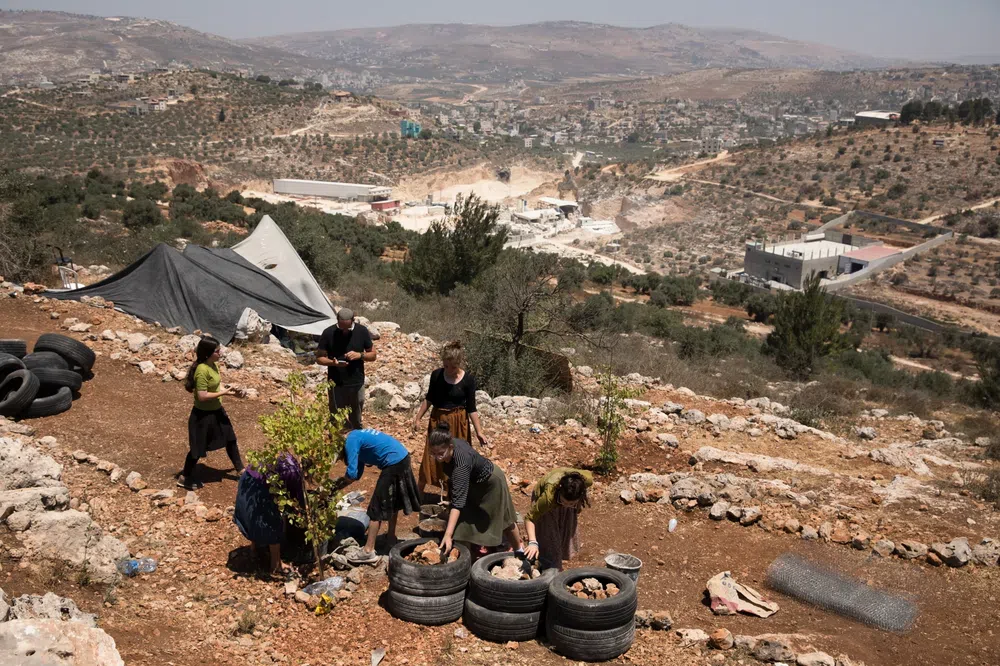
The liquidation of Amon settlement in 2017 I watched with my own eyes. The sight is not for the faint of heart. The police and special forces were literally pushed, carried out by force, threw resistant settlers from houses. And houses were destroyed by bulldozers.
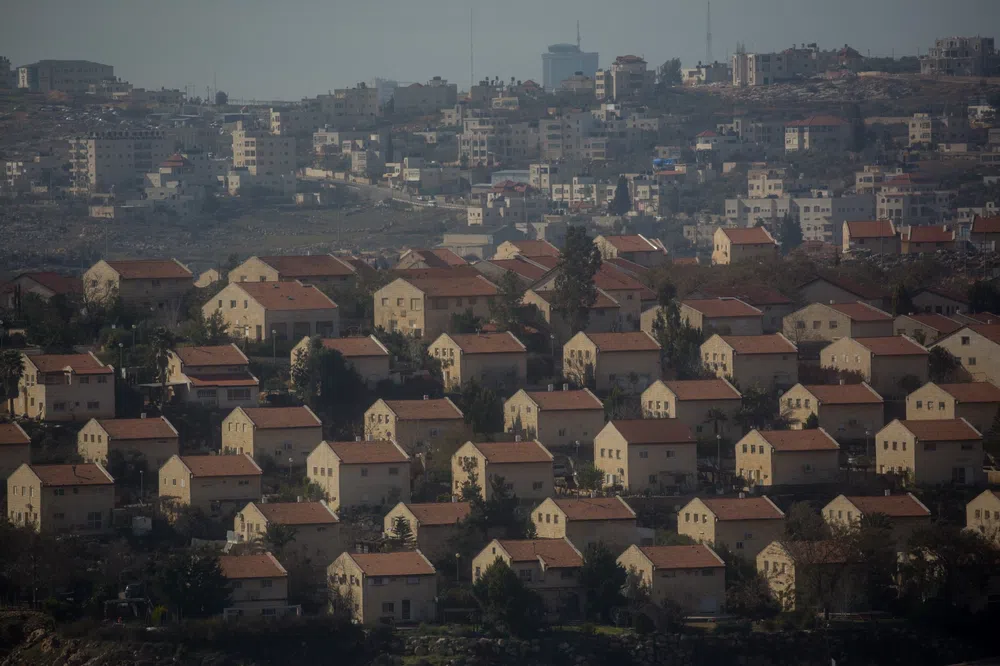
Most Jewish settlements on the west coast are urban settlements. In the so -called large Israeli triangle from large cities - Maale Adumim, Modin Ilit, Beatitar Ilit. Only about 10% are agricultural villages. All residents in them are citizens of Israel and the laws of Israel are applicable to them. Palestinians on the west coast of Israeli citizenship do not have, many of them are citizens of Jordan.
Jerusalem-divisible-weekly
The Arab-Israeli conflict gave rise to many problems-social, economic, demographic, political, moral and ethical. But one of the most painful questions is the section of Jerusalem.
You can be touched by the majestic views of the eternal city, to join the holiness of the three religions, but we must not forget that Jerusalem today is one of the most dangerous foci of tension and for those who are behind “Jerusalem - one and indivisible”, and for those who see in it two cities living according to various laws.
“A single Jerusalem is a fiction,” says Arieli.
- East Jerusalem, the territory that was separated from Jerusalem as a result of the war for independence in 1948, has a very small area - only 6,000 Dunams, or about 6 square kilometers. This is the so -called Al Kuds, which includes the old city - about 1 kilometer. "Unified Jerusalem" today exists as two separate city. West Jerusalem - Jewish quarters. Eastern - Arabic. And the connection of these two cities is very weak. Residents of the Arab quarters of Jerusalem do not have Israeli citizenship. They participate in the elections to Palestinian Autonomy. They have separate transport, schools, their trade, entertainment and business centers.
- And how do you propose to share Jerusalem?
- I published my proposal many times. I emphasize, we are talking about the division of East Jerusalem annexed by Israel. 12 districts of East Jerusalem will move to Israel, including the Wailing Wall, the Jewish Quarter of the Old City and Mount Zion. In holy places, a special regime will have a special regime that will ensure freedom of access and freedom of religion for adherents of all religions.
Safety
Shaul Arieli is a member of the Association "Council for Peace and Security." It includes the highest reserve officers of the Israeli army, Mossad, Shabak, the police, as well as ambassadors, leaders of various ministries, scientists, and university professors. All of them believe that the process of peaceful settlement is an important component of state security.
- One of the terms of the agreement with the Palestinians is the demilitarization of the Palestinian state: they will have neither the army nor heavy weapons.
He is called the negotiator. Arieli was the head of the negotiation group from 1994 to 2001. The plot of secret negotiations in Oslo in 1993, when the leaders of the peaceful initiative met secretly, became the basis of the new action -packed melodrama of the NVO channel.
- Shawl, and in Oslo, so was it romantic as in the film?
- At that time it was difficult to call romance.
Jerusalem - Nabi Schmuel - Gush Etion