
Translated material
Katya goes into space
Artem Roganov - about the collection of stories and stories by Anna Matveeva
Anna Matveeva’s book “Katya is going to Sochi. And other stories about the doubles ”consists of nine moderately optimistic stories about how, against the background of the Ural mountains, a variety of people - local historians, adventurers, maniacs, artists, lovers, etc. - overcome the existential abyss that separates their excerpt from it). Read more about this - in the material of Artem Roganov.Anna Matveeva. Katya goes to Sochi. And other stories about doubles. M.: Elena Shubina Elena, 2021
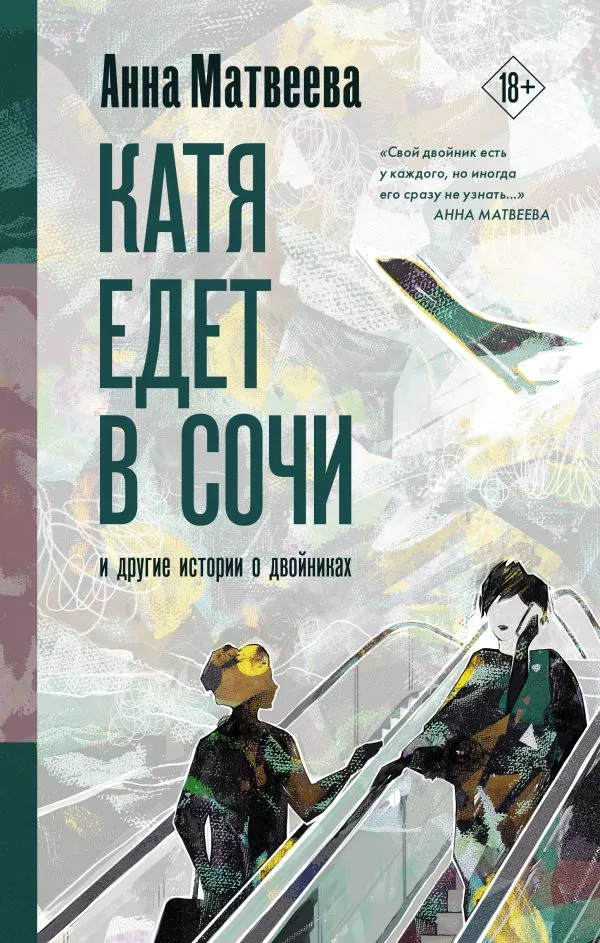 In literary subjects, doubles are most often associated with an alarming, frightening atmosphere. They are easy to confuse, they make them doubt their own uniqueness. When such a textbook theme, such as a duality, is already declared on the cover, it, in turn, is alarming: it makes you doubt the originality of the book in advance, because who just did not create heroes from the alter ego - from Gogol and Dostoevsky to Limonov and Pelevin. Fortunately, the subtitle of the collection of stories and novels by Anna Matveeva “Katya goes to Sochi” deceiving. The duality here is interpreted widely and often comes down to a certain rhyme in the images of two or more characters: a general situation, similar psychology and manners, the same goal in life. Even the introductory story “Grand of General Ignatiev”, where there are twins and there are direct discussions about doppelgangers, is more devoted to the shallow line between truth and untruth, as well as the adherent of the half-truth-a charming fraudman-priest to a clear one. The fate of this Ural Ostap Bender, consisting of adventures of varying degrees of harmlessness, intently echoes the fate of the storyteller. She spends his whole life as a mistress of a married man - in fact, also a game against official rules, not alien to deception and self -deception. In turn, in the title short story, an intelligent woman in years meets at the airport almost her antipode, young habalist Katya. But both heroines suffer from complex, painful love, being at a crossroads. And although they experience a love drama in completely different, a short acquaintance in Sheremetyevo gives them if not hope, then comfort.
Let the declared duality in many ways nominally, “Katya goes to Sochi” does not turn into a fragmented selection of two stories and seven stories, but looks like a holistic cycle. For example, all stories are optimistic with rare exceptions, at times paradoxically, in the spirit of conditional “happiness, contrary to happiness”. For the work of Anna Matveeva, who debuted twenty years ago with a rather gloomy novel about the tragedy on Dyatlov’s pass, optimism is not that characteristic. In the most famous collections of the writer who entered the final “Big Book”, “Nine nineties” and “Wait, I will die and come” - either nostalgic sadness prevailed, as in the first case, either the atmosphere of unfulfilled hopes, as in the second. “Katya goes to Sochi” is much more ironic, and in some places the irony approaches aphorisms or flows into full jokes.
About money and various wonderful things that you can afford, if you have money, Brusilovsky spoke infrequently, because these conversations were remembered.
Vitaly Mikhailovich once asked Misha: when, in his opinion, the picture can be considered complete?
“When it is sold,” said Brusilovsky.
<...>
Natasha fell in love with her new (alien, but it doesn’t matter), because she had everything that was needed for life - that is, almost nothing.
Even a tough, seemingly heavy story about a pagan maniac “The Day of the Week was Friday” ends with life-affirming. The criminals are punished, and the remaining orphans of the child takes under his wing an extremely respectable deputy, in whose image Evgeny Roizman is partially guessed by a foreign agent in Russia . However, there is no glamorization of serial killers, nor silence of cruel details, and the plot, apparently, is based on the real case of Arsen Bayranbekov, who committed human sacrifices in the Urals in 2014. The wildness of esoteric fanaticism unfolds slowly, with everyday plausible calm, and the household existential crisis of the deputy adds a beautiful contrast. On the one hand, people with ready -made answers in the form of occult faith reach bloodshed. On the other hand, a seeking and uncertain hero makes someone's life better, not understanding why. Good always asks questions - the postulate, albeit controversial, but at least curious, and in the end, “the day of the week was Friday” claims to be the strongest text in the collection. Only the biographical short story of the “Words” about the artist Brusilovsky and his wife, where, with all the documentary, the intriguing, figurative picture of the thorny creative path, is recreated, can be competition.
Artists have more than once arise in the stories that you can attribute to the influence of Anna Matveeva’s previous book “Picture Girls” dedicated to women in painting. Only occasionally giving way to other cities in Yekaterinburg is another recognizable feature of Matveevsky prose, which was not in vain long before the “Petrovs” Alexei Salnikov received from critics the characterization of “Ural magical realism”. True, it is the collection “Katya goes to Sochi” closer to realism without magic. Yes, accidents are not random here and the conditional “plan of fate” reigns, but faith in the supernatural is supplied more like a profanation of reality, and individual hints of double -regions do not change what is happening globally and sometimes even seem to manifest the absurd humor. At the same time, conscious continuity in relation, for example, to Hulio Cortasar, excerpts from which served as epigraphs at once to two novels, is quite noticeable. And the point is not in experiments with form - on the contrary, almost all subjects are chronologically transparent, with clear climax and denouement. It's not about the topic of the game, beloved by the Argentine classic. The game is central only in the second story about the gambling mother and a sensitive son-in history quite passing due to a previously understandable finale. The similarity with the masters of magical realism lies primarily in the style, especially in detailed, original comparisons, where an almost independent context sometimes grows.
In Komarova, something squeaked in his throat after these words, and she felt naked, like a Gader pepsic. The boys gave such boys on March 8-not in all schools of the USSR, of course, but in those where a more or less wealthy contingent studied.
Like metaphors, deployed and organic references look. What is worth only an attempt by the heroine of the title story to correlate her condition with Brodsky’s poem half -forgotten. Or a local historian, all the time quoting Grebenshchikov. Irony, irony and appropriate, dosed quotation - all this makes the reading of the collection fascinating even when the traditional plot is practically absent. For example, as in the final lyric “where are you?”, Passing at the end to the mother’s appeal to her son. And the book would be pleasant, but that is just a pleasant harbinger of the writer's big novel promised in the fall. Summer, bright and light. In many ways, therapeutic, especially given the oppressive atmosphere, which from time to time occurs today due to an epidemic, political scandals or economic instability. To a certain extent, such a book “Katya goes to Sochi” and it turns out, but just the nerve of modernity is demonstrated quite clearly in it.
Despite the flashbacks from the Soviet period and the nineties, for the most part “Katya goes to Sochi” is a panorama of Russia for the beginning of the twenties. Moreover, attention is paid to the phenomena quite global. There is a place for external attributes, such as digital ludomania or self -isolation, and less obvious social phenomena. Pagan mysticism in the same story about the maniac recalls the syncretic teachings and conspiracy theories that are common today. “The Day of the week was Friday” shows that the development of technology does not cancel our irrationality, the desire to blindly believe, which, together with ignorance, sometimes leads to tragedies.
A special role in the collection is played by the motives of inner loneliness and burnout from the fast pace of life. The same Katya goes to Sochi not just to her lover, she also wants to escape from the routine, everyday work in the event agency. In the story "Spring, Sveta!" The heroine-journalist feels like a squirrel in a wheel, who does not even have time for grief in his native father. The story of Misha Brusilovsky, even if it unfolds in the past, hints how important it is not to forget about the direct observation of reality - to know the world and other people not only with the help of words, but also non -verbally, as in the book of the Soviet artist Vladimir Sokolov, “Eyes and Heart”. And this sounds relevant, given how much an information society with a huge amount of media is tied in words and artificial images, often leading to the space of post -truths. The halo of the latter is represented in the mentioned "grandson of General Ignatiev", where the methods of the scammer lead to thoughts about fakes on the Internet.
At the same time, social issues are given gradually, it does not develop into a satire or an indiscriminate wall about how everything is bad. On the contrary, the optimistic note in the stories indicates that, despite the alienation characteristic of society, people can still understand and hear each other. Let it even as if a certain unknowable force helps them in this, which in the book is responsible at least for coincidences. In fact, the title theme of duality turns into a much broader message - the belief that even very different, opposite by the nature of the personality can join dialogue. All stories speak of a hidden universal unity, whether it be a short story “after life”, where the heroine unexpectedly feels an inner relationship with an unfamiliar dead woman, or “long and frequent letters” - about the unobvious significance of relations with foreign friends in correspondence. The new book of Anna Matveeva describes the space of a cold post -industrial society, where "a person needs a person." If you like, you need a double, but not a gloomy otherworldly shadow and not a twin-assistant, but simply someone who at least try to share thoughts and emotions with you. Perhaps this is what a convincing literary optimism looks like - problems are recognized, but are not declared hopeless.