
Translated material
Stretch register for 30 million

Second study on the coronavirus base of the Ministry of Health
Two weeks ago, Mediazon, Medusa and Kholod issued a joint study on the federal coronavirus register, in which we counted 29 million records. We received many additional questions and objections from readers, and the Ministry of Health - instead of a detailed answer to our requests - called the publication “fantasies”. To respond to all claims, three editions have collected a large array of certificates - and now we better understand how closed registers of the Ministry of Health are arranged.
Medusa and Mediazon, with which we did this study, are included in the register of "foreign media that perform the functions of a foreign agent." Therefore, in accordance with the order of Roskomnadzor, we are obliged to precede the publication with the following notification: “This message (material) has been created and (or) widespread by a foreign media that performs the functions of a foreign agent, and (or) a Russian legal entity that performs the functions of a foreign agent.” The font size of this notification is also regulated by order of Roskomnadzor.
In the first text, we told how coronavirus certificates on “public services” allowed us to understand how registration is kept in closed registers of the Ministry of Health. We wrote that we found 29 million records for a register for coronavirus patients.
The Ministry of Health called our conclusions “nothing more than fantasies”, independent analysts arose questions for data - for example, about whether the numbering in the register is really consistent, whether there are a large number of empty records and whether it is possible to re -record remote numbers. And about whether the coronavirus falls into the register.
The first publication was based on a limited number of certificates collected from readers that did not allow these questions. This time we applied another method that allows you to answer the claims of the Ministry of Health and remove the main questions to the quality of our data.
Closed register, in which you can spy
According to a familiar to the information resource of the Medusa source, access to the federal register of patients with coronavirus infection (part of the unified state information system in the field of healthcare, which has been developing and supporting Rostec since 2019) does not even have technical specialists of the Ministry of Health; Only members of the government and the leadership of the Presidential Administration can receive complete data.
Nevertheless, we found a way to collect statistics on electronic certificates issued by those who have been ill, vaccinated or simply handed over the PCR test.
This became possible due to the specifics of the site of the "State Services". If you follow the link from the certificate’s QR code and open the page HTML code, one of the links will lead to the technical page of the State Services. In the address bar you can set another certificate number - and then the server will answer whether there is a certificate with such a number or not; No data from it will be available (for this you need to know a unique security code).
Studying certificates with this method, we found out that by the end of July in the coronavirus registers of the Ministry of Health and Rospotrebnadzor (is only responsible for the PCR):
- 30 million 270 thousand records of sick;
- 35 million 780 thousand records on vaccinated;
- 13 million 580 thousand records of PCR tests;
So few PCR tests?
“State Services” accept both positive and negative tests. So far, there are few of them, since the laboratories are required to provide data from the end of March 2021, but in July the government had to tighten control - the data not all loaded.
We additionally confirmed that the unique number from the register when it enters the “public service” becomes part of the certificate number - without any distortion. The Petersburger was ill with coronavirus in February, but did not receive the certificate right away. To do this, in July, she had to first contact the clinic, and then write a complaint to the city authorities. In one of the answers, she was informed that “data on the disease transferred to the EPGU ( the Unified Portal of State Services. - approx.“ Cold ” ) correctly” and named her unique register number (UNRZ) - such a term indicates records in the registers of federal departments. When a week later the certificate nevertheless appeared on the "State Services", his number completely coincided with the UNRZ.
The data we received on the number of records in the registers coincided with conclusions on the certificates collected by the manually collected. This is how, on the basis of our array of data, the accumulation of serial numbers of the sick from the moment the epidemic in Russia begins.
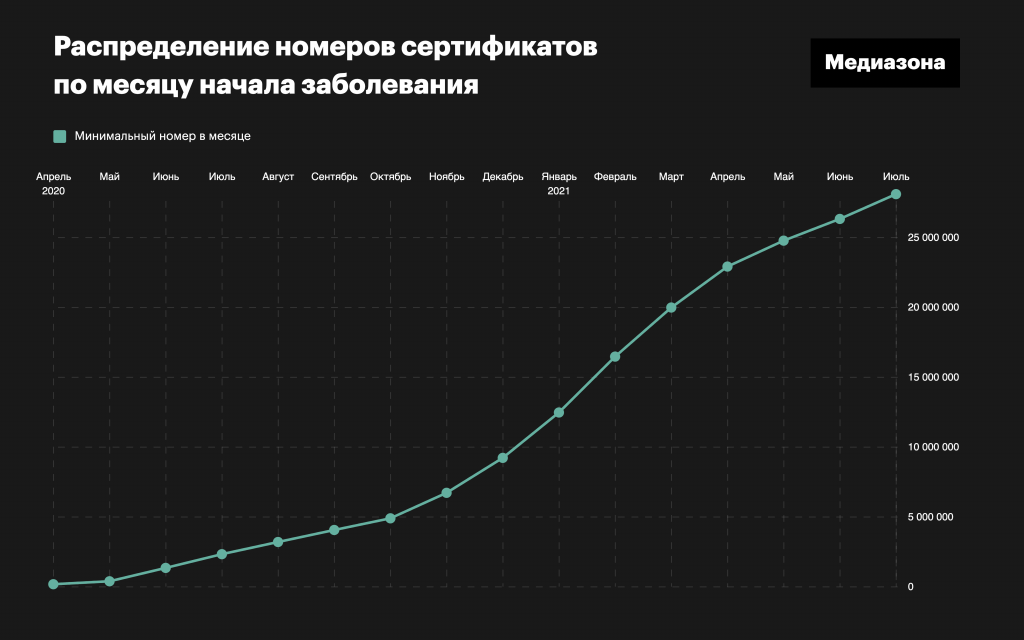
But it is more important that the new data allowed us to answer the objections of the Ministry of Health and the doubts arose among our readers.
What if this is a single database where the ill-fledged, vaccinated and someone else is mixed?
In his only comments after our publication, the Ministry of Health claims that the “information resource” is one on all (the answer is quoted in the Kommersant newspaper, it can be completely read in the Life Shot channel), “sick Covid-19, pneumines, vaccinated and other categories of records” are brought there. And there are more than 39 million records in this resource.
From the collected data it follows that this is definitely not one large table for all cases. The Ministry of Health uses the word “resource” in its response, obviously referring to the government’s decree on the creation of such a system. Different registers are parts of the resource. It is intentionally or not, the department only confuses readers with such a mixture. But these are independent registers, because in all three types of certificates we have proven, the same serial numbers come across, for example:
- 7000 0000 1304 6765 -a certificate of the PCR test, made, most likely, in mid-July 2021.
- 8661 1220 1304 6765 -a certificate of the ill, the diagnosis of which was made in December 2020 (1220) in the Sverdlovsk region (66th region).
- 9490 0000 1304 6765 -a certificate of vaccination in the Magadan region (49th region), which in its serial number dates back to early May 2021.
It is unclear what the number of 39 million named by the Ministry of Health consists of. As the analyst of open data, Alexander Dragan, does not even agree with official data on vaccinated and sick - only they give more than 43 million records.
What if the rooms in this register are not serial?
“The unique register record number is not a through ordinal number - the algorithm for its formation is nonlinear and takes into account several factors,” the Ministry of Health says. A similar question arose among readers, it was formulated in detail, for example, in the post of open data analyst Alexander Dragan.
In the code of the certificate of the echoed only eight unique numbers denoting the serial number, so we randomly checked a large number of numbers from 0000 0000 to 9999 9999.
How does the number even arrange?
The entire number of the certificate consists of 16 digits: the first digit encodes the type of certificate, for example, “8” means a certificate of the eccentric one, the following two digits are responsible for the region’s code, the fourth digit is the recipient of the budget funds (in all the numbers we have found, this is “1” - that is, the executive authorities of the constituent entities of the Russian Federation), then the year and the year of the beginning of the disease in format 0821. The remaining 8 digits - the remaining 8 digits - A unique certificate number.
Here is the result of the distribution of numbers found by months (the month is indicated separately from the number in the second group of certificate numbers):
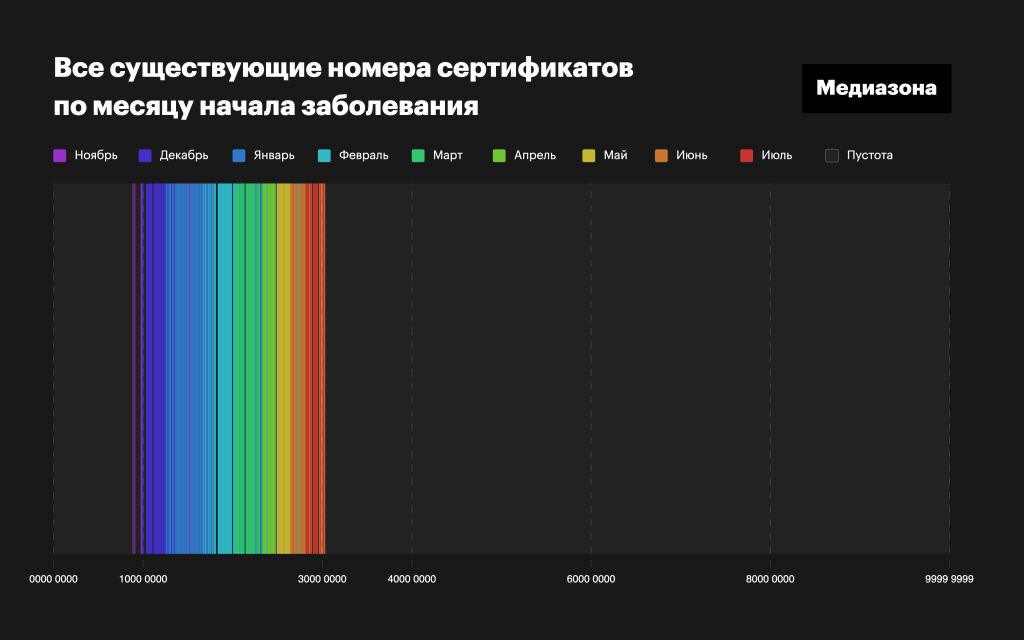
As can be seen from the schedule, there are more than 30 million numbers among available certificates. The rooms less than 10 million are almost inaccessible - if a person has been ill over six months ago, his certificate is already invalid and disappears from the “public services”.
Despite this, we found unit old certificates, including for April 2020, when the epidemic was just beginning-for example, a Moscow certificate with number 8771 0420 0017 5725 is available. We assume that in register records of such patients we made some mistake (according to the Government Service rules, they should not accept the certificates without the dates of the disease), due to which they are due They are considered “forever” ill -fed - and the certificate remains valid.
Rare deviations of the numbers are explained by the later entry in the register - so ill, for example, in April received a number in the order of the corresponding June.
Certificates that records go in order are in the documentation for coronavirus and other registers. On the website of the St. Petersburg MIAC in the section on working with the Federal Covid-19 Register there is a table ( XLSX ) with a record of records in this database. It indicates that the type of unrz line (unique register record number) is Bigserial . This is a numerical data type in database management systems - for example, in PostgreSQL - which automatically generates consistent numerical values for each new entry.
Why did you get the idea that there is postgreSQL?
The fact that the entire EGISZ was at least until 2016 worked under the control of Postressql, is said in the report of the Ministry of Health on the creation of the system. It is logical to assume that they did not change: the contract for the finalization of the coronavirus register of 2020 indicates the requirement: the software should be either Russian or freely distributed. PostgreSQL is suitable for the second category.
The version using serial numbers is confirmed by the video instruction of the Ministry of Health to the Covid Register - there are three consecutive UNRZ numbers. In the PDF file with the instructions, the first two of these numbers are used to combine takes. It can be assumed that they were simply created one after another to demonstrate accessible functionality. During our study, we have repeatedly found certificates with the numbers going one after another.
The representative of the Ministry of Health at the request of the Medusa correspondent to tell about the principle of numbering in the register answered the question:
- You do not worry, how does the traffic police give out numbers?
“But the cars do not lie under the Ivl.”
- Are you wondering how the random number generator works?
- That is, the register works on this principle?
- Send the request.
The editorial office did not receive the answer to the request sent two weeks before the release of this text. Mediazona also asked the Mincifers about how many certificates were issued to the “public services”, and for what reason they could be unavailable. The department promised to answer, but several times transferred the deadlines, and by the time the article was released, they didn’t say anything.
What if the rooms are ordinal, but in the base itself are there omissions?
Alexander Dragan and other experts suggested that in the register of the Ministry of Health, gaps are possible - due to the technical features of building databases. This would mean that even if the number 30 million 270 thousand is really the last in order, then in the base itself not 30 million records indicating the patients, but much less.
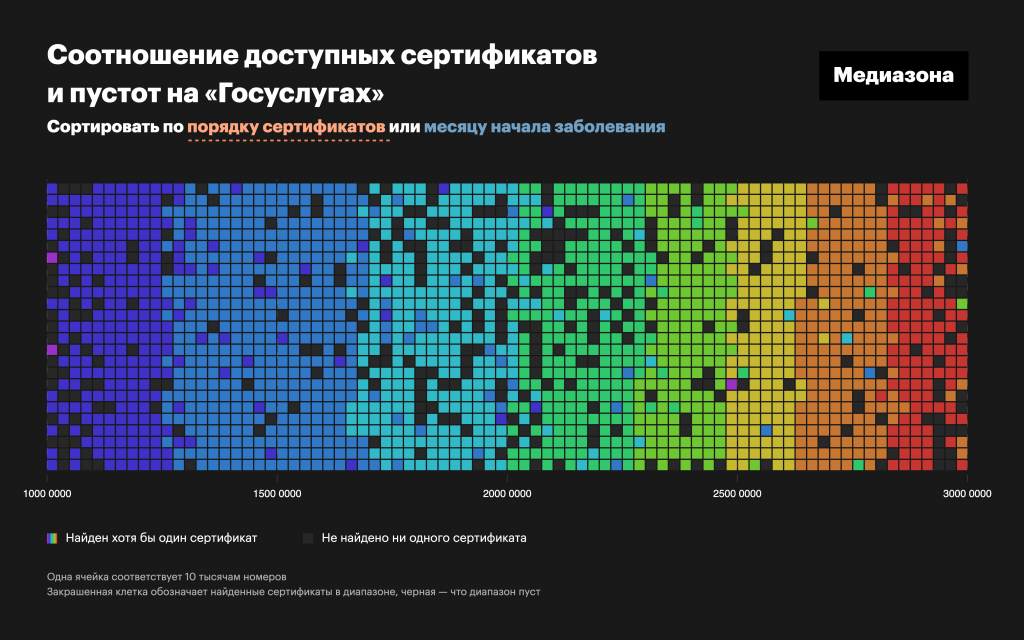
To check this version, we studied in more detail the range of numbers issued over the past six months: from 10 to 30 million. As can be seen from the general schedule, there are no large holes in millions or even tens of thousands of records in the numbering.
Can I do more about the passes?
Only in a couple of places the pass between the numbers found randomly reached several tens of thousands of values, the average size of the interval - 2,409 values, the median - 939.
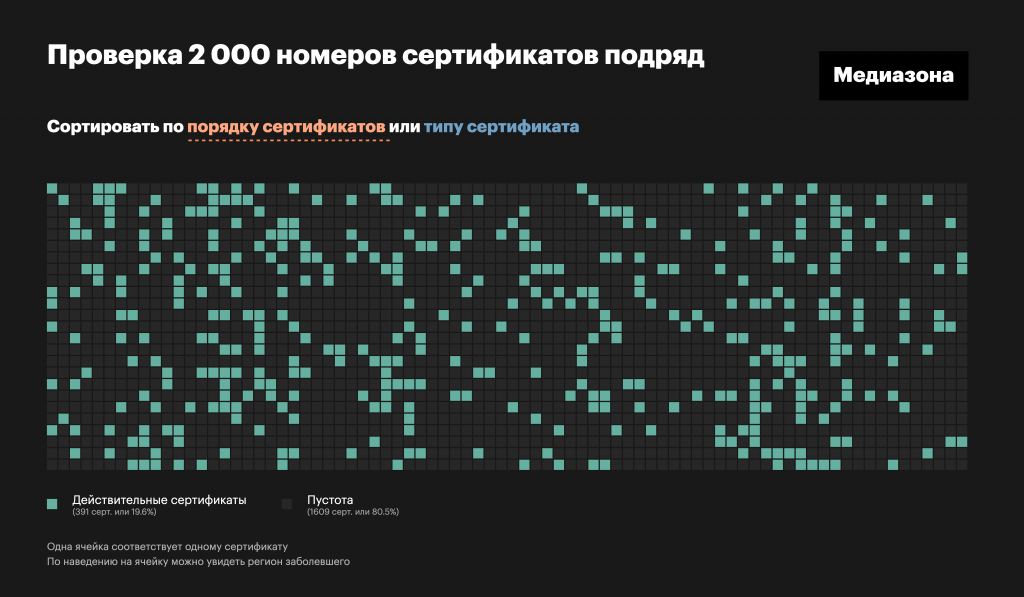
It could be assumed that there are no intentional gaps in the numbering, but there are quotas - for example, for regions. Then, if Moscow is allocated from 13 to 14 million, there can be no other region in this range of its patients to write down its patients. After checking two thousand numbers in order, we found out that there are no such quotas in the register either.
Moreover, in the register, as in any database, due to errors, voids in successive identifiers can really occur. For example, the PostgreSQL documentation indicates that the serial number for recording - in our case for UNRZ - will be considered involved, even if the data could not be entered.
This can sometimes happen due to some random error, or because of a constant error in the program code that makes an entry in the register. In the second case, passes will appear regularly, for example, each second record will be missed or the number of missed lines in a row will coincide with the number of lines in a row. During the study, we did not find such patterns, gaps are random.
Voids can occur when removing “garbage” records that will inevitably appear during work - the sistema is designed for 44 thousand users, follows from two contracts with a roster for the finalization of the coronavirus register. A doctor who worked with him from the Krasnoyarsk Territory told Mediazone that in 2020, at meetings on working with a registry in their region, it was said that some patients were mistakenly “rejoiced” - that is, when transferring a person from one hospital to another, he could be brought into the system again. Apparently, such a case is also described in the above video instruction to the register. According to the documentation, this should not happen to the current version of the register: when entering data on the already mentioned person, the user will first be proposed to update the existing entry.
To evaluate the exact number of holes that have appeared for such reasons - which means that the exact number of records is impossible without access to the register. For example, if we assume that all the gaps were the result of technical linings, it turns out that the register is 90% (more about this figure - just below), consists of defective records. Only the Ministry of Health can make clarity here.
And what about the rewriting of remote numbers?
During the preparation of the first text, the informed source told Medusa that if the erroneously entered record is removed, its serial number is released and it can be issued to recording a new case. This would mean that there are no free numbers in the register - even at the site of the erroneous record that was deleted during rechecking.
The statistical data on certificates that we collected do not allow this statement to confirm.
To find out whether the patients rewritten, it is necessary to collect not only unique numbers for a large number of records (we have them), but also the date of entering the register. By comparing the numbers on neighboring dates, one could understand whether there are rebounds in the numbering due to rewriting or not.
Moreover, in our method it is possible to check only whether a certain certificate number is available or not - the rest of the data is protected by the security code that cannot be selected. But even if we had access to all the information from all certificates, we would not be able to check how the numbers jump - the fact is that the date of entering the register (that is, the date of diagnosis) is not transferred from the Ministry of Health to the “State Service” to create a certificate of a chosen one (only a recovery date is needed for him).
Putting an end to the issue of theoretically possible rewriting is possible only with full access to the register. And only the Ministry of Health has it.
Most of the emettered certificates are not available on the "public services"
Our graphs show that not all verified certificates of certificates were available - although we substituted all possible regions and months in them. Among the numbers from 10 to 30 million, who added to the register over the past six months, we can collect only 10.26% through “State Services” (an error of 0.21% is 95% confidential interval) - the server replies to the rest of the numbers that the certificate is not available.
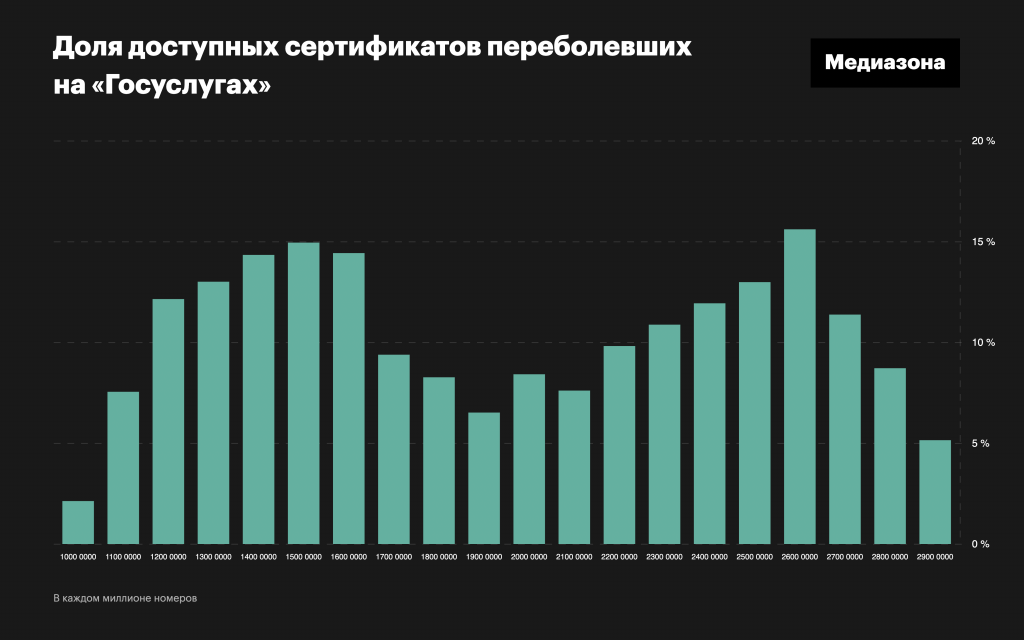
There are several reasons why the coronavirus may not have a certificate at the “public services”:
- If a person is ill, but then vaccinated - vaccination “extinguishes” a certificate of illness;
- The confirmed entry on the “State Services” necessary to receive any type of certificates has only half of Russians - this is 78.5 million people (children without a passport definitely do not have such confirmed records);
- Mistakes are possible when entering SNILS to the register (then the recording will not be able to attach to “public services”), such cases only officially up to 20%;
- There are official restrictions for law enforcement officers and military personnel, their data also do not fall into the “public services”;
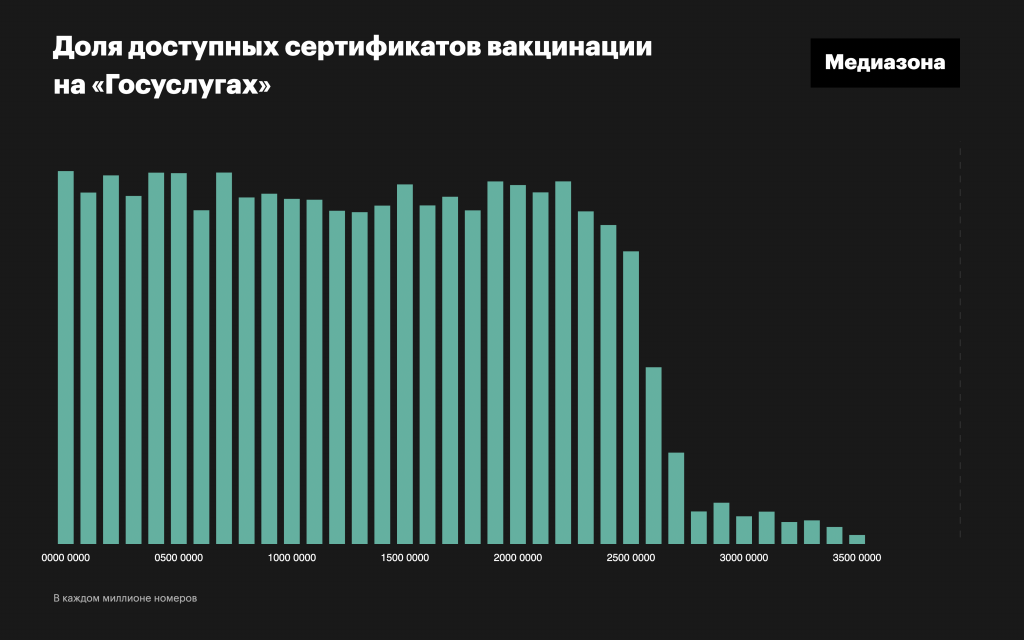
But all these problems did not prevent 70% of the vaccinated ones from getting their certificates on “public services” - we checked this, studying numbers from the register of vaccinated. The decline at the end of the schedule can be explained by the fact that the number is assigned after the first dose (at the time of the self -observation diary), and the certificate becomes available only after complete vaccination - 21 days later. Most vaccinated after a 25 million mark simply did not complete the vaccination.
In addition, in June in Moscow they began to massively vaccinate foreigners who may not have an account at the “State Services”. For their vaccination, the Luzhniki sports arena was specially redone. According to Medusa in the Moscow Department of Health, 170 thousand foreigners have already vaccinated. In addition to “public services”, they can receive an electronic certificate on the portal of the city hall or on SMS.
Why are they not considered all over the register who are ill?
Another reason for a small number of visible certificates may be the principle of their selection in the synchronization of “public services” with the registry. In the final report for 2020, the Ministry of Health wrote that it was the coronavirus register that “served as the basis for managerial decisions”: information on cases of diseases, treatment and patients of patients was promptly entered into it. This is probably due to the fact that the specificity of the register allows you to track not only positive PCR tests, but also suspicious cases and severity of the course of the disease in patients.
Not only those whose test showed the presence of coronavirus, but also patients with diagnoses from the risk group, is entered into the Covid-19 register. For example, all patients with pneumonia are brought there without fail. It is possible to get into the register and people with SARS and other respiratory diseases.
Similar criteria are used in other countries. For example, from the point of view of American centers for the control and prevention of diseases (CDC), symptoms of acute respiratory viral infections or pneumonia (optionally confirmed by pictures) in contact patients or people from risk groups - this is the reason to consider the case as a possible coronavirus and include it in public statistics. In Russia, the requirements are tougher : only the case with fixed changes in the lungs (CT) and direct contact with the sick (or recently returned from abroad) is considered clinically confirmed (without a positive test). The World Health Organization also calls on to rely on CT, X -ray or ultrasound in doubtful cases.
This is also evidenced by doctors who worked with the registry. At the level of hospitals, the proportion of inconceivated patients entered into the register is minimal, the Krasnoyarsk doctor told Mediazone: “In the infectious hospital we had several hundred people, we had one or two out of the six hundred, we suppose”. According to him, in clinics, people with confirmed PCR or with covid pneumonia are brought into the register: “I think the contribution of acute respiratory infections [to the register] is minimal and at the clinical link.” At the same time, the doctor emphasizes that his opinion about the clinics is “theoretical, not practical”.
The district doctor told Mediazone that she brings all patients to the register with suspicion of Covid-19 ; After this, the person is directed to PCR or CT, where the diagnosis is either confirmed or not. She does not know what happens to the records further, since she is engaged only in primary diagnostics. According to her, at the peaks of incidence of coronavirus, in almost any SARS, doctors suspect the Covid-19 : “A light coronavirus from SARS does not differ in absolutely nothing. Therefore, they can both arbitrarily remove from the register, and not remove what needs to be removed. <...> Given the fact that the majority are still the lungs, they are not sent to CT, only PCR and symptoms. PCR shows the truth in 60% of cases. Everyone who maintains the register understands this. ”
Moreover, according to the Research Institute of Influenza to them. Currantsev, who monthly distinguishes various viruses in thousands of patients, has almost never spread from the beginning of the epidemic in Russia (except for December and February); Other viruses causing SARS were sometimes detected more often than coronavirus.
Thus, in the theory and practice of doctors there are many criteria for entering the patient in the coronavirus register of the Ministry of Health. But when transmitting from the registry to “State Services”, only the recordings are taken into account in which the doctor entered the Covid-19 by laboratory tests (diagnosis code U07.1) or by symptoms and pictures of CT (U07.2). No other diagnosis is accepted for issuing a certificate.
And if the doctor in a particular medical institution for some reason did not put a note on the coronavirus in the register, then even a patient with pneumonia from the coronavirus hospital will not be able to receive a certificate of the agitated at “public services”.
Many patients with coronavirus could not get to the register at all
After the publication of the first text, the reader of Kholoda told the editorial office about an interesting case: “I was ill at the end of April, recovered in early May. But I was sick in a small town and in a small hospital. There were no information about the disease on the "public services" and other sites, there was no certificate, although I officially received a sick leave with a diagnosis of covid . "
On July 14, the reader went to the clinic, where the secretary of the head physician promised to immediately enter him to the register. He received a certificate after an hour and a half. And although the date in it is April, the serial number was more than 29 million, since the record was made only in July.
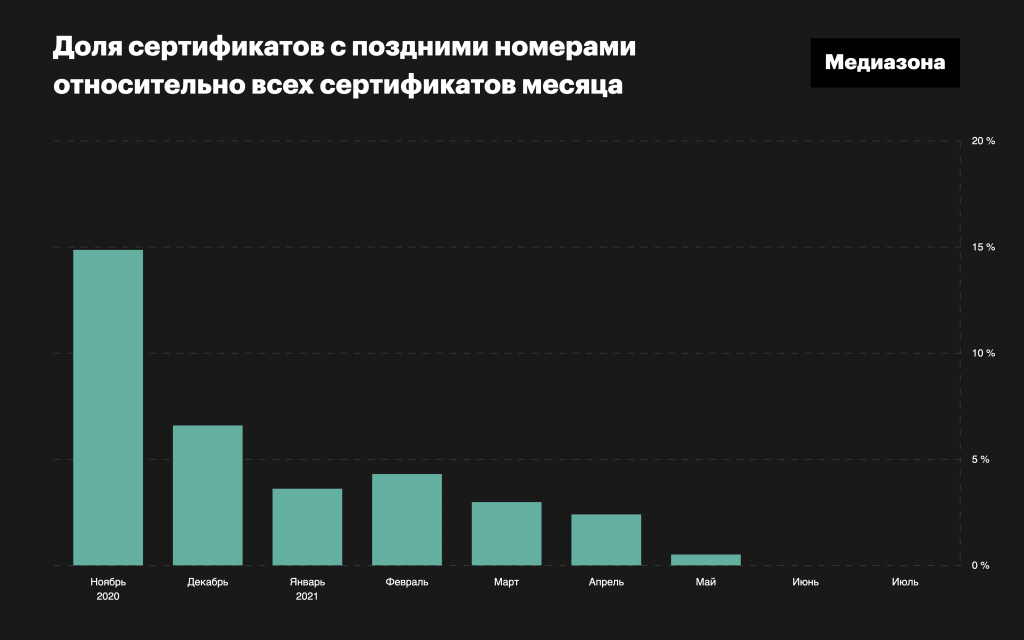
This case is definitely no exception. We found dozens of certificates whose serial number is too large for the month of making a diagnosis. For example, if in April there were no certificates with a number of less than 23 million, then any February (two -month ago) certificate with a number of more than 23 million - “lagging”. It turns out that after the announcement of the need to receive QR codes, people who have been redearing coronavirus massively went to find out why they were not issued certificates.
And then they began to be added to the register with the old months (by the date of diagnosis), but by large serial numbers. In some months of such cases - up to 5%. If we assume that such a percentage of non-use was throughout the epidemic, then in Russia there may be more than a million covid-19 , which there is no information at the federal level-even in closed registers.
And what in the end?
Judging by the data we collected, only a tenth of the already 30 million records in the register of the Ministry of Health is turning into certificates of ill -fed - this is about three million. Given the fact that only half of Russians have confirmed records on “public services”, we can assume that this figure in rough approximation coincides with the official reports of the operational headquarters (6.3 million cases at the beginning of August). But in the register, as mentioned above, they are not always brought even by those who were definitely diagnosed with coronavirus.
In addition, an assessment of several million sick people is not consistent with either the data on excess mortality , and with the number of officially hospitalized coronavirus patients (more about this in the text of Medusa ). So, information about the number of patients brought to the register of the Ministry of Health is an important and most likely the most complete source of information about the real scale of the epidemic. And the numbers of the certificates of the ill ones allow you to track it in real time.