
Translated material
"Sanitary" cutting
Where and why the right was left from state life
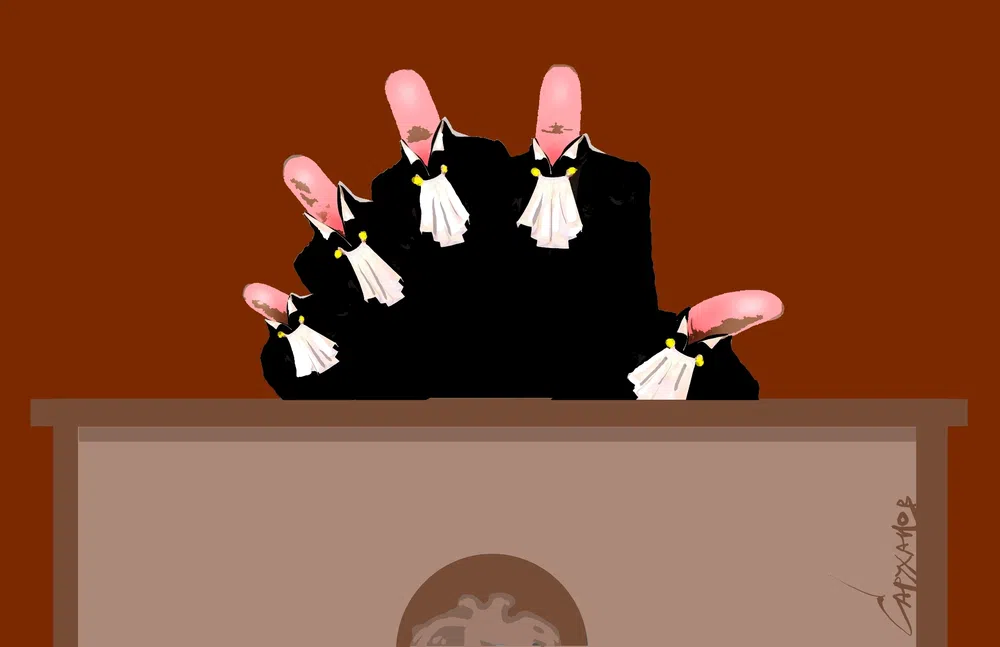
When the majority of those nine who are judged by “sanitary affairs” (sic!) Was still on foot, in February 2000, presidential candidate Vladimir Putin wrote in an “open letter of voters”: “Democracy is the dictatorship of the law, and not those who are obliged to defend this law as a position.”
Golden words, to draw them, say, on the facade of the Investigative Committee. But the jurists intrigued an unusual formulation. It seems to be akin to the famous Rule of Law, but what then did the “dictatorship” have and where did the “right”, which was supplanted by the “law”?
It is easy to deceive in words, they are the same for completely different ones, but the shades of carefully selected words, on the contrary, do not lie, the intentions are distinguishable in them. “Law” is a system of norms, oriented primarily to equality before the law, and the “law” itself is only a tool - like an ax with which you can build a house and kill a person. Over the 20 years, the regime has been modified, more and more tolerating accents from attempts to convince violence, but orientation on the applied nature of the “law”, requiring the rejection of the normative order creating predictability, was laid down on the very basis of the regime.
Today it is "sanitary affairs." Why were there ten of them (for nine instigators and one “instigated”), and not one, “united by a single intent”, which was excited from the very beginning of January 24? Only guesses are possible here, but the most likely is that it was precisely about the intent that “collective Bastrykin” did not remember at first.
The problem is that not without difficulty found by the SK "incentive" is responsible under Art. 236 of the Criminal Code of the Russian Federation for "violation of sanitary and epidemiological rules that entailed by negligence (allocated by me.-L. N. ) a massive disease ... or threatened the onset of such consequences."
But you can’t “undermine” anyone to an unintentional crime, this is nonsense.
The disposition of the article, which, apparently, was then frightened by the UK, could be described as follows: "Carrying out mass events that pose a threat of violation of sanitary and epidemiological rules." Without clarification “by negligence”, the norm would imply actions committed with indirect intent (in case of indifferent attitude to consequences). The emergence of such a norm, unlike many others composed by the recent Duma, may have been even advisable in pandemic conditions. But, secondly, it would first of all fall under it, held by no means opposition. And firstly, there is no such article in the Criminal Code!
Investigators, no matter how they studied, is known for the principle, which is closed in the first courses, to all lawyers even in Latin: Nullum Crimen Sine Lege-that which is not described in the law as a crime cannot be considered a crime. There is nothing to judge these nine. But then how to “solve the problem”?
The legal absurdity of the prosecution highlights precisely the instrumental goal: to prevent Navalny’s supporters to the elections. It can be solved by different means, including as, apparently, they tried to do this with Navalny himself. Can I try as with Ivan Kolunov - suddenly this time roll? But all this is risky, and harsh, but “sanitary affairs” with predominantly conditional sentences - just right.
Well, it’s not very folding - but this is from the standpoint of Rule of Law, and from a tool point of view - is the goal amazed?
This is, perhaps, the embodied “dictatorship of the law”, because the right has disappeared from here, leaving the court with a completely incomprehensible function - rather a media than legal: so that they could put such a task (hint, approve of the post -fact), seized its achievement with sacramental: “The court decided! In Russia, no one can intervene in the prerogatives of the court. ” Or are you enemy Rule of Law?
Selective law enforcement (and non -use - for example, to the "security forces") has long been described in detail, but
Gradually, the state and at the legislative level passed into the “lead” regime: they are not cutting the grass now, but immediately poured the entire clearing with acid, so that it certainly does not grow.

Such a preventive one - in the manner of processing pest picos - the nature has recently expanded legislation on “foreign agents” and especially restrictions for everyone who “is involved in the activities of extremist organizations”. On this inaudible and in advance, they can be deprived of a lot of things: first of all, passive suffrage, and retroactively.
But the right, in principle, is in principle-in the form of min-traps for those who have not yet done anything-does not work. So it loses the quality of norms, equally designed for everyone, but turns into a purely managerial decision to deprive the rights of absolutely specific individuals, who, in contrast, for example, from the Stalinist “fists”, are not so difficult to even list in advance by name. Such “laws” are essentially administrative orders, anyless sanctions.
On the basis of the same legislation (but not right) over the past weeks, the sites of most of the still operating opposition media were blocked, and their teams were forced to declare self -dissolution under the threat of criminal prosecution of not only journalists, but also active readers.
Yes, in such a situation, we are largely deprived of the opportunity to do something, but, thank God, we are not without the opportunity to understand. And understanding, as Hannah Arendt notes in one of his essays, is perhaps the best remedy against horror, against tetanus in the face of a totalitarian regime.
On July 6, our conversation with Professor Andrei Medushevsky was published on the News website, I refer to it those who want to figure it out deeper (due to complexity and size, the material was not published in the paper version). Medushevsky, analyzing world literature on this subject, discusses the growth of popularity of the ideas of Karl Schmitt, leading lawyer of Nazi Germany, and his follower and our contemporary Georgio Agamben. Agamben, like Schmitt, considers reasoning about the rule of law a waste of time, since a reality for “sovereign” is always a state of emergency, that is, the suspension of law and transfer of decision -making centers to the administration area, that is, in fact, manual management.
Behind the concept of Agamben, there is, like in Russian, a cherry is true: history begins to develop at such a speed that normative regulation often simply does not keep up with it. However, referring again to world literature, Professor Medushevsky speaks of the danger of an imaginary emergency as a design, “consolidating in mind the very form of cognitive design of reality. Such a view of the world constantly projects new crises and does not know other way out of them, except for the continuously replacing emergency measures. ”
This is what we must ask ourselves in order to understand, and if possible to pose this question before the legislator in the broad sense of the word. Is it really a state of emergency? And why then not to say it directly about it, not to introduce instead of ships, for example, “triples”? Do Russia really have “enemies” who justify such a suspension of law? And what do these “enemies” want-not in the sense of the on-duty “weakening of Russia”, but somehow more specifically?
What if it’s just the fear of thieves and villains from the party in power (whom she herself regularly reveals there) to lose warm places, but in fact there are no enemies?
We should just raise these questions for now, and someone will answer them. History, unlike us, always knows the answer, it is somewhere on the following pages.