
Translated material
Applicants and students of journalism about pressure on independent media: "The turn will also come to you"
Journalism has been unsafe in Russia for almost 20 years, and it is already difficult to do it, applicants and students from Irkutsk and Novosibirsk, who have chosen their studies at the profile faculty. They told Taiga.info about “fear of speaking” and how they are going to work in the conditions of pressure on media “important people in jackets”.
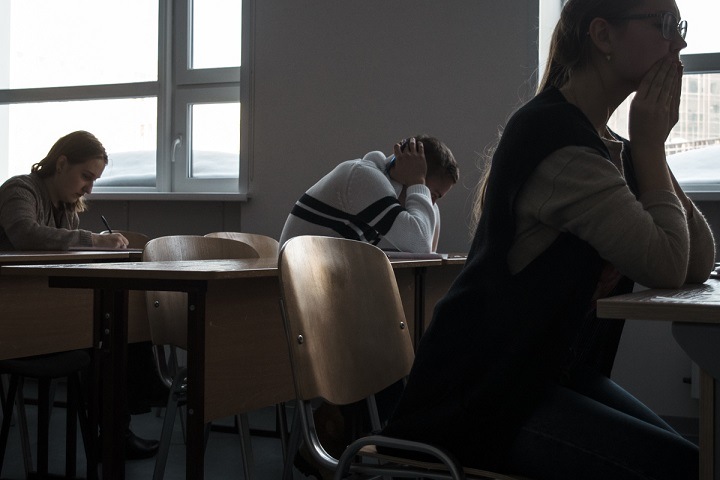
The publication “cold” launched a flash mob #forbidden_professia, in which journalists talk about how they began to work and how new repressive measures regarding the media affected them. Taiga.info talked with students of journalism and applicants about what they expect from the profession and why they still choose it, despite the enormous pressure on reporters in Russia.
Andrey, 1 course of the Faculty of Journalism of one of the Novosibirsk universities
I decided to enter the journalism department, because I thought that I could get a good journalistic education here, then to work by profession. After graduating from the first year, I have very bad impressions of study and the university as a whole. I don't know what will happen next.
Back in 9–10 grade, he often wrote posts about school and internal activities. I listened to a lot of performances of [politics] Alexei Navalny during his presidential campaign. I have been following him since 2014, but this period was the brightest and, I think, he influenced how I wrote then. And then I began to lead the district group, because I began to notice a lot of problems around, which had to be covered. So, the journalism department has become the most suitable place for admission.
From the publications I read “Mediazon”, “Medusa”*, Taigu.info, “NGS”, “MBH”, “Rain”, “New Gazeta”, Deutsche Welle. I look at YouTube, but not very often, the video “Rain”, “Editorial”, [Director of the City Projects Foundation] Maxim Katz, [Blogger] Ilya Varlamov, [journalist] Yuri Dudia and Ethri [independent deputy of the Novosibirsk City Council] Sergey Boyko. More than others are interested in the topics related to the municipal agenda and urban economy.
I believe that the last round of repressions associated with the distribution of the status of the media inoacon to the left and right is nothing more than a tantrum before the elections and in the current situation as a whole. Nobody has been dying of blocking yet, at least while there are social networks, you should not overestimate these events and assume that everything was lost. The learned helplessness is very bad for the journalist and very good for the system.
It becomes more difficult to work in such conditions, but journalism in Russia itself is unsafe for almost 20 years, and it is already difficult to make it worse. It is not clear what will happen in a year or even six months, so you need to continue to work, as before, acting on circumstances.
The applicant of the journalism department of the Novosibirsk State University (NSU)
I like to write, shoot and take pictures. Coronavirus, terrorist attacks and other incidents, like an execution in the Kazan school, influenced the decision to enter the journalism department.
On March 11, an attack occurred in Kazan No. 175 in Kazan. 19-year-old Ilnaz Galyaviev fired at gymnasium No. 175 in Kazan, 9 people were killed. It turned out that private security was not in the educational institution for three years, but an alarming button was installed and the watchman worked.
I read “Medusa”*, “RBC”, Harper's Bazaar, “Knife”, I really like the projects “Arzamas” and “Shelves”. On YouTube I watch the video of [journalists] Alexei Pivovarov, Ksenia Sobchak, Irina Shikhman, [film critic] Anton Dolina, [blogger] Ilya Varlamova and the releases of the show "Evening Urgant". The topics closest to me are art and culture.
I feel bad about the pressure on the media, I was incredibly offended when my beloved Medusa* was recognized as an foreigner. I think it is unfair, because it should always exist independent journalism. It is also dangerous, terribly expressed, given what journalists have encountered, for example, Doxa. But those journalists who are not afraid of this, well done.
Four journalists of the student publication DOXA were charged with involving minors in unlawful actions, which are a danger to their life and health, committed by a group of persons through the Internet (part 2 of Article 151.2 of the Criminal Code). For this, they face up to three years in prison. The reason for the initiation of the case was the video posted on the DOXA YouTube channel on the eve of the promotion in support of Alexei Navalny. The court chose a preventive measure in the form of a ban on certain actions, but actually placed journalists under house arrest. The defendants are regularly called for interrogations in the UK.
Elena Lazikova, applicant of the Faculty of Journalism of the Irkutsk State University (ISU)
My dad and aunt are journalists, so in the seventh grade I decided that I would do the journalism factory. I love literature, I also like to write reviews and compositions. On YouTube, I look at the releases of Dudia.
I am not very familiar with the problem [pressure on independent media in Russia] to draw any conclusions. I believe that it is difficult to work in such conditions, but there are no light paths, you need to break through.
Salmeg Radnaeva, applicant of the Faculty of Journalism IGU
Why did I choose journalism? This is due to exams. In my school they were held in the late eighth and ninth grade in the form of research work. In the projects that we did, there was just the entire journalistic "routine". Search for information, writing a title, concept and so on. And I really liked it.
For example, it would not have been influenced, but so inspired that at the beginning of the pandemic, the Tiktok platform rapidly began to advance, and now people can earn money on this. It is very inspired that even adolescents under 18 can be “built” with a career.
From the news editions I read “Medusa”*, “Komsomol truth”, I listen to the Podcasts of TVS. Of the journalists, I am attracted by Ivan Surillo, a correspondent [State Agency] TASS, The Village [and former RT employee]. Ivan has his own “show” - “interviews about personal”, and this is very cool, that the releases are comfortable. Surillo learns a lot of information interested in society.
There are topics that attract me more than others. For example, hippy subculture. Many negatively talk about them, but sad because people do not see the pluses that hippies brought (strengthened): feminism, pacifism and ideas in the world of fashion and music.
It is upset that the media has to work in conditions when they are recognized as foreign agents, because the “Medusa”*that I read was faced with such a problem. Now they have to mark each publication that “this message (material) has been created and (or) widespread by a foreign media that performs the functions of a foreign agent, and (or) a Russian legal entity that performs the functions of a foreign agent.”
Dmitry Kuznetsov, 1 course of the NSU journalism department
He entered the journalism faculty with a purely practical benefit: to learn how to work with the video, it is beautiful and clear to write texts (and quickly, which is also important), as well as find children with whom I can realize my ideas. I am exclusively in musical journalism methyl, and therefore I write almost exclusively about the musical industry. Being an applicant, he was worried that he would have to deal with social topics only at the university, but, as it turned out, there is enough freedom at the university to do what is interesting.
At first he planned to write only reviews, but in the 11th grade he read the news that in Russia, musicians were massively prohibited. Around then I realized that musical journalism, as well as social, is also a kind of “front”, where there is a need to protect freedom. Only in social journalism this freedom is quite literal, and in musical, the freedom of creativity.
I usually learn about the news of a social nature from Esquire or Taiga.info, I read about music on The Flow. On YouTube I look at the “VSRUK”, I read the telegram channel of Kolya Redkin (one of the leading shows), signed on Warhol, a telegram channel [Novosibirsk music journalist] Alexander Morsin. “The VSSO” is now, in my opinion, the highest quality interviews with popular musicians: an abundance of locations and interesting questions that help to look at guests from a different angle. Morsin, like a number of other musical journalists, today manages to write about music (old, new - no difference). And I myself decided to write about music thanks to Anthony Fantano - one of the most popular music journalists in the USA.
I also really like to read the website of Genius, which, by the way of "freedom of creativity", was not so long ago blocked. Probably, like more than one hundred journalists, I am more concerned about the problem of pressure on freedom of creativity/word/self -expression.
Genius - one of the world's largest sites with texts of songs has become available in Russia since August 6. The restriction of access to the site was shot after Genius deleted the texts of songs prohibited in Russia. So, from the list the texts of the songs “Panel” of the performer Husky and the “numbers” of the musician LSP disappeared.
The recognition of the media in -agents is bad and sad. There is another question: for whom it became news? For journalism in Russia, “important people in jackets” crushed before I was born. When you plan to engage in journalism, I must know that the “project” has already been covered, and to the point that you are expensive, that you love, maybe, and you yourself will also reach you.
The Ministry of Justice of the Russian Federation on July 15 decided to recognize the chief editor of the publication “Project” of Roman Badanin “foreign agent”. Journalists Maxim Glykin, Olga Churakova, Maria Zheleznova, Julia Lukyanova, Mikhail Rubin, Sofya Groysman, Julia Apukhtin and former Taiga correspondent, Peter Manyakhin also fell under this status. The Prosecutor General of the Russian Federation announced the publisher of Project - the American organization Project Media, Inc - "undesirable in Russia." This legal entity has already been eliminated .
On July 16, in the center of Novosibirsk, shares of solidarity with journalists recognized as foreign agents were held . Media employees announced the censorship and destruction of the profession in Russia.
Once I asked the question of how to work in the current conditions in an interview with Alexander Morsin, he said that independent media all or almost everything will push out of the legal field. Of course, many journalists after that will go to PRAR, but those who will not be able to live without journalism will develop a new type of journalism - “partisan”. It seems to me that the second path of the development of events is not.
The publication “cold” launched a flash mob #forbidden_professia, in which journalists talk about how they began to work and affected their work new repressive measures regarding the media.
In total, for July, the Ministry of Justice recognized the media-foreigners 13 journalists, as well as the publication of The Insider*. On August 3, MBH Media and Open Media sites blocked Roskomnadzor at the request of the Prosecutor General’s Office as “Information resources [British] Open Russia Civic Movement, Open Russia”, which were recognized as “undesirable” in 2017. The next day, they announced the closure. Earlier, in addition to Medusa, the authorities declared the “first anti -corruption media” and VTIMES “the ino -agent”.
* (According to the Ministry of Justice of the Russian Federation, is the media that performs the functions of a foreign agent that we are obliged to indicate by prohibitive laws)
Prepared by Irina Belyaeva