
Translated material
"Gift, not much deserved by me"
Human rights activist Svetlana Gannushkina - About the years of work and friendship with Sergey Adamovich Kovalev
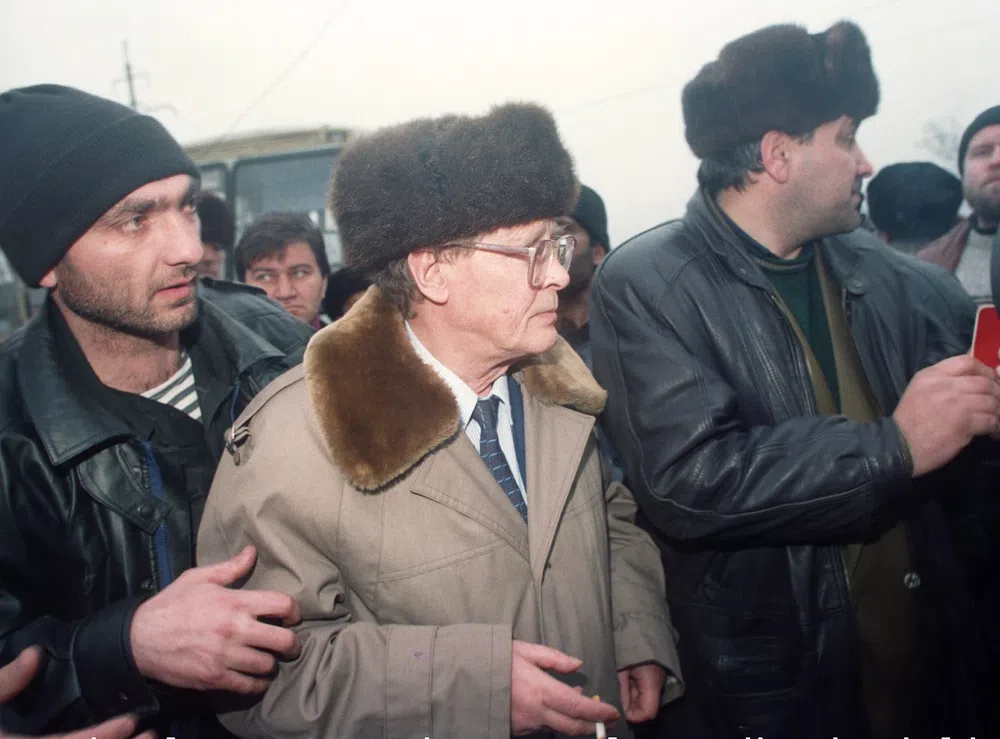
I had known a lot with Sergey Adamovich, about whom, of course, I first met at the end of the 90th or early 91st year, when he was the head of the Human Rights Commission under Yeltsin. At that time, we had already created the Civil Civil Council Committee*, the main stream at our tricks was refugees - Armenians from Azerbaijan. I well remember that the person who represented me said that they "live better than us, they have mink coats and golden teeth." I thought with longing that the meeting on this might end. But Sergey Adamovich interrupted him and gave me to tell about the situation of refugees in fur coats, but without a roof over his head. The meeting was short -lived, but we received support. The then decree of the Council of Ministers on the liberation of Moscow, Leningrad with the regions from refugees was not implemented. They were settled in boarding houses and hotels. And work began on the creation of Russian law in the field of asylum and repatriation. Sergei Adamovich did not participate right in this work, but he gave her some push.
And then there was Chechnya.
For many months, the Kovalev group was in Grozny, and Russian aviation bombed a living city, in the center of which the first Ombudsman of Russia was with its colleagues.
Periodically, Kovalev with one of them came to Moscow in order to tell at a press conference about which hell turned into Chechnya. The world received first -hand information, it was impossible not to trust it. She defeated official propaganda. There was a large conference in Chechnya, at which Sergey Adamovich was the main speaker, and Lida Grafova and I talked about the situation of refugees, I was already involved primarily for legal problems.
Our assessment of Dudaev’s reign was different. Kovalev called him three years of peaceful life. But we took the stream of refugees from Chechnya in those years - the so -called non -conventional population. I started with this short objection to Sergey Adamovich and wanted to talk to him separately after the meeting. But I was ashamed, saying that he was very tired. And they were right, although such a discussion could slightly move his position and make it impossible for all speculative accusations of inattention to Russian problems in Chechnya. These problems were quite serious, but, of course, incomparable with what Chechnya became during the war, at the entrance to which the inscription “Welcome to hell!” Appeared.
I often recall 1996, when Sergei Adamovich, despite a serious heart disease, escaping from the hospital, I had a single rally so to speak. He was put a chair, it seems that it was near the Polytechnic Museum, and Kovalev told people for a long time what was happening at that time in Chechnya, to which interest began to fall. There were few listeners. It was an attempt to be heard when the authorities no longer wanted to hear us.
Kovalev was a desperate debate - gambling and assertive. However, I, perhaps, do not know the second person who would recognize the right of another to have a different position, which is significantly different from his own. When during the discussion I heard his words: “I understand Svetlana Alekseevna,” I felt protected.
As for personal relationships, I am grateful to Sergey Adamovich for the warmth that he gave me over the years of our closer communication. It was a gift, I was not particularly well -deserved, but therefore especially valuable and cordial.
Kovalev’s contribution to the development of human rights movement in Russia and throughout the world is huge. Studies will still be written about this. But about one thing he did not say too long at any of our conferences. Thanks to him, his comrades and like -minded people here, in Russia, the international Helsinki movement began. This movement covered Europe and spread beyond its limits, united civil societies of many countries and served as the beginning of the creation of a single civil society in which we now live and which should preserve.
The authorities and rulers who prefer to negotiate our backs with each other cannot like this. This happens especially noticeable in non -somocratic regimes. Well, ours is now trying to simply destroy civil society.