
Translated material
Little Big Urals
Taiga.info continues the series of programs "Address of the Soviet Union". 30 years have passed since the collapse of one of the largest empires in the history of mankind. During this time, the history of not only the former republics of the USSR, but also the Russian regions began to disperse. The next issue was aired on August 13, it is dedicated to the Urals.
The presenters are sociologist and local historian Andrei Pozdnyakov, publicist and politician Dmitry Kholyavchenko . **
Each program is dedicated to the post-Soviet history of any territory, comparison of regional groups or some important phenomenon of finding identity or place in life. The Ural term is especially multi -digit - it is a mining system, and the Gosplan economic district, and the Putin Federal District and the mining civilization. Moreover, the boundaries of these territories do not coincide. The northern half of the Ural Mountains is territorial to the north (Komi and the Nenets Autonomous Okrug) or to Western Siberia (Yugra and Yamal). The extreme south goes to the Orenburg region and Kazakhstan. At the same time, the warrior is very much connected with the Volga region, and the Trans -Urals with the Big Tyumen Region.
Economically, the mining zone was located from Izhevsk in the West and to Irbit in the East, from Ivedel in the north and to Orsk in the south. At the same time, most plants are located on the territory of the current Sverdlovsk and Chelyabinsk regions, the Perm Territory and the Republic of Bashkortostan, partially entering the territory of the East of the Orenburg region and Udmurtia.
In our program about the Urals, we will consider four regions - Perm Territory, Sverdlovsk, Chelyabinsk and Kurgan regions. The first three are the basis of the historical Gornazavodsky Urals. And the Kurgan region, although it belongs to the border of the transition from the Great Steppe to Siberia, but is currently very much connected with Chelyabinsk. Bashkiria and Udmurtia will be considered in a separate program dedicated to the National Republics of the Volga region.
In order for the conversation on the topic to be substantial, and our listeners were oriented in what space we will be discussed, we decided to collect the main data about the entire region - economics, population, city, and communication in one place.
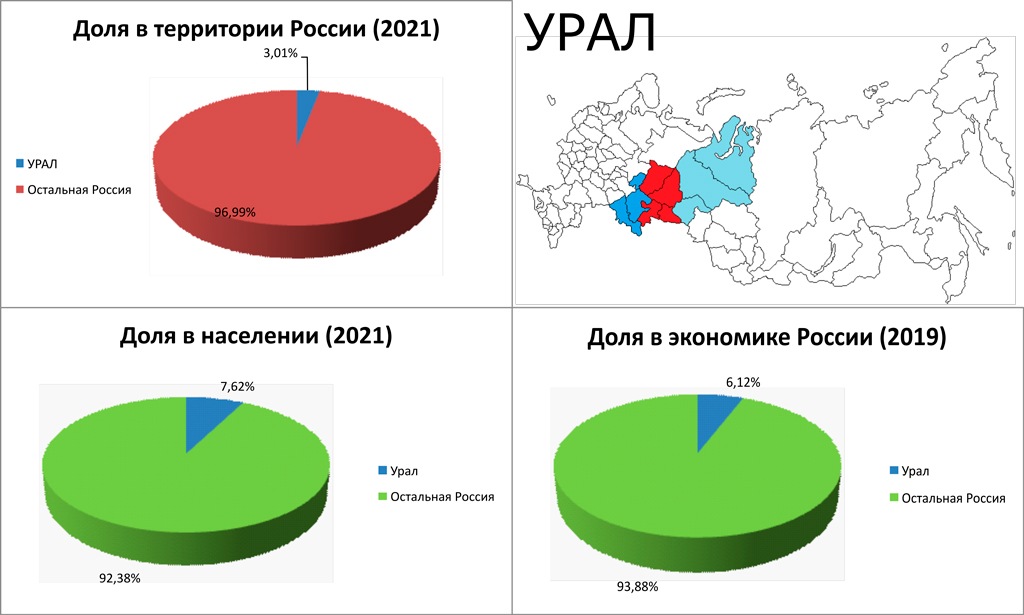
In general, as we see, the regions we are considering occupy about 3% of the territory of Russia, but more than 6% of its economy and a little over 7.5% of the population concentrate. Moreover, the share in the population of Russia over the past 30 years has decreased by 1%, and the share in the country's economy is almost 2%. The population also fell and quite noticeable: for example, in 1991, 12.6 million people lived here, and at the beginning of 2021 it was already 11.1 million.
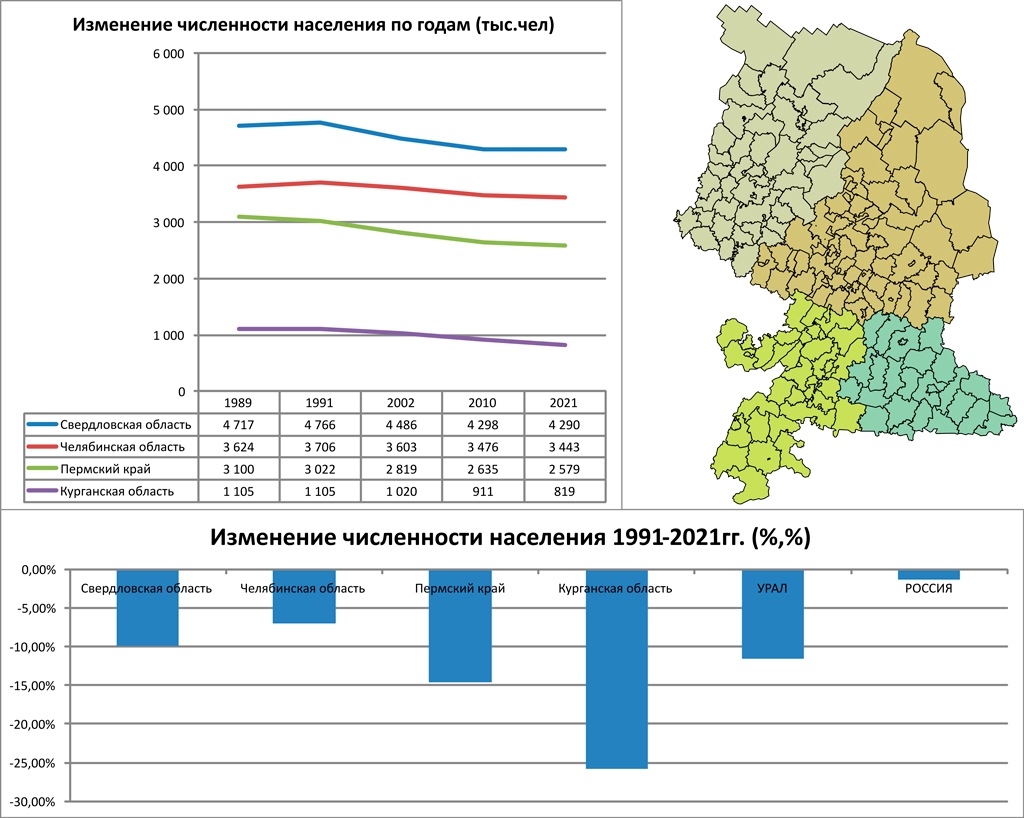
If we look at a change in the population, we will see that the population fell in all the regions under consideration. The Chelyabinsk region lost 7%of the population, Sverdlovsk - 10%, Perm Territory - almost 15%, and the Kurgan region - more than a quarter. The Kurgan region, in addition, is also included in the ten worst regions of Russia in mortality.
If you look at the statistics of the natural movement of the population, then all four regions of the Urals looked worse than the average Russian indicators until the end of the 2000s. After that, from 2010 to 2016 (the last peak of birth rate), the Urals (except for the Kurgas region) showed either a greater increase or a lesser population decline than the country on average. And since 2017, again, the decline in the Ural population has been faster than the average in Russia.
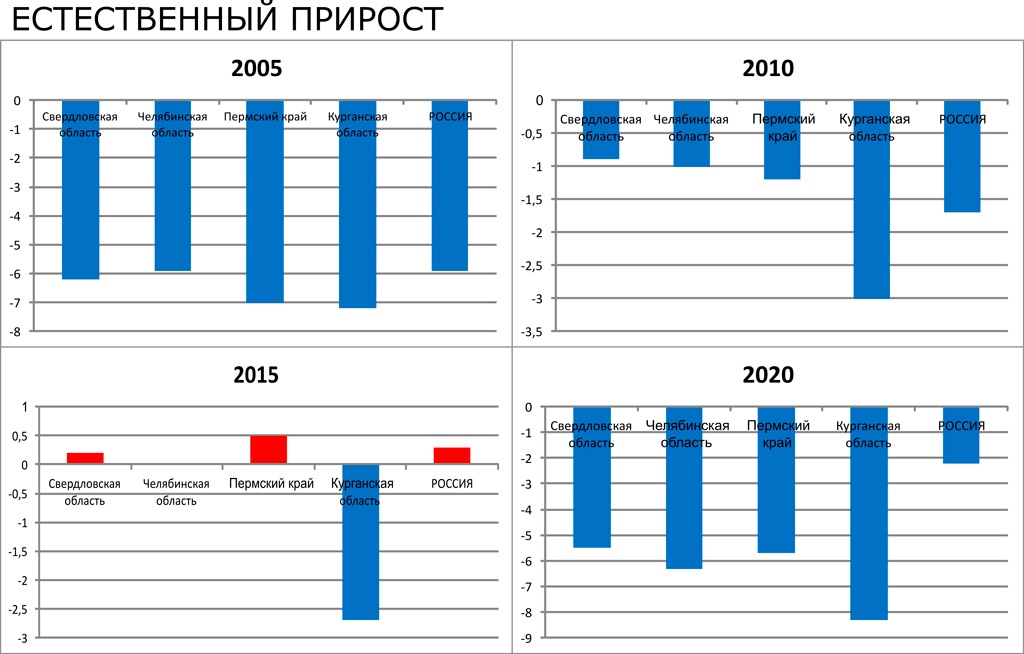
As for the natural growth of the population, in the Sverdlovsk and Chelyabinsk region it was observed only in 2012-2015, and in the Perm Territory in 2012-2016. The Kurgan region showed a steady population decline in all the post -Soviet time.
As for the population of large cities, there are twelve of them here. At the same time, three million-plus cities are clearly distinguished: Yekaterinburg (1.5 million people), Chelyabinsk (almost 1.2 million people) and Perm (1.05 million people). At the moment, this is the 4th, 7th and 14th city in Russia in the population. Perm in the late 2000s fell out of this club for several years, but since 2011 she returned again. In general, if we compare the modern population of the largest cities in the Urals since 1991, then the population of Chelyabinsk increased by 3.5%, Yekaterinburg by almost 9%, and Perm fell by 5%. There are no cities with a population of half a million to a million people in the region under consideration.
The remaining large cities are clearly divided into two groups. The first group is cities with a population of 300 to 500 thousand: Magnitogorsk (413 thousand people), Nizhny Tagil (345) and Kurgan (309). All these cities were permanently lost the population for the past 30 years, while the metallurgical capital of the Southern Urals lost 10%, but Nizhny Tagil even 20%. The mound, despite its status of the regional center, lost the population at the same pace as the entire region and its population is -25% of the year of the collapse of the USSR.
The second group is cities whose population is 100-170 thousand people: Kamensk-Uralsky (164), Zlatoust (164), Miass (151), Kopeisk (149), Berezniki (137) and Pervouralsk (119). At the same time, the population in these cities (except Kopeisk) fell even at an even faster pace. Miass lost 11%, Pervouralsk-17%, Kamensk-Uralsky and Chrysostom 11–12%, and Berezniki is almost a third of the population. As for Kopeisk, the population of this city, which is part of the agglomeration of Chelyabinsk, has grown 2 times mainly for reasons for the accession in 2004 to the city of neighboring villages. However, from this moment on, the city’s population increased by another 5%, which is comparable to the growth rate of the population of Chelyabinsk agglomeration.
The Urals is a very urbanized space. In addition to 12 large cities in this territory there are 17 middle cities (from 50 to 100 thousand people), 82 small cities and 72 urban -type villages. 8 urban settlements in the regions under consideration have the status of it. Including four nuclear cities with a population of 50 to 100 thousand people.
The population of two middle cities at the time of the collapse of the USSR exceeded 100 thousand people. The population of Serov - the largest city in the north of the Sverdlovsk region - fell by 8% and at the moment is 95 thousand. The population of Solikamsk - the oldest city of the Urals and one of the capitals of the Stroganov empire of the XV -XVI centuries - has fallen by 17% since 1991 and amounted to 92 thousand. At the same time, the population of Solikamsk falls smaller than the population of neighboring Berezniki, who remain a large city.
Around Yekaterinburg, Chelyabinsk, Perm, Nizhny Tagil, Magnitogorsk and Zlatoust-Miass can be distinguished by completely established agglomerations.
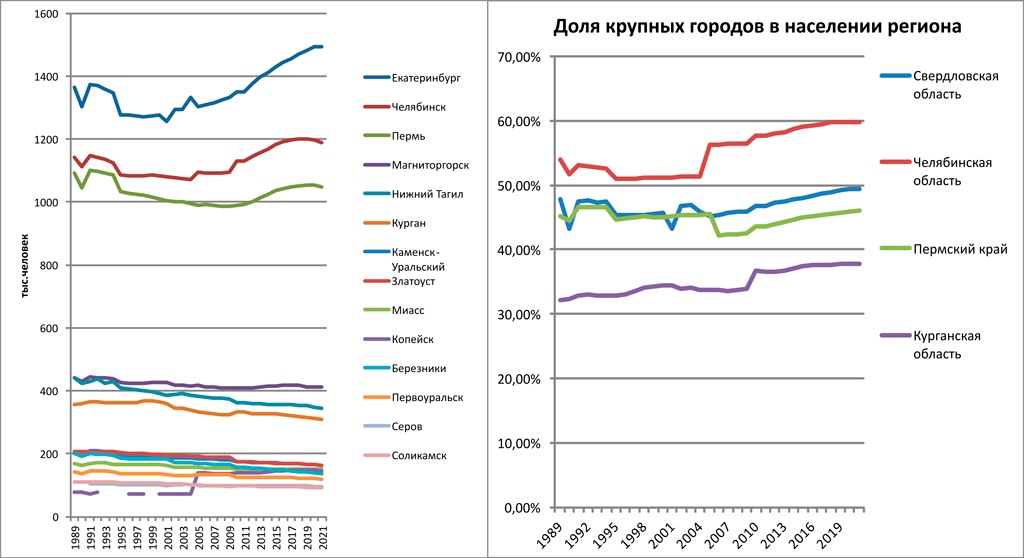
As for the share of the population of regions living in large cities, the level of such a concentration for these regions is very different: 38% in the Kurgan region, 45% in the Perm Territory, half of the population in the Sverdlovsk region and about 60% in the Chelyabinsk region. The fluctuations in the share of the population living in large cities depends on the growth of the population of regional centers, the fall of the rural population and the population of small and medium -sized cities and towns, the loss of Serov and the Solikamsky status of a large city and the acquisition of such a status of Kopeysk.
Certain interest is the statistics of the national composition of the population.
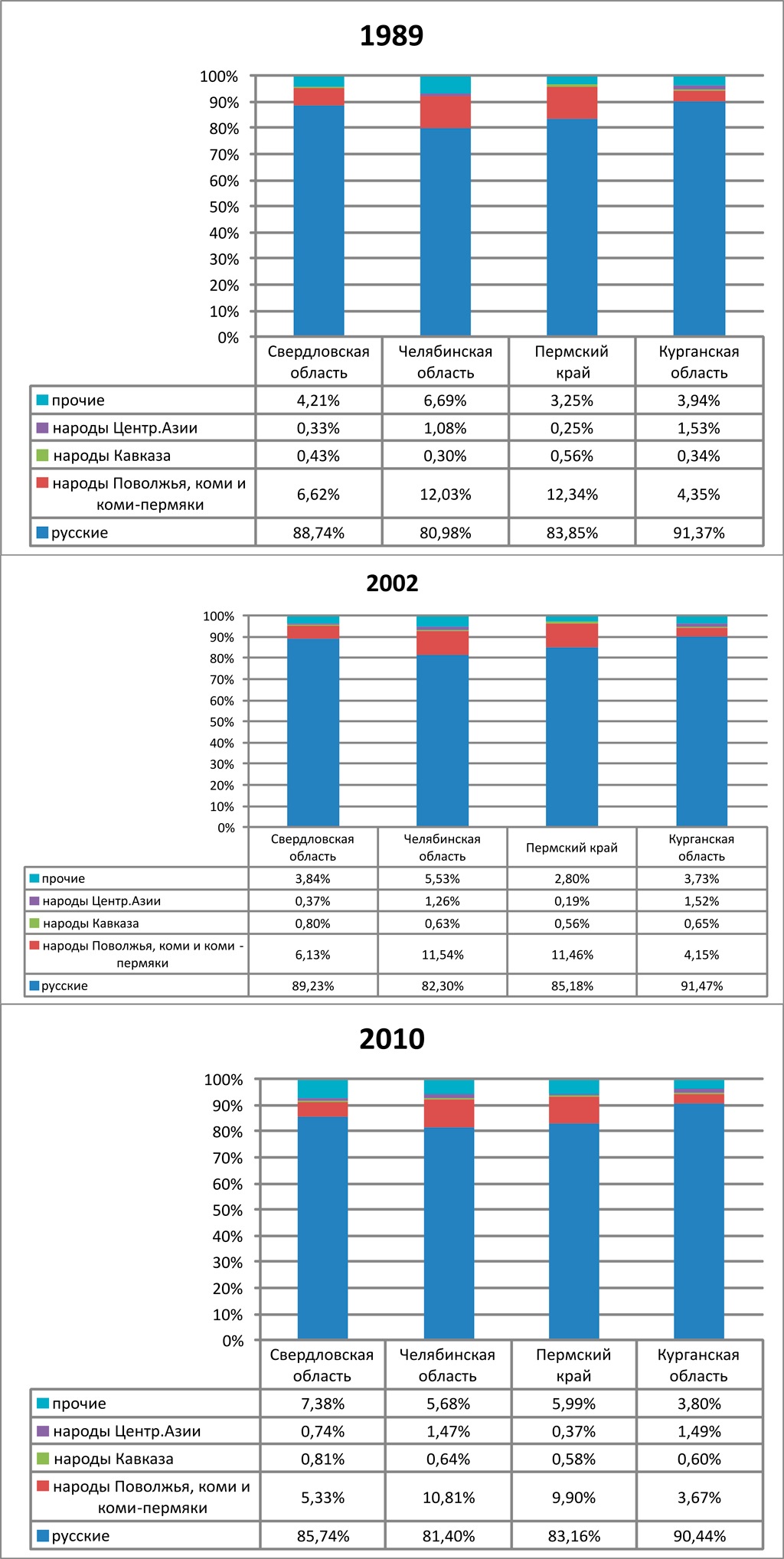
It is important to understand that this statistics are an average temperature in the hospital. In the considered region there are areas and numerous municipalities where the Tatars, Bashkirs, Mari, Nagaybaks, Siberian Tatars, Komi-Permyaks, Udmurts or Kazakhs are completely predominant. In addition, there are municipalities where the share of Mordovians, Chuvash of Germans and Ukrainians is pleased.
Economy.
From the point of view of the economy, the basic indicators of the gross regional product (GRP) per capita of the population of the Sverdlovsk, Chelyabinsk, Kurgan regions and the Perm Territory are inferior to the Central Russian. Moreover, if the GRP per capita of the population of the Middle Urals is about 90% of the Central Russian, then in Chelyabinsk there are already less than 70%. The GRP of the problematic Kurgan region is only 43% of the level of pillow GDP of Russia. It should be noted that Puzushva GCP of all regions in the 21st century fell in relation to the corresponding average Russian indicator. In 1998, the GRP per capita of the population of the Sverdlovsk region exceeded the Russian level by 3%, and the Perm Territory even by 16%. However, in the Sverdlovsk region, the situation has become worse than the Central Russian Center by the end of the 20th century, and in the Perm Territory by the mid-2000s
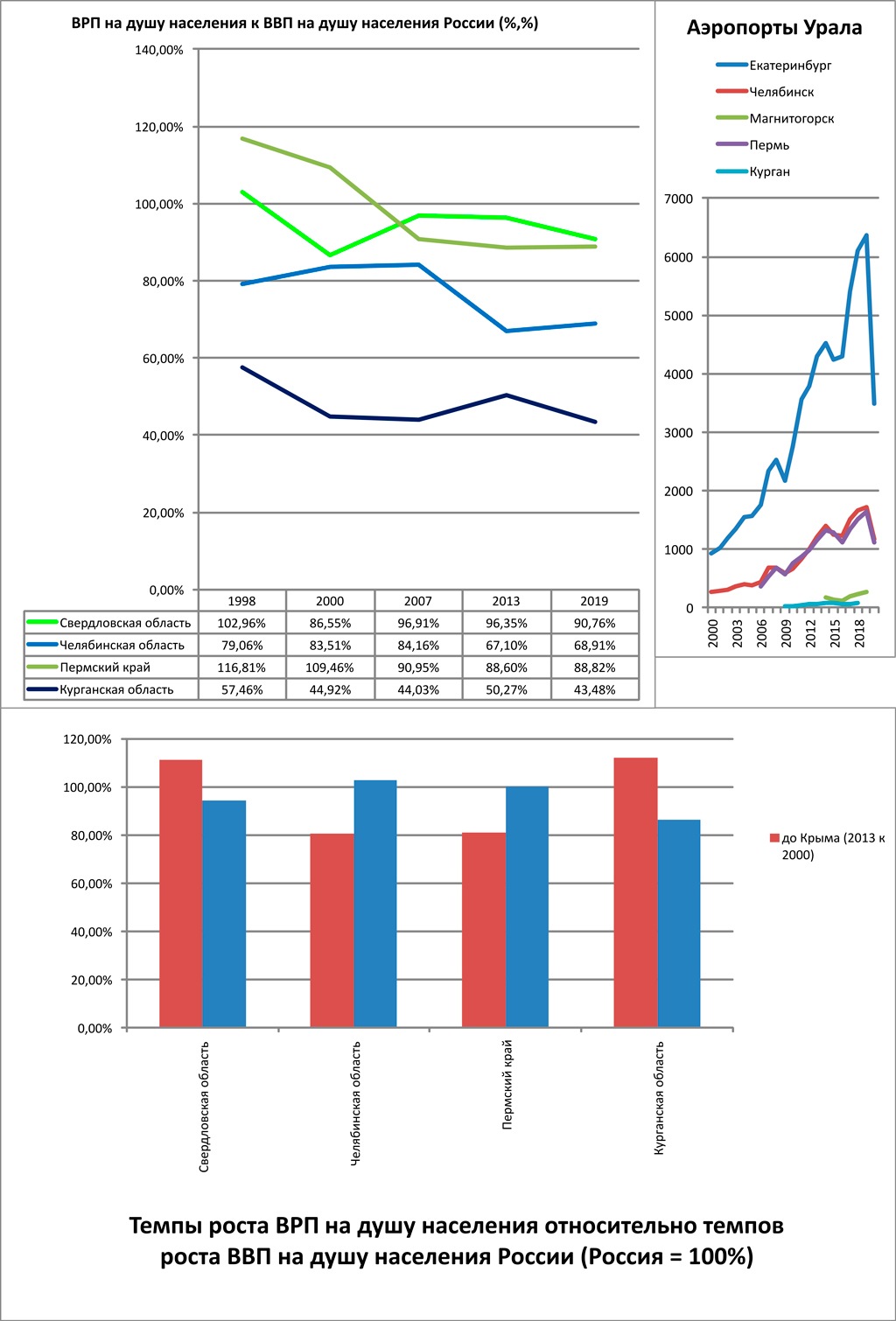
As for the growth rate of the economy, if we look at the period from 2000 to 2013 inclusive (that is, the Plac Putin Russia), we will see that the economy of the Sverdlovsk and Kurgan region developed on average 10% faster than the economy of the country on average. At the same time, the growth rate of shower indicators of the GRP of the Chelyabinsk Region and the Perm Territory were inferior to all -Russian by 20%
Since 2014, the situation has changed exactly the opposite. The growth rate (or fall) of the shower indicators of the economy of the Chelyabinsk region and the Perm Territory become approximately equal to the all -Russian. At the same time, the growth rate of shower indicators of the economy of the Sverdlovsk region is 5% lower than the shower indicators of Russian GDP growth, and the Kurgan - by almost 15%.
If we compare these regions in the nominal GRP per capita with the rest of the world, then this indicators of the Sverdlovsk region and the Perm Territory corresponds to the level of Brazil, Montenegro or Botswana and just below Kazakhstan or Turkey or just above Serbia or Thailand. The shower GRP of the Chelyabinsk region corresponds to the GDP per capita of the population of Colombia or Belarus, and a little higher than South Africa. As for the per capita GRP of the Kurgan region, it corresponds to the level of Armenia, Mongolia or Indonesia. If the Kurgan region were an independent country, then it would be the poorest country in Europe after Ukraine.
As for the development of communications, we see that the Urals, like the whole country, is very immersed in global transport processes. The most vividly illustrated by airports. So, from 2000 to 2019, the passenger turnover of Koltsovo Airport (Yekaterinburg) increased more than 6 times. Currently, outside Moscow and St. Petersburg, Koltsovo is the largest regional airport in the country after Sochi and Novosibirsk-6.3 million passengers in 2019. Large regional airports (22–23 seats) are also large Savino (Perm) Balandino (Chelyabinsk) - about 1.7 million in 2019. In addition, there are two small airports in the region - Magnitogorsk (about a quarter of a million passengers per year) and a mound (about 100 thousand).
Join, ask your questions, subscribe to our channel. We are all only at the beginning of the understanding process.
In the design of the program, photos of Yuri Artyushkin (unknown artist. From the project Unknown Siberia. 1998-2003 were used)