
Translated material
The waters of the world
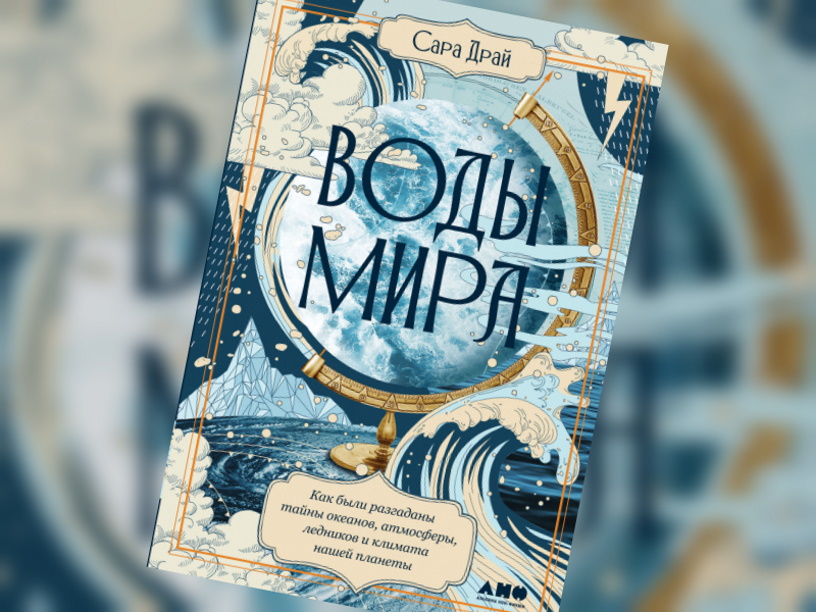
The Alpina Non-Fixes Publishing House represents the book of the writer and historian of science Sarah Drai “The Water of the World. How the secrets of the oceans, atmospheres, glaciers and climate of our planet were solved ”(translation by Irina Evstigneeva).
Sarah Drai tells about people who found out how the climatic mechanisms of the Earth work. The main characters were seven scientists, whose contribution to meteorology and oceanography is still relevant. Among them, John Tyndall, who is considered the father of the science of the climate, the Dane Willy Dalsgord, who discovered the “climate chronicle” in Greenland’s glaciers, Joan Simpson is the first woman who received a doctoral degree in meteorology, and others. The heroes of the book rose to the mountain peaks, flew through thunderclouds and, with a risk to life, went around Cape Horn. Gradually, their discoveries united into a single working theory of the climate of our planet. The book was among the five best books about science for 2019 according to Nature.
We offer to read a fragment of the book.
All these “growth crises” associated with changes in oceanographic practice and new opportunities for studying the ocean on a global scale were mainly internal, reflecting the specific history of oceanography as a scientific discipline and its formation as a physical science of the ocean. But by the beginning of the 1970s. In oceanography, as in meteorology, new external factors came to the fore. The military significance of this science, which ensured its generous financing and prestige during and after the war, gradually gave way to a new important role in studying the problem of climate forecasting. By 1974, it became clear that the changes taking place in the atmosphere of the Earth as a result of increasing the level of carbon dioxide cannot be understood without understanding the oceans. Since by that time the numerical computer models that Rains referred in his article on the role of whirlwinds in the general circulation of the ocean began to play a crucial role in the studies of climatic changes, the oceanographers faced the task of “achieving progress in creating the oceanic part of the model”, as mentioned in the report of the National Council “On the role of the ocean in the prediction of climate”. To coordinate efforts to study the “large -scale interaction of the ocean and the atmosphere (especially those aspects that are associated with the influence of the ocean on the climate)”, a new leading committee was created under the chairmanship of Stommel. At the end of the decade, the National Council on Scientific Research was created by another special committee, which was fame as the Charni Committee, which was instructed to study the possible changes in climate, caused by an increase in the concentration of carbon dioxide in the atmosphere. Stommel was one of the three oceanographers entering this group. In their report, the oceanographers made some assumptions regarding future global average temperatures, and also emphasized that the ocean reaction to atmospheric warming, the problem of absorption of carbon and its thermal memory in many ways remain unexplored.
The desire to understand the role of the ocean as the most important component of the global climatic system coincided in time with the advent of the opportunity to observe the Earth - and the ocean - from the cosmos. The oceanographers have dreamed about this since 1960, when, with the help of Meteorological satellites, Tiros managed to get the first pictures of the cloud cover. If the satellites were able to provide sufficiently accurate measurements of the height of the sea surface (with an accuracy of 50 cm), this would make it possible to correctly display the location of sea currents on the map, since they are warmer than the water surrounding them and appear on the ocean surface. Fifteen years later, that which once seemed to be science fiction, became a reality. In 1975, the geos-3 satellite provided the first full image of the ocean geoid-an uneven surface corresponding to the average level of the waters of the oceans, which he would have if he was only under alternating exposure to earthly gravity and was not exposed to tides, waves and other factors. To make sure of the accuracy of the geosa-3 data, scientists used them to search for the so-called ring with a cold center (vortex), comparing with the data obtained using measuring violet stations in the ocean, aircraft in the sky and infrared (not altimetric) satellite systems from space. In 1978, the special oceanographic satellites of Siasat provided even higher data on the topography of the ocean surface, which discovered the presence of the Gulf Stream.
The new ocean was born thanks to the pictures from space and climatic models, which, with the development of computing technologies, became more accurately due to the fact that the sizes of the cells of the calculated grid that entangled the planet gradually decreased. These models promised to open access to a new source of global knowledge based on physical equations that imitated the behavior of real water. But without data about the ocean, on which these models could be checked and calibrated, the latter could not get closer to reality. Unlike the plush hare [1] , the models, to become real, required not love, but data.
In the same year, when Stommel became the chairman of the Committee on the Study of the Ocean and Atmosphere, the first meeting of the new group called the “Committee on Climate Changes and the Ocean” took place in Miami. The question of the role of the ocean in the formation of the global climate became more and more relevant as scientists gradually came to understand: the climate of the Earth is a global and interconnected system, and the ocean is a critical component. At a meeting in Miami, Karl Vunch said that for a better understanding of the contribution of the ocean to the formation of the climate, it would be nice to at least try to collect data about its global circulation. So there was a soil for a new project, for the first time uniting two groups of researchers, whose fates will continue to be closely intertwined. These two groups were oceanographers that study the oceanic circulation as the problem of the dynamics of the ocean, and the new generation of climatologists (which to some extent inherited the concern of their predecessors with average temperatures), striving to understand what relations the ocean and the atmosphere are in terms of the absorption of anthropogenic carbon dioxide.
Like Mode, the new project was conceived as an experiment - a worldwide experiment on the study of the world ocean (World Ocean Circulation Experiment, Woce). And like Mode, he had to answer a specific, albeit global, question: what is the nature of the circulation of the oceans? The scale of this issue gave rise to another one - regarding the nature of the project itself: could Woce really be carried out as an experiment, if you mean a single event, focused in time and on the process? Or, in order to somehow get closer to the answer to any question about the oceans, the efforts of such a scale were required that Woce was doomed to become a new-fangled version of old-fashioned hydrographic filming, rich in observation and poor on theory?
Stommel preferred to stay away from Woc. The scale of this project scared him, although he always welcomed close cooperation between theorists, developers of models and observers and emphasized its necessity. In the case of Mode, the scale of the project was, in his opinion, optimal. As for more grandiose programs, such as Woce, he was afraid that the interaction between researchers was noticeably formalized. The larger the concept, the more observations need - and the more difficult the organization. Stommel admitted that the format of the Mode project, which, in its expression, was implemented by the “free community of independent people who decided to temporarily unite to build a barn to a neighbor”, is not suitable for testing more large -scale ideas that takes more time. “If you want to participate in one of such long -term and large -scale projects, you, in fact, should become a full -time employee of the construction company. And most of us are not very attractive. We are a little afraid of those long -term obligations that are usually related to such programs. ”
From the first stages of planning the WOCE project and until the analysis of the data collected by him, about 30 years have passed. In the process of this, Woce contributed to the transformation of oceanography. In 1985, the hope was expressed that this project “would provide the first comprehensive global vision of the ocean as an element of the planetary climatic system ... Since the main driving force of the WOCE program is the recognition that the prediction of climatic changes in the ten -year interval will depend on the accurate calculation of changes in large -scale circulation of heat, fresh water and chemical elements in Oceans ". The project completed this task, allowing you to obtain a simplified but functional quantitative assessment of the role of the ocean in the transfer of heat, which could be combined with the same assessment of the atmosphere for creating a model of the climate system of the Earth on a global scale.
No matter how impressive this result is, perhaps the main achievement of the WOCE project was that he clearly demonstrated the entire depth of ignorance of the oceanographers and showed what research programs should be to accumulate the necessary knowledge step by step. Thinking about the future of his scientific discipline in the early 1980s, when the Woce planning, Karl Vunsh and Walter Munk wrote: “Now we can appreciate the scale of the task facing the oceanographers who want to understand how the ocean“ operates ”and hopes to once learn to predict its changes. The ocean is a global liquid environment that is not much different from the atmosphere, and this global system must be observed in the same way - in all significant spatial and temporary scale. ” Conceived as the “instant picture” of the ocean, the Woce project helped to realize the need for a constant global observation program. This was not a return to the previous practice of oceanographic survey, but it was a kind of return to the discipline of regular observation - with one difference: against the background of growing concern about climate change, observation gave way to monitoring. The ocean could no longer be just a place of searching for knowledge (if it has ever been so)-it began to signal the change in the global climate, and these signals had to be carefully monitored.
[1] Here the author has in mind the story for the children of Mardgeri Williams "Plush Hare, or how toys become real." - approx. per.