
Translated material
Mol and moth take revenge!
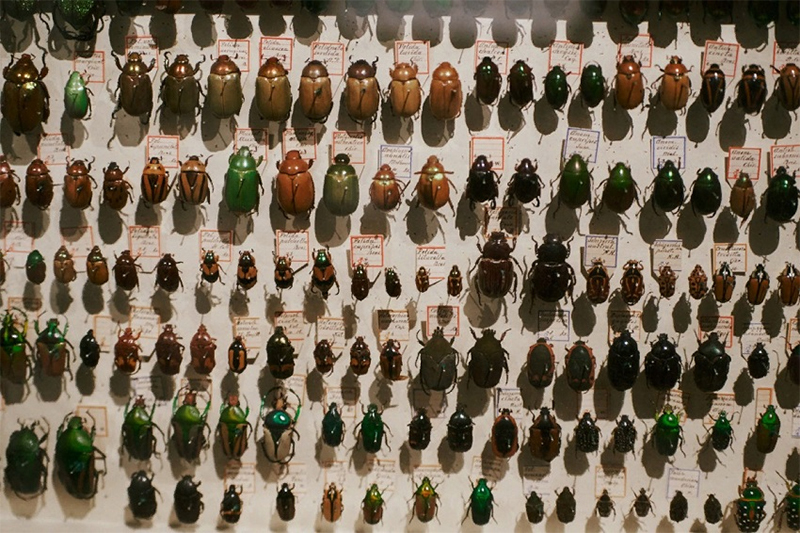
The fictitious worlds of animation, films, comics and advertisements often endow animals with human features: with a straightforward body and gift of speech, or even ingenuity, intelligence. In everyday life, in everyday life, on the contrary, people liken each other to birds, animals or insects, generating “cultural bestiary”. The white crow is not like that or not like everyone else. The hare is a shirt or a coward. The fox is a cunning and flattering deceiver. Pig - dirty, slut. A bear or an elephant in a bowl shop is clumsy. The donkey is a stubborn. Baran is not a very smart person. A worm is a non -insignificance. The bee and ant are hardworking characters. The beetle is a slippery, piercing and jerking type.
From ancient times to the present day, the discourse of culture disciplines animals and insects, endowing them with certain functions, placing in narratives that produce metaphors, allegories and common names. Observing how the process of cognition produces the object of cognition itself in scientific texts or in the literature, the interaction of power-knowledge can be found. This discursive intention constructs an idea of the flora and fauna, more and more incorporating the “animal” in the cultural field and increasingly refusing the “living” in the autonomy of the wild world.
And unexpectedly this summer, the study of the world of flora and fauna in artistic practices has become the method of detecting borders, the manifesto of inclusion and turning to the animal in the living.
A rare exhibition in the context of the domestic art landscape, broadcasting the ethical positions of inclusiveness and research of disciplinary boundaries, took place in St. Petersburg until August 14. The Anna Nova Gallery introduced the viewer to the conceptual exposition of Ilya Fedotov-Fedorov "Moths and a bat and fly into the light." I will not repeat the words of the artist himself: he said in detail how the experience accidentally acquired in Switzerland forms the basis of total installation. The zoo during, as I recall, Lokdown, where the animals stuck into people after some time, led a lonely and “wild” lifestyle. With an increase in the social distance, the model of the behavior of animals and their mood have also changed. Their other, their enemy and friend, guest, their host and ghost disappeared (the work of the Derridian Semiotic field is important here - Ghost , Host ...).
And now - two stories as a visit to the exhibition.
History is the first : it is in Paris. Grows moths. Lives with them in the same room, making his gender transition, accompanied by hormone therapy. Once she notices how a moth shows an interest in a forgotten ampoule with hormones, trying to feel and drink the remains from the bottom with a barely noticeable proboscis. Moths are a metaphor of metamorphosis: having passed the condition of the larva, caterpillars, dolls, it now rushes to another - hormonal - transformation. The world of nature involves mutations within the framework of one species; Moth practices permanent reincarnation, changing its body, its essence.
The second story : during one experiment, the bat was completely painted blue, after which they returned to ordinary, unreleased bats. The latter simply ignored the “blue” individual, as if not noticing it. Then they put a mouse to them, in which only one wing was painted. And here - aggression broke out. Partial recognition in half with differentness in the individuals of their species annoyed and disturbed by the mice, forcing them to destroy the “mistake” in the relatives. The level of tolerance sought to zero.
Both of these stories are directly related to the experiment, the process of which is presented in the gallery in the form of diverse art practices.
The Fedotov-Fedorov project is a synthetic study, and this is, in fact, his bewitching fascination with the viewer. This is the intrigue. The project affects several areas: zoology, zoopsychology, anthropology, engineering, physiology, anthropogenesis. Its theoretical frame at the junction of the optics of Michel Foucault, Georgio Agamben, Rosie Brydotti and the Presiado fields: partially built by the curator, it partially formed within my audience perception is also interesting.
Ilya Fedotov-Fedorov. Fragment of the video from the exhibition "Beetles and caterpillars. Insect culture "
© Ilya Fedotov-Fedorov 1920s-1940s
All details and parts of the exhibition are mounted in a single field, the topic of which is different. The other is like an animal. The other as a radical otherness, external and internal. Another as a permanent process of mutations and transformations of a biological body: inside the species, inside the individual. The exhibition-and in this its originality-shows how differentness in front of our eyes unfolds and mutates at different levels in a whole series of plots, genres and types of art: in objects, video art, sound art and performance.
The exposition includes several experiments that comprehend the themes of the flora, fauna and bodily uncertainty. Part of the space is occupied by a platform for Vogue -Tanzorov . This dance direction became part of the Harlem Renaissance and appeared in the 1960s-1980s among African American and Latin American Drag Queen and homosexuals, which copied the poses and appearance of models from glossy magazines.
The broken choreography of the dance performance refers to the delinquency of the animals - through certain body techniques. Through this detection and study of the borders of the Gender and his representations, the path of communication with another is planned. The multiple differentness of the dance traces through plastic movement the path, mutation and formation of a body that experiences and living metamorphosis, which break or erase the boundaries of the social and biological.
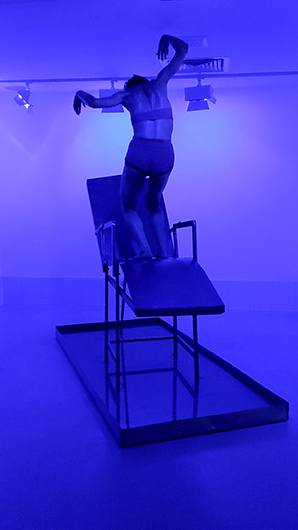 © Valeria Kosyakova Ilya Fedotov-Fedorov. Frame from the video from the exhibition "Moths and bat fly into the light" in the Anna Nova gallery
The performance of the performance unfolds in the empty atmosphere of the hall filled with anxious cold light. The body of the workshop seems to study the environment of its sudden habitat - without a clear understanding of patterns of action and knowledge of space. The costume marks the gender neutrality of the body: each, each and at the same time no one becomes actors gaining biskets. The chair is associated with medical discourse, where the subject is no longer in power over his body - from the gynecological chair to the dentist’s chair and, finally, to an electric chair. Dispositive structures set the norm of behavior of bodies, the rules for their operation and content. Nietzsche broadcast with the mouths of Zarathustra: "The state is called the coldest of all cold monsters." And this cold monster, a cold discourse of power is opposed to a living Dionysian body with all its lively and fragile pulsation.
The metap of the exhibition is associated with the image of androggin. Videoart shows a creature that moves, mutates and lives through its body in a whitish, becoming identical, in non -warity and gender neutrality. It exists alone with itself - without role -playing models, behavioral patterns and language frames. And this is the lack of social strata, frames and clusters (designed to design identity, self -reflection, self -conformation, edipal complexes, mirrors, etc.) is expressed through plastic movement, visual series and color.
Scientific discourse sets the boundaries of understanding the norms of the body and its behavior; Catalogization, marking and medical intervention determine the hierarchy system. The artistic study of Fedotov-Fedorov is aimed at finding a new language, or rather, other visual epistemology, which absorbs many (excluded) living forms/creatures and does not limit the body of a reproductive function.
Videoart - one of the central forms of exposition - problematizes the idea of stream, biological bodily, its objectification under the supervision of the camera, and in the end it calls into question the methods of scientific knowledge itself. The practice of decolonization of the body becomes the very light that an animal can open to a person - despite the fact that a person continues to think and determine the environment of his habitat in economic and political categories, in the context of capture, enslavement, use of bodies and matters.
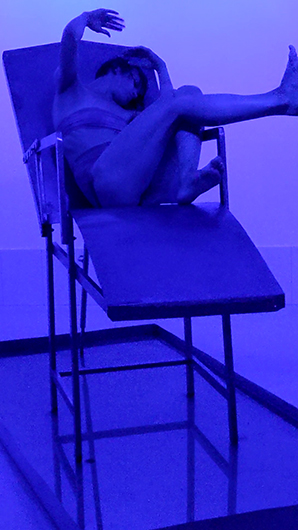 © Valeria Kosyakova Ilya Fedotov-Fedorov. Frame from the video from the exhibition "Moths and bat fly into the light" in the Anna Nova gallery
Scarecrow, naphthalene, harsh glass windows, glass eyes at the stuffed birds, Soviet handwriting in organizing exhibition space and excursions for children - usually such a set of associations causes the exhibition space of the Darwin Museum. The conservative zone of taxidermist reports on the colonial ambitions of man: submission, study, rationalization of nature. But what if, through a latent intervention, to introduce objects into this space that pose questions to the logic of the old museum?
Two Moscow exhibitions echo with the study of Fedotov-Fedorov. One, under the name "Museum of Artificial History" , takes place until September 12 at the Moscow Darwin Museum. The exposition-the result of the work of the joint master program of the Garage Museum and the Higher School of Economics-is a project to combine contemporary artists in a single space of work with the exhibits of the museum, once alive, and now artificial objects of natural-scientific interest and research.
The viewer is offered a museum quest traverse for various methods, reasons and principles of collecting art objects and (not) living beings. A fictitious or fictitious museum proposes to join the game interaction mode: in the near future, a neural network created to collect and process data on bioenginery and genetics, by random error, combines artifacts and living creatures. Thus, the museum space is reinstalled, completely turning into a total installation. Scarecrow foxes is a stuffed or an art object ? A giant skeleton -like mask hanging under the ceiling - what is it: the object found by the anthropologist or installation?
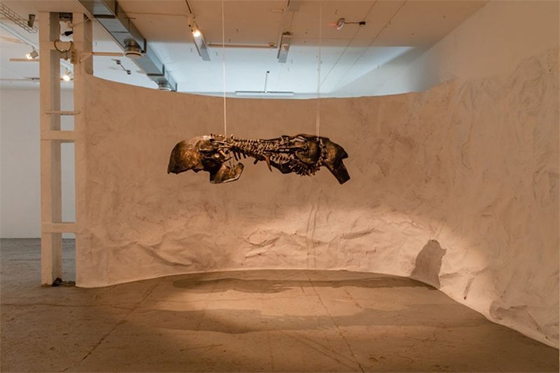 © TVC Makaronka Masha Bogoraz. "Mask". 2019
The works of artists in the circle of natural science exhibits strangely shift the differences between fundamentally different objects. This contact appeals to the logic of the formation of a common discursive field - to institutional practices for selecting works, their exhibiting and classification. By deducting the catalog of the cataloging set by museum practices, proximity and community between the sphere of art and the environment of biological objects are found.
These problems are developing the works of Maria Simun and Ilya Fedotova-Fedorova, whose short films are presented in the museum cinema. The film "Butterfly and bat run away from a fairy tale" Ilya shot specifically for the exhibition in the funds of the Darwin Museum. In this video work, a rare hero becomes a moth-a thunderstorm and an enemy of funds that destroys objects faster than time! It is customary to systematically overtake insects. But what if the mol becomes a full museum employee, which is partly?
If in the video installations for the Anna Nova Motylek gallery - the image of the gender transition and intraspecific tolerance, then the story in the Darwin Museum makes us recall intolerance in relation to certain types. A person often corrected the course of natural selection, extoling and preserving those species that he considered “beautiful”, pushing the rest into the background or getting rid of them at all. The similar logic of couthes (from the English. Cute - “cute”) can also be extrapolating to the choice of museum objects: what paintings, arts of art or the natural world are worthy of exhibiting, and which are not? On what basis?
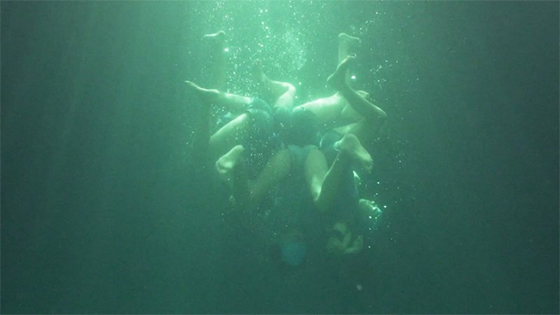 © MIRIAM Simun Miriam Simun. Fragment from the video "Your need to breathe - lies." 2017–2020
The principles on which the work of “classic” museum institutions is based on were formed in parallel with the colonial attitudes of Eurocentric culture and reflected the installations of a more global level associated with the state and its principles of segregation of objects and bodies. Therefore, in my opinion, exhibition projects based on the study of the relationship of the world of people and the natural world due to the intake of removal (as in the “holster” of Leo Tolstoy) make both the structures of social conflicts and the degree of alienation of a person from the ecosystem. The image of the “nature”, looking at us from the pages of biology textbooks, from landscapes and still lifes, from the windows of museums, acquired the features of emasculated domesticity, adjustment, and research. The “strangeness” and “wildness” of the world of nature lying outside the borders of everyday spectator experience indicate another that a person is involved, being a biological being. Artistic statements in this case can become the experience of Mayevtics of detecting the nature of otherness.
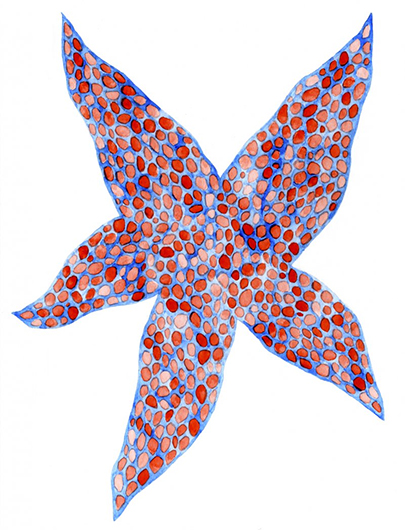 © Ksenia Kadrova Ksenia Kadrova. From the series "Zoofita". 2021
The third perspective of the topic is the exhibition “Beetles and caterpillars. The insect culture of the 1920s-1940s ” , which until October 10 works in the Moscow Gallery“ On Shabolovka ”. Here, the search for another, living and animal, is carried out not only (and not so much) as the practice of understanding otherness (fully and exhaustingly demonstrated and revealed by the expositions of the Darwin Museum and the St. Petersburg Gallery), but also as an algorithm for detecting, definition and nomination of this very differentness in the status of adversary, compromise and the world with which are impossible already impossible Principly.
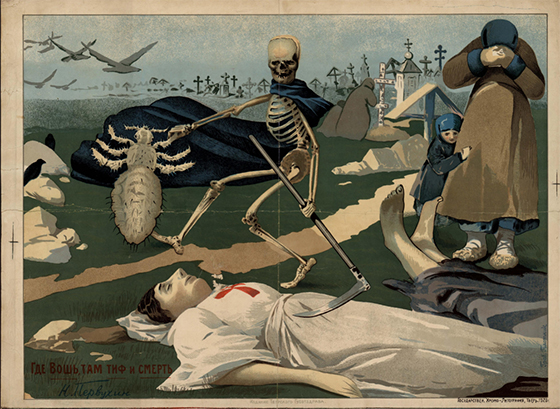 © RSGB N. Pervukhin. The poster is "where the louse is, there is typhoid and death." Tver: Gubotstrav. 1920
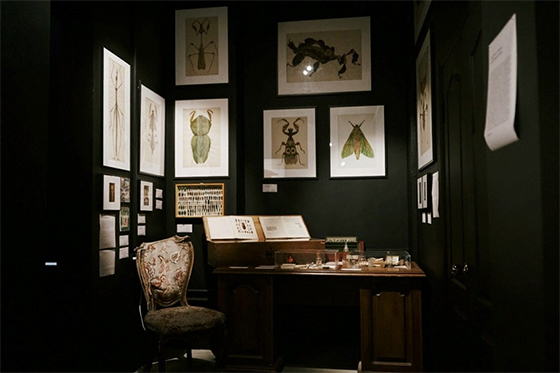
The propaganda apparatus and satire in different eras used images of animals and insects in visual political rhetoric: campaigns and agitation, posters and encouraging speeches, caricatures and social advertising - especially intensively between the first and Second World War. In modernism, the natural world is nominated and stigmatized as hostile, marginal, different, another: it must be broken, subordinate and defeated for the sake of culture and future person. The projection on a person of natural and natural images as a negative, hostile and marginal one involved the identification of the non -insanity zone in every citizen and every civilian, cleaning and annihilation of this zone. Despite the chamberity, the exhibition is versatile to images of insects in early Soviet propaganda and graphics - from newspapers, magazines and a poster to book illustrations - and makes the scope with which the discourse of power and culture repressed the natural environment, and after it and its negligent child - man.
 © Valeria Kosyakova
On the new wave of current pandemia, all three exhibitions are updating the topics of borders and restrictions. They explore the living and animal in different angles and optics, with different theoretical prerequisites, but always as a subject of colonization and repression, whether it is the exploitation of a person, animal or natural resources - or the use of the image of an insect or animal as an allegory, metaphor, and symbol. The biological becomes a resource for the economy, politics, ideology, scientific discourse, finally obeying the logic of large narratives and education. Is it possible to say that such a practice of systemic operation of a living or animal simultaneously emancipates it, inevitably bringing closer and overcoming alienation, and the possibility of accepting otherness by the world and society?