
Translated material
"Clay" of hatred
What is wrong with the sculpture of Urs Fisher?
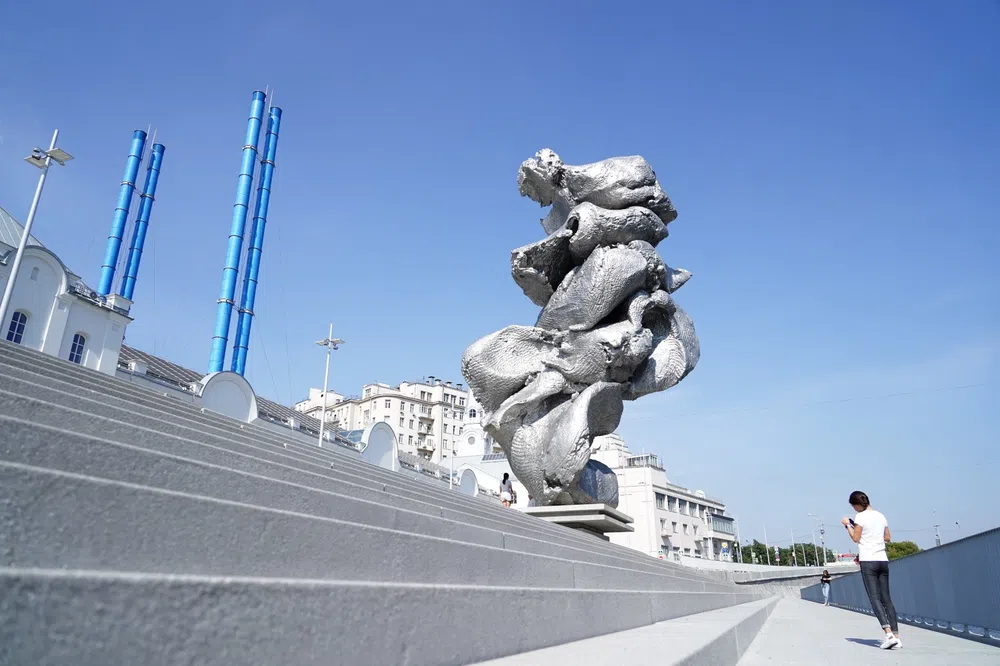
Recently, a huge sculpture appeared on the Swamp Embankment in Moscow, depicting ... Well, everyone can decide what it portrays. Its author, the famous Swiss artist of the URS Fisher, gave the work the name "Big Clay No. 4". Judging by art history descriptions, this is a monument to the artist’s creative thought. Here the sculptor thinks, wrinkles clay, tears it into pieces, folds these pieces together, and at that time something is born in his imagination. And this clay, necessary, in essence, only in order to pull something in your hands, while you think, a huge monument from metal is erected.
By the way, I perceive this sculpture is wrong. It seems to me that this is a cliff -washed with the winds. There are such - even in Crimea, even off the coast of Sardinia. This is a kind of reminder of the romanticism we have lost and a reference to the origins. And then the stones of the city no longer remember where they came from. Even the strips distinguishable on the surface of the metal - fingerprints of the artist - do not prevent me from seeing this.
But most Muscovites, as it turned out, see something completely different here. And specifically - excrement. Here are a bunch of excrement. By the way, I am sure that not that the artist did not lay such an opportunity into his work. Fisher is generally inclined to play with this topic. A few years ago, at the exhibition at the Garage Museum showed its object - a toilet filled with beautiful fruits, because no matter what wonderful things we eat, they will still be there.
Provocation (and Fisher is a master of this business) requires at least two participants. One provokes - the other provokes. Only then does it work. In the person of users of domestic social networks, Fisher received the public extremely grateful.
Blogs burst out with three -story curses and ridicule. The Russian reaction turned out to be much more malicious than the reaction, for example, residents of Florence, where this sculpture stood right on the square near Palazzo Veckio next to David Michelangelo (well, with its copy). It cannot be said, of course, that the Italians somehow loved her especially, but in the rejection competitions we definitely defeated them-some city activists are already collecting like-minded people for protests.
The architectural critic Grigory Revzin said in an interview that our sculpture Fisher became a monument to "unity in hatred that we pour into the pages of social networks." In his blog, he added that “any sculpture causes such anger at all: it doesn’t matter whether it is Vladimir, Kalashnikov, the Rzhevsky monument or the modest monument to Samuel Yakovlevich Marshak on Lyalina Square, which was able to kill the public in the bud”.
An important point is forgotten in this list of protesting statues - a monument to Peter the First work of Zurab Tsereteli. Namely, it is adjacent to the Fisher object on the Bolotnaya embankment. Almost like with the statue of David in Florence.
But if David has opposed this very “clay” (like the whole surrounding revival architecture), then with Peter they constitute a certain co -dependent hollow. Peter does not contrast with the sculpture of Fisher, but rather supports and thereby stunes it. It seems that well, Okay, since the outrage was possible - perhaps this.
It was established (by the way, not forever-this is a temporary exhibition) excited all the object in the territory belonging to the Center for Contemporary Art of the GEC-2, which is engaged in the VAC Foundation, created by Leonid Michelson. There is no doubt that the leaders of the Center were aware of this gesture as a provocative, but still, I think, such an almost universal embittered reaction is not what they wanted. Art critic Dmitry Pilikin wrote that the whole point is that VAC was late. “They built their center to prove that Russia is part of Europe and nothing happened. Alas, it happened, and we are going to reserve for a new iron curtain and further. ”
It seems to me that the point is not so much late, but rather in the special isolationism of our cultural institutions and some part of the cultural public.
There is a well -known joke about how a Jew tells a friend that he found a wallet on Saturday on the road, but could not raise it, since this is prohibited on Saturday day. “But I prayed,” he continues, “and the Lord created a miracle: there was Saturday around, and I have Thursday.”
For the time being, many of us tried to live in this mind that we can create Thursday around us. That the context can be if not won, then extend. Or at least not notice. Such a territory of Thursday was, for example, Gorky Park, when it was made by Sergey Kapkov, or the famous Moscow space "Yama", until it was overlaid with fences and auto -zats.
But no, the context cannot be ignored. And in the context of today and today's Moscow, the “Big Clay” does not tickle our aesthetic feeling, as planned, does not allow us to feel anything new (even a new discomfort), but only slightly increases the usual injury to the Muscovite, which arose on the basis of urban monuments. The sculpture fainly becomes in a row and so hated items.
And to analyze that “this is another”, there is no longer forces.