
Translated material
Escape from Kabul. Evidence of an eyewitness
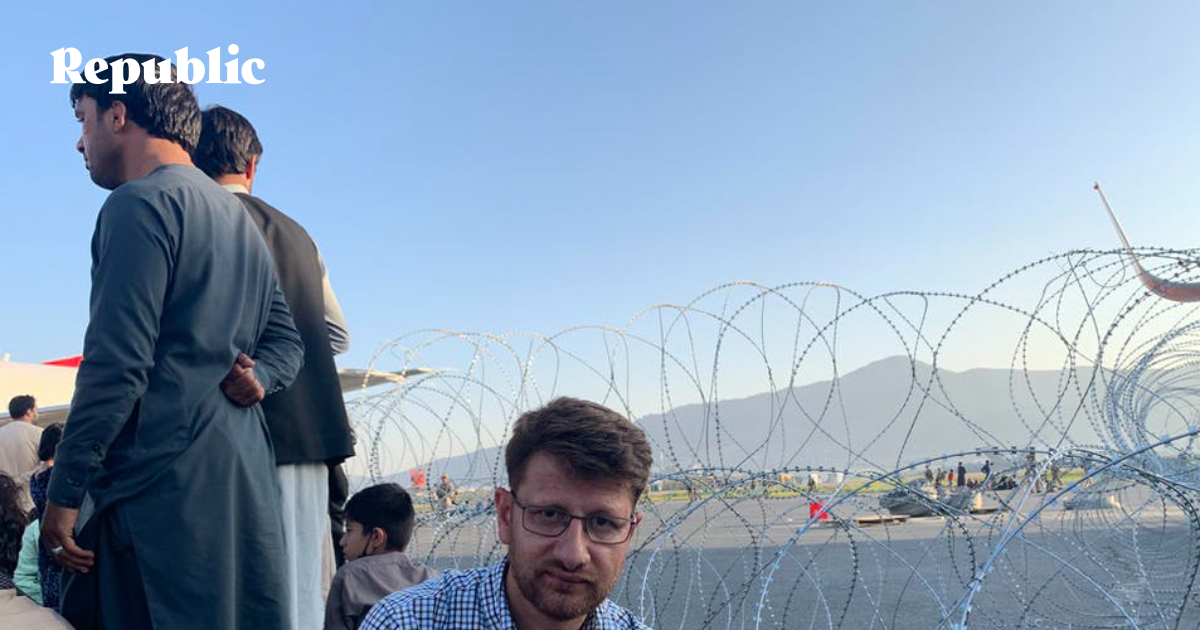
The Afghan economist and former government official Hanif Sufizada, now working in the Center for Afghan Studies of the University of Nebraski in Omaha, ended up in Kabul during the chaos during the withdrawal of US troops, when thousands of Afghans rushed to the airport, trying to find a way to get out of the country.
In a letter to the editorial office of The Conversation , with whom Sufizada constantly cooperates, he told how he managed to leave Afghanistan, overcoming many “unthinkable and completely irrational” obstacles-and this despite the fact that he has a Green Card (a residence permit in the USA) and he and his family have been living in Omakh for a long time.
This letter was published as a column in The Conversation . With the kind permission of the author and the magazine, we publish in the public domain the translation of this text with small abbreviations.
Important: all materials of The Conversation are published on Creative Commons, that is, they can be freely posted in other media or social networks, provided that they maintain complete access to the text and compliance with the regional rules . However, the rights to the Russian translation of the text are completely behind the translator and magazine “Republic. Books ".
Tuesday, August 17, Qatar
I was in Kabul when all this chaos erupted. On Sunday, August 15, that is, just on the day when the Taliban entered Kabul, I went to the airport, but I was soon confused because I could not find American responsible persons who should help me with evacuation.
On the way, of course, I drove to the US Embassy, but there was no one there, because all the employees moved to the territory of the Hamida Karzai International Airport, and the embassy was now working there. I was terribly tired and was very afraid that I would not have time to get to the airport before the Taliban completely captures the city.
Since I have already filled out in advance the online form of the evacuation request, I had to meet someone from the evacuation team to explain my case. But when I got to the gates of the airport, there was a full chaos. It was said that only one civilian aircraft remained, but he was told exclusively for the evacuation of Afghan officials. Even some passengers with existing tickets in their hands were refused a passage to the airport: as we suspected, several senior officials took their places on the plane.
The rest, including me, were shocked and terribly scared by the way the situation developed. For more than two hours I tried to find at least one of the Americans. Thanks to some employee of the airport who told me where the American soldiers were located, after several hours of waiting and the hustle and bustle, I finally found an American soldier and begged him to help me with evacuation. He actually agreed to help me, but at first they had to check me.
However, after some time desperate people who wanted to escape from the Taliban and still stood peacefully in line at the gate, began to push the fence with the whole crowd, begging American soldiers for help, and eventually broke into the field. Of course, they immediately forgot about me, because the soldiers had to pacify an uncontrollable crowd. In the end, everyone was sent back for the fence, but I lost my place in line, to which I had to stand for nine hours. I did not sleep all night and begged the passing soldiers to allow me to evacuate, because I have the current Green Card of the United States. But no one wanted to listen, and we all did not sleep all night until the morning.
Hungry, dying with thirst, tired and frightened, we, along with two other Afghans (one with a German passport, the other with the British), wandered along the fence in despair, almost losing hope of evacuating. I turned to everyone in a row for help, but the situation was so chaotic that no one even heard us, because everyone thought that we were just a part of the crowd that wants to break through to airplanes. From time to time, shooting suddenly began.
Finally, I managed to talk with one of the marine infantrymen who guarded the flight field, and explain that we have current documents of the United States, Germany and Great Britain, that is, we have the right to evacuation (my new comrades also turned to their embassies before, but also did not receive any help). I showed the soldier Green Card and documents proving that I was working at the University of the United States. Having looked at our documents, he finally gave us the green light and allowed us to separate from the crowd and go to the northern gates of the airport - the moment of great relief for all of us three. It was already at about 16:00 on Monday.
Here we broke up with my comrades who were to fly on a commercial flight of British airlines, and I was missed into the territory of the American air base at Hamida Karzai International Airport and ordered to wait for the US Air Force transport aircraft.
Then another nine still sleepless hours, landing on the plane, take off-and at 5:30 a.m. on Tuesday we arrived at the El Udeid air base in Qatar. Now that I am writing this letter, I am still in Qatar in anticipation of a flight to Kuwait, from where I finally go to Washington, and then to Omaha. But I need to get some more additional permission to enter the United States. All this is such torment.
I am terribly tired and feel nothing but a feeling of complete helplessness. But I try to think only that my children in Omakh are waiting for me, that I am returning home and that I am happy, that we are all safe from the Taliban.
Translated by Valentin Linev
What else to read:
Night before the reform. Egor Gaidar and the financial collapse of the Soviet Union .
According to the Trans -Siberian Railway to Moscow in 2035. Essays from the collection "Russia-2050. Utopias and forecasts. "