
Translated material
Cut the window to Europe
Why Alexander Nevsky was chosen for the role of a cult figure even under Ivan the Terrible
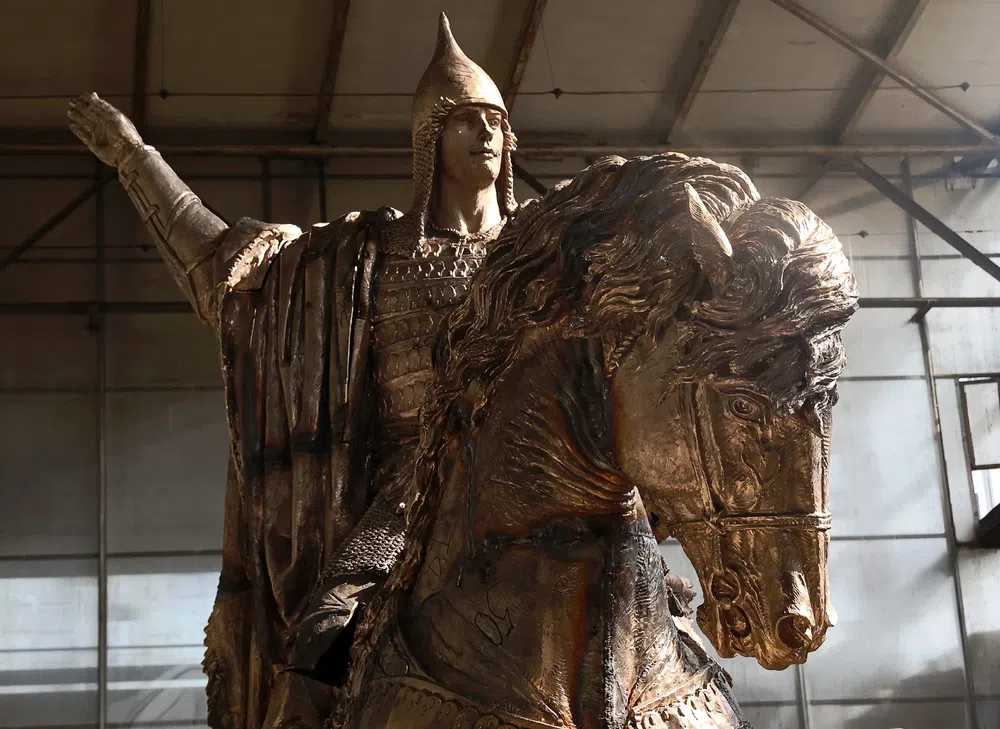
The ghost wanders around Russia, the ghost of the Inquisition. He spoke about the Russian medieval prince without proper trepidation and reverence - get an invitation to the investigator. So, the historian Sergei Chernyshov had to explain to the investigator about the publication on Facebook, in which he wrote that Alexander Nevsky was a “collaborator” and “ sold to the conquerors for status”.
But why did the investigator be interested in the opinion of Chernyshov, and not this statement about the relations of Alexander Nevsky with Tatar-Mongols?
“Unlike his son Vasily, the brother of Andrei, other relatives who headed rebellions against the Horde, Alexander considered it impossible, and preferred to extinguish local unrest on his own - that is, before the Mongols arrived, thus speaking on their side. Did this mean pragmatism or devotion to the conquerors not for fear, but for conscience ? ”
This is TASS's opinion from 05/13/2021 about the same
Historical reality: Nevsky received a label to reign from the Horde, and he suppressed his rebellions against the Tatars mercilessly, actually playing the role of their governor.
Soon after this statement, TASS published the words of Vladimir Medinsky, who called the prince "a pillar on which the spirit of the nation stands." The assistant to the president, who considers the Russian Middle Ages, the front line of the information war with the West, emphasized that the memory of the medieval prince is important for Russian ideology. According to TASS , "one of the most amazing and unfair myths, according to Medinsky, is that Nevsky was supposedly a collaborator and served as a Golden Horde, although the prince went to the khan only with a diplomatic mission."
And indeed, if we follow historical facts and admit that the prince “walked under the yoke”, then that so large-scale is celebrated in connection with his 800th anniversary? Russian news is full of the Middle Ages, as if Nevsky received a label for a great reign from the modern Kremlin.
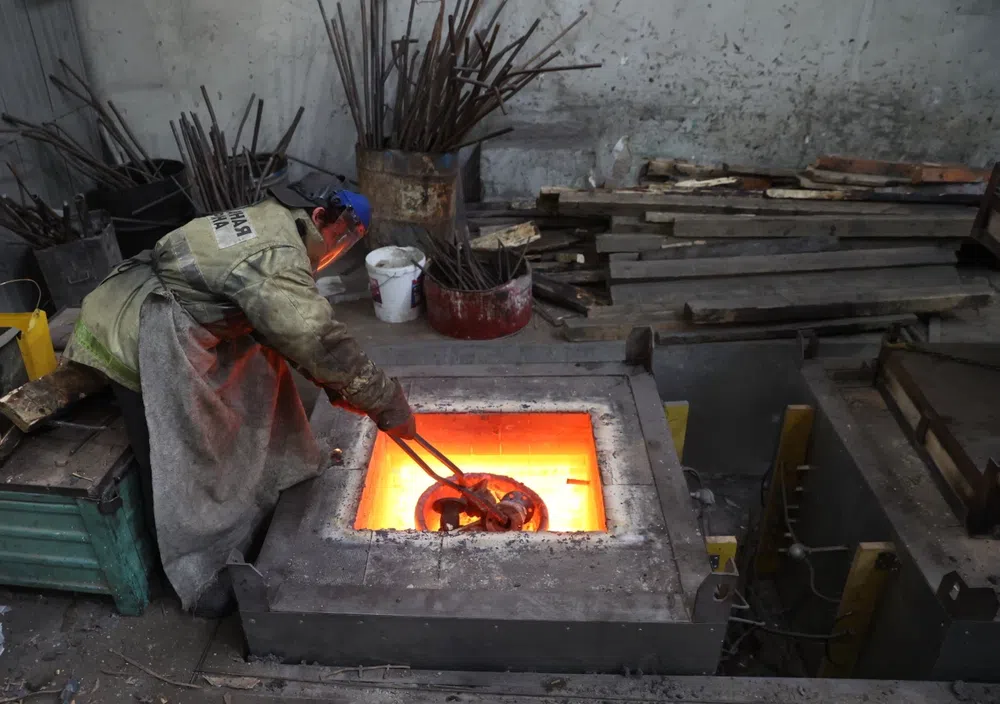
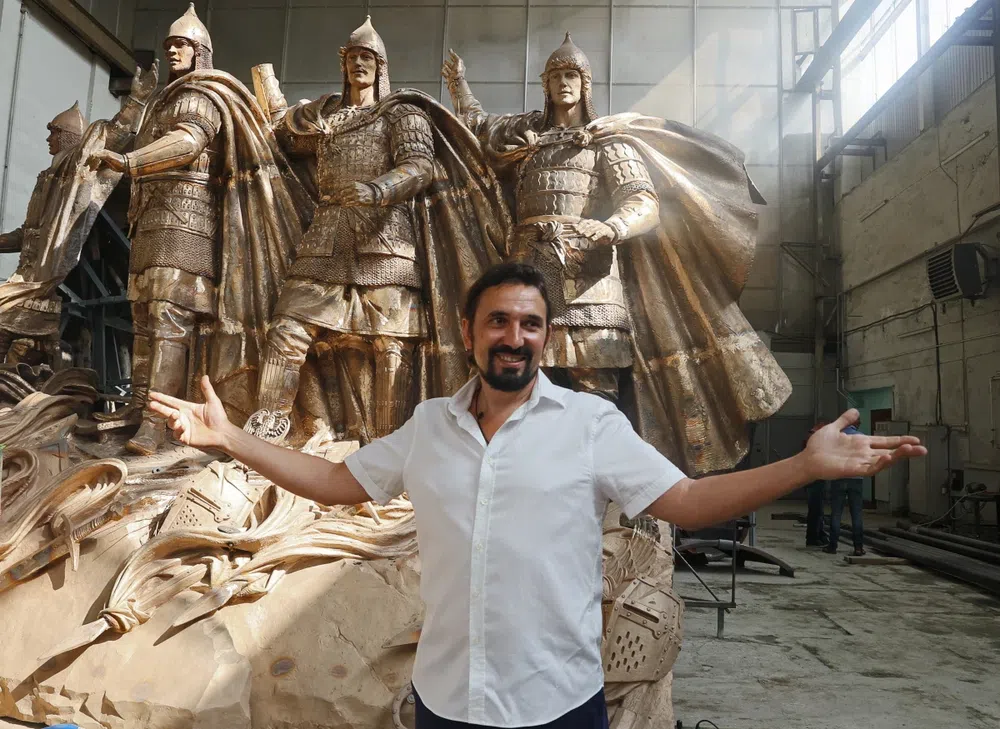
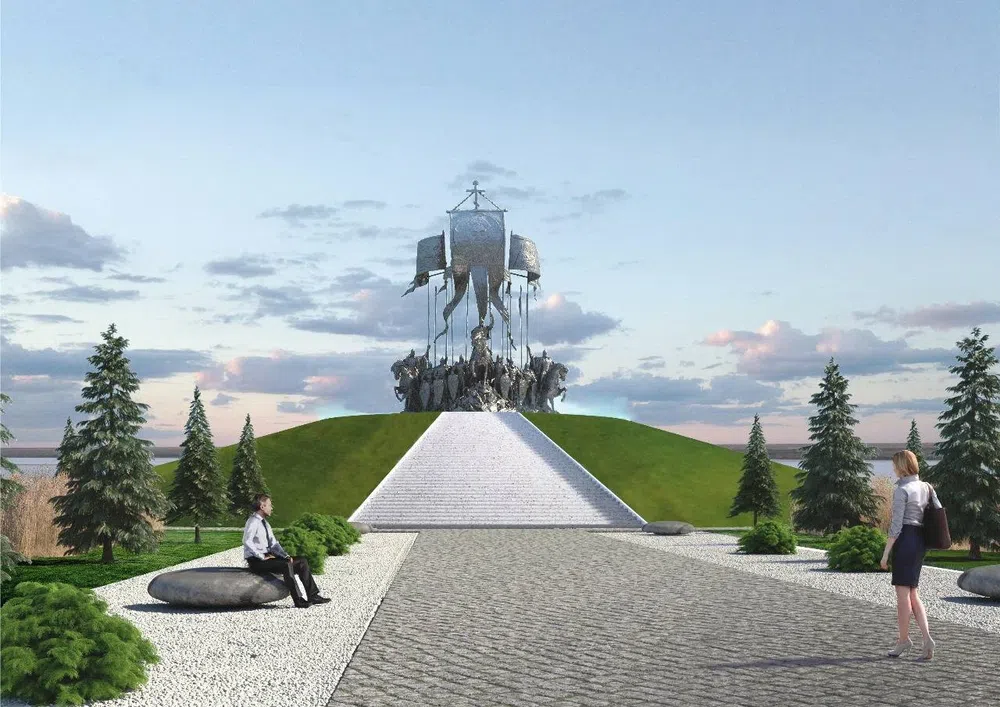
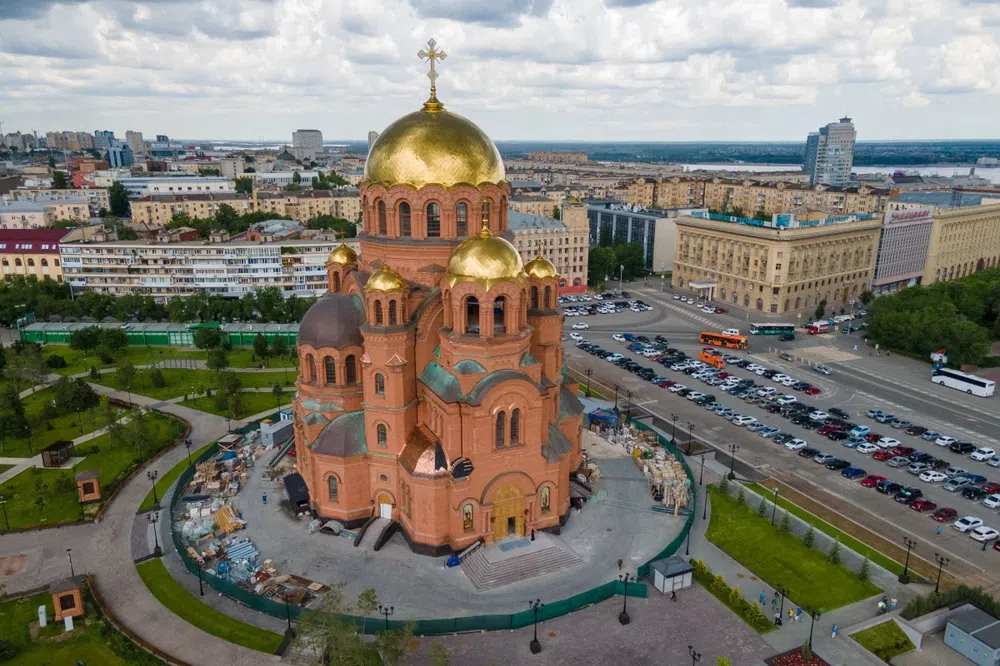
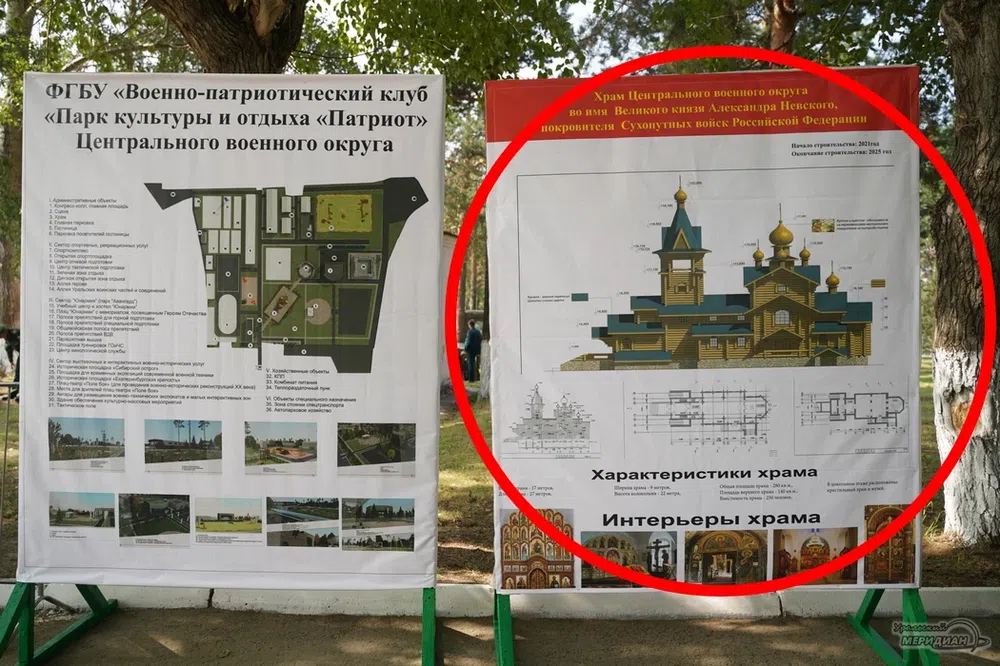
Recent initiatives related to his memory are impressive. In Khimki, only (08/18/2021) was held “Press Speech of the control assembly of sculptures of the memorial complex“ Prince Alexander Nevsky with a squad ”. The memorial of a 30-meter height with the same name threaten to open under the GDOU-with a special purpose, so that it is "visible in Estonia." The reconstruction of the Church in Volgograd dedicated to St. Alexander Nevsky continues. In Verkhnyaya Pyshma they build "a military temple in the name of the Grand Duke Alexander Nevsky."
Where there was not enough stone and stone, local authorities glorify the prince "in alliance with the creative intelligentsia." In Yekaterinburg, the multimedia exhibition "Alexander Nevsky. The fate of Russia ”is in the historical park“ Russia is my story ”. The press service of the Ministry of Sports of the Moscow Region reports that the show-operator “Alexander Nevsky” will be represented as part of the fifth festival of the peoples of Russia and the countries of Eurasia “Russian World”. In Astrakhan, in honor of the 800th anniversary of Alexander Nevsky, they will fulfill the cantata, in Veliky Novgorod the premiere of the play “Alexander Nevsky. The birth of a warrior ”, in Kamensk-Uralsky celebrates the 800th anniversary of their“ heavenly patron ”, in the Yaroslavl region“ reconstruction of the equestrian campaign of Alexander Nevsky ”will begin, and the exhibition“ Alexander Nevsky: Legend of the Holy ”will open in Vladimir. For December, an exhibition “Alexander Nevsky: Legend of the Hero” at the State Museum of the History of St. Petersburg was scheduled. And at the same time - the international conference "Alexander Nevsky in the historical memory of Russia." Participants of the June International Forum “History for the Future: Alexander Nevsky” even received a telegram from Putin, in which he called Nevsky the “great son of the Fatherland” and stated that “the solemn celebration of the anniversary of our outstanding compatriot ... strengthens the connection of times and generations, serves the patriotic education of youth, testifies to the sincere, growing interest of citizens in the history ancestors ".
Why are the Nevsky of the Russian authorities so dear? How did it happen that he became such an important figure in the Russian policy of memory?
It is clear that the prince gives the respectability and political legitimacy of modern power than for obvious reasons she should not be scattered. But ideologists of the current regime are not the first to use the cult of Alexander Nevsky.
Ivan the Terrible created the all -Russian cult of the Nevsky, then the local saint, to legitimize his own power. Under the Romanovs, the cult of Nevsky acquired imperial sound. It was used by Peter to consecrate his new capital, where the relics of the saint were transferred. The genuine militaristic scope of this cult was especially evident in 1938 thanks to Eisenstein’s film, in which an atheistically -minded Novgorod prince smashes religious fanatics - Western intervention. During the Second World War, Nevsky lifted Stalin to the shield, calling on in November 1941 the soldiers leaving for the front to be inspired by his example. The fact that the decision to celebrate the 800th anniversary of the prince was made in the year of the annexation of Crimea also fits into this imperial context.
The opportunity to connect the saint with anti -Western policy is an important bonus of his image. This is how she was meaningful by Patriarch Kirill in 2017: “Those who tried to control Russia from the east were interested in our wallets, and those who tried to control from the West were our souls. <...> As a result of the Horde captivity, Rus' did not lose its identity, it did not lose its faith, did not even lose its state structure. ” [On the contrary, due to the arrival of the crusaders] Russia as a historical, cultural, spiritual phenomenon would cease to exist. ”
However, the causes of today's popularity of Alexander Nevsky are not reduced to this. His ascent on the post -Soviet horizon began with the commemorative contest “Name of Russia”, the counting commission of which was Nikita Mikhalkov. It was then that Alexander Nevsky first fulfilled the function of the screen, for which the activity of the ultra -right, who had almost “broken” Stalin into the absolute leaders of the competition, was hidden. The prince helped to avoid the scandal, which proved his potential. And the authorities looked at him in a new way, although her genuine sympathies were, of course, on the side of Stalin: the restalization campaign was gaining momentum.
Of course, Ivan the Terrible, of course, was Ivan the Terrible, who had been PR over the past decade in bronze, stone, and in words.
But the creation of the Terrible cult came across resistance and did not go as triumphantly as the authorities would like: the inhabitants of Alexandrovo, Kazan, Astrakhan and even Ruza resisted the installation of monuments.
Not to mention the number of publications and protests from the opposition community. Therefore, as it has repeatedly happened in recent years, the authorities temporarily retreated - of course, not in order to completely abandon their memory policy.
Nevsky grew up in a full -scale post -Soviet hero, when he was aware of as a way to promote that system of ideas about society and rights - or rather, lawlessness - the individuals that Russian nationalists call the "new medieval".
Today, Alexander Nevsky, a serious propaganda task is connected with Alexander Nevsky: around the “pillar”, on which the spirit of the nation is “standing, it is necessary to create a new pseudo -memorial construct, including Stalin and Terrible. Here is how the director of the St. Petersburg Institute of History of the Russian Academy of Sciences, corresponding member of the Russian Academy of Sciences, Alexei Sirenov, interpreted this function of the Alexander Nevsky: “If you remember, Stalin has long held in the leaders [sociological polls]. And it was a real social conflict. Alexander Nevsky is a consensus zone. This figure does not cause fierce controversy. <...> He is encoded in our memory. "
The prince is designed to unite those who long for the reconstruction of the empire personified by Stalin, and those who dream of the authoritarianism of the quasi-medium-type, embodied in Ivan the Terrible, but not mentioning them directly. But their shadows lurk behind the princely back. In this “consensus” the sanctity of the prince should add positive, and his battles with the “dogs-people”-political acuity. So neo -Medievalism - a historical policy based on the denial of the values of democracy and the glorification of authoritarianism under the guise of the Middle Ages - is gaining the advance of Russian ideology before our eyes.