
Translated material
"ER" with them
As “United Russia” with small forces seized municipal power in the country: the study of the “new” and the project “Elections of Russia”
In addition to the elections to the State Duma in a number of regions of Russia on September 19, municipal deputies will also be elected. On the eve of the New Gazeta election, together with the journalist Data Alexander Bogachev, she conducted a study of the state of affairs in local authorities and came to disappointing results: at the moment, out of 192 thousand mundits, almost 147 thousand are members of the United Russia party. In more than half of the Russian municipal formations, 80 or less votes were enough to win.
WARNING
election.novayagazeta.ru - How are the elections in Russia arranged
We conducted a study, and also formed the platform, focusing on open databases of the CEC. Unfortunately, during the study, we are faced with a number of problems.
Firstly, the CEC bases do not completely coincide with each other.
Secondly, in automatic mode it is not always possible to completely compare information about elections with a particular geographical territory.
Thirdly, the electoral formations are constantly enlarged-on the scale this can not always be quickly tracked. An error is possible in the amount of 1-2% (no more). It does not affect the conclusions of the text.
In Russia, 192,000 municipal deputies account for 19,000 municipalities. The vast majority of them - about 188 thousand - were elected according to the majority system, in which voters vote for a specific candidate, and not for a party list. Most of them are in United Russia. If you look in numbers - 76%, or 146,857 people.

The powers of local authorities are prescribed in Federal Law No. 131-ФЗ “On the General Principles of the Organization of Local Self-Government in the Russian Federation”. According to the law, municipalities have a fairly wide range of rights and opportunities, for example,
can create municipal enterprises and carry out their financial support,
engage in the improvement of the territory,
organization of heat and water supply,
Install tariffs for services provided by municipal enterprises and institutions.
In Russia, “United Russia” is responsible for this - in the absolute number of elected deputies in all regions of United Russia, the majority. Somewhere it is overwhelming-for example, in Mordovia of 2400 deputies 96% are included in United Russia. In all regions, except for the Sakhalin Region, United Russia has a majority in more than half of the municipal areas. In the Kaliningrad region and Mordovia, United Russia has a majority in all urban districts and municipal regions. Even in a significant number of regions, for example, in the Orenburg, Tomsk and Rostov regions, the majority of United Russia are in 90–95% of the districts.
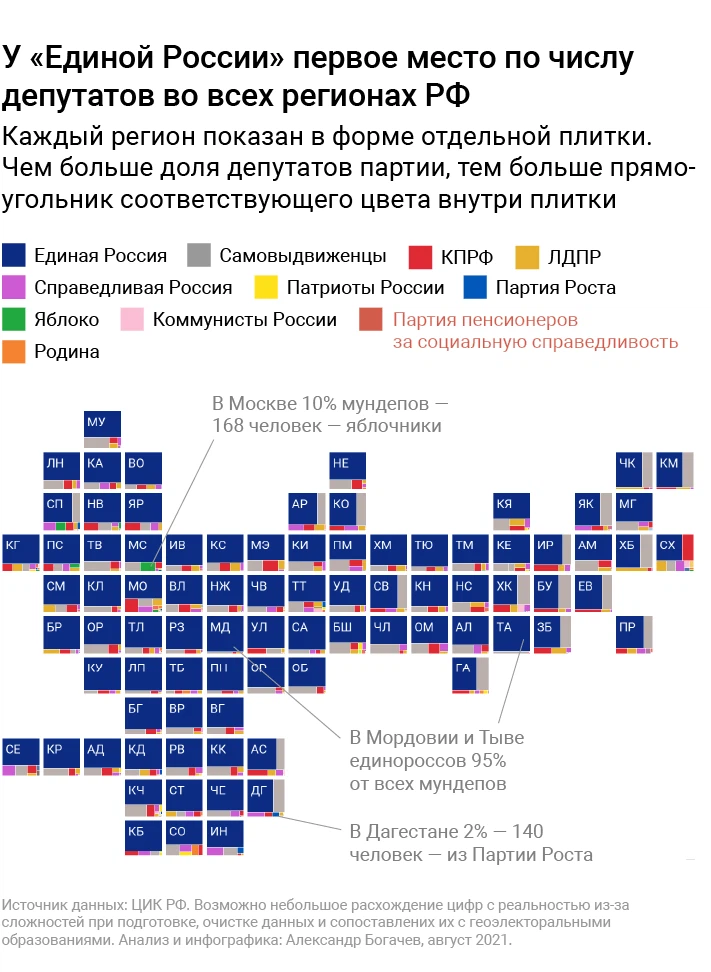
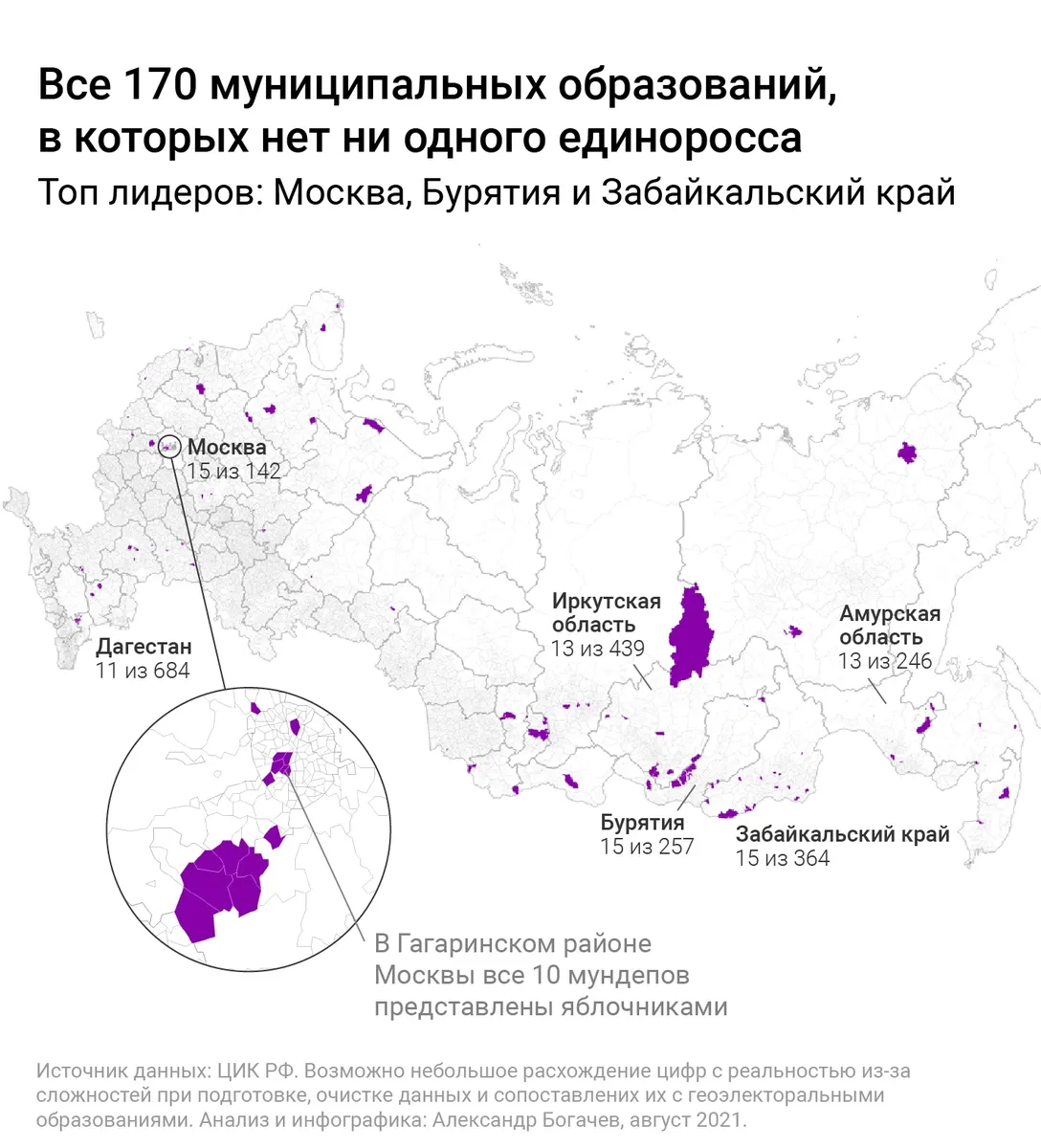
Of the 19,000 municipal entities, only 170 have no representatives of United Russia.
Most of the municipalities without “EP” in Moscow, Buryatia and the Trans -Baikal Territory (each in each of 15 municipalities).
As the political strategist Abbas Galyamov explains, it is still worth talking about such a significant predominance of “United Russia”: far from always municipal deputies that are included in the party are actually strict adherents of its ideology. Often, membership is an "exclusively formal thing." According to him, future mundops are primarily determined by the head of the municipal administration or the head of the settlement. Before the elections, officials find people whom they would like to see in the Council of Deputies (this may be the director of the school or head physician of the local hospital), and draw them up through United Russia.
- You need to understand that this is a disguise. In reality, these are people who are proteges of a local administrative resource. By random coincidence, they are called united Russia, but could be called somehow differently, ”Galyamov believes.
“In another way” administrative candidates are “called” quite often, the “new” experts surveyed are noted, but it is impossible to accurately calculate the percentage of “agreed” and “independent”. For example, sometimes in the elections, candidates from United Russia are under the guise of “self -nominated”. In total, among the mundors a little more than 13% (or 25,934 people) were advanced without party support - in popularity they occupy the second place in the composition of representative bodies. Which of them actually supports United Russia, it is also impossible to determine, but the trend for disguise could be noted after the protests of 2011-2012 provoked by elections to the State Duma: in 2013, a sharp increase in self -nominates coincided with a noticeable reduction in candidates from EP. At the same time, the proportion of the elected self -nominates among all the nominated candidates grew up (then this value fell back).
The most high -profile case is the elections to the Moscow City Duma of 2019, on which the party in power did not nominate a single candidate. Even the chairman of the Moscow City Duma Alexei Shaposhnikov decided to advance through the collection of signatures, although he did not hide his party affiliation.
Nevertheless, after a single voting day, the United Russia faction and the loyal city hall of the Moscow Association of My Moscow were immediately formed from the “Parliamentarians-Summarians”. Last year, three self -nominates helped to form the majority of “United Russia” in the Novosibirsk City Council, immediately after the election, joining the appropriate faction, and in the Pskov City Duma, the only elected self -nominee joined the “EP”.
- The disguise of “United Russia” under the guise of self -nomination is characteristic of large cities where protest moods are strong. However, not always dependent people - members of United Russia, the situation of deputies is determined by local specifics. It can be housing and communal services that depend on the authorities, but do not take the party, ”explains the member of the Voice Council* Arkady Lyubarev.
As the co -chair of the Voting Andrei Buzin supplements, not only a self -nominee, but also a representative of another party, can be an unobvious administrative candidate in the district. According to him, this was especially manifested in the elections to the Moscow City Duma in 2014, when preliminary agreements were concluded in the districts of the districts (for example, in the district where Leonid Zyuganov was nominated from the Communist Party, United Russia was not at all in the elections). Moreover, this practice is also common in other subjects of Russia.
- In Russia, the main participant in the elections is not the party, as it is written in the law, but the bureaucratic corporation is the executive branch that sits at the top of the vertical. Here it is the main informal election participant, ”Buzin points out.
Elections without candidates
However, candidates from alternative parties simply do not go to the elections in many municipalities. If you look at the data of all the participants in the elections, it is noticeable that in the constituent entities of the Russian Federation each alternative party usually puts forward significantly less candidates than United Russia, especially this trend is noticeable in rural settlements and small cities. Political scientist Alexander Kynev is not surprised at the percentage of the party affiliation of deputies. In his opinion, the reason is simple: "The lion's share of the election takes place at the lower level, on the periphery, where there are no political parties at all."

-The parties in our country are very present only in cities. There was an attempt to reinforce parties under President Dmitry Medvedev. In 2011, a law was adopted on the forced introduction of party lists in areas and cities, where there are more than 20 deputies (we are talking about Federal Law of 03.20.2011 No. 38-ФЗ, which obliged to elect at least half of the deputies to the representative bodies of municipal districts and urban districts with the number of deputies at least 20.-Ed. ) . Because without party lists on the periphery of the party no one needs. This was an attempt to at least somehow interest the party elites, but the norm was canceled in the fall of 2013, says Kynev.
The absence of deputies from alternative parties, the political scientist explains the majority system of elections in which the one who takes first place relative to the majority wins. In the municipal elections of deputies, they are chosen mainly according to this scheme.
- Wins the one who is consolidated, and loses the one who will split. The candidate from the authorities is one, and the opposition is always split, ”Kynev notes.
Another problem lies in the fact that it can be difficult to find candidates for elected positions at the municipal level. As political scientist Mikhail Vinogradov notes, even “ER” sometimes succeeds: “Active people sometimes do not want to publish income and property at least. Therefore, local authorities have to recruit state employees. ”
At the same time, there are often not so many votes for victory, and in the theory to get around the agreed candidates should not be difficult (which is the story of the cleaning lady of the village administration Marina Udgodskaya, who last year in the elections of the Povalikhinsky rural settlement bypassed the candidate from United Russia).
The CEC data on past municipal elections show that in the whole country about 80 vote is enough in the country in half of the munobractions (taking into account elections in small cities and rural settlements). Somewhere this figure may be lower: for example, in the Ryazan region a median minimum number of votes for victory-31, in the Bryansk region-37, and in the Omsk-17. At the same time, there are 800 deputies in Russia, who had less than 10 votes for victory.
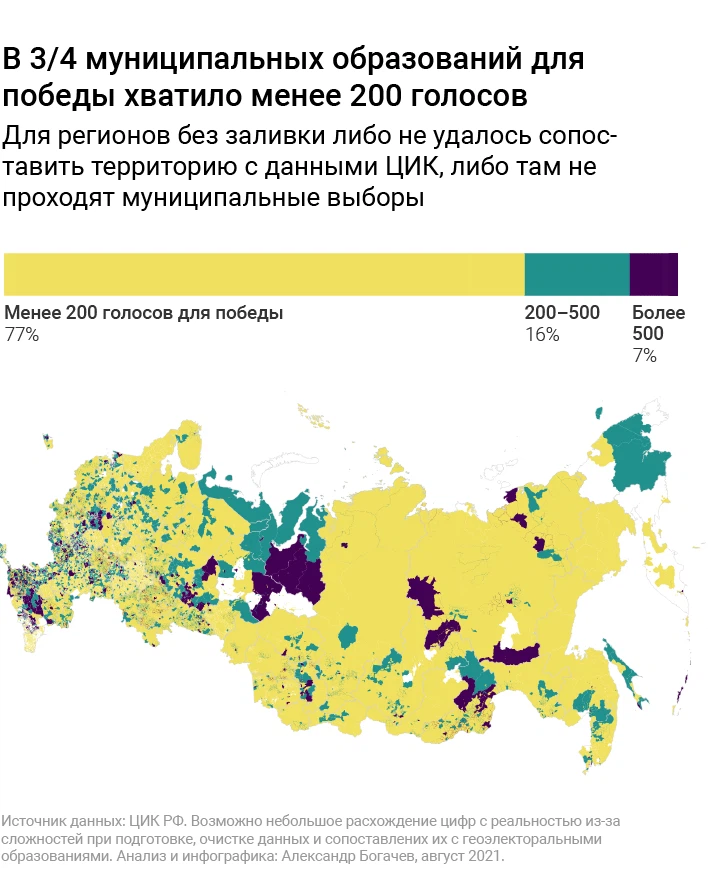
- The municipalities are different. There are municipalities where less than a thousand voters. If in the municipality, where there are a thousand voters, the appearance in the elections is 30% - 300 people come. In single -mandate districts, for the election, the candidate needs to get 35–40% of the vote. 40% of 300 people are 120 votes, with great competition and in multi -member districts, less may be required to win, ”explains Arkady Lyubarev.
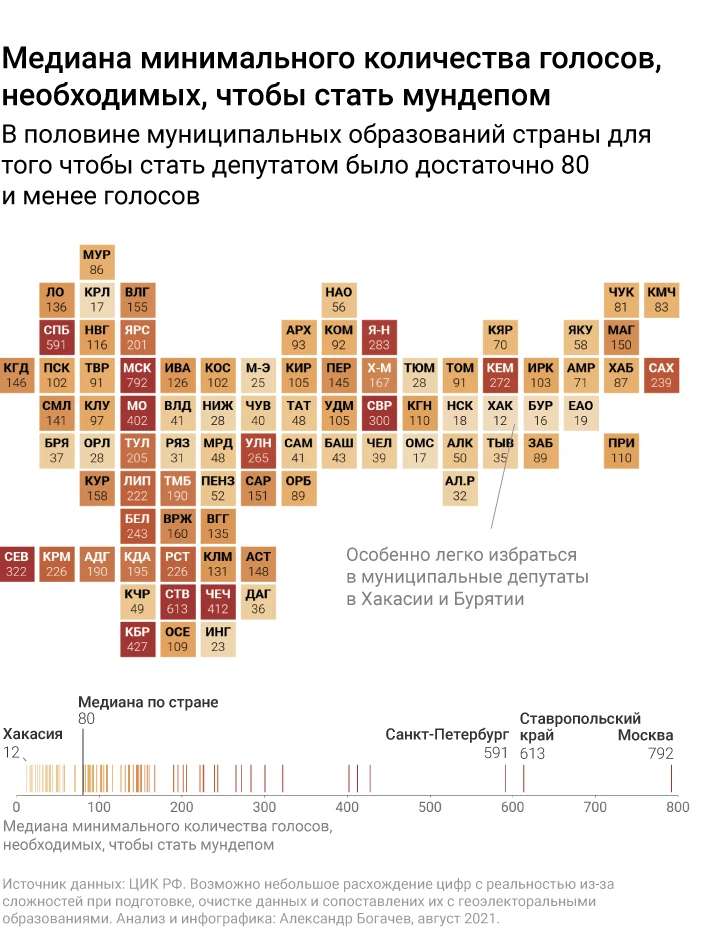
Moreover, the number of votes for victory may not reach critical values in large cities. For example, in the municipal elections in Moscow in 2017, candidates usually had to get a minimum of 1,500 votes to get to the Council of Deputies, and in the Tver or Presnensky district, candidates could become deputies, having received less than 500 votes. At the same time, in the Municipal District of Solntsevo, where 1564 votes became the lower threshold for passage to the representative body, there were many times more voters - 70.5 thousand people. In Dorogomilovo, where the candidates took place in the Council, gaining 400-500 votes, there are 35.5 thousand of them. In those elections, the turnout amounted to 14.82%.
- People are not interesting for people. The turnout can be 15%, it may be 18%. So
The winners are chosen by a small percentage of voters.
The situation is twofold. On the one hand, the authorities are profitable to shorten the turnout. On the other hand, mobilization by the authorities may not go very well and voters who have come to the polls can vote not as it should. In addition, the opposition in such elections can carry out its mobilization and collect a sufficient number of votes to win, ”explains political scientist Alexei Makarkin.
This mobilization in the municipal elections has already held the United Democrats project in Moscow, headed by politicians Dmitry Gudkov and Maxim Katsa. In the elections of the Gudkov and Katz, they literally created the “Political Uber” - a convenient site for candidates who simplified the advanced process for new politicians. In addition, politicians oversaw the campaigns of candidates. Most of the politicians supported by them were nominated by the Yabloko party, but the project also helped self -nominated people, representatives of the Communist Party, Just Russia and the Party of Growth.
The main goal of the unification was to overcome the “municipal filter” in the elections of the Moscow Mayor in 2018 (this requires support for 5-10% of mundories and heads of municipalities). At first glance, the victory of the opposition was really triumphant: 266 opposition candidates won 63 out of 146 municipalities in Moscow (about a thousand people nominated). However, their distribution in the districts did not allow to close three quarters of municipalities to overcome the filter.
In 2019, in the municipal elections in St. Petersburg, the project was headed by the former Executive Director of Open Russia ** Andrei Pivovarov, who is currently in the Krasnodar pre -trial detention center on charges of carrying out the activities of an unwanted organization (Article 284.1 of the Criminal Code). In addition, the project “United Democrats” nominated 650 candidates in the municipal elections in the Vladimir, Nizhny Novgorod, Ivanovo regions and the Republic of Tatarstan in 2020 (about 160 for each selected region). At the same time, the mandates were played significantly more. There are more than 2 thousand in Tatarstan.

- Local government, unfortunately, did not become a real force that could promote from below its leaders.
( continues ) on the one hand, people themselves do not go to representative organs. On the other hand, those who go are very much limited in electoral rights. People can be put forward in the elections, but they simply will not register them, ”says the former municipal deputy and politician Julia Galyamin.
The politician cites the case of the case of the supporters of Navalny Violetta Grudina, who at the beginning of the month, the Murmansk as a murmur, did not register the candidate for the city council in connection with the letter of the Ministry of Justice about her relations with the “extremist organizations”, as well as the Nizhny Novgorod politician, a member of the Yabloko party, Alexei Sadomovsky, who was not registered a year ago due to supposedly incorrectly filled documents.
The registration problem is really very serious. As Andrei Buzin says, even if you take into account that many districts need a small number of votes for victory, getting out is not an easy task (unless local business elit has no interest). The reason is that independent candidates usually simply do not reach the election, and over time it only gets worse. To begin with, Buzin notes that from the nineteenth year a number of legislative norms have been adopted, which facilitated the weeding of inconsistent candidates. In particular, 50 articles of the Criminal Code were included in the electoral legislation, which deprive citizens of the right to occupy elected positions (before that, only convicts on grave and especially grave articles were lost). Among them, for example, “Dadinskaya article” (Article 212.1 of the Criminal Code) for repeated violation of the order of mass shares, as well as an article for the use of violence that is not dangerous for life or health, regarding the representative of the authorities or his relatives (part 1 of article 318.1 of the Criminal Code). In 2021, Russia was legally limited in passive election law involved in extremist and terrorist organizations - all supporters of Alexei Navalny were banned, since the FBK ***, as well as the regional headquarters of politics *** were ranked for extremist organizations.
- There is a theorem for the elections in Russia: if desired by signatures, you can always not register. In 2014, the required number of signatures increased to 3% of the number of voters - the dragon norm, which is difficult to fulfill. But even after collecting signatures, graphologists can always reject them. It is almost impossible to challenge their solutions - this trend has been observed for seven years. In addition, you can always find shortcomings in the documents submitted for registration or in the opening of the electoral account, ”Buzin explains.
However, according to Buzin, the tools for removing candidates were before. Not all of them were related to the law. For example, last year in Tatarstan, the court removed 13 independent candidates from the municipal elections because of the opponents of the construction of a garbage plant, which was created several years before the elections and did not have attitude to agitation.
State without local self -government
Publicly CEC, at least the head of the commission Ella Pamfilova, often criticizes the laws on municipal elections in Russia, as well as the implementation of the procedure in many regions. For example, in 2019, the official called mass violations in the municipal elections in St. Petersburg "Municipal-electrical banditry." Before the municipal elections in Moscow in 2017, which was recorded a record low turnout, Ella Pamfilova accused the Mosgorisbirk of the failure of the information campaign.
In practice, data on candidates and future elections, as well as the composition of representative bodies, can not be so simple. In theory
The CEC could simplify this task by creating a single platform on the technical database of the commission using its own databases. However, the experts surveyed by the “new” experts agree that the commissions simply do not need this.
- The organization is bureaucratic, it does what they demand from it. You should not expect some of your own initiative from her, ”said Lyubarev, a member of the Voobarev Council.
- There are no interested in these open data. Why do they need it? In Russia, a political strategy prevails to reduce the participation of our citizens in the elections. In such conditions, the representative office is very easily regulated towards people who seized power in the country. ЦИК — это всего лишь инструмент российских властей, хоть он и должен быть независим, — полагает Юлия Галямина.
«Новая газета» попросила ЦИК прокомментировать, как в комиссии оценивают доступность информации о выборах всех уровней, однако к моменту публикации материала комиссия еще не успела ответить на запрос.
Несмотря на то, что мундепы имеют прямое влияние на муниципальный фильтр, необходимый на выборах глав субъектов РФ (муниципальный фильтр обязывает всех кандидатов на пост главы региона собирать определенное количество подписей муниципальных депутатов и глав муниципальных образований, чтобы быть зарегистрированными на выборах. — Ред. ) , в остальном реальной власти у них не так много. Как отмечает Бузин, в малых городах ее, возможно, даже больше из-за связи с местными элитами. Эксперты сходятся на том, что у муниципалитетов очень мало ресурсов, так как бюджеты крайне маленькие, особенно в малых городах и сельских поселениях, где бюджеты поступают от регионов. Кроме того, если в представительный орган и избирается оппозиция, зачастую она находится там в меньшинстве и ни на что повлиять не может.
— У этих людей есть только право одобрять решение главы муниципалитета. Конечно, в некоторых муниципалитетах может быть противостояние бизнес-элит, но это скорее исключение из правил, — описывает Аббас Галлямов текущую ситуацию.
— Большинство бюджетов проводится не через прямые доходы местного самоуправления, а через субвенции или субсидии региональных или федеральных властей. Поэтому орган местного самоуправления не является самостоятельным, даже если у него есть такие полномочия, — поясняет Юлия Галямина.
Тем не менее в России власть довольно активно выступает против гражданских инициатив в сфере муниципальных выборов.
К примеру, в 2020 году силовики не раз срывали лекции «Объединенных демократов» в разных городах, а в этом году задержали всех участников форума «Муниципальная Россия» — больше 200 человек. В конце мая сотрудники правоохранительных органов также сорвали «Земский съезд» — форум нескольких десятков независимых депутатов органов местного самоуправления из разных регионов России в Великом Новгороде. Политика Юлию Галямину, принимавшую участие в съезде, арестовали на семь суток за неповиновение полиции (19.3 КоАП). Сама Галямина считает, что объединять преследование «Объединенных демократов» с разгоном «Земского съезда» все же не стоит.
— Задержания во время форума «Муниципальная Россия» все же больше относятся к попытке связать «Объединенных демократов» с «Открытой Россией» и превентивно зачистить активных людей. «Земский съезд» в свою очередь затрагивал важные смысловые вещи, в том числе осмысление России как демократии. Кроме того, это была горизонтальная самоорганизация политиков из разных регионов. Этого власти очень боятся, так как, в отличие от вертикальной организации, разрушить горизонтальную структуру намного сложнее. Также важно, что у депутатов «Земского съезда» есть представление о том, что они являются избранниками людей. Поэтому к ним относятся с опаской, — поясняет Галямина.
Андрей Бузин объясняет сложившуюся ситуацию трендом на централизацию власти. В конце концов, даже местное самоуправление в обновленной Конституции формально вошло в единую систему публичной власти, хоть и автономии своей не потеряло.
— Антидемократическое государство не может иметь самостоятельный нижний уровень, потому что он всегда начинает отстаивать свои права и подтачивает власть верхнего уровня.
( продолжает ) Поэтому у нас постепенно самоуправление уничтожается. Мы возвращаемся в Советский Союз, где вместо самоуправления была единая вертикаль. Самостоятельное самоуправление — это всегда подрыв централизации, — поясняет Бузин.
— Независимые депутаты в местном самоуправлении бы не молчали, а требовали от региона уважения их полномочий и субъектности. Они отстаивали бы интересы своих населенных пунктов, что привело бы к росту политических конфликтов. Все бы это вышло на региональный уровень, в результате политика бы стала живой и начала в большей степени отражать интересы реальных социальных групп. Это означало бы демократизацию политического процесса, — резюмирует Аббас Галлямов.
What can I do?
election.novayagazeta.ru
Расскажите о проекте друзьям. Share a link