
Translated material
Polevin of this year - "Transhumanism Inc."
The first writer’s first career is novel in stories. About the ecological Russia of the future, which is controlled by a bloodthirsty corporation. What you need!
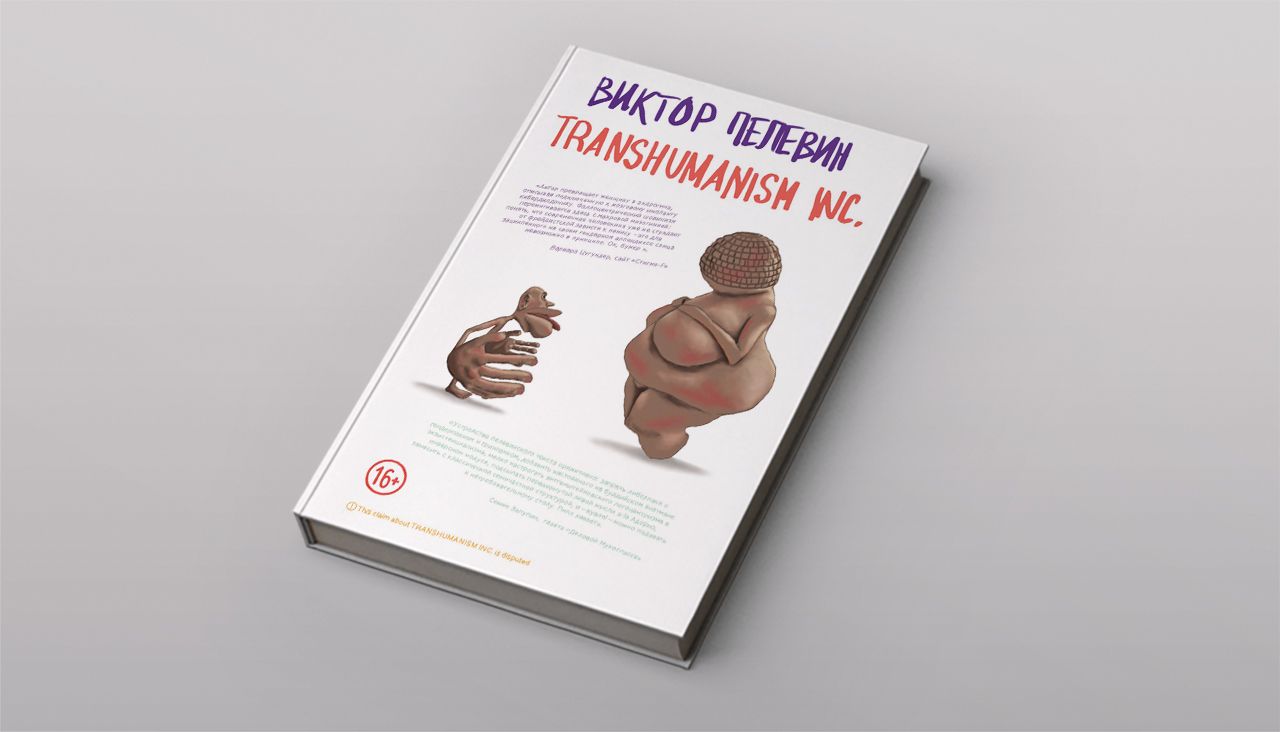
Literary critic Galina Yuzefovich talks about the new novel by Viktor Pelevin “Transhumanism Inc.”. Everything that the author loves for, in this text about Russia the future will certainly be: irony, postmodernism, and Buddhism. From innovations: this is the first novel of the author in stories. And the mood swings in the texts this time is more cool than ever.
Victor Pelevin. Transhumanism Inc. M.: Exmo, 2021
When you have to write about Viktor Pelevin annually for eight years without a single pass, to maintain proper drive and intrigue, each of its next book has to proclaim “first” or “most”: the most mizoginin ( “secret views of Mount Fuji” ), the first professionalist ( “invincible sun” ), the very conceptually saturated ( “iPhucks” 10 ” ), the first not funny ( “ caretaker ” ), the most successful or unsuccessful (here each reader let his own option) - and so on. Without changing traditions and not sinful this time by subjectivity, let's say that "Transhumanism Inc." - The first in the career of Viktor Olegovich Roman in stories united by a single setting, the idea and partly heroes, but at the same time plotly completed and quite self -sufficient.
The action of all seven texts included in the book unfolds, as usual, in the world of the future, but this time - probably due to the compositional specifics of the novel - Pelevin made somewhat more efforts to describe and explicate this world. Since the days of the IPhuck 10, a little more than two hundred years have passed. Over the years, the so-called compassionate revolution managed to occur in Russia, overthrowing the cloned kings from the Mikhalkov-Ashkenaz dynasty, the fashion for ordinary, biological sex (intricate sex toys of the past era, has now look funny and obscene), Moscow has become mainly two-story and wooden, and chipped horses came to change cars and aircraft. Tigs, the population was significantly reduced, and in general, the entire civilization became almost completely “green”, extremely preoccupied with a decrease in the carbon print. All heavy work are assigned to the so -called “Helper”, or in the colloquial of “slaves” - brainless clones similar to people, but completely devoid of self -awareness. And of course, feminism in this world finally won: the middle-sides took the matrics, neurostron is officially recognized as part of the female body, and exclusively men are engaged in prostitution (for some reason combined with the performance of some strange hybrid of Kay-Pop and rap).
However, you do not need to be a special connoisseur of Pelevin's work in order to understand: not everything in this new ecoidillium is so simple. Firstly, a chip was impressed with each law-abiding citizen, not that completely controlling his consumer behavior, views and preferences, but pretty much modifying them for the sake of corporations. Or rather, one corporation, because, despite the formal existence of states, governments and businesses, genuine power belongs to the global megamont Transhumanism Inc. - The company that managed to give humanity a new great dream. The dream of immortality.
Immortality, according to Pelevin, cannot be bodily - only the brain is always capable of living. After death, the rich now move to the “bank” - a special device that provides the brain with autonomous and almost endless existence. A “banker” personality in the brain (the so -called representatives of the new elite) finds himself in a bizarre cyberspace, equipped in accordance with its income and taste, but continues to maintain an active connection with the material world and even lead it. The “banks” also find the leader of the Medobol-Bolshevik Russia, known under the nickname Bronhutor (just like that, with a modest small letter), and the leader of Jihad Sheikh Ahmad, and other world leaders. And since the rental and maintenance of the “banks” is an expensive pleasure in order to pay the TRANSHUMANISM InC., the powers that be mercilessly have to ruthlessly lease the brains of their fellow citizens, subjected to more and more massive effects from advertisers, political technologists and other “influences”. Well, the reduction of the population, in addition to the obvious environmental effect, has one more - much more sinister - meaning: a lot of people are not required to serve the interests of “bankers”.
At the head of the pyramid is the great Goldenstern-the founder of the corporation, omnipotent and shrouded in legends, whose name is so forbidden that it is considered unacceptable to mention it in a decent society (for this, the euphemism of “Mr. Word” is invented). Around his figure, there is a special cult, based not on faith, but on the hope of someday he will become like (“Faith is impudent hope,” Viktor Olegovich tells us) and surprisingly reminiscent of the ironic rethinking of Buddhist teachings. The power of the Goldenstetern, in the eyes of the profans, is limitlessly, however, also gloomy puppeteers pee out from his back, who have their own, not altruistic goals and interests in all this, which are leaving into the depths of the underground hierarchy bunkers.
The world described above is a background on which quite different are played both in the manner and in the meaning of history. The stupid seventeen-year-old girl at some point seriously decides that she is the chosen one of the incomprehensible and transcendental Goldenstherna, but very soon she will have to understand that chosenness is not at all the very length of which she dreamed about (“Goldenstern everything”). The Japanese master of the sword arranges for the fun of the saturated “jans” the bloody fights of programmable bioculars, but at some point, the spirits of the great fencers of antiquity are really mysterious, and their fight is filled with a completely new deep meaning (“duel”). In the middle years, the rural landlord lends itself to a temptation and enters into a painful and shameful connection with his own “servant” (“Mitina Love”). The immortal married couple spends the next honeymoon in a special cluster of the digital world, where people can temporarily feel like cats (“cat”). And through all these plots - touching, funny or dramatic - another, through and almost detective, associated with the fate of the Goldensteral, the global backstage and, as usual, the great nothing, continuously generating and devouring the whole wounding world to us.
The creativity of any cult author (and who, like not Victor Olegovich, can claim this title in our realities), in addition to the “new”, “first” and “very”, is also based on the usual one: over the years, the reader adapted to a certain set of images and techniques and always longed to know that he will be offered from the classical set of basic elements this time. If you are disturbed by the question, whether Pelevin will show in "Transhumanism Inc." Conventional tricks, do not worry: the writer will work out all his signature numbers to glory.
The postmodern quotes in the new book are also responsible for the earlier texts of Pelevin (on the pages of “Transhumanism Inc.” fans easily distinguish between the echoes of “IPHUCK 10” and “Empire V”, and Shakespeared Sitman will flash in one of the passage episodes, familiar to us from the “Holy Book. Werewolf ”), and appeals to the classics from Shakespeare and Borges to Bunin and Bulgakov.
Buddhist elements, in one form or another, present in almost all the things of Victor Pelevin, are taken into subtext this time, but with all the volume they are instantly read as not needing an ideological firmware that does not need to pronounce. Over the years, we are accustomed to scrape the bright celluloid shell of the decorations created by the writer-and you will find the same incomprehensible, illusory and dreary vain of the cyclic-sansara. In "Transhumanism. Inc. " With this complete order: the being of Pelevin is still in vain, illusory, dreary and cyclical.
If you love Pelevin for the elegant recognizable Bon Mots, which, on occasion, is so nice to drive into the conversation, for materialized metaphors and jokes, then this time, perhaps, are somewhat more than in past books (and some are really good, which has not happened for a long time). Burning parallels with modernity - those that will require a factual comment in a couple of years - in "Transhumanism Inc." Quite a few, and those that are, relate rather to life and morals (like, for example, not worn by one of the heroes of the pants during the official video service) than political or social aspects. Essay fragments (they are invested in the mouth of school teachers who are trying to convey the crumbs of wisdom to negligent adolescents) are relatively compact and compositionally justified. The ritual, like Judy and Pancha’s fight in the English puppet booth, a skirmish with critics is also on the spot-like a charming self-irony, this time in the image of the only classic surviving in the “can” world with the speaking surname Sharaban-Mukhlyuy, the author of unpretentious and vulgar anecdotes (which, however, by the will of readers and researchers without difficulty without difficulty Source complex and deep meanings).
In a word, we can say that "Transhumanism Inc." -This is the next typical product of the “annual Pelevin” class, at the same time canonical and not devoid of novelty, with a traditional set of runners put up for various values-approximately like the regulators of Kaya, a mechanical sex doll from the Snuff novel, which, I remember, could be regulated by such categories as “thermal” or “intelligence”.
However, "Transhumanism Inc." has "Transhumanism Another important property is not reduced to the set of typical runners and wheels and refers to the most early, still roadless work of Viktor Pelevin - to the time of the “yellow arrow”, “blue lantern”, “prince of the state plan” and “recluse and six -fingered”, with which the current texts are related not only to the formal belonging to little prose. And this property is a broadest emotional range that allows the writer in a matter of seconds to take off from caustic total irony to piercing and extreme seriousness. This is not the most obvious of his skills, Viktor Olegovich involves "Transhumanism Inc." To the maximum, twisting the corresponding lever further than ever in recent years.
A couple of paragraphs ago, we chuckled at the unlucky landowner, who decided according to the good old noble tradition to have fun with a wordless peasant woman, and after a second we are already in all our souls to empathize with his loneliness, longing, touching vulnerability. The entourage from the story about the fighting Samurai dolls looks simultaneously absurd, grotesque, comical, but in paradoxically and majestically. The cynical and disgusting armor, shamelessly exploiting Russia for the sake of its “can” well -being, in the last story of the book (“Homo OverloCved”) makes a spiritual journey, during which all the jesters fly around him, exposing the genuine essence - tragic, harsh, adamant and, as found, dilapidated.
One of the important features of Pelevin as an author is his fundamental elusiveness. Moreover, the point is not only in the banal impossibility of seeing and asking him - the reader simply cannot understand what this great tricster really thinks, for the Reds he, roughly speaking, or whose, on whose side of his sympathy and what are genuine beliefs. No matter how much we strain our eyes, we cannot reliably apply its whereabouts to the map - neither physical, nor mental, and after thirty years and eighteen novels in this sense, we are still not ready to say anything definite about Pelevin. And, perhaps, the only method to catch, fix and make out his protein nature is to concentrate on this ability to scurry with a fiery arrow from darkness to light, from laughter to pathos. If genuine, real Pelevin exists, then it is necessary to look for it in the gap between the funny and majestic, in the rapid one flight, or a fall from one to another - and "Transhumanism Inc." It fully gives us such an opportunity.
Galina Yuzefovich