
Translated material
Alarm calls
History, patriotism, “enlightener” Medinsky, textbooks and marginals ... Young teachers told “New”, which is worried before the start of the school year
What place the legs of the emperor torn off
“When I asked classmates, if they would go to school, the standard answer was:“ No, I will kill these children, ”laughs a history teacher Alexei Dmitrievich. Three years ago, out of thirty graduates of the Eastfaces, three became teachers. In his school, Alexei remains the youngest of teachers.
“What historical issues are interested in adolescents? For example, when I talk about the murder of Alexander the Second, the class clarifies what place his legs were torn off. Medieval torture, plague, secret societies. The eighth-graders were very impressed by Ku-Klux Klan. Immediately climbed on the Internet, look at the photo. Sometimes I think: “Well, you have a nervous system, children,” the teacher shakes his head. - In Russian history, the same eighth -graders were attracted by men's clothing of the 18th century - tight pants resembling modern leggings. I ask: "Why did the elite drop a fur coat?" The class is silent. The reforms of Peter the Great were in the lesson before last and were already completely forgotten. ”
History lessons begin in the fifth grade with the study of the ancient world. In the sixth grade, history is divided into universal and domestic. The courses are synchronized, for each there is a separate textbook. “Most of the tasks concerns the history of Russia on the OGE and the exam, so many teachers are emphasized on this course. But children get tired of the formation of Russian statehood, ask: “When will we go through the Vikings?!” Therefore, I am alternating: we study one chapter from the history of Russia, then the chapter from the universal, ”says Alexey Dmitrievich.
As expected to a young enthusiast, having come to school, Alexei tried to diversify the forms of work with the material. With fifth graders, he successfully played the battle of Hannibal with the Roman army. “With the middle and senior link, I wanted to organize discussions, theatrical performances, distributed the roles of historical figures. But he faced the fact that it is very difficult for children to formulate thoughts out loud. This is noticed by teachers of geography and literature.
The situation is catastrophic. For three years I tried to teach children the simplest speech constructions: “I think that ...” I did not achieve the result. ”
“There is no oral part in the exam in history. Current grades are set by written work. Children virtuoso write off from the phone in the classroom, and at home they download ready -made essays without reading, ”Alexei Dmitrievich shrugs his hands.
"This is a conveyor"
Alexei works at one and a half rates. These are lessons from 8:00 to 15:30, then taking “debts” with lagging lags, rehearsals of the dance circle, checking notebooks, setting assessments to an electronic journal.
As a class teacher, Alexei Dmitrievich, collects a folder with protocols of parental meetings, acts of examination of the housing and living conditions of students, certificates of health, personal matters of gifted children and children from the risk group, safety magazines, etc. As a subject, he is obliged to draw up a work program and a calendar-thematic plan, a percentage of academic performance and the education of the curriculum, personal personalities and summary sheets.
Arriving home in the evening, the young teacher immediately falls asleep, otherwise the nervous system does not withstand. “This is a conveyor. You do not notice how a week, month, a quarter passes. Only at the end of the year you raise your head: it remains to somehow live to the last call, ”says a 25-year-old teacher.
Alexey receives less than 30 thousand rubles. The products take about 700 rubles for each visit to the supermarket. Mortgage payments (16 thousand rubles a month) help to make parents. You have to save on the phone. In the first year, the teacher worked part -time with tutoring, but exhaled.
The working conditions of the teacher in the mass school directly affect the content of education. No satrap forces the historian to use exclusively “the only true” textbook. There is no time and effort to work with additional sources of information.
The story of a short course
In 2013, President Vladimir Putin, speaking at the Council on Interethnic Relations, demanded to develop the concept of teaching history, save the educational literature “from double interpretations” and teach children “respect for all pages of our past”.
"Where is the list of contradictions or anti -scientific versions in the approved federal list of textbooks?" - Academician of the Russian Academy of Sciences Valery Tishkov asked on his Facebook page. “How, for example, can you respect serfdom? Sympathy for the victims - yes, of course. Respect for heroes and wrestlers against evil - yes. But respect for everyone indiscriminately the pages of the past, especially for some elements of state policy, is never, ”wrote the doctor of historical sciences Andrei Zubov.
A year later, at a meeting with the developers of the historical and cultural standard, the president emphasized the need to “get rid of ideological garbage”:
“In the educational literature that entered schools, such things that were absolutely unacceptable for our country have slipped out, it’s just like a spit in person.”
Putin explained that he was outraged by “belittling the role of the Soviet people in the fight against fascism”, but not only: “We ourselves, freely or involuntarily, belittle what was done by our ancestors. An objective assessment can and should be given to everything that has been made by our people in more than a thousand years. ”
The Ministry of Education claimed that during the development of the standard, a “widest public discussion” was carried out, more than a thousand comments were received from scientists, mainly relating to the twentieth century. The director of the Institute of General History of the Russian Academy of Sciences, Alexander Chubaryan, noted that the developers were faced with the objections of foreign colleagues on the emergence of the Old Russian state (as now called Kievan Rus), as well as the accession of the Caucasus and Central Asia. Archimandrite Tikhon (Shevkunov) proposed to describe in the new textbooks "Pantheon of Heroes, not raising the screams of the liberal public."
In 2014, the chairman of the Russian Historical Society, Sergei Naryshkin, presented a list of “difficult issues of the history of Russia”. Initially, there were more than thirty points in it-from the Varangians to the Great Russian Revolution (this is also a new term introduced by analogy with the Great French Revolution, the concept unites the events of February and October 1917) and further to the “reasons for the stabilization of the economy and the political system of Russia in the 2000s”.
Later, the contradictions of the 19th century were excluded from the list, and exactly twenty remains questions.
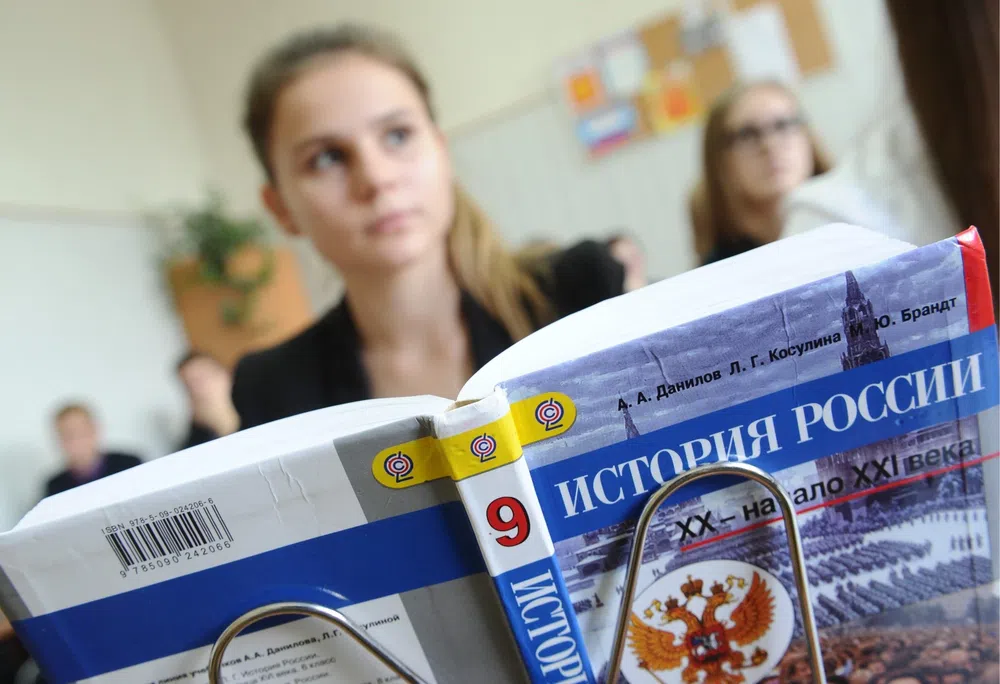
In 2015, the Ministry of Education and Science selected textbooks corresponding to the new historical and cultural standard. The competition was attended by eight training complexes from five publishers. The examination was conducted by the Russian Historical Society. The approval was received by three sets of manuals of the publishing houses “Education”, “Bustard” (from 6th to 10th grade) and “Russian Word” (from the 6th to the 9th).
A school teacher has the right to choose one of these lines. In practice, the teacher most often works on those textbooks that are in the school library. Alexey teaches from the textbooks of the publishing house "Education" edited by the rector of Mgimimu Anatoly Torkunov.
The main enlightener
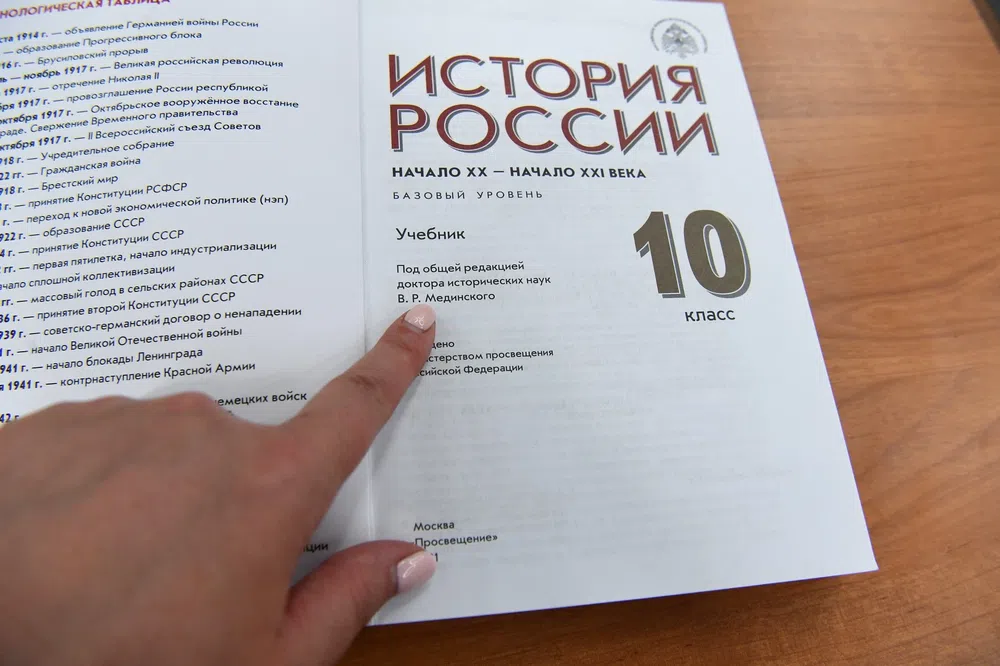
This summer, the publishing house "Education" was published by a textbook on Russian history of the XX - early XXI century edited by Vladimir Medinsky. The manual will become the final in the kit by which schoolchildren begin to study from the 6th grade. The textbook covers events from 1914 to this day.
Medinsky defended a doctoral dissertation on the topic “Problems of objectivity in the coverage of Russian history of the second half of the XV - XVII centuries” in 2011, being a State Duma deputy. In 2016, the activist of the Dissernet community, philologist Ivan Babitsky and doctors of historical sciences Vyacheslav Kozlyakov and Konstantin Yerusalimsky, specializing in the era described in the dissertation of Medinsky, doubted the scientific value of the work. Having examined their complaint, the profile expert council of the highest certification commission recommended that the author of the degree to deprive the author. The Presidium of the Higher Attestation Commission did not support the decision.
Recall that Vladimir Medinsky has been the Minister of Culture since 2012. In January 2020, he became an assistant to the president. In the summer of this year, he headed the commission on historical education. Medinsky dreamed about creating such a structure before he began his career as an official.
“There was a historical policy under Stalin - there was an order for historical films, historical books. For example, the novel "Peter the Great" was written by Tolstoy on the direct order of Stalin. There were other masterpieces. Because a person knew a lot about ideology and brainwashing. Now everything has been put to the very efficiency and efficiency, of course, “below the plinth,” Medinsky said to the Yekaterinburg publication New Region in February 2012. The hero of the interview proposed to transform the commission on countering the falsification of history, which existed "without an apparatus, without a budget, exclusively on the enthusiasm of the organizers", "into a certain political body."
Before the release of the new textbook, experts wondered about its content, recalling Medinsky’s statements that "it is impossible to give rise to pluralism in the head of a fifth grader." The current chief enlightener called the variety of scientific points of view "ridiculous intellectual internodes".
He warned that only "proven assessments of scientists taking into account our state interests will fall into the new edition."
“The textbooks present a positive view of our history, in which the unbending of our people is distinguished by external threats, the ability to sacrifice in the name of the Motherland and the willingness to help those who have undergone aggression. The special role of the Russian Orthodox Church is shown, ”says the new UMK on the website of the Russian Military Historical Society (RVIO).
Forty pages of patriotism
We read the new textbook so far. According to Fontanka, at the editorial office a copy of 600 pieces is indicated at the editorial office. Teachers surveyed by journalists consider the publication high -quality. The book presents the sources: General Kornilov’s speech before the attack on Petrograd, notes of witnesses of dispossession, the Fulton speech of Churchill, etc. It tells about the repressions, Moscow processes of 1936–1938, the second front. The tasks are interestingly formulated - it is proposed to postcate the collectivization, the causes of the Cold War, the positive and negative aspects of Khrushchev’s reforms.
Positive reviews of teachers relate to chapters that tell about events until 2000. This part of the textbook is written by professional historians and methodologists. According to the honored teacher of Russia Tamara Eidelman, the quality of the last chapter of the new textbook “Behind the Facility of Good and Evil”.
“Putin’s speech clearly showed that the time when it was possible to not reckon with Russia has passed,” the textbook reports to schoolchildren about the president’s speech in Munich in 2007. The abolition of the governor’s elections is explained by the “immaturity of civil society” and the need to resist the “administrative resource”. Among the regional chapters of separate mention, Ramzan Kadyrov was awarded, under which the Chechen Republic became “one of the dynamically developing regions”. The accession of Crimea is described as a peaceful process. In the story of the Sochi Olympiad there are no references to the doping scandal.
Alexey Dmitrievich explains that the study of events after 2000 falls on the very end of the 11th grade. “This is April - May. Children are completely focused on preparing for their USE, they do this in extracurricular time. In the lessons, we must study new topics within the framework of the work program, but these classes are in the nature of a relaxed conversation. There are issues regarding August 1991, the economic reforms of the 1990s and the war in Chechnya. Chronologically, they are limited to 2000. I did not meet tasks related to later events even in the second part, where I need to work with the text. The latest text is the report of Mikhail Gorbachev at the 19th Party Conference of 1988. ”
In Saratov schools, they have not yet seen a new textbook. Theoretically, he should get to the desks when sixth graders who began to study the subject according to the Medinsky educational and methodological complex, will finish studying to the tenth grade.
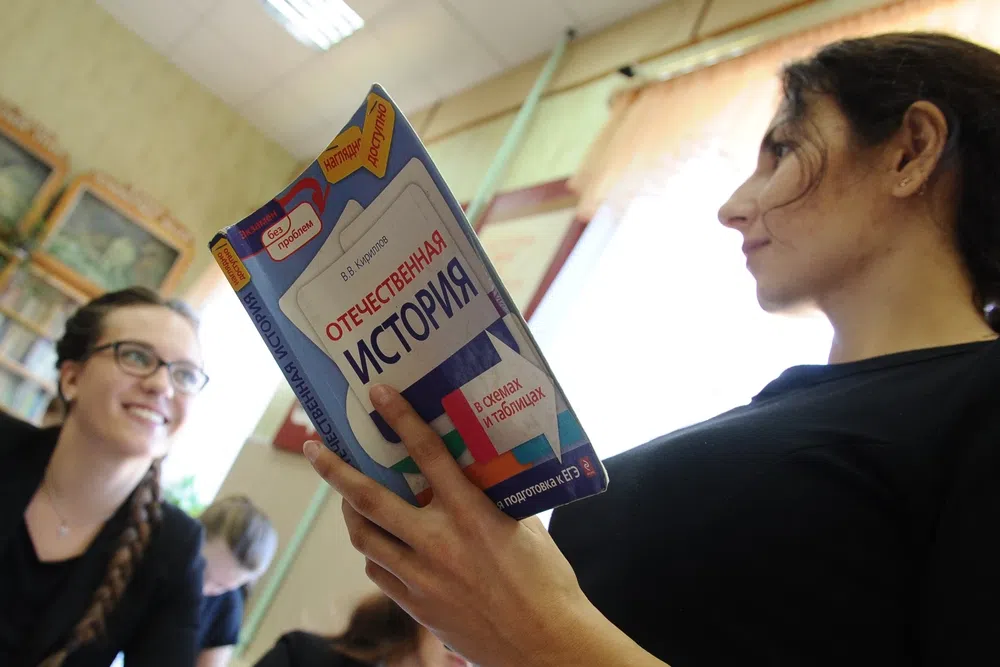
They will teach the homeland to love
As the state interest in the past grows, the number of undesirable topics increases. If earlier there were risky conversations about the events of the first half of the 20th century, now a careless historian can fly in for insufficient respect for the leaders of the Middle Ages. That is
The school teacher enters into thin ice already in the 6th grade, when, according to the program, children need to tell about Alexander Nevsky and Dmitry Donskoy.
“I hope we say on the terms of anonymity? - the teacher asks, lowering his voice. - I think that it is impossible to write the perfect history of the state, leaving white and fluffy leaders. You must also be able to recognize mistakes. The task of the historical and cultural standard is the education of patriotism. The school is obliged to hold dozens of promotions like “Victory Windows” - when the participants are sculpting paper cloves on the windows of the apartment. Will it cause love for the homeland? I’m afraid that the Great Patriotic War will soon be associated with this tinsel. ”
No matter how much sweet words about stability are written in the textbook, "Children come home and hear from their parents: prices are rising, salaries fall, roads are broken."
During winter protests, they “lowered the installation” to the school - to conduct preventive conversations with the middle and high -grade. “Before that, many only posted near political memes in social networks, and here we are with our class hour: on Saturday, a rally will take place on the theater square on so much, so that none of you have been there! What will the teenager make in response to the ban? - Alexei shrugs his hands. - The schools remained guilty. For each minor who was calculated among the participants, notifications came: here, they say, you can’t cope with work! ”
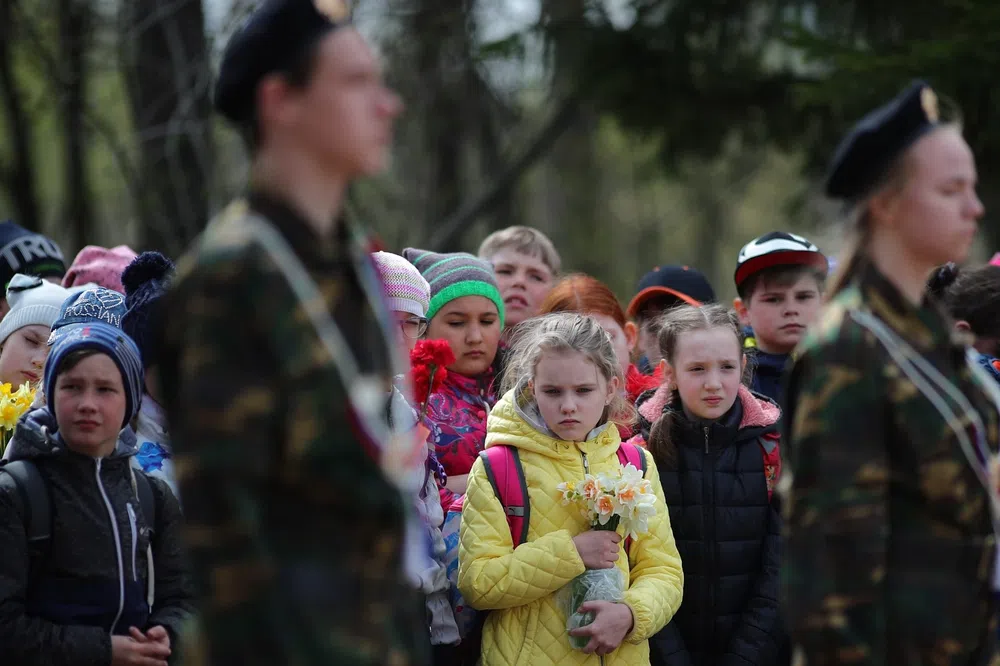
"Rules incomprehensible to the human mind"
Elizabeth constantly calls the phone: on the eve of the beginning of the school year, headlines urgently draw up a schedule. Elizabeth Alexandrovna get 34 hours of English and five hours of class leadership. This is more than two bets.
“I like it,” the girl vigorously smiles. - On the salary, this is positively reflected. No one believes that the teacher can receive so much: 43 thousand rubles! ” For a rented apartment, Elizabeth gives 12 thousand plus utility bills.
The school in which Lisa works is very large - 1600 students. Foreign teachers are only five. “There is a turnover. One of my predecessor went to China, the other went to the neighboring gymnasium. Unlike our comprehensive school, marginal families are eliminated on input testing. ”
At the university, the future teacher had one semester of pedagogy and one month of practice. “When I came to work at school, I was sure that the teacher’s task was to shift knowledge from one head to thirty -others. In fact, the teacher is an incredibly multitask person. It is necessary not only to tell about the wrong verbs, but also to check what the child heard, to make sure that he doesn’t give another on the head, answer the endless “can I come in?”, “Can I go out?”, “I want to drink!”, “Where is my pen?”. If you say to the class: “In the upper right corner we write our last name with a blue pen”, a hand will certainly rise with the question: “Can you black?” I myself do not understand why you need blue. Why can not be distinguished by a marker, why do we need fields of a certain width? For me as a teacher, this does not matter.
This is not spelled out in any document. But the school authorities demand from teachers, and from him, probably, someone from above.
I try to explain to the children honestly: wherever you go after graduation, you will meet the rules that are incomprehensible to the human mind. ”
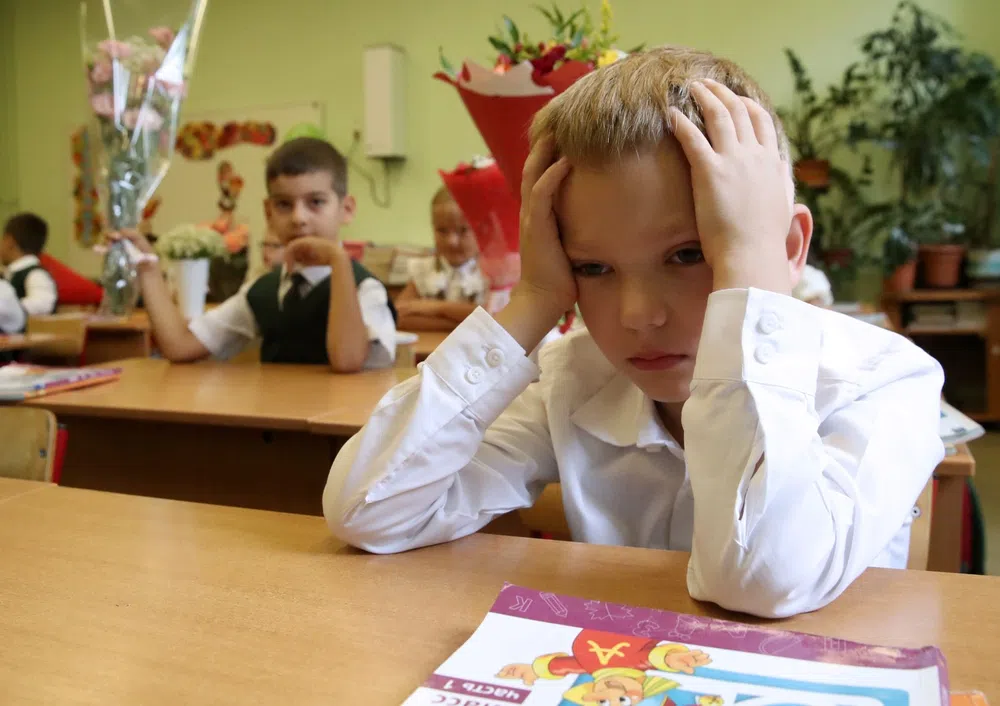
Elizaveta Aleksandrovna is a class teacher of the sixth (since September Seventh) grade. “The past leader even cried, said that these were heavy, disgusting children. Yes, heavy. But crying is definitely not about me! - the interlocutor is dismissed. - The school is in a specific microdistrict. Here they give apartments to orphans, immigrants from emergency dormitories. There are a lot of dysfunctional families. ”
In the class of Elizabeth Aleksandrovna, there are twice as many boys than girls. The teacher calls one of the most outstanding “heroes” every morning to wake up in front of the school. The boy’s mother drinks, there is no dad.
"It cannot be kind"
“I am not the teacher to whom the children run to hug at a break. Sometimes I regret that it is not possible to be kind, ”says Elizabeth, looking at the table. “But I know: it is worth giving slack - and they will sit on my neck.”
Elizaveta Alexandrovna leads many lessons in grades 8–9. They are considered the most difficult. Eighth -graders can easily ask the teacher: "What is your linen color?"
In disciplinary means, the teacher is limited. The school has a social teacher and psychologist, once a quarter gathers an expanded teacher's council, where the offender is “relyed” before registering on an intra -school or police record. Но душеспасительные беседы на подростков из микрорайона, как убедилась Елизавета, не действуют. Исключить из школы неуправляемого ребенка до окончания 9-го класса невозможно. «Я не имею права даже выгнать нарушителя из класса. Это было бы на пользу самому ребенку — пройтись по коридору, подышать, попить водички и немного успокоиться. Но по закону это считается лишением права на образование. А разве нарушитель, срывающий урок, не лишает права на образование других детей?»
Учительница подметила любопытную особенность: многие подростки с проблемным поведением мечтают пойти работать в полицию, «это те, кто привык действовать силовыми методами и оставаться безнаказанным».
«Как жить эту жизнь»
Подростком Елизавета с братом оказалась в школе-интернате. «Государству наплевать на сирых-убогих, оказавшихся на его попечении. В интернате была ужасная дедовщина».
Елизавета мечтала учиться на журфаке. Но администрация интерната, находящегося в 200 километрах от Саратова, просто не привезла воспитанницу на вступительные испытания. Девушка поступила на романо-германское отделение. «Английский у меня был на троечку. Но я люблю ставить цель и достигать. Окончила языковой бакалавриат и магистратуру по русской словесности и журналистике».
Учителю непросто объяснить детям из микрорайона, которые вряд ли когда-нибудь поедут за границу, зачем им английский. Сохранившийся с советских времен метод обучения, основанный на чтении и переводе, дополнительно осложняет дело: ученикам скучно. Елизавета считает, что на уроках нужно больше говорить, но не помнит, чтобы кто-либо из образовательного начальства, отвечающего за совершенствование учебников, спрашивал мнение практиков из массовой школы.
В январе нынешнего года Минпрос официально отказался от планов сделать ЕГЭ по иностранному языку обязательным. С облегчением вздохнули не только родители, но и учителя. «Большинство детей экзамен не сдали бы, — уверена Елизавета.
— Как можно выучить английский за два часа в неделю, если классы переполнены и половина урока уходит на то, чтобы всех утихомирить?»
В новом учебном году Елизавета мечтает открыть театральный кружок и школьную газету, попробовать формат TED Talks. «Идей много, ух, разгулялась бы!» — смеется она.
Сейчас внеучебная работа с детьми проходит в виде «уроков патриотизма» по скачанным из интернета шаблонам. «При всем уважении к героям я не могу каждый месяц говорить детям про войну. На самом деле мы 10 минут работаем по плану, фотографируемся для отчета, а потом говорим о том, что интересно и важно. О хобби. Об экологии, о том, зачем сортировать мусор. Однажды учились писать резюме. В общем, о том, как жить эту жизнь».
Зимой многим саратовским учителям настоятельно рекомендовали ходить на митинги и фотографировать своих учеников. «Я бы отказалась. От всей политической работы, которую обычно делает школа — собирать подписи, разносить агитацию, — я отказываюсь. Это не прописано в моем трудовом договоре. Как избиратель я не согласна с действующей властью. Пока мне за это ничего не было».
Учитель — человек, который должен не только государству, но и обществу. Причем часть общества бдительно следит, чтобы даже в прорубь педагог нырял в деловом костюме. «У меня куча сережек, — собеседница касается пальцами уха, — в нашей школе к этому не придираются. Но на всякий случай я закрыла инсту и внесла директора в черный список».
Елизавете повезло в офлайне: «Я не живу в районе, где работаю. Иначе нельзя было бы спокойно купить прокладки и пиво. В очереди у кассы обязательно встретится кто-то из 1600 учеников и закричит: «Мама, это наша учительница, а вот что у нее в корзине!»
Молодая учительница не боится выгореть. «Я чувствую, что школа — это мое место. Я холерик, экстраверт. Здесь я выплескиваю энергию, но домой прихожу еще активная и громкая. Чтобы не выгорать, нужно не превращаться в героя, хотя у нас принято давить на энтузиазм. Учительство — не больше и не меньше, чем работа. Да, эта профессия требует большой самоотдачи, но не принесения себя на алтарь. Важно еще видеть альтернативу. Если меня перестанет устраивать сегодняшняя работа, я могу вообще уйти из школы и вести кружки в доме творчества».
Учителя попросили не публиковать их настоящие фамилии и фотографироваться «для газеты» отказались.