
Translated material
Radical "Taliban"
Who are the Khorasan Vilac - a branch of ISIS in Afghanistan - whose terrorist attacks even condemn the Taliban
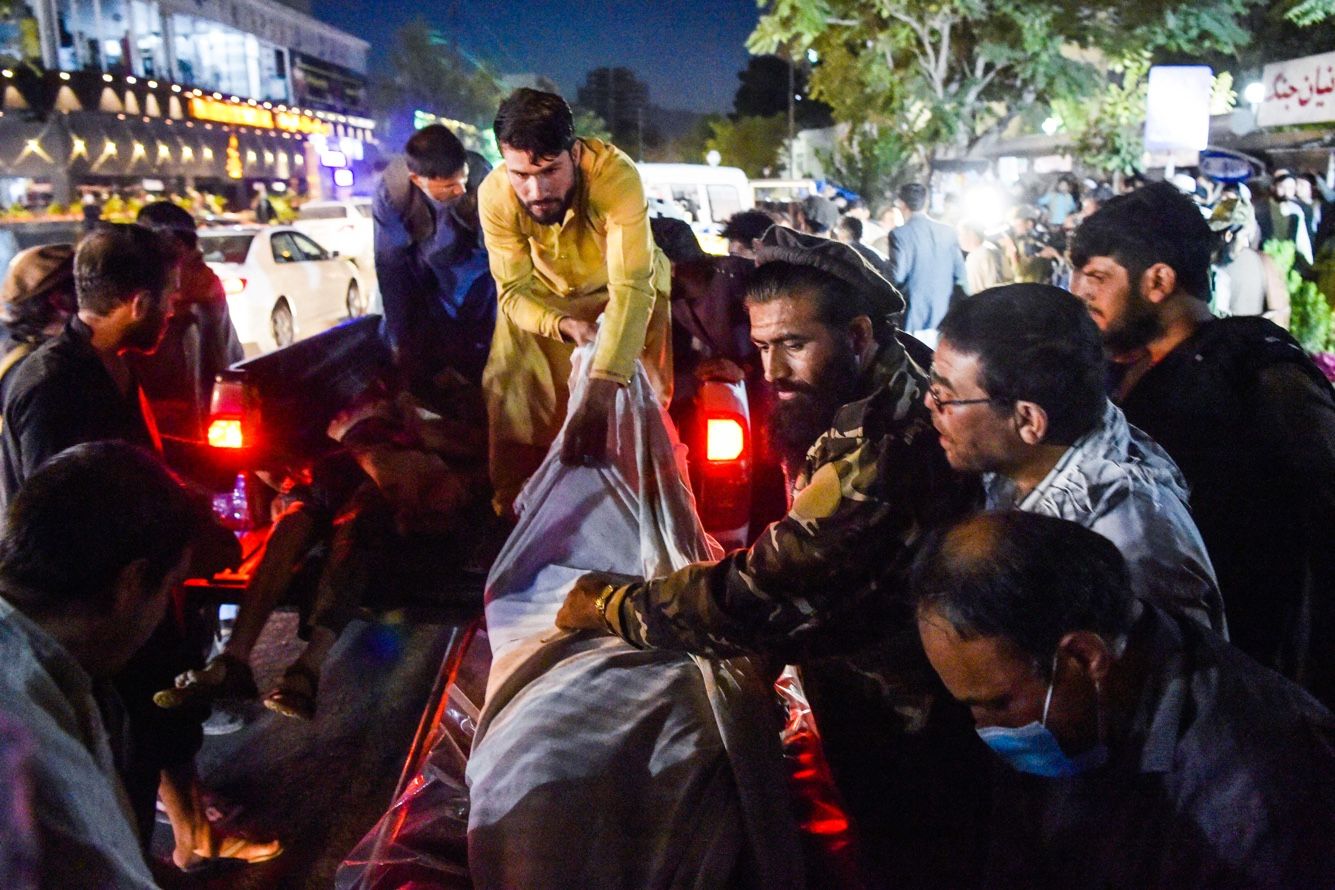
On August 26, 2021, two explosions thundered near the Kabula airport, which were arranged by suicide bombers. As a result, at least 170 people died . The “Islamic State” took responsibility for this attack: this radical Islamic group officially appeared in Afghanistan in early 2015 called “Khorasan Vilayat”. We explain who it is and why the Taliban and the United States consider them such a significant threat that they are even ready to cooperate in order to fight ISIS.
What is an Islamic state in Afghanistan?
When the Taliban occupied Kabul in mid -August 2021, they first captured the building of the National Directorate of Security of Afghanistan and released prisoners - all, except for nine of them, which they executed on the spot. One of the killed was a man known under the pseudonym Abu Omar Khorasani - a former one of the leaders of the Afghan branch of the Islamic State . It was ISIS that took responsibility for a series of deadly terrorist attacks from the Kabul airport on August 26, 2021, which claimed more than 100 people. The official representative of Taliban sharply condemned these terrorist attacks.
The Afghan branch of the Islamic State is known in Western sources under the abbreviations of ISIS-K or IS-KP, where KP means Khorasan Provincy, that is, the “Islamic state in the province of Khorasan”. In the terminology of ISIS himself, this is the “horasan”: “ Vilayatians ” are the administrative units of a non -existent global caliphate, which is trying to build the IG.
Although there is no such province in Afghanistan (but there are three of the same name in neighboring Iran), the historical region of the Big Khorasan, which included parts of modern Iran, Afghanistan, Uzbekistan and Tajikistan, has a special symbolic role in ISIS eschatology . Several hadiths mention the “black banners” that will leave Khorasan and will not stop until they reach Jerusalem.
The last successor of the Prophet Mahdi will come with them, a kind of Messiah, whose parish will announce the end of time. The faithful, according to these hadiths, must join these detachments with black banners, even if you have to crawl in the snow for this. The black banner appears in the symbolism of both ISIS themselves and other, earlier jihadist groups. True, a number of Islamic theologians doubt the reliability of these hadiths.
Where did they come from?
The first emissaries of the Islamic State, according to media reports and observers, appeared in Pakistan in the fall of 2014. They brought with them leaflets in the languages of Pushta and Dari, in which they called on local Muslims swear in the fidelity of the “Khalifa” ISIS Abu Bakru al-Baghdadi and join his worldwide jihad. And in January 2015, the Islamic State, which was then at the peak of its power and international influence, officially announced the creation of Vilailayat Khorasan in Afghanistan.
By this moment, ISIS was already captured by Iraqi Mosul and Syrian Racca, proclaimed the creation of the World Caliphate and took the oath of other radical jihadic groups in other countries - for example, Boko Haram in Nigeria.
According to the Center “Analytical Network in Afghanistan” (AAN), the basis of the new “Vilayata” was members of the Pakistani Islamic groups, who fled in 2010-2011 across the border from the operation of the Pakistan army in the northern regions of the country.
They called themselves “muhajirs” (that is, “refugees” or “immigrants”) and enjoyed the tradition of hospitality of Pashtun peoples. At the end of 2015, according to the analytical center, there were more than 2000 Pakistani “immigrants” with families with families in the Border Afghan Province of Nangarhar, of which about a thousand can be considered active militants.
In early 2015, the emir of Vilayata Khorasan was declared by the field commander Hafiz Said Khan-a former one of the leaders of the Technic---Taliban Pakistan (TTP) group, which included a number of radical Pakistani organizations. True, he did not lead for long - already in August 2016, the American military announced that they had killed Hafiz Said Khan with a blow to the drone. In the ranks of the “Vilayata Khorasan” militants there are a lot of defectors from the Taliban - both Pakistani and Afghan.
In August 2015, the oath of allegiance to the Islamic State in Afghanistan was brought by the leaders of the Islamic Movement of Uzbekistan - the Afghan terrorist group, founded by two natives of the Uzbek SSR, participants in the Soviet contingent in Afghanistan in 1979-1989. In addition, the Indian media reported that in 2016, several dozen Islamists from India joined Vilayat Khorasan.
The United States considered the Afghan ISIS branch as a serious threat that, as reported in 2020, The Washington Post, the American military even conducted a special operation in the Kunar province, supporting the Taliban of rockets and drones from the air at the Vililayat Khorasan positions. In a sense, a special operation can be called jointly: The Washington Post writes that the Americans, without making direct contact with the Taliban, collected information about their military campaigns against ISIS, listening to their radio converters, and then acted on the basis of these intelligence.
The Taliban, notes the publication, seemed to understand this and accepted the help of their formal opponents, putting forward on an attack on the positions of the ISISTOS only after the Americans are at first bombed at them. In addition, it was in the position of “Vilayata Khorasan” in the province of Nangarhar in 2017 that the United States dropped the most powerful Moab bomb in the world.
As a result, Khorasan was not able to make important territorial conquests in Afghanistan - their last stronghold in the province of Nangarhar, the joint military forces of the United States and the Afghan army, with the unspoken support of Taliban, defeated in July 2018. Instead, the ISISITS focused on conducting the most bloody and destructive terrorist attacks, mainly with the participation of death terrorists and directed against civilians (especially the Shiite minority of Afghanistan and Khazareans-the most often persecution), doctors , specialists in the clearance of the territory, civilian activists and journalists.
The terrorist attack alone in April 2018, arranged by a suicide suicide bomber Khorasan from the center of registration of voters in Kabul, took the lives of 69 people. The UN mission in Afghanistan (Unama) counted 77 terrorist attacks for which the Islamic State took responsibility, only in the first four months of 2021.
What is the relationship between Taliban and ISIS?
Officially, the Taliban and the Islamic State are opponents and regularly condemn each other in public statements. Despite the similarity of radical Islamist ideology, there are a number of fundamental differences between them. The Taliban never claimed universal domination and was limited only to claims of power in Afghanistan itself, which the Taliban strive to save from any foreign invaders.
The Taliban also consider newcomers to the Islamists from other countries. In 2001, after the expulsion of Taliban and their then allies from Kabul, the journalists of The Wall Street Journal gained access to the computer, which were left by the fled members of Al-Qaeda. From the documents and correspondence discovered on it, it became clear that there was little mutual understanding between the Taliban and their then allies: Al-Qaeda members considered the Afghans an illiterate rustic, incapable of understanding the Qur'an, and their Taliban would not bring anything good to their homeland, except for the next bombing and international isolation. And ISIS, who broke away from Al-Qaeda in mid-2014, in turn,considers Taliban to be “apostates” and traitors for their willingness to go to negotiations with the United States.
Some observers believe that the connection between the “Islamic state” and “Taliban” still exists-the “Hakkani network”, an independent radical group, allied “Taliban”. The son of its founder, Sirajuddin Hakkani, holds the post of deputy head of Taliban.
The Wall Street Journal writes that the Afghan authorities constantly accused the Hakkani network of hidden support of the Islamic State. The former vice president of Afghanistan Amrulla Salekh also announced the connection of Talibana and the Hakkani network. In addition, there is personnel diffusion between Hakkkanni and Vilayat Khorasan: some members of both groups passed from one to another.
Alexey Kovalev with the participation of Dmitry Kuznets