
Translated material
You can mow. Criminal cases under the "Dadine" article returned to the regions

Illustration: Tanya Safonova / Mediazone
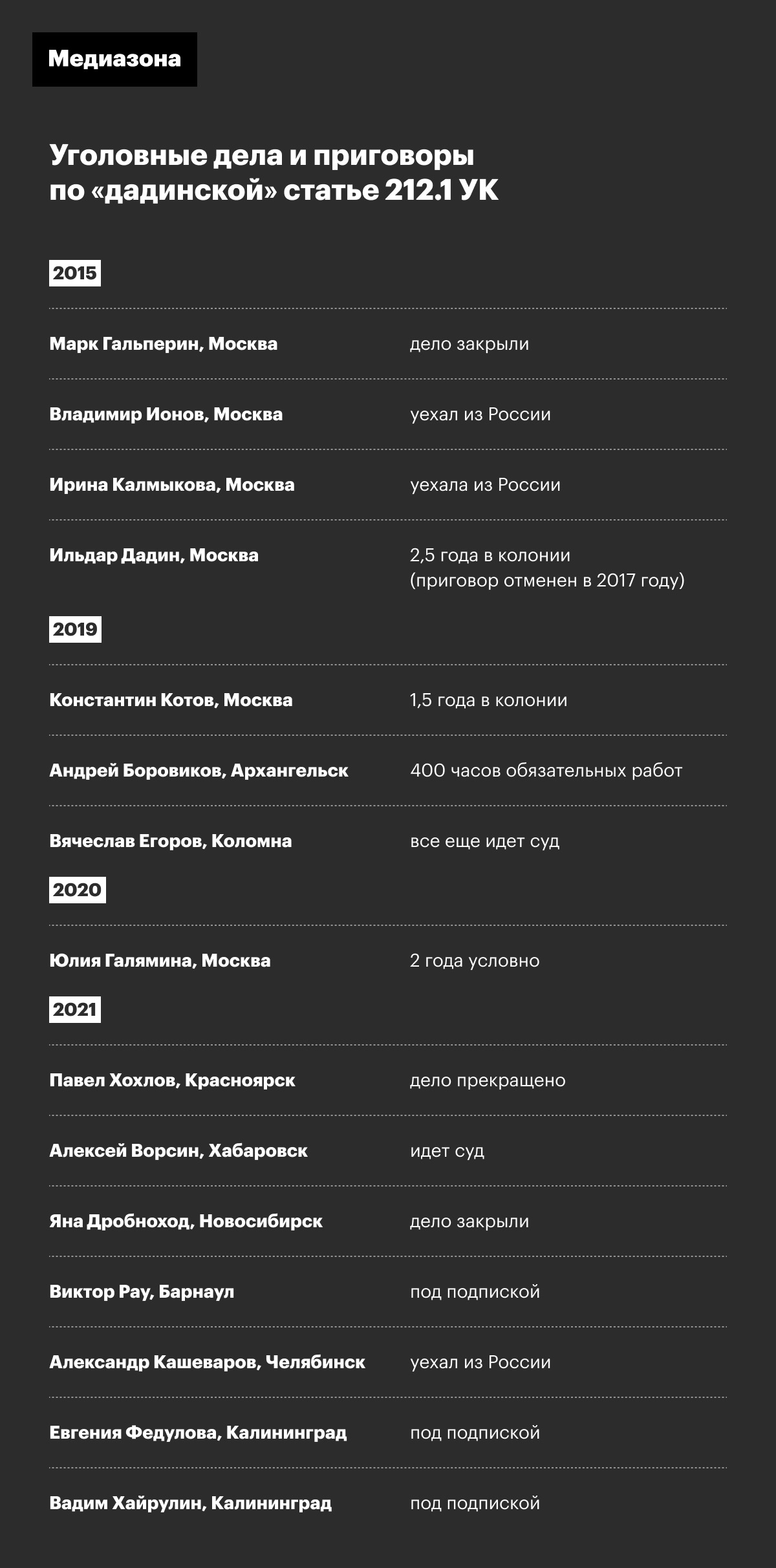
Six months after the winter protests against the detention of Alexei Navalny, a dozen criminal criminal ones have already been opened under Article 212.1 of the Criminal Code - she punishes for repeated participation in inconsistent demonstrations. Even the Constitutional Court was expressed against the article, for several years it was actually frozen, until Moscow security officials again tested it two years ago. Now the practice of pursuing activists has developed and reached the regions - there are already criminal cases in Novosibirsk, Khabarovsk, Chelyabinsk, Krasnoyarsk, Barnaul and Kaliningrad.
At the gates of the Consulate General of Poland, Evgeny Fedulov, the operatives of the EC center were already waiting for. The 45-year-old activist says that she was going to discuss the issue of receiving a visa on this day, August 19, on August 19, a common thing for residents of Kaliningrad. True, Fedulov went there instead of interrogation in the Investigative Committee - on the eve of the investigator called it by phone, but did not hand it to the agenda.
The activist suggests that the investigators learned about the conversation with the consul, listening to her phone. Together with Fedulova, a friend, who accompanied her, Kaliningrad activist Anastasia Nechaev, was also detained.
They were taken to the Office of the IC in the Kaliningrad region. There Fedulova announced that she was a suspect - and sent to. Nechaev was interrogated as a witness. The criminal case was opened on July 18 - a month before the detention. The pre -investigation check began even earlier: a month before, Fedulov was already called for a survey.
The failed meeting with the consul of the UK interpreted as an attempt by Fedulova to escape from the country. In the court, the investigator and the prosecutor demanded that the activist be detained, explaining this by the fact that Fedulova did not come for interrogation, and after the detention, they found a passport and “things necessary for living outside the Russian Federation” in her bag.
But the judge considered that the investigation did not provide evidence of the planned escape to the European Union, and on August 23 the activist was released - without a preventive measure at all.
Almost simultaneously with Fedulova, another Kaliningrad activist, Vadim Khayrulin, became the suspect under the same “Dadinskaya” article.
The reason for initiating affairs against both activists was to participate in the procession in support of Navalny on April 21 - they were not detained that day, but later they decided to hold accountable for participating in an inconsistent demonstration. For both, this violation has already become the fourth over the past six months - and, and, and went to the January rallies in support of Alexei Navalny and participated in pickets, they were delayed and fined or placed for several days. Fedulov, for example, was fined that after the poisoning of Navalny, she entered the center of Kaliningrad with a poster “whose tea, Vova?”.
The court did not consider this protocol for the action on April 21 - instead, the UK opened a criminal case. Article 212.1 of the Criminal Code can excite just against a person who, for six months, was at least three times brought to administrative responsibility for participating in rallies.
“This is political persecution,” says the Kaliningrad activist. Having been released, Fedulova told reporters of the New Kaliningrad that she was not going to participate in protests anymore: “I am not a bulk, I am not a hero to put my life on a fight. Well, I can’t go to the rally next time: here, take me and plant me. I can’t ruin my life in prison ... Of course, I would not survive, there. This is not a place for me at all - I am a creative, free person. My views remain the same, but since in our country there is neither freedom of speech, nor human rights, we have no other way out. ”
The article freezes
This article 212.1 of the Criminal Code was invented, “in order to prevent mass riots according to the Ukrainian scenario,” the deputies who introduced the bill to the State Duma in the spring of 2014 explained its need.
Soon the article began to be applied against activists - the first cases were brought on several regular participants in the pickets and “walks of the opposition”: Ildar Dadina, Irina Kalmykova, Mark Halperin and Vladimir Ionov. But the verdict eventually passed Dadina - Ionov went to Ukraine, Kalmykova in Lithuania, and the case of Halperin was closed (but the activist was still imprisoned on charges of extremism).
In 2015, Dadina was sentenced to three years in prison, after an appeal in the Moscow City Court, the term was reduced by a year. He got to the Karelian IK-7-and after a while he handed over a letter with a story about torture in the colony.
At the beginning of 2017, Dadina was released-at first the Constitutional Court found violations of the Basic Law in the article itself, and then the Supreme Court recognized the verdict to the activist unlawful.
The Constitutional Court then clarified that the case under Article 212.1 of the Criminal Code could be instituted only if there were three court decisions that have entered into force in the case of Dadin, this requirement was not fulfilled.
Moreover, the Constitutional Court ruled that the formal violations of the rally legislation are not enough for a criminal case - it is necessary that the participation of the accused in shares entails “causing or real threat to harm to the health of citizens, property of individuals or legal entities, the environment, public order, public security or other constitutionally protected values”.
The article was not used for several years - until in 2019, it was not convicted of the programmer Konstantin Kotov. This time, the investigation used the vague formulation of the Constitutional Court of the “harm”; Kotov received four years for participating in protest and post on Facebook. Soon, the Constitutional Court ruled , and the Moscow City Court softened the sentence until one and a half years in the colony. In December 2020, Kotov left the colony-he was sitting in IK-2 in Pokrov, where Alexei Navalny is now.
Another convicted person in the same 2019 was the Arkhangelsk activist Andrei Borovikov, he was sentenced to 400 hours of compulsory work.
After that, the Investigative Committee has not turned to the "Dadin" article for a year. But in December 2020, the Moscow activist and municipal deputy Julia Galyamin received a conditional time-Galyamina herselfis sure that the reason for the persecution was the desire of the authorities not to allow her.
Who and how they were judged by the “Dadin” article until 2021 * Ildar Dadin against Article 212.1 of the Criminal Code “Real Threat”. Why the decision of the Constitutional Court on the “Dadinskaya” article did not prevent Constantin Kotov from condemning “History with Kotov, of course, scared me.” As an activist from Arkhangelsk, he became the third convicted person under the “Dadin” article (and at the same time - the head of the headquarters of Navalny) * Normal Russia of the future. The last word of Julia Galyamina
And again returns
The new surge in the “Dadinskaya” article occurred in 2021 - after the protest shares in support of Navalny. At least eight criminal cases have already been instituted in different regions - in Novosibirsk, Khabarovsk, Chelyabinsk, Krasnoyarsk, Barnaul and Kaliningrad. In two cases, things were terminated on non-rehabilitating grounds-Yana Frontsikhok from Novosibirsk took off a judicial fine, and the case against Pavel Khokhlov from Krasnoyarsk was terminated due to “active remorse”.
According to the lawyer, new cases are now due to the fact that law enforcement practice has nevertheless developed on it - and the security forces use it to pursue the disagreements. Until recently, Eismont says, the protest was primarily the work of Moscow and St. Petersburg, and the appearance of more and more criminal cases under the “Dadinskaya” article indicates that now the regions are protesting regularly and massively.
“It is clear that after the January actions, the topic of mass protest of citizens sounded again loudly and throughout Russia,” Eismont notes. - Therefore, it would be strange if they, having hung so many guns on the wall, cleaning them even with the help of a constitutional court and opening the way for this practice by the Kotov case, first of all, [would not pursue protesters] - the practice has developed. You can mow on it. Apparently, there was a political task - to reanimate this article. ”
Editor: Yegor Skovoroda