
Translated material
Love on the eve of evil
The story of the unrequited feelings of the boy of Seny to the girl Nate shortly before the execution in Babi Yar
Senya and Nat
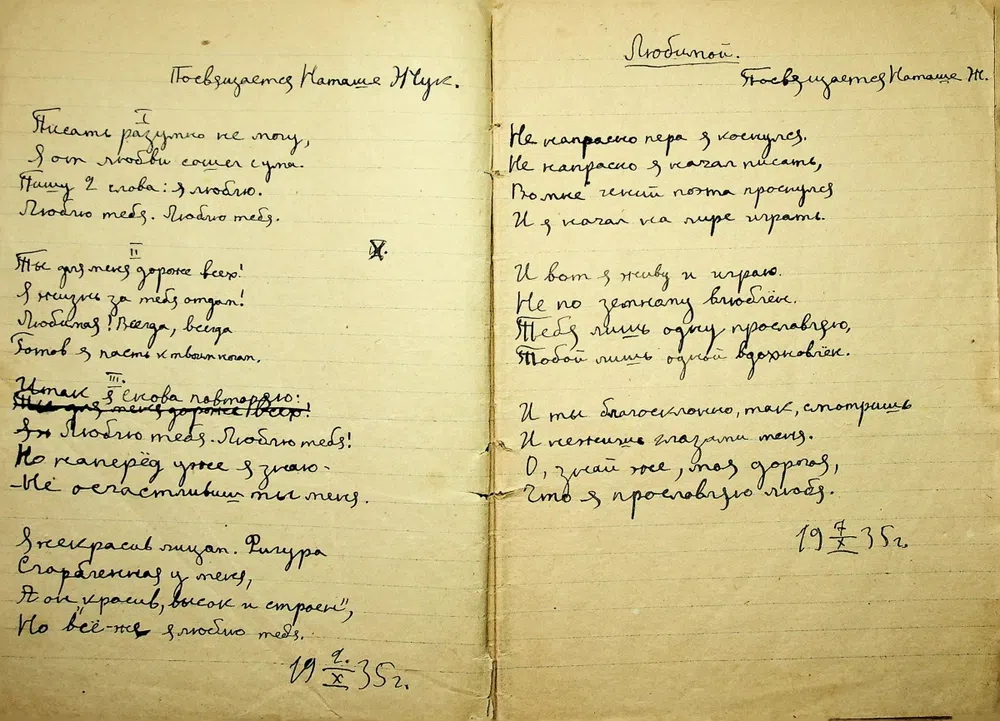
A yellowed common notebook, non -school, into a wide ruler*. In the middle and in the center of the first page - in large, uncertain letters - bred:
*For memory Natasha Zhuk
from
Seny Zvonitsky*
And further, one after another, a page behind the page, there are poems by this very canopy- seven- or, possibly, an eighth grader. More precisely, 15 screams or sobs over the ears of a boy in love - ardent, touching and sincere, but literary inept, even clumsy.
Here is their model:
Dedicated by N.Zh.
Again the storm trembles in the shower,
Again my thoughts are bubbling!
Again life boils in me!
And I am happy with this storm.
You forgave me, and I am a fighter again.
I'm standing again in a mighty building.
Your court, I am again a poet and singer,
And I again sing the stans to you.
The forces again sounds in the verse,
To friendship, calling for love.
Know - alone, alone, only to you
I devote all my poems to my poems.
1935.30.xi
All 15 poems were written during October, November and December 1935, that is, in the first school half -year. And all-are dedicated to one single-class girl-Natasha Zhuk (only in a couple of the latter to the addressees, a certain “L.S.” was added to the addresses-presumably the very mysterious third whom Senya considered his happy rival).
Poems, as a rule, have names and initiations, but there is no difference between them: “dedicated to Natasha Zhuk”, “N.Zh.” (twice), “my beloved”, “my jewelry”, “a letter to the queen of thoughts - from the poet”, “in the album” (twice), “an eternal friend - a beloved forever”, “imitation”, “friends”, “best and only friends”.
It would seem an ordinary business. The boy fell in love with a girl, a classmate in a classmate, but did not feel reciprocity, why only wound up even more, and then, then-a hand to the feather, a feather to paper-and here you are, Natka, my poems, that’s what I feel for you and because of you, know, Natasha! Touching, but banal, in essence, history.
But everything turns over when you read on the first page of the notebook a record with a ballpoint pen. She was made by Natasha Zhuk herself - the addressee of the poems,
After years, probably 30 or 40 after she received this notebook from lovers, with which, before giving it to the archive, she did not part.
Here's what she wrote:
“Sene was 14 years old, like me, when he wrote these verses.
Senya Zvontsky - my school friend, died with his mother in Babi Yar (Kyiv) at the end of September 1941. 12 days after the Germans entered Kyiv. His father - Eser - died in concentration camps from tuberculosis. Mother was a teacher of Franz [of the Ksatsky] language. Mother died with a canopy together. "
It turns out that Arseniy Zvontsky, the author of these inept lapeling, is one of the tens of thousands of victims of a monstrous execution in Babi Yar. In the base of the established names of the victims of Babi Yar, the surname Zvodnitsky is found five times:
Veniamin Markovich (born in 1868),
Sofia (born in 1873, nee Sukotskaya),
Eugene (born in 1910, nee Avrutskaya),
Maya (born 1936)
And - without a name and initials. It is possible that the nameless is Senya .
What did he feel when the Red Army left the city and entered it brown?
Isn't that what Vasily Grossman described?
“In these minutes, everyone felt with bodily obviousness that every step to the east of the departing Soviet troops is fatally connected with the movement of the still invisible German columns. They were approaching closer, methodically, step by step and each step of the Red Army men leaving for the Dnieper brought closer to Kyiv by Hitler.
And as if caused by the approaching black force, in the lanes, dark gateways, new people appeared in the booming courtyards, their quick, unkind eyes grinned boldly, their whisper became louder, they squinted, looked at the wires, prepared for the meeting. And here, passing the lane, Krylov first heard, then more than once the words he had heard: "Sho Bula, then Bachili, sho wleams."
Grossman V. from the first edition of the novel “For Just business” (reported by Yu. Volokhova).
Is it not about that 15-year-old Sofa Malovitskaya wrote on September 9 from Kyiv to Voronezh Aze Polyakova, who was evacuated by her friend:
“ ... We stayed for the faithful death ” **.
A common notebook with verses is the last and only that remains in this world from the hauls of Zvonitsky and from his love.
Not even six years have passed since their spelling at the end of September 1941, but Babi Yar seems to return the author to his “forenight years” ***. And he makes his poems indirectly “involved” in real anthology.
And how to know! Maybe that legendary Ukrainian boy who, of his own free will, went to Babi Yar with a Jewish girl, his lover, and her mother, maybe he also wrote poetry to her?!
Nata and her family
So, a notebook with verses, their author is known, and the addressee is also known.
... There are no problems with the personal service of Natasha Zhuk. This is Natalya Borisovna Tarasova: the surname - in the first husband, Sergey Alekseevich Tarasov (1917-1982).
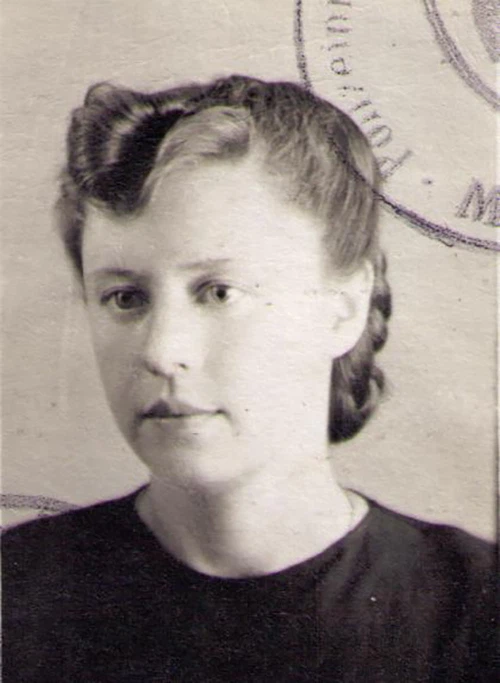
Natasha Zhuk was born on June 18, 1921 in Kyiv. Father is a Ukrainian ethnographer, art critic and archaeologist Boris Kasyanovich Zhuk (05/13/1878, Kyiv-11/22/1960, Frankfurt on the Main)-professor of the Kyiv Theater Institute and deputy director of the Museum of Ukrainian Folk Art. During the years of occupation, he professed at the University of Kiev, there was also taught by the Russian language and her mother, Lidia Ilyinichna Zhuk, nee Baratynskaya. In November 1943, his father insisted on leaving the whole family to the west, where he also took out his personal collection of jewelry of Kievan Rus from a treasure found in a tenor church .
Daughter Natasha in 1939-1941 She studied at the Faculty of Biology of Kyiv University, and in 1943-1945. - Already in exile - natural sciences at universities in Vienna and Innsbruck. In 1945, the family moved from former Austria to former Germany, to the Menhegof camp near Kassel, where a rather dense environment of diplomians, that is, displaced persons, had already developed. By the middle of December 1945, there were more than 2500 people in the camp, leading a difficult-half-shine and barracks-the post-war life of non-evidence refugees-and even under the eternal threat of violent repatriation in the USSR.
There and then it began under the strongest influence of the Archbishop Nafanail (Lviv; 1906-1986), the shepherd of the second emigration wave, the churching of Nata Zhuk: she stored for the end of her life for Nafanail Gospel. Later, having settled in Frankfurt, Natalia Borisovna became a loyal parishioner of the Frankfurt Temple.
In 1946, back in Menhegof, she married Sergey Alekseevich Tarasov (1917-1982), whom she was familiar with - and even a reserved person - back in the Innsbruck. But this marriage broke up, imprinted in the daughter of Alena (Elena). In 1955, Natalya Tarasova married for the second time-for Mikhail Ivanovich Parfenov (1919-1977): the family grew up with two more daughters-the reception (Masha) and the native (Nadia). Both husbands are prominent figures of the People’s Labor Union (NTS), and the second is also his treasurer. Natalia herself was a member of this union: all her subsequent secular life was held in his ranks.
In 1946, the first issue of the Enteis magazine "City" was published in Menhegof. The very one, as well as with the NTS, is closely woven by the literary life of Natalia Tarasova - both the author and editorial. Natalia Tarasova published her first story-“Berlin”-published in the New York “New Russian Word” in 1948. In 1951, the first publication in the Flays, and in 1956, Tarasov became part of the editorial office of the magazine. From 1962 to 1982, she was the editor -in -chief of the magazine, while continuing to be printed both in Russian and German periodicals (for the latter she had a separate pseudonym - Barbara Bode).
Having left the “line” in 1982, she, to the amazement of many colleagues, took an outwardly extremely extravagant, but internally completely logical step in September 1983-she went to the monastery, becoming a novice and inhabitant of the Holy Bogoroditsky Lesnensky monastery in a prime minister in France. The monastery library, which Alexander’s mother (this church name) brought her obedience to her, led to an ideal order.
Alexander’s mother died, she was Natalya Borisovna Tarasova, she was Natalia Zhuk, on January 8, 2006 and was buried in the rural pro -Utonian cemetery ****.
Senya and his family
But what do we know about the author of poems - about the hay, about Arsenia Zvontsk?
And for what is here, in the search, to catch on?
For the mother - a French teacher?
Or, maybe, for the Socialist-Revolutionary Father, who died in the Gulag?
The combination of the surname of the father and Socialist -Revolutionaries walked only one result. Here he is:
“... British consul in Baku Ronald Mc Donell brings into the diary:“ The soldiers of the Caucasian army are covered by concern, as if others, more quick-hearted, did not share the entire land of the landlords before their return. ”
- Want to get the land? - At the rallies, the chief Baku expert on the peasant needs of Socialist -Revolutionary Zerotnitsky asks. “Thirty -seven acres with a complete guarantee, as soon as our Socialist -Revolutionary Party comes to power!” Record to the Socialist -Revolutionaries immediately after the meeting ... Remember, thirty -seven acres to everyone!
The catch of Zvontsky is not at all bad. At the end of May, after the merger of the Council of Workers 'Deputies and the Council of Soldiers' Deputies, the Socialist Revolutionaries have two -thirds of the vote. Plus fifty six Mensheviks. Even in the addition of Dashnaksakans, the obligatory allies of those in power.
The Bolsheviks are only twenty -five. The dream of Sako Sahakyan comes true. The chairman's bell is in his hands. ”
Dubinsky-Muhadze I. Narimanov. M.: Young Guard, 1977. S. 69.
1918, Baku? So far? Kiev?
Why not? Remember.
We are looking for further and - we find! First - in library catalogs - father: Zvonitsky Alexander Solomonovich , author of the book “ On the pledge of Russian law” (Kiev - Spas: N.Ya. Ogloblin, 1912. XVI, 401 pp.). This book is dedicated to the author of the author - Clara Samoilovna Zvonitskaya, so we find Senin grandmother *****.
But the main family celebrity was, undoubtedly, Agnes Solomonovna Zvontskaya (04/05/1897-17.08.1942) -native aunt Arseny and her father’s younger sister, the first woman-sociologist in Russia ******. She was born and studied at a gymnasium in Kyiv, then at a foreign university - at Heidelberg, where she studied the right. The First World War squeezed her from Germany to Switzerland, where she continued to study for a while, and in 1915 returned to Kyiv.
Its original system of sociological concepts has developed surprisingly early. The central in it was the concept of social connection, that is, the dynamics of the consciousness of people who enter into interaction with each other, which largely brought sociology closer to psychology.
This is amazing, but already at the beginning of 1914, - in the incomplete 18 years - she published her first book: “The experience of theoretical sociology. T. 1. Social connection ”*******. Reviewing it in the March issue of the magazine “Testaments”, Pitimim Sorokin wrote: “ Extensive erudition, systematic thinking, the integrity of construction, discovered in this work, make a valuable contribution to the library of Russian sociology .” This book was conceived by the first volume of the conceived four -volume, which was to complete the “analysis of the method of sociological science”. This, however, was never written, while the second (“Sociology as a doctrine of personality”) and the third volume were written, but alas, they did not see Sveta.
After the revolution, Agnes Zvontskaya moved to Petrograd - at the invitation of Sorokin, presumably. In 1918-1921 She worked at the famous Bekhterev Institute for the Study of the Brain and Mental Activities - she had an assistant to the laboratory of collective reflexology, which was taught consistently Sorokin, V.M. Bekhterev and finally she herself. The research field of the Zvontskaya was the sociological aspects of labor activity and labor protection in Russia, as well as the mental performance of children in groups and alone.
Father's illness forced her to return to Kyiv, where in 1921-1925. She taught at the Law Faculty of the Institute of National Economy. In the 1923/24 academic year, she organized and headed the office of the Department of Criminal Law, or, otherwise, the “legal clinic”, who studied personalities and psychology of both criminals and witnesses and judges. At the same time, she prepared a large work “On the nature of science” for printing.
When the father died in 1925, Agnes Solomonovna returned to her “city familiar to tears”, where she settled with her relatives, in the family of her cousin-Julian Vladimirovich Zvoniki (1897–1939)-a brigade military doctor and head of the military sanitary department of the Leningrad Military District. In 1925-1929 She is again a researcher at the Institute of Brain and at the same time - more precisely: in 1926-1930. - A researcher at the Leningrad branch of the Institute for the Study of the Criminal and Crime at the OGPU of the USSR (here she developed the methodology of sociological surveys of crime and penitentiary case). In 1930-1936 - Work by a senior assistant in the psychotechnical laboratory of local transport of the Leningrad city railway (work on characterological tests and psychodiagnostics), as well as in the psychology section of the Institute of Scientific Pedagogy.
The last place of her work in Leningrad is the public library, where it was credited with the chief librarian on April 10, 1937 with a salary of 400 rubles. After not five months, from September 1, she quit at her own free will ********. In the statement of dismissal, it means “in view of the difficulties to combine with work in the specialty”, but the true reason is most likely connected with a great terror: in Kyiv her brother, Senin’s father was arrested, and in Leningrad - August 11, 1937 - and her cousin, which and under the protection of which she lived all her Leningrad years *********.
After that, Agnes Solomonovna began to overcome diseases. At the beginning of the war, she was evacuated in Frunze, from where she moved to the village of Buruldey, where she instilled in a rural school for a year. She died in Buruldea - August 17, 1942.
PostScriptum
Arseny’s notebook with verses indirectly tells us about one thing-about that national tolerance and internal openness, which developed in Soviet Kyiv before the war-in the 1930s. The Jewish boy falls in love with the Ukrainian girl-classmate, he writes and gives her his ardent verses; The same, knowing about his death in Babi Yar, lives up to 85 years and, even becoming a nun, retains a notebook until the end of her life and takes care that she does not disappear after her death, puts in her archive.
The same - about the reduced degree of national self -identification, that is, in essence, about the interethnic world - recalls Anatoly Kuznetsov in his "woman's Yar". In 1941, he was only 7 or 8 years old, half as much than the Seine and Nate in 1935. The invaders glued all the fences and advertising cabins of Kyiv with their posters. And on one of them Tolik “ ... read such that he did not believe his eyes:
"Jews, Lyahs and Moskali are the most important enemies of Ukraine!"
For this poster, for the first time in my life, I thought: who am I? My mother is Ukrainian, father is Russian. Half a Ukrainian, half Moskal, I, therefore, is an enemy to myself.
Further - worse. My best friends were: Matsa’s shurka - half a Jew, that is, a Jew, and Bolik Kaminsky - half a Pole, that is, Lyha. Continuous devilry. Immediately reported to the grandmother.
“Do not pay attention, son,” she said. - That fools wrote.
Suppose fools. But they did not write, but printed. Why print such nonsense and put on fences? .. "
Or another episode from Kuznetsov - this time with the "positive", from the point of view of the invaders, ethnic connotation:
“Once after the dining room, we went to Lyala. And suddenly I saw on the table a loaf of real fresh bread, a jam jar, a little cat.
I literally dumbfounded.
“They give us out,” Lyalya said.
- Where?
I was ready to run and shout: “Grandma, what do you not know, they already give out, but we don’t get, rather run!”
Lyalya showed me a notice. It said that Volksduch should appear in such and such a month in such and such a store, to have hacks, bags and banks with you.
- What does Volksdeuto mean?
- This means - half -German, almost Germans.
“Are you Germans?”
- No, we are Finns. And the Finns are an Aryan nation, Volksdouche. And Aunt said that I would go to study at a school for the Volksdyuchi, I will be a translator like she is.
“That's how you got a job,” I muttered, still not quite comprehending this difficulty: there was Lalya, a girlfriend, almost a sister, everything in half, and suddenly she was an Aryan nation, and I am a lower ...
Previously, the selected party members lived, they received everything from the bases, they did not know the queues. Now the same is the Aryans. Either party members, then Aryans. A furious hungry anger broke out in me. So this is not working for us, so we worse the horse chestnuts, and they already live!
“So, so, with a Volksdouche,” I said gloomily. “Do you also go to the starving canteen, Zar-Raza?”
And I left, so banging the door so that it became ashamed myself, but for many years I hated it, although somewhere deep down I understood: what does Lalka have to do with it? .. ”
But the Germans were not fools, putting all these leaflets around the city, printed in a field military printing house. So many eyes of the eyes, having read them, joyfully grinned, but hatred - to the Jews, to the Lyahs, to the Muscovites, separately to the Partys - at a time, woke up, sprouted inside and burst out. Entire streams of amateur, but agile anti -Semitism then spread out according to the bends of the Kyiv relief - to meet with the ninth shaft of the anti -Semitism of German, state, from a needle, highly professional - towards the woman’s tier.