Date
Author
Антонина Асанова, Катя Бонч-Осмоловская, Артем Щенников
Source

Preserved copy
Translated material
What are you taking?!
The results of the State Duma in five graphs. Research "New"
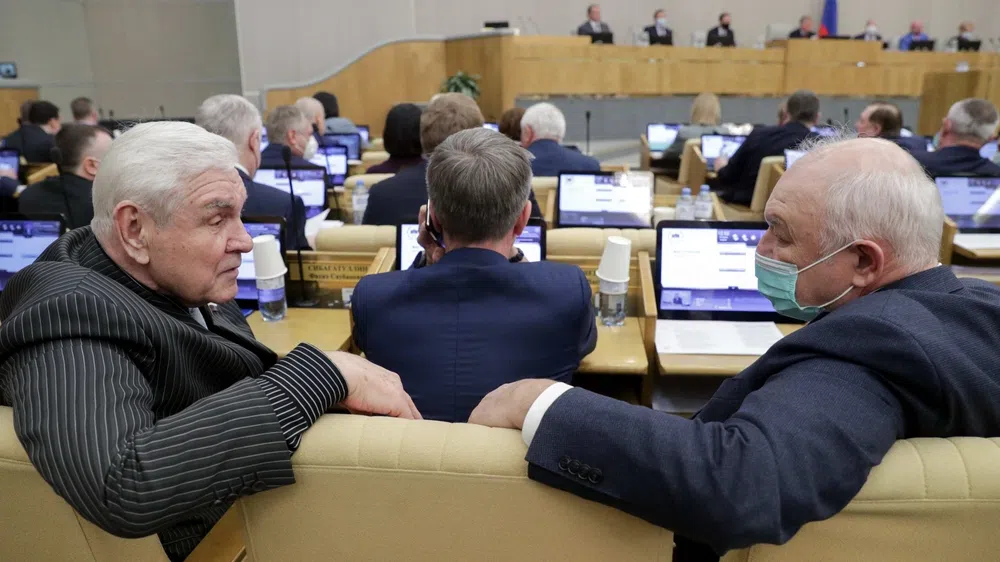
Iron discipline, voting only “for” and collective lawmaking - “New Gazeta” collected and analyzed information about 26 thousand bills and two thousand deputies to understand where the State Duma is moving for the past 20 years. Here are five features of the Russian parliament that we traveled on the data.
1. Everything will accept
In the last, seventh convocation, the Duma set a peculiar record. The deputies first adopted more laws introduced to the current session, which rejected (2380 bills were adopted, 2129 were rejected).
The country's parliament has gone to this result from the beginning of the two thousandth. For comparison, in the State Duma of the third convocation - the last, when United Russia did not have a majority (2000-2003) - only 16% of the bills introduced were adopted.
How did the Duma manage to achieve such "effectiveness"?
In the last convocation, United Russia had a constitutional majority - 74% of places. Lack of competition allows her to introduce and quickly adopt the necessary bills. According to our estimates, 29% of the bills adopted in the latest convocation were introduced from the United Russia faction, that is, directly from the party leadership.
More and more bills are introduced by the government. (We will tell you more about this below.) And such bills are more often adopted. In the last convocation, the State Duma approved 81% of government initiatives and 99% of the presidential bills.
In the latest convocation of people's deputies, they limited them to the freedom to submit their bills. Deputies were recommended to coordinate their initiatives with the leadership of their factions. Due to this, parliamentarians began to introduce fewer “unpromising” bills and initiatives aimed just at the PR of the deputy, experts say.
As we thought
Using the State Duma API site, we have collected information about all the bills submitted for consideration by the Duma from the 3rd to the 7th convocation (26.3 thousand initiatives), as well as all the results of the latest votes. We determined whether the deputies adopted the bill or rejected. We also calculated the number of readings for which the deputies adopted the law.
We calculated the convocation number by the date of introduction of bills. Among the initiators took into account only State Duma deputies, unless otherwise indicated.
Grigory Golosov, Dean of the Faculty of Political Sciences of the "European University":
- The growth of the share of the accepted bills speaks simply about the intensity of the work of the presidential administration on the preparation of bills. Moreover, we are talking not only about those bills that are prepared directly in the presidential administration, but also that the presidential administration still approves of those bills that are submitted on behalf of the deputies. And before they put it off, but now, obviously, they considered it necessary to speed up the legislative process.
This (the growth of “approval”.- Ed. ) Never to do with the own activity of the State Duma, because it is generally not an active subject of the legislative process in Russia.
2. He does not like discussions
Deputies are increasingly adopting bills without the discussion by the regulations - that is, in several readings in one day. The peak of such high -speed examinations came at the sixth convocation (2011-2016), when the Duma was called the "frantic printer." In the latest convocation in an accelerated mode, every third of the bill submitted (752 initiatives) was adopted.
Parliamentarians practically stopped discussing draft laws at plenary meetings. According to the “New” estimates, on average, on the discussion, one bill in the seventh convocation was allocated only 18 minutes. In the sixth convocation - even less than 14 minutes.
The “zeroing” of the deadlines of President Vladimir Putin was discussed at plenary meetings for 25 minutes.
Age restrictions of 65 and 70 years for the work of officials appointed by the president were canceled in 21 minutes.
The Law on LGBT Propagand, the “Dadin” article that allows you to plant pickets for several exits, and the law on unwanted organizations discussed for less than an hour-45–46 minutes each.
The law against the FBK*, which prohibits the run to deputies to members of extremist organizations, was adopted in 50 minutes.
Ekaterina Shulman, political scientist, specialist on lawmaking problems:
- The problem is not so much in the speed of consideration (it decreased in the seventh convocation compared to the sixth), but in the fact that the main substantive discussion - trade between groups of interests - is secretly at a plenary meeting. The most public stages of the legislative process become the least significant and saturated, more ritual.
In those parliaments where there are no guaranteed majority, of course, plenary meetings are more substantial. There is more, so to speak, battles are happening. We would like to strive for this. But you can strive for this in one way: increasing political competition in parliament. If you have a majority, especially constitutional, you don’t have to discuss something at all, you can just accept everything you want without asking anyone.
3. Encourages discipline
The most protest parliamentary faction of the seventh convocation is the Communist Party. She managed to get this nomination with only 7% of the vote “against” in final votes on all bills. The deputies from the “EP” since 2004 in 99.9% of cases vote “for” any initiatives that have reached the last stage.
But the deputies are increasingly simply missing voting. Almost every third parliamentarian from the Communist Party and LDPR in the last convocation was absent on the final votes under the bills. Even in the EP faction, this figure reached 10%.
Indeed, deputies refrain from voting against. In recent years, this began to be perceived as a demonstrative statement, an open speech, experts explain. Instead, parliamentarians often simply do not vote.
On the one hand, a simple majority is needed to make most decisions - this is 226 votes for the pros. There is no deputy or presses the “against” button, it does not matter - he still does not support the bill.
On the other hand, the people's deputies really often miss the State Duma meetings. Sometimes the Sopartians vote for them. So, at the beginning of this year, deputy Vakha Agayev died of coronavirus, but on the day of death managed to vote for eight bills.
In United Russia, iron discipline reigns at all - sanctions may follow for voting against important bills for the party. Natalia Poklonskaya, who voted against raising the retirement age, was first deprived of the post of head of the commission to control information on the income of deputies, and then sent an ambassador to a tiny cabin. Oksana Pushkina, who opposed the EP initiatives, for example, on the restriction of abortion , will also not be in this convocation. The deputy from the YP faction Anton Romanov voted against the "Package of Yarova", Boris Reznik - against the law of Dima Yakovlev. There were no both in the next convocation.
Grigory Golosov:
- The fact that the deputies do not vote against can be explained by the fact that parliamentarians who are going to be elected ( once again. - Ed. ), They are afraid that they will not be missed into the Duma, and those who are not going to be elected will not want to spoil their future life. Of course, if a person is going to make a career dependent on the state or in the executive branch, and if he at the same time gets a note as not a very trustworthy frame, he cannot expect anything good from this. “If you have earned the reputation of Balamut, you will have problems” - not necessary, but people are careful.
4. Friends with the government
The laws adopted by the Duma are increasingly writing in recent years. Back in the 2000s, it introduced 300-400 bills in the convocation. And in the last five years - has prepared 1.6 thousand initiatives.
At the same time, the executive branch has the highest approval indicator. Deputies adopt up to 92–93% of government bills and up to 99% of the president’s initiatives. For comparison: in general, deputies adopt from 16 to 42% of the bills according to the convictions.
Ekaterina Shulman:
-The government began to introduce more bills, because there was an idea that it should be the main lawmaker, because he knows better what economics, social sphere needs, it is not tied to elected situation and some political interests. This is called the "theory of equilibrium parliamentarism." Strange as it may seem, her defender was Igor Shuvalov, who wrote a whole book on this subject - “The Government of the Russian Federation in the legislative process” - back in 2004. There, referring to the experience of France, he wrote that the bulk of the bills should be introduced by the executive branch - the government.
This is all very cute, but in France a parliamentary democracy. If your government is formed by parliament, it is logical that the government formed from the parliament, and the parliament itself with each other is transferred to bills. In our case, this is not so. The parliament has nothing to do with the formation of the government. But this thought, of course, fell on the soul of the executive branch, so they further spent this idea over the next years of development of our parliamentarism. And since just after 2003 a stable pro -government major was formed, there was no one to mind.
5. Loves to be in the majority
Since 2012, the lists of the initiators of bills sometimes look like a list of ships by Homer. The law of Dima Yakovlev put forward 436 deputies and senators with the whole parliament. The law on counter -sanctions against the United States of 2018, which allows people and the company to recognize “unfriendly” ones and freeze their accounts, signed 370 deputies.
A new unofficial expression appeared in the Duma - the “mass grave”. Such a phrase began to be called a format when hundreds of deputies immediately introduce the bill.
Lawmaking as a whole is becoming more and more a collective business. Until 2011, 3-4 deputies of the State Duma were introduced on average on average. In the latest convocation, the average initiative was nominated by a navigator.
The practice of collective introduction of bills existed before, but became mass in the last two convocations. 87 out of 100 bills with the most extensive number of initiators were introduced after 2012.
Why are the bills introducing hundreds of deputies?
The massive signing is designed to demonstrate both voters and external observers by the political unity of deputies, which overcomes interfraction differences.
There is a more pragmatic reason. If several fractions and dozens of deputies introduce the bill at once, it is more likely that it will be accepted quickly and without scandals. That is why collective introduction is sometimes practiced abroad, for example in the USA.
Finally, the deputies themselves try to follow personal KPI. The effectiveness of the deputy is measured by how many bills he introduced and how many of them were adopted. Therefore, parliamentarians often try to subscribe to the initiatives that will probably be accepted. So they earn points for an intrafraction assessment of effectiveness.
Vladimir Gelman, Professor of the European University:
- Not always all parties in chorus support bills. When some bills are pushed by United Russia, but at the same time they meet resistance from other parties, this can cause an undesirable resonance. The current convocation in the State Duma, in particular, decided to increase the retirement age. This is a very unpopular measure, and it is not surprising that United Russia supported it, and other parties did not. And “United Russia”, frankly, from such success a little uneasy. If other parties supported this bill, they probably would have felt more comfortable.
Editor Arnold Khachaturov
With the participation of Nadezhda Sidorenko and Ilya Mastyukov
* The Moscow City Court recognized the FBK and the headquarters of the Navalny extremist structure and banned their activities on the territory of the Russian Federation, they are included in the List of NGOs that perform the function of a foreign agent.