
Translated material
Pressed on gas
Europe publicly accused Gazprom of blackmail. The era of large "flows" is coming to an end
“A thousand dollars per thousand cubic meters” - such an alluring forecast for blue fuel was given by the head of Gazprom Alexei Miller in 2008, based on an unprecedented increase in oil prices: then they reached a historical maximum of $ 140 per barrel. After 13 years, this forecast actually came true - in September 2021, gas prices in Europe stopped half -step from this mark. However, the reasons for the “ideal storm” in gas markets this year turned out to be completely different.
Winter is close
In the market in Europe - the main export market for Russia - this year many of the previously seemingly impossible scenarios came together. It all started with the fact that due to abnormal frosts that swept over the past winter throughout the northern hemisphere, by the summer, underground gas storage facilities in Europe approached pretty empty. And already in the summer it turned out that there is actually nothing to replenish these reserves to a comfortable level - there is a gas deficit in the world.
The production of liquefied natural gas at factories from Australia to Trinidad and Tobago and from Nigeria to Indonesia turned out to be significantly lower than the design capacity-for individual reasons from problems in deposits to conducting the necessary repair and preventive work in production. And the LNG that nevertheless gets to the market, first of all, goes to Asia, where the economies are actively restored after coronacials, and China continues to be directed by the policy of replacing the coal with gas.
Norway, the second main gas supplier to the European market after Russia, in the summer and early fall, carried out prevention at its deposits and gas pipelines and also could not saturate the growing appetite of the gas market.
In addition to the fundamental factors of the market, in the current price storm there is a serious factor in financial players who disperse gas prices to maximums and provoking the irrational behavior of traders - for example, the selection from the PPG before the heating season. The consequences are the strongest - in Europe, production that depends on natural gas even stop .
There are a lot of fragments in the mosaic of the gas market of Europe this year, where prices took off to $ 970 per thousand cubic meters. However, many influential European analysts, journalists and politicians are unanimous in opinion: the main culprit of the gas deficit in the market is the Russian Gazprom.
Game for raising
By the beginning of 2021, Gazprom did not fit in its best financial form - amid a fall in Europe in Europe, in fact, to the domestic -Russian level and coronacial decrease in export volumes, the concern’s net profit of the concern over the past year decreased nine times compared to 2019. The company introduced the “economy regime”, and reducing capital costs.
But last winter, General Moroz and the restoration of Asian economies came to the rescue of Russian gas export. LNG reached out to the shores of the Pacific Ocean, and Europe selected gas from the "Snowmark" by the Stakhanov pace.
From the very beginning of the year, Gazprom chose for itself a strategy that excludes large -scale reservation of additional transit capacities through Ukraine, which has strictly followed throughout the year. Under a contract this year, Gazprom can transport 40 billion cubic meters through Ukraine. m of gas (in 2019, the transit amounted to almost 90 billion cubic meters), plus in some months, the company was additionally bought small and not changing the overall auction picture. The Russian concern successfully balanced the peaks of winter demand with the help of gas from his own underground storage facilities in Europe.
Observers expected that in the summer Gazprom would begin to use the existing gas traffic corridors to the maximum to saturate the growing demand for gas in Europe. This did not happen. Gazprom did not change the load of the Ukrainian corridor, which today is the only channel on which it is possible to quickly increase deliveries (its own gas pipelines "North Stream" and "Yamal -Europe" the concern and so loads to the maximum).
The official logic of the company is extremely rational: additional capacities are expensive for the concern, so from a financial point to launch the Nord Stream 2, this transport channel must be used in a minimum, within the framework of an already prepaid contract. Note that in the framework of the basic contract, the gas transit through Ukraine costs Gazprom a little less than $ 30 per thousand cubic meters. According to media reports, the fee for additional capacities is 20% higher than the base rate. In the prices of 2020, this would be a prohibitive tariff, but what is $ 40 or even $ 50 transit payments at the moment when prices in Europe are approaching the thousand -agricultural mark ...
And against the background of such prices in the first half of 2021, Gazprom’s profit increased by 22 times, the records of the second half of the year show that this is far from the limit.
Sleight of hand
De Jure Gazprom supplies gas to Europe in the parameters of its long-term contracts, albeit not at a contract maximum. This year, the company expects exports in the amount of 183 billion cubic meters. m - this is not much, because in good years there were more than 200 billion cubic meters. At the same time, Gazprom completely stopped the practice of additional sales to Europe on its spare platform on 2021. That is, consumers of those countries where demand exceeds the possibilities of a long -term contract, this year cannot count on the purchase of additional gas volumes from Russia.
This situation differs from 2014-15, when Gazprom intentionally did not fulfill its contract obligations, trying to limit the scheme with Ukrainian reverse. That unsuccessful struggle with a reverse cost the concern to billions of dollars and was completed only after the meeting of Vladimir Putin and ex-Prime Minister Italy Matteo Renzi.
This year, Gazprom’s strategy is legally protected, but at the same time such an argument in favor of the procurement of pipeline gas from Russia, like its flexibility, loses its meaning. This gives rise to surprise and becomes an object of various theories.
In recent months, the version of the physical inability of Gazprom has become quite popular in the market in recent months to ensure high volumes of exports to Europe. Alexey Miller just the other day refuted this theory, saying that the surplus of Gazprom for production (that is, the ability of the concern to increase gas production in response to changing demand) is 150 billion cubic meters. m of gas per year.
These are giant numbers - no such opportunities have such opportunities in the world. This year, the giant Bovanenkovskoye field in Yamal will reach its design capacity, reaching a mining level of 115 billion cubic meters. m of gas per year. In previous years, less than 100 billion cubic meters were mined on it. m of gas per year.
Thus, at first glance, there are no problems in the most important-the prey sector of the company. In addition, Gazprom is not a company that calculates its gas balance to a cubic meter, because the degree of responsibility for providing Russia and most of Europe is too high to take risks of shortage in anticipation of the heating season.
Finally, another explanation of Gazprom’s strategy this year sounded from the lips of the company itself: after an abnormally cold winter of last year, it is necessary to make up for reserves in the Russian PPGs with an accelerated pace. In the first half of September, 325 million cubic meters were pumped into the Russian PHG. m of gas per day - this is a quarter more than all of Europe in the same period pumped into its "subway." The strategic postulate of Gazprom is the priority of the domestic market over the external: export cannot be carried out to the detriment of deliveries to the domestic market. However, this explanation did not convince European politicians.
Europe against
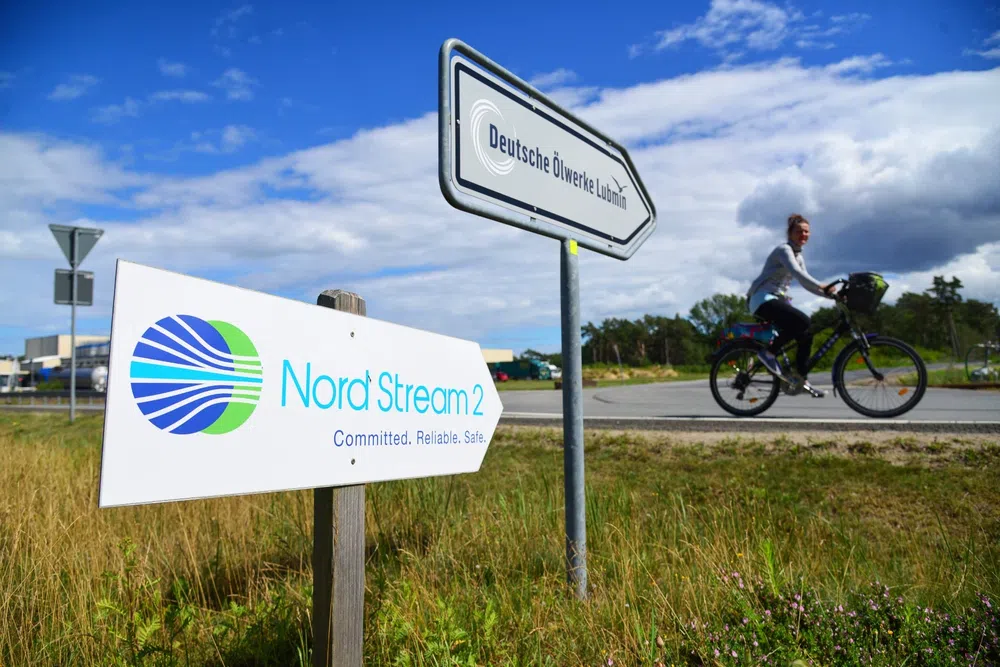
The other day, deputies of the European Parliament signed a letter to the European Commission with a request to investigate the current activities of Gazprom. From their point of view, the Russian concern now simply blackmail Europe with restrictions on gas supply before launching the Northern Stream 2, perhaps hoping for some kind of delights in the regulation of this gas pipeline. So far, Gazprom will only be able to load the new gas pipeline only half - this issue can be disputed in the courts of various instances, but such a process will take years.
The next call against Gazprom from the part of mainly deputies from Eastern European countries can, of course, miss the ears.
But history shows that this bell can be serious. So, in 2012, at the request of the East European countries, the European Commission began an antimonopoly investigation against Gazprom, accusing it of abuse of the dominant position in Central and Eastern Europe and the establishment of unjust prices. Then the investigation led to a long six years of negotiations and eventually ended with a settlement agreement. Gazprom pledged to bring all its contracts in line with the laws of the EU and escaped multibillion -dollar fines.
Today, any complication of relations in the gas sphere with Europe is a huge risk, taking into account the fact that the Nord Stream 2 has not yet been launched, and in the next three years, Gazprom will have to extend the contracts for tens of billions of cubic meters with its old customers in the West. Poland has already officially announced the abandonment of a new long -term contract with Gazprom (and this is no less - 10 billion cubic meters per year). From other consumers of Russian gas, such rhetoric is not yet heard. But the situation may begin to develop in the most unpredictable way.
Is an old friend better than two new ones?
According to the forecast of the International Energy Agency, by 2025, gas exports in the form of LNG from the United States will reach 130 billion cubic meters. m of gas per year (more than doubled from current indicators). By 2027, Qatar plans to increase the production of LNG from the current 77 million tons to 126 million tons per year. Such countries as Mozambique, Canada and others should appear on the map of LNG exporters.
Of course, when there will be a lot of gas in the world, consumers will be able to choose which of the manufacturers to conclude contracts for gas purchases. In addition, in the next ten years, Europe has planned € 1 trillion investment in sustainable development, a significant part of which will go to the creation of renewable energy and new types of energy, such as hydrogen. The “green turn” of Europe and so leaves not a lot of space for gas in the energy balance of the region in the long term. Recent events can give an even greater impetus to the decarbonization trend.
Gazprom, in fact, is very fond of European gas workers. For more than 50 years of cooperation, a number of joint pipeline projects have been implemented, Gazprom entered the retail markets of Western European countries, and German and Austrian companies began gas production in the strategic region of Gazprom under the New Urengoy. When there were frosts in Europe, Gazprom often increased supplies above its contract obligations. So it was, for example, in the case of Turkey in 2007 , it was in 2018, when, against the backdrop of the Frosty Front “Beast from the East”, Gazprom updated the supply records every day.
There were also negative moments of cooperation: gas crises with Belarusia and Ukraine, short -range in the winter of 2012 and an unsuccessful struggle with Ukrainian reverse in 2015, when Gazprom did not fully fulfill customer's applications.
This year, before the launch of the Northern Stream 2, the last symbol of that leaving large era of cooperation in the gas sphere between Russia and Europe, Gazprom had all the possibilities to show their power and flexibility to customers. So it coincided that this could not be done.
Norway brought a temporary respite to the European market, which prematurely completed the prevention in deposits, as a result of which prices collapsed by almost $ 200.
Before the arrival of cold weather, there is still time, storage facilities in Europe can still have time to fill out at least to a more or less comfortable level. Even if the economic factors are against, Gazprom is still very important now to show Europe that the concern is able to reduce the voltage in the market. Without such a demonstration, the attitude of European politicians to gas from Russia can worsen even more. Indeed, with the departure of the Angel Merkel from the post of German Chancellor, the Allies-Slezhelves, who are able to defend the need to preserve the strategic gas axis “East-West”, does not remain in Europe. And then for Russian pipeline gas the time of unpredictability will come.