
Translated material
DEG results: You can not leave to control
Scandal in the capital: a long calculation, a radical change in the results of the elections as a whole and the disconnection of the node of the observers.

Moscow: Long counting, fundamental changes in the results, lack of observation
In the capital, DEG was scandalous. Firstly, summing up the results . Secondly, the result of the DEG radically changed the results of the elections as a whole, making a strong skew towards leaning candidates . Thirdly, the “Noda observers” were turned off exactly at 20:00 on September 19.
The delay in the calculation in the Department of Information Technologies of Moscow was explained by the use of delayed voting (bars).
“In the morning, everything was recalculated several times just in case that we, unlike the whole country, had a unique function for people - an overlayed vote,” said the head of the department Eduard Lysenko. - This has created new features in the implementation of the blockchain, which is implemented by the Kaspersky Laboratory for us. ”
According to him, the experts of the Kaspersky Laboratory had to conduct “re -curric and multi -vector checks of the correctness of chains” to make sure that it was the last voice of the introduced that was taken into account.
However, this does not convince independent IT specialists.
“I was an observer, was a member of the election commission. I will say from experience: when the delay begins when counting the voices, then something goes wrong. The longer the delay, the more they were packed or hidden. Even one of this point, we can say that the DAG in Moscow has fallen, technically or organizationally, ” said Mikhail Klimarev , Executive Director of OZI in an interview with Roskomskvoboda.
The largest number of questions was caused by the fact that the results of DEG completely changed the picture in Moscow as a whole . According to the calculations of the Telegram channel, “we can explain”, it participated in it for a third more people than in the usual vote: “More than 1.8 million electronic ballots were issued to the elections in single-mandate districts, and only 1.3 million Muscovites came to the sites (or voted at home).”
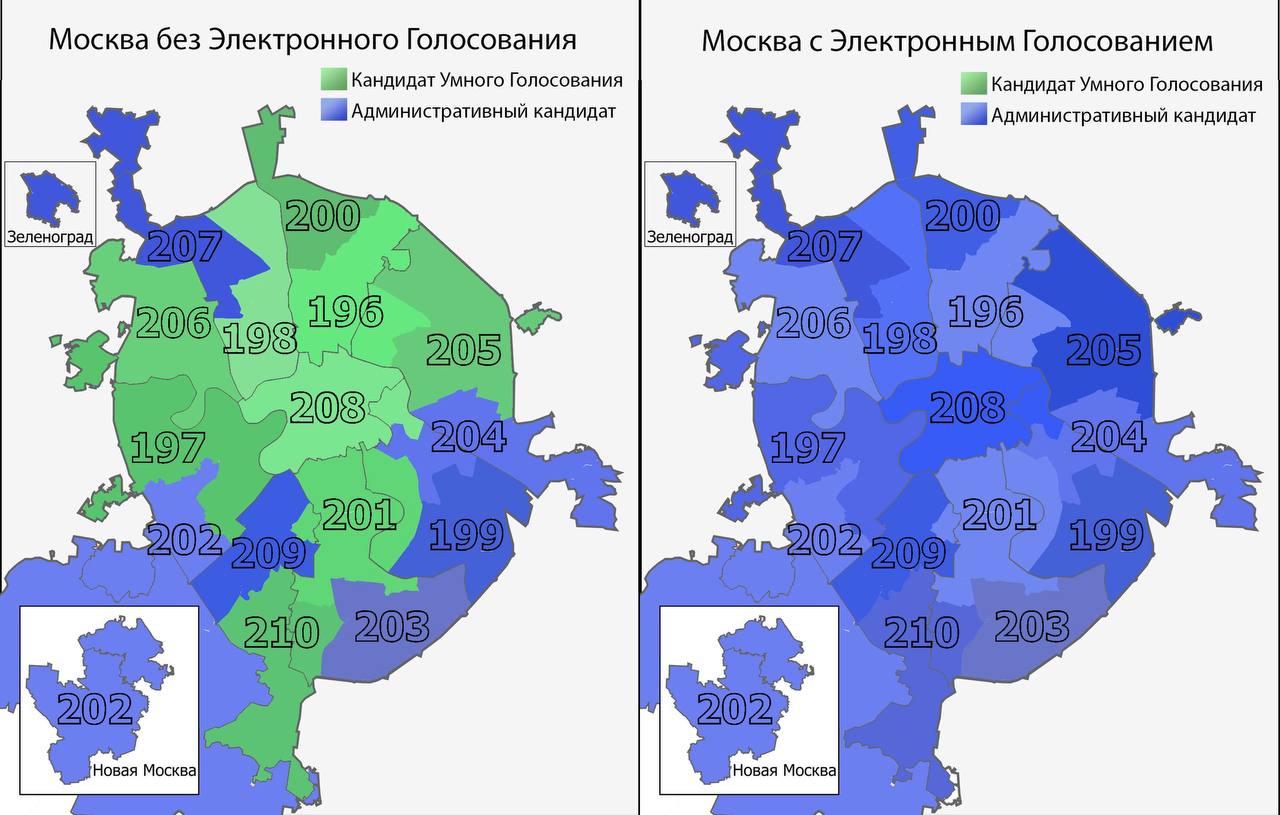
*Source:
Nackepelo*
Co -chairman of the social movement
The Voot Roman Udot also said that the number of electronic votes, subjects for candidates in Moscow, turned out to be 78 thousand more than the ballots were issued. He called the proceeding the voting procedure “shame”, and the elections themselves were “one of the most dirty” in Russian history. According to the Udut, the results of at least electronic voting in the capital should be completely canceled.
The difference between the two types of voting is explained by the distrust of voters in DEG. “... Experts, political scientists and sociologists have repeatedly discussed the ambiguity of the effect of the fact that the candidates of opposition parties publicly made calls to boycott electronic voting. As a result, perhaps they lost part of the votes of people who did not want or could not come to the site, but did not have time to take part in electronic voting, ”the department said .
The author of Republic magazine Fedor Krasheninnikov believes that DEG will be distributed throughout Russia.
“Please note that they repeat the thesis again and again, as if the pro-government electorate voluntarily and massively recorded for electronic voting, unlike skeptics-oppositions of all stripes, and therefore, it is not surprising that it was the results of DEGs fundamentally changed the voting results in the same Moscow. Already now you can easily imagine the script for using this experience in 2024, ”he writes .
Indeed, the press secretary of the President of the Russian Federation Dmitry Peskov has already stated that electronic voting should be distributed as broadly as possible. And the speaker of the Federation Council Valentina Matvienko completely expressed the hope that it could be widespread throughout Russia during the presidential election in 2024.
The Technical Director of Roskomvoboda Stanislav Shakirov draws attention to the third suspicious detail: September 19 at 20:00 turned off the Noda observers (a special computer from which observers can monitor the voting process). The key to access to this node was withdrawn by the FSB officers, after which it supposedly had to be done again. Initially, the refusal of access was explained by the technical failure.
“But none of the observers received access to this node: neither at 2 in the morning, nor at five in the morning, nor at 09:00, when the final protocols in a printed form were published,” says Denis Shenderovich’s municipal deputy from the Yabloko party.
The Constitutional Court of Russia indicated that the right of citizens to participate in the administration of the state is not exhausted by one free participation in the vote. Citizens are entitled to control over procedures related to voting and establishing voting results, as well as the possibility of legitimate response to identified violations.
“However, in the case of remote electronic voting, the legislator did not provide for effective mechanisms that allow citizens to realize this constitutional law: the voting and counting system of votes is opaque even for persons with special knowledge in the field of information technology, not to mention other voters,” the Voice movement notes .
All this undermines the trust in online.
Experts: "You cannot trust DEG"
However, experts say that the electronic voting system cannot be trusted initially.
“Firstly, DEG cannot guarantee that this particular person came and cast a voice, and not people chose for him. Secondly, no one can maintain the secret of voting in which a person votes without pressure, ”Klimarev explained to Roskomvobod.
In addition, the voting system online, according to him, is extremely opaque. So, DEG should have open source code. Of course, Dit posted it, but, according to the expert, it is impossible to call it an open code: “This is a set of files without documentation on how the system is arranged (what servers, what OS, etc.).” Moreover, it is not at all necessary that the published “code” was installed in DEG.
“And the operation of the system should be under supervision: servers are sealed, in stock - systems of double, or even triple keys. Now there are some servers with a certain system with a certain code that could be changed along the way, ”says Klimarev.
At the same time, you can make a technically transparent and safe online vote, if there is political will for it , Shakirov believes. However, in the past elections, he said, "there was no will to honest and open elections."
Recall, according to the development of the developers, the recording of the votes occurs using the blockchain, which supposedly should provide protection of the votes from the fake. Blockchain - technology for recording information with blocks (Blockchain - a chain of blocks). To change information in one block, you will have to change all subsequent ones. It is usually difficult to do this, since the network is distributed (all units are duplicated on many network computers-NODs, components-and mutually verified). Due to the fact that the nodes do not obey each other, any change in the contents of the chain will be rejected. Therefore, it is believed that the record of information in the blockchain is especially reliable.
However, protection against fake is guaranteed only in cases of using a distributed network, where nodes are not controlled by the same “master”. Unfortunately, in the case of the DEG system (and some other systems that “parasitize” the “glory” of the blockchain) this is not the case: all the nodes participating in the network are controlled by the same persons. There is no speech about any distribution of the network of speech in this case. As a result, one cannot talk about the impossibility of falsification of the contents.
As for the secrets of voting (in the rhetoric of the authors of DEG - “anonymity”), nominally, the authors promise it and even in every possible way protrude the thesis about its presence, however, there are great doubts when the voting systems are ongoing.
By the way, the original
The “codes” of DEG systems can be seen here and here (in Russia two DEG systems are involved, the federal from Rostelecom and the metropolitan from DIT).
Accusations of foreign intervention and "protection" of the CEC site
In addition to disputes about the device and the results of DEG, there were other problems around the elections. For example, on September 17, “DDOS attacks” from the USA, Germany, Ukraine and other countries allegedly went to electronic voting structures, the head of the CEC Ella Pamfilova reported . Because of this, the Mos.ru portal introduced the waiting mode in the queue, while trying to get a ballot for electronic voting, a sand clock sign appeared and a message about the exceeding the number of simultaneous requests to the system.
On the same day, Roskomnadzor demanded from Twitter as a shortest possible time to explain the reasons for blocking the account of the Moscow City Election Commission. The department regarded the actions of the Twitter administration as a foreign interference in the Russian elections.
These “unprecedented attacks” were the reason that the Central Election Commission included the defense of its site. On September 19, an electoral statistics specialist Sergei Shpilkin noted that the CEC put a system that does not automatically copy data on the voting results. He noticed that if you try to copy the data from the page, instead of numbers there will be “strange letters”.
It is interesting that in the protection against attacks this system is most likely useless, but it interferes with the data parsing. According to political scientists, earlier any data on the results of voting could be downloaded from the CEC website in Excel format, or copy data in Excel Table from the page in HTML format. Now this is impossible. It turns out that the data is available for viewing, but not available for computer processing.
“Protection” costs, for example, printing a page in PDF format, from which you can further pull out the usual text. So all the work has been done in vain. But the system really interferes with the parsing. But if the CEC does not like this, it would be possible to make an API (a special interface for requesting and receiving data), which would significantly reduce the load on the server, ” says the technical specialist of Roskomsvoboda Vadim Misbach Solovyov .
Researchers wrote an open letter to the head of the CEC Ella Pamfilova with an appeal not to interfere with the study of the election results.
In addition, the CEC decided to hide his site from the search for Yandex. On September 21, at the request of the CEC RF Site, the search engine issued only the news with mentioning links to social networks of the election commission. The same was with the "GAS election site." At the same time, Google worked as it should.
What will be a public consensus?
On September 22, the public headquarters on observation of the election instructed the technical group to recalculate all the votes received from voters during electronic voting in the State Duma elections in Moscow. But there will be no legal force of such a “recount”. A public control group of online voting will also be created. She will be headed by the co -chair of the movement recognized by the ino -agent in defense of voters' rights “Voice” Grigory Melkonants . Molkonyanz himself in his Facebook confirmed participation in this initiative.
“There is no point in this audit. The main falsification takes place due to a violation of the secrets of the voting. What is technically laid out there does not matter at all, ”Mikhail Klimarev convinces.
On September 23, members of Moscow district and territorial election commissions, together with observers in the elections , advocated the cancellation of the results of DEG in Moscow . They filed an open letter to the head of the public headquarters to observe the elections in Moscow Alexei Venediktov. The letter states that the electronic voting system “is an tool for falsifications”, and the reasons why DEG cannot be recognized is listed. So, in addition to the listed in this article, the following was also recorded:
- Voters repeatedly came to the sites, who were surprised to find that they were registered in DEG, while they did not;
- there were “technical malfunctions”, as a result of which continuous monitoring of the work of DEG was not ensured even in the obviously insufficient degree that was provided;
- About 300 thousand voters changed their vote in DEG.
“Electronic voting mechanisms turned out to be difficult for public control, the preparation and/or search for independent qualified specialists who deserve trust, requires significant time from all interested (candidates and parties). This is feasible only if the preliminary publication of detailed technical documentation, which allows you to prepare such specialists. This possibility of interested parties was not provided, ”the authors of the letter summarize.
UPD. On September 24, the CEC said that the next federal election in Russia will be made a single online voting system. The option of delayed voting, which was criticized after DEG in Moscow, will not be applied in it.