
Translated material
Lost decade. What will be the long -term effect of pandemia
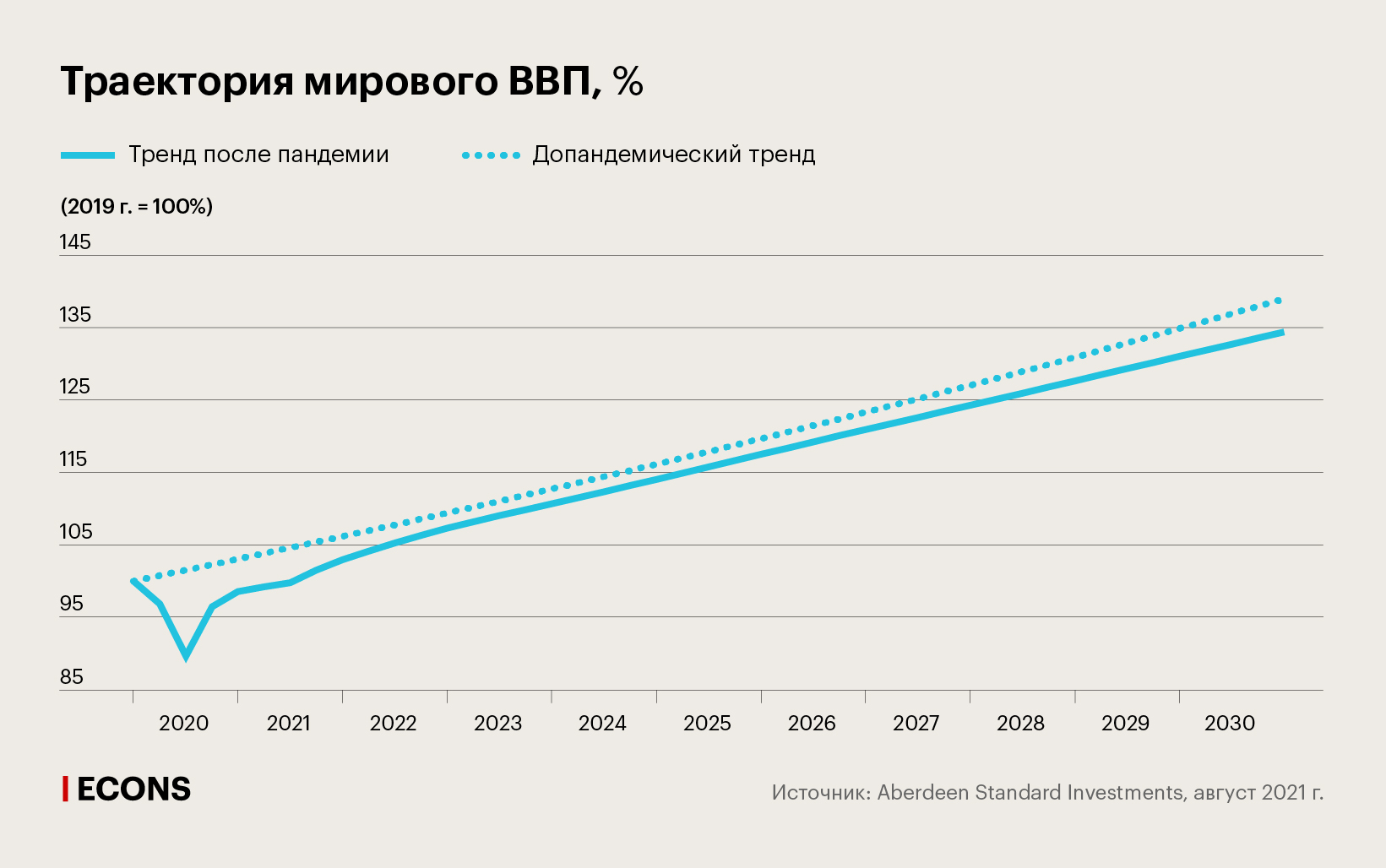
The coronavirus crisis will continue to influence the global economy for a long time. By 2030, its trajectory will lag behind the Dopandemic trend by 3%, and the damage to Russia for 2020–2025 will be equivalent to the loss of almost three years of growth. Our colleagues from Econs.online are divided by the last grades on the long -term influence of the current crisis. With their permission, we publish this material.
As the global economy exits from coronacials, assessments of its long -term influence on the production potential of the economy are becoming increasingly important: such estimates are important for making decisions in the areas of budget, monetary, and economic policy. For example, the budget plans of the UK Government are based on the fact that the country's trajectory will remain below the dopandemic for a long time. And as the measures to support the support of the federal reserve system and other central banks, the assessment of the potential growth of the economy and the gap between it and the actual growth will be of key importance for understanding how high inflationary pressure is written by the hatch Bartolee and the floor of Diggl, economists of the Aberdeen Standard Investment (investment company, which controls more than $ 600 million Assets of governments, pension funds, insurance companies in 80 countries).
For such assessments, it is quite difficult to use historical analogies, economists note: most studies on the long -term influence of crises are focused on financial crises, but coronaccrisis is not such; Past pandemias are also unlikely to help to understand the influence of coronavirus due to significant changes in the structure of the economy that have occurred since those times, as well as the difference in the scale of the pandemium.
However, you can try to identify channels through which the current coronavirus shock can cause long -term changes in the economy, and evaluate how the reaction of economic policy to this shock in different countries could weaken or strengthen the effect of these channels. According to Bartolomu and Digl, who made such an attempt in their study , the global economy by 2030 will still continue to lag behind the dopandemic trend by 3%, but this effect will be extremely uneven in countries.
"Scars" of the labor market
Economists have long discovered that crises leave indelible “scars” in the labor market, continuing to influence it even when they ended. For example, periods of high unemployment can result in the subsequent reduction in labor efficiency and lower labor productivity . This can happen due to the skills and losses of specific human capital caused by the liquidation and unemployment of “erosion” (advantages for employees and companies due to the fact that a particular employee is more productive in this workplace, and not in alternative); Due to the loss of contacts of part of the employees with the labor market, when the inability to find a job corresponding to their skills and the usual level of compensation leads to the fact that they “fall out” from labor force; Due to the use of unproductive forms of employment. In addition, young generations who enter the labor market during economic downturn are faced with the worst prospects of hiring and lower earnings compared to those who do this in stable times, and this gap is persisted for years.
Coronacrisis in almost all countries led to shock in the labor market, and how the economies coped with it depended on the politics pursued by specific countries. For example, unemployment payments have grown in the United States, and European countries followed the path of forced holidays and reducing the number of working hours in order to maintain jobs and the communication market between employees and employers. In the long -term perspective of the country, where unemployment has grown stronger, most likely, they will encounter a longer reduction in labor participation, although its more efficient redistribution may occur, the authors reason.
The negative effect of coronaccrisis can be stronger than other recessions, due to the huge number of lost training hours due to the closure of schools and universities: this will be caused , possibly, irreparable damage to the accumulation of human capital. In addition, it will be more difficult for young employees to acquire skills necessary for specific firms due to the distribution of remote work.
Politics errors
The second mechanism that can enhance the negative long -term effect of crises is political errors, for example, insufficient stimulation of demand or insufficient support for the proposal to improve the functioning of the labor market.
Before the global financial crisis, it was believed that active monetary policy was enough to stabilize fluctuations in economic activity, while the task of tax-budget policy was to control public debt. After the crisis and the collapse of interest rates in the entire developed world to the effective lower border (when the nominal rates cannot be more reduced for greater stimulation, and therefore the monetary policy becomes much less effective in providing incentives) that the tax-budget policy can also play a vital role in macroeconomic stabilization. But the insufficient flexibility of these politicians was partly the cause of slow recovery after the financial crisis.
Thus, the premature fracture of the Federal Reserve of the stimulating monetary policy in 2013 prompted the expectations of the growth of bets, which occurred when inflation was still significantly lower than the target level. The Eurozone needed to survive the crisis of sovereign debt before the ECB acted as a real creditor of the last instance and introduced quantitative softening to combat deflation. At the same time, the transition to tough budget savings in the USA, Eurozone and the UK in 2010 and 2011 greatly influenced economic activity .
The measures of the monetary and budget politician during the Covid-19 were impressive and helped to avoid turning the coronavirus crisis into financial, which, perhaps, prevented long-term damage associated with financial crises. Reducing bets and expanding the balance sheets of central banks improved financial conditions. And the global package of fiscal measures twice as much as the volume of the one that was used during the global financial crisis of 2007-2009.
The worst case
The long -term damage to the global economy caused by the global financial crisis of 2008-2009 is an example of the worst consequences of the crisis. The growth trend of world GDP in the pre -crisis years was 4.3% per year; At the peak of the crisis, in the first quarter of 2009, the world GDP was 7.1% lower in comparison with the pre -crisis trend. In subsequent years, the gap was never eliminated; Moreover, the growth rate of global GDP from 2009 to 2019 amounted to 3%, that is, lower than before the global crisis. This meant that on the eve of the Covid-19 crisis, the global economy was almost 18% less than it could be while maintaining growth rates observed before the global financial crisis, compared Bartolee and Diggl.
Nevertheless, the risks of politics errors are preserved, the authors believe. Review of the Fed’s policy of inflation targeting and the transition to medium -term Target will really allow you to correct past deviations from the goal. However, the blurry of the Fed is how allowed by excess of inflation of this goal in the future can impede the formation of healthy inflation expectations, and the lack of clarity in relation to which period is considered to be medium -term, leads to the fact that some members of the Federal Open Market Committee already believe that the average target goal has been achieved and the policy must be tightened.
Errors of tax and budget policy are more likely in the UK and some eurozone countries, which discusses how to increase taxes in order to pay for the crisis. “Although it is true that the tax burden should probably increase as a result of this crisis, it now seems to be a wildly premature to talk about increasing taxes and even more so to tighten tax and budget policy,” the authors write. Such a step will probably slow down the restoration in the UK and the EU and, thus, increases the risk of irreversible damage, they note.
"Scars" of beliefs
The third mechanism, through which the damage from the crisis can be stretched for years is the so -called “scarring of beliefs” , or a persistent change in the perceived probability of a future strong negative shock. For example, before the 2008 crisis, the possibility of a collapse of the financial system was practically not discussed, and after the crisis, the question of the possibility of repetition periodically rises again, although the financial system has since become much more stable. Until 2020, the world did not even think about pandemia - and now people and companies will make decisions taking into account the fact that such outbreaks of incidence are not excluded in the future. Although such strong shocks as a pandemic are extremely rare, the experience of their experience will give the risk of repeating such events excessively high weight in the beliefs of economic agents, the authors note.
This increased perception of the “riskiness of the world” increases the demand for safe assets, reduces the appetite of the business to accept risk, increases the desired level of savings and reduces the level of investment. The decrease in investment, in turn, negatively affects the accumulation of capital and, therefore, on potential growth. The postpandemic losses of the US economy from this effect, for example, are estimated at 4% of GDP compared to a pre -crisis trend.
However, the “update of beliefs” also works in the opposite direction, notes the economists of Aberdeen Standard Investments: the speed with which vaccines were developed is perhaps a new positive information that should give people more optimism regarding the possibility of solving problems in the future. Similarly, the scale of support provided in a number of countries could convince households that in the event of future crises, they can count on the help of the state. This can somewhat soften the growth of savings and a decrease in investment, although it all depends on the conditions of a particular country.
Unscrew from the rut
In 2014, the strike in the London metro forced passengers to experiment with the routes: it turned out that as a result, the routes chosen by people became more optimal, and this increased the overall efficiency of the transport network. Sometimes, due to the “rut effect”, economic agents can maintain non-optimal behavior, and shocks can adjust it. Coronacrisis could also provoke a similar process - for example, through greater use of remote work, accelerate the spread of technologies that contribute to adaptation to changes in production and consumption, reason Bartolee and Diggl. Similarly, the development of vaccines can be a starting point for other innovations, which in theory can increase overall factor performance.
Zombification
Against the background of the crisis, the number of zombie companies-unprofitable companies that are unable to serve their duty, which manage to continue to exist due to low rates. Among the reasons for a long decrease in the performance of the last two decades, it is precisely the increase in the number of zombies-companies: so, in 14 developed economies it increased from 4% in the 1980s to 15% in 2017. These firms are less productive and at the same time interfere with the entering the market of potentially more effective new players, so their growth in number restrains the total performance in the economy. The ongoing existence of a zombie company prevents the natural turnover of firms, when ineffective leaves the market, releasing the economic resources they used-capital, labor, etc. - In favor of more productive companies.
Given the various support mechanisms introduced by the countries in response to coronacrisis (reduction of bets, the provision of liquidity, weakening of regulation), it could lead to a further increase in the number of zombies-films. For example, the Institute of the German Economy in Cologne (IW) at the end of 2020 assessed that due to the weakening of bankruptcy legislation in Germany in the country's economy, 4,300 additional zombies turned out to be. Of course, support has simplified the companies to stay afloat, but the problem is not so much that the number of zombies in the crisis increases, but in the fact that restoration after the crisis does not lead to a significant reduction in their number. And this will undoubtedly affect long -term growth and will cause irreparable damage to the economy, the authors conclude.
Now the premature abolition of support measures, and not the existence of zombies, but the second risk will grow, the authors say, can be considered a higher risk for long-term economic development. As the economy is restored, it will be important to allow resources to be redistributed more efficiently.
Slow down structural reforms
Another channel through which coronacrisis can reduce the potential growth of economies is a weakening of stimulus for structural reforms and globalization. Governments, due to the shock of a business cycle, are forced to engage in short-term stabilization at the cost of postponing long-term structural transformations-due to a lack of time, political capital or the fall of ratings.
Moreover, the coronavirus crisis can become an incentive for a policy that will rather negatively affect long -term growth - in particular, the governments will probably grow in the support of strategic industries, which usually leads to a decrease in production efficiency (by reducing competition that is built under the interests of certain regulatory firms, distorting market incentives). And firms will begin to reduce supplies and increase the localization of production, which can also lead to a less effective distribution of resources.
At the same time, stability, provided by shorter supply chains and local access to strategic goods, reduces the risk of future catastrophic failures , thereby reducing the negative consequences of the crisis. The crisis can even spur countries to carry out some structural reforms, as, for example, occurred after a global financial crisis with labor market reforms in some countries that strengthened support and retraining of workers. The package of measures to restore the NEXT Generation EU economy with financing of 850 billion euros by the European Union through the release of pan-European bonds, although it is not, is believed by the authors, in the true sense of Hamilton fiscal integration-consolidation of national debt undertaken by one of the “founding fathers” by Alexander Hamilton, still represented Progress in the direction of general fiscal architecture, the necessary eurozone for long -term economic stability.
Long -term damage
Given all the listed channels of the long-term damage transmission, Bartoloi and Diggl are predicted, due to coronaccrisis, the global GDP will maintain a gap with its dopandemic trend, and by 2030 this gap will still be 3%-this is about a third of similar losses after the global financial crisis. The scale of the damage varies depending on the country - how much the crisis hit it, and the response to this blow from state support measures.
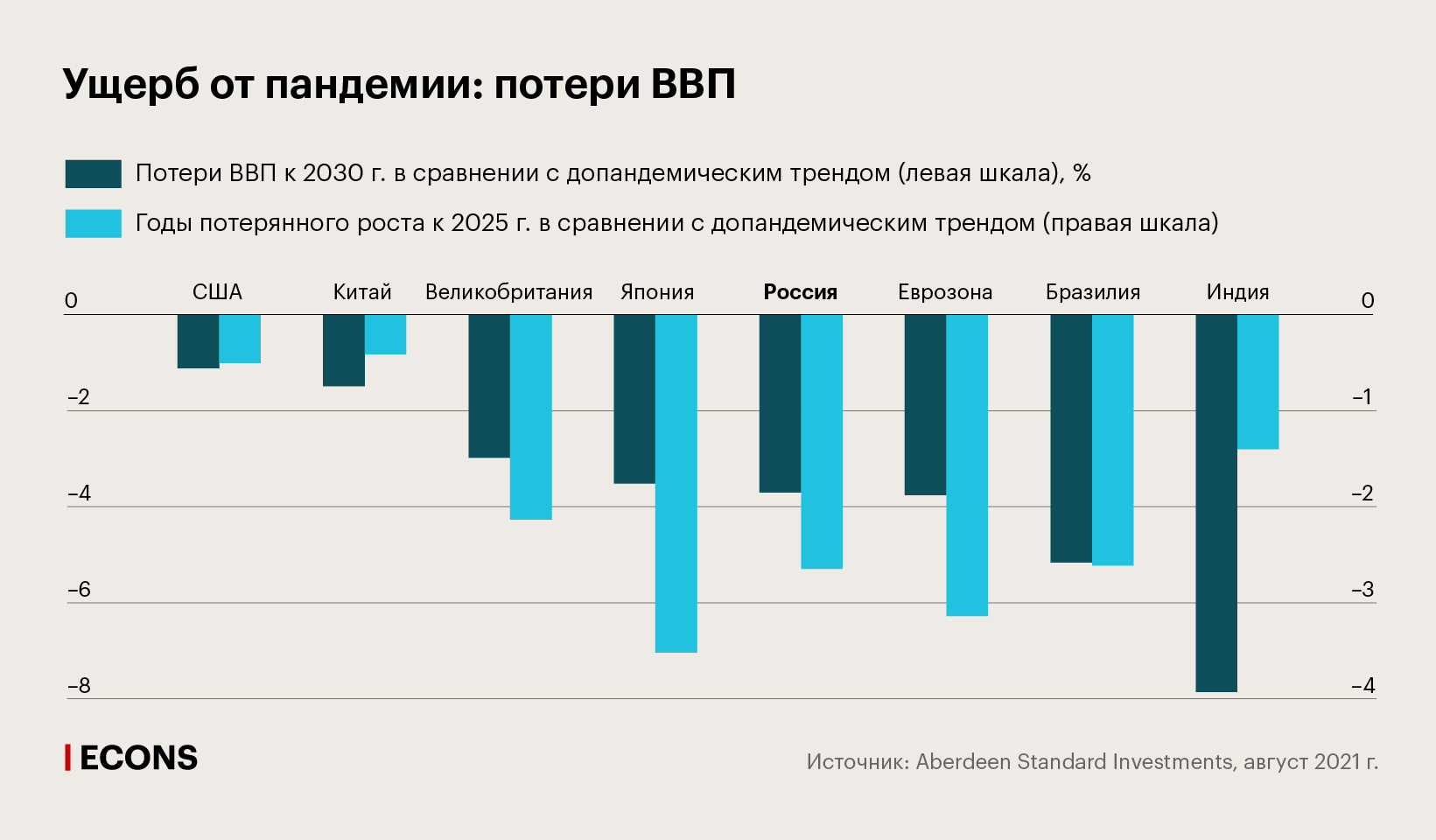
The effect of the "scars" of the labor market will be stronger in countries that are faced with the most significant increase in unemployment, such as Brazil and India. At the same time, in Europe and Japan, which supported employment during the crisis due to the reduction of working hours, a negative long -term effect can also manifest itself through erosion of workers' skills. In some countries, especially developing, the effect of “scars” can be compensated by a more flexible informal sector that absorbs unemployment, but at the same time, work in the informal sector is usually less productive.
Problems of politician errors will be especially relevant for countries that did poorly with the virus, did not quickly quickly introduce economic support measures and plan to cancel them prematurely. This is characteristic of the majority of the world economy, economists write, with the exception of the United States (where fiscal policy has become less limited by deficit and duty, and the Fed has switched to targeting medium -term inflation, thereby choosing a systematically more liberal policy) and China (which quickly returned to more neutral policy - but not prematurely, but against the background of the success of its strategy to combat the combat. pandemia).
The problem of “scarring of beliefs” is suggested by Bartholomew and Diggl, it will be most relevant for Europe, Brazil and India, where the frequency waves were very large, and vaccination was delayed. At the same time, in China, where a successful struggle against coronavirus became the reason for pride, this channel can work in the opposite direction.
Зомбификация затронет все экономики с учетом вводившихся программ госгарантий. Что касается структурных реформ, пандемия затормозила программы, рассматривавшиеся в Японии, Бразилии и Индии, но стимулировала европейские государства вводить меры (в частности, поддержки занятости), которые могут быть институционализированы.
Для России авторы отмечают в качестве повышенного риск для рынка труда — указывая на относительно высокий рост безработицы, частично отражающий сдержанный фискальный ответ на кризис. «Пособия по безработице повышались, и расширялся доступ к ним, домохозяйства с детьми получали единовременные выплаты, но это не позволило сдержать разрушение связей на рынке труда», — пишут экономисты. По их оценке, канал рынка труда станет основным механизмом, продлевающим негативные последствия коронакризиса. Все остальные каналы имеют более умеренный эффект. В числе ошибок политики, по мнению авторов, то, что фискальные меры поддержки были ограниченны, а ставки сохранялись относительно высокими. Кроме того, разработанная Россией собственная вакцина могла бы стать ее преимуществом, но «вакцинная дипломатия» оказалась приоритетнее национальной вакцинации, считают авторы, а население не стремится участвовать в последней. Спешка с одобрением вакцин и ограниченная социальная поддержка могут оставить «рубцы» на убеждениях населения. В числе же плюсов то, что Россия незначительно наращивала долг, а восстановление цен на нефть смягчит фискальные ограничения.
В совокупности все эти факторы, по оценке авторов, приведут к тому, что из-за коронакризиса потери для экономики России к 2025 году составят, в сравнении с допандемическим трендом, почти три года роста: то есть в 2025 году ВВП страны будет на том уровне, который, не случись пандемия, соответствовал бы 2022 году. Еще через пять лет, к 2030 году, разрыв ВВП с докризисной траекторией все еще будет составлять 4% — что эквивалентно примерно двум годам роста средним за три докризисных года темпом (за 2017–2019 годы среднегодовой рост экономики России составил 2,2%) .
Правда, оговариваются экономисты, очень высока неопределенность: полученные оценки зависят как от развития пандемической ситуации, так и от мер политики.