Date
Author

Preserved copy
Translated material
Stragged, but not upset
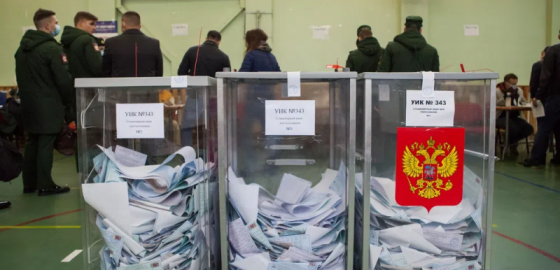
You pretend to be elections - we pretend that we choose
In the Soviet Union, which some recall with nostalgia, there was a saying: "You pretend that you pay us, we pretend that we are working." In modern conditions, work and salary thanks to a market economy more or less correspond to everyday realities, but in politics, imitation covers literally everything. “You pretend that these are elections, we pretend that we are choosing,” says the people Smolny. That is how things were going on last weekend when they wanted to get votes in the elections.
In a different situation, the governor would have to spin at least a couple of months to get decent indicators for “United Russia” in St. Petersburg in St. Petersburg. But Alexander Beglov even turned on heating in a freezing city only on the first day of voting. Like, by evening, people will warm up and run to support the united Russia. It is clear that with the democracy of the voter, you need to crush for a long time, but with the manipulative system that we have developed, the mood of the townspeople is almost not related to the election results. And where will the people go? The real opposition is not allowed for the elections. The possibilities of observers are reduced to almost zero. And even if some part of the votes leaves the United Russia to the Communist Party (according to the recommendations of “smart voting”), by and large the Kremlin does not care. With the Communist Party, negotiating the correct behavior in the State Duma or in Zakza is not much more difficult than with United Russia.
The applicants of our votes themselves behaved about the same indifference as the authorities.
We all know all about key political parties for a long time. They did not offer us anything new. We hung, for example, a poster of four letters, and enough. Could not hang anything at all: it would be just as informative.
The only new party campaigned on the streets of St. Petersburg, resting on the very fact that it was new. If suddenly someone is tired of old nonhumans, you can vote for new people. What are their intentions that these people have already done, where they came from and what they are going to do in the State Duma does not bother anyone. We only pretend to be choosing.
And even indignant at how we are manipulated, we also pretend to be more than expressing our dissatisfaction in fact. How much has written and said recently that the elections are falsified, that they are not allowed to be a real opposition, that we are frankly led by the nose. Yes, it is for this place that they lead us to the election urns. And they do it for a long time. If not twenty years, so ten years for sure. From that hot winter 2011–2012, which we met with mass protests. Even then, it was clear that in the context of economic stagnation, our authorities have no choice but to manipulation.
So what should be expected from the current voting procedure, which I do not want to call the elections at all?
Perhaps the only curious story in St. Petersburg happened to the Yablonnik Boris Vishnevsky, who was “being built” , but did not be upset and stubbornly continued to fight for victory in his district. The manipulators created him doubles, who were called Borisov Vishnevsky, although mothers knew them in childhood under completely different names. This move was so primitive and cynical that in real elections could rather harm the true opponent of Vishnevsky. But everything is different with us: “You pretend that this is an election; We pretend that we choose. ”
Ultimately, the real Vishnevsky, thanks to this curious history, acquired not only all -Russian, but also international fame. And for Petersburgers became the true personification of the "apple."
However, in the last days, I personally have much more history with the “finished” Vishnevsky was held by thoughts aboutthe mysterious death of Judge Natalia Repnikova, who recently planted Alexei Navalny. If you figure out what actually happened to her, then much can be understood in how the regime functions and what are its prospects. If it turns out that we have not only prominent representatives of the opposition “suddenly mortal”, but also obedient representatives of the authorities who honestly work out the “state order”, which means that the notorious “struggle between the towers of the Kremlin” entered a new stage. If it ever turns out that the death is the same imitation as everything else in our political processes, this “medical fact” (as Ostap Bender would say) will talk more about the nature of Russian justice than the nature of the struggle of various power groups.