
Translated material
Parliamentary elections in Germany
Parliamentary elections in Germany on September 28, 2021, Alexey Makarkin 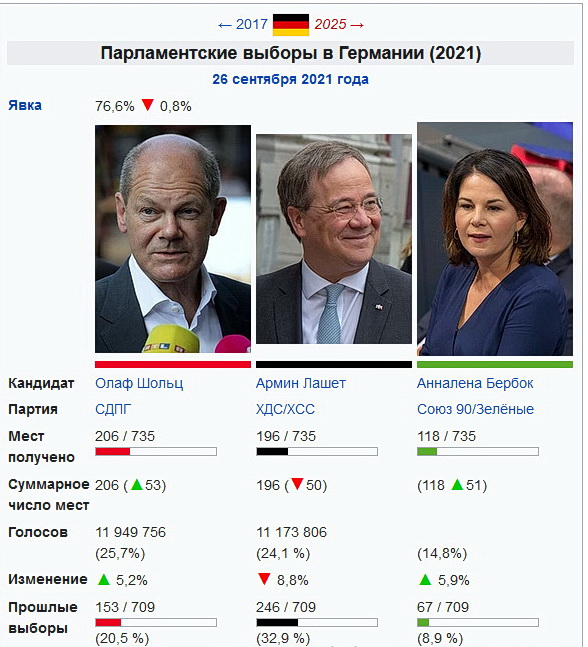
On September 26, the next parliamentary elections in Germany were held. As a result, the government will be formed and the chancellor is nominated, which will replace the Angel Merkel, who has held this position over the past 16 years. The Social Democratic Party of Germany (SDPG) won, gaining 25.7% of the vote. The second largest fraction will be formed by the block of Christian Democratic and Christian Social Unions (CDU/CSS), 24.1% of voters cast their votes for it. This is a historically worst result of conservatives in history. In total, six political associations take place in the Bundestag of the new convocation: in addition to the SDPG and the CDU/CSS, these are “green”, which took third place with 14.8% of the vote, a free democratic party (SVDP) with 11.5% of the vote, a fragilist “alternative to Germany” with 10.3%, the left party with 4.9%. The latter enters the parliament only due to the fact that it received three direct mandates in the constituencies. According to the law on the elections of Germany, in this case, parties are provided with places on party lists. As a result of the previous elections, held in 2017, the two largest forces in the Bundestag became the CDS/CSS and SDPG. At the same time, their representation has seriously decreased. Coalition negotiations then dragged on, but as a result a new government was formed, based on the COILISE OF CDU/CSS with Social Democrats. Popularity in recent years has been actively gaining a party of "green" against the backdrop of the importance of the climatic agenda in Europe and the USA. The main competitors in the past elections were the CDS, SDPG and the Green Party. At the same time, a few weeks before the election, the surveys of electoral preferences gave a noticeable advantage to the Social Democrats. A week before the elections, the last debate between the candidates for the chancellors - Armin Lashte from Christian Democrats, Olaf Sholts from the SDPG and Annalen Berobok from the Green. They demonstrated the priorities of each parties mainly on issues of socio-economic policy and climatic agenda. An interesting moment was the positioning of the candidate from the SDPG, Scholts. As the Minister of Finance and the Vice-Chancellor, with approaching the finish line, he began to advance himself in two ways: as a levocentric, who offers alternatives to Merkel’s policy and at the same time as the Minister of the Government, who will maintain stability and certain continuity of the course. Scholz managed to convincingly imagine himself as a natural successor to the outgoing Merkel and on the last debate. The express survey immediately after the debate showed that according to 42%of the audience, Scholz came out the winner, the championship was given to the championship 27%, Berbok-25%. There are three most probable options for the coalition at the moment: this is the “Big Coalition” (Social Democratic Party of Germany-SDPG-Block CDU/CSS), “Traffic lights” from SDPG, Green and Alliance from the CDS/CSS, “Green” and SVDP (Yamaika Coalition ”-according to the colors. symbolizing the parties and coinciding with the flowers of the flag of the yamyka - black, green and yellow). The low result of the left excludes them from coalition negotiations, and the “alternative for Germany” was excluded in advance from this process, since none of the parties want to be blocked with it. At the same time, a large coalition is the least likely, since it can only be formed in the case of the leadership of the SDPG and refusal of the CDU/XSS to implement a significant part of the software provisions. In this situation, the CDU/CSS can lose its own identity and repeat the long-term crisis of the Social Democrats, from which only this year was possible. In the remaining two versions, the key role is given to younger partners. The Chairman of the SVDP Christian Lindner has already spoke for Jamaica. His Deputy Wolfgang Kubikki said that the SVDP and the Green should preliminarily agree with whom to go to the coalition-with social democrats or with the CDU/CSS. Under Merkel HDS/CSS, she became close to the “green” agenda (in particular, refusing to support nuclear energy), which largely brought them closer to the “green”, removing the old antagonism. The Green themselves clearly want to enter the government, which have not been since 2005. “We want to enter the Cabinet of Ministers,” said Robert Habek, co -chair of the Green. Yamaiki, however, has a great drawback - it will not include the recognized winner of the parliamentary elections, the SDPG, and the government will lead the unpopular lace, and not the leading candidate for the post of chancellor Scholz. Such a situation can create the effect of “conspiracy” of politicians who revise the main trend of the current elections. To the greatest extent, this can discredit “green”, the popularity of which has already decreased during the current campaign (they were among the leaders six months ago). In this regard, the version of the “traffic light” remains on the agenda, and negotiations on the creation of the coalition may be difficult. According to Deuteche Well, for Russia, any of these two options for the future government coalition may mean further cooling of relations or even the tightening of Berlin policy against Moscow. After all, both “green” and the SVDP are more critical of the domestic and foreign policy of Vladimir Putin than the Merkel government. Thus, the “green”-decisive opponents of the North Stream-2 gas pipeline, harshly condemn the annexation of Crimea, expressed for the supply of German weapons to Ukraine and the expansion of sanctions against the Russian Federation. And the SVDP, for which human rights topics are traditionally important, show increased attention to the topic of human rights in Russia. In addition, the SVDP proposed to put a moratorium on the commissioning of Northern Stream-2 in order to achieve the release of Russian opposition Alexei Navalny. At the same time, the convincing victory of the Social Democrats (40% according to preliminary data) in the elections in the land in the land of Mecklenburg-the front Pomerania strengthened the positions of the local prime minister Manuel Schvezig. It actively supports the North Stream-2, the receiving terminal of which is located in this federal land in the territory of the former GDR. She will be able to use her increased influence in the leadership of the SDPG to lobby for commissioning the gas pipeline.
Photo: wikipedia.org
On September 26, the next parliamentary elections in Germany were held. As a result, the government will be formed and the chancellor is nominated, which will replace the Angel Merkel, who has held this position over the past 16 years. The Social Democratic Party of Germany (SDPG) won, gaining 25.7% of the vote. The second largest fraction will be formed by the block of Christian Democratic and Christian Social Unions (CDU/CSS), 24.1% of voters cast their votes for it. This is a historically worst result of conservatives in history. In total, six political associations take place in the Bundestag of the new convocation: in addition to the SDPG and the CDU/CSS, these are “green”, which took third place with 14.8% of the vote, a free democratic party (SVDP) with 11.5% of the vote, a fragilist “alternative to Germany” with 10.3%, the left party with 4.9%. The latter enters the parliament only due to the fact that it received three direct mandates in the constituencies. According to the law on the elections of Germany, in this case, parties are provided with places on party lists. As a result of the previous elections, held in 2017, the two largest forces in the Bundestag became the CDS/CSS and SDPG. At the same time, their representation has seriously decreased. Coalition negotiations then dragged on, but as a result a new government was formed, based on the COILISE OF CDU/CSS with Social Democrats. Popularity in recent years has been actively gaining a party of "green" against the backdrop of the importance of the climatic agenda in Europe and the USA. The main competitors in the past elections were the CDS, SDPG and the Green Party. At the same time, a few weeks before the election, the surveys of electoral preferences gave a noticeable advantage to the Social Democrats. A week before the elections, the last debate between the candidates for the chancellors - Armin Lashte from Christian Democrats, Olaf Sholts from the SDPG and Annalen Berobok from the Green. They demonstrated the priorities of each parties mainly on issues of socio-economic policy and climatic agenda. An interesting moment was the positioning of the candidate from the SDPG, Scholts. As the Minister of Finance and the Vice-Chancellor, with approaching the finish line, he began to advance himself in two ways: as a levocentric, who offers alternatives to Merkel’s policy and at the same time as the Minister of the Government, who will maintain stability and certain continuity of the course. Scholz managed to convincingly imagine himself as a natural successor to the outgoing Merkel and on the last debate. The express survey immediately after the debate showed that according to 42%of the audience, Scholz came out the winner, the championship was given to the championship 27%, Berbok-25%. There are three most probable options for the coalition at the moment: this is the “Big Coalition” (Social Democratic Party of Germany-SDPG-Block CDU/CSS), “Traffic lights” from SDPG, Green and Alliance from the CDS/CSS, “Green” and SVDP (Yamaika Coalition ”-according to the colors. symbolizing the parties and coinciding with the flowers of the flag of the yamyka - black, green and yellow). The low result of the left excludes them from coalition negotiations, and the “alternative for Germany” was excluded in advance from this process, since none of the parties want to be blocked with it. At the same time, a large coalition is the least likely, since it can only be formed in the case of the leadership of the SDPG and refusal of the CDU/XSS to implement a significant part of the software provisions. In this situation, the CDU/CSS can lose its own identity and repeat the long-term crisis of the Social Democrats, from which only this year was possible. In the remaining two versions, the key role is given to younger partners. The Chairman of the SVDP Christian Lindner has already spoke for Jamaica. His Deputy Wolfgang Kubikki said that the SVDP and the Green should preliminarily agree with whom to go to the coalition-with social democrats or with the CDU/CSS. Under Merkel HDS/CSS, she became close to the “green” agenda (in particular, refusing to support nuclear energy), which largely brought them closer to the “green”, removing the old antagonism. The Green themselves clearly want to enter the government, which have not been since 2005. “We want to enter the Cabinet of Ministers,” said Robert Habek, co -chair of the Green. Yamaiki, however, has a great drawback - it will not include the recognized winner of the parliamentary elections, the SDPG, and the government will lead the unpopular lace, and not the leading candidate for the post of chancellor Scholz. Such a situation can create the effect of “conspiracy” of politicians who revise the main trend of the current elections. To the greatest extent, this can discredit “green”, the popularity of which has already decreased during the current campaign (they were among the leaders six months ago). In this regard, the version of the “traffic light” remains on the agenda, and negotiations on the creation of the coalition may be difficult. According to Deuteche Well, for Russia, any of these two options for the future government coalition may mean further cooling of relations or even the tightening of Berlin policy against Moscow. After all, both “green” and the SVDP are more critical of the domestic and foreign policy of Vladimir Putin than the Merkel government. Thus, the “green”-decisive opponents of the North Stream-2 gas pipeline, harshly condemn the annexation of Crimea, expressed for the supply of German weapons to Ukraine and the expansion of sanctions against the Russian Federation. And the SVDP, for which human rights topics are traditionally important, show increased attention to the topic of human rights in Russia. In addition, the SVDP proposed to put a moratorium on the commissioning of Northern Stream-2 in order to achieve the release of Russian opposition Alexei Navalny. At the same time, the convincing victory of the Social Democrats (40% according to preliminary data) in the elections in the land in the land of Mecklenburg-the front Pomerania strengthened the positions of the local prime minister Manuel Schvezig. It actively supports the North Stream-2, the receiving terminal of which is located in this federal land in the territory of the former GDR. She will be able to use her increased influence in the leadership of the SDPG to lobby for commissioning the gas pipeline.
Photo: wikipedia.org
| Print version |
-
 Alexey Makarkin
 -
Konstantin von Eggert: The victory of the Social Democrats in Germany is a good event for Putin. This party is known for its long -standing dialogue with Russia at all costs.
