
Translated material
Inexplicable growth

From 17 to 19 September 19, the State Duma and regional parliaments were held in Russia. For the first time, the vote lasted three days, and in seven entities it was possible to vote online.
The head of the Central Election Commission (CEC) Ella Pamfilova reported to Vladimir Putin that "the level of transparency that we provided allowed to exercise multi -stage total control over how the elections are held." According to Pampilova, there was no intervention in the online voting, she promised that the geography of electronic voting would expand to the next election. However, according to the report “Voice”*, the movements in defense of the rights of voters, the elections of 2021 do not comply with either Russian or international standards for the will of citizens.
The results of electronic voting in Moscow seriously changed the distribution of votes. In eight of the 15 single -mandate districts, candidates supported by the “smart vote” of Alexei Navalny won the votes in the plots. But when the results of online voting appeared, the United Russia came forward in all districts.
As a result, United Russia received 324 out of 450 in the State Duma - this is the constitutional majority, which allows the "united Russia" to adopt laws without looking at the opinions of other parties.
“Important stories” analyzed data on online selection in Moscow and explain why the results of remote voting could be falsified.
"Too rapid changes"
For analysis, we used data published on the Remote Electronic Voting website (DEG). They show how the voices between parties and candidates in single -member districts were distributed every hour or every minute. If you look at the distribution of votes within three days, it is noticeable how, on the last day of the election, the share of votes for United Russia increases sharply.
Such a surge of an percentage of electronic votes for United Russia, like a carbon copy, was repeated in all electoral districts.
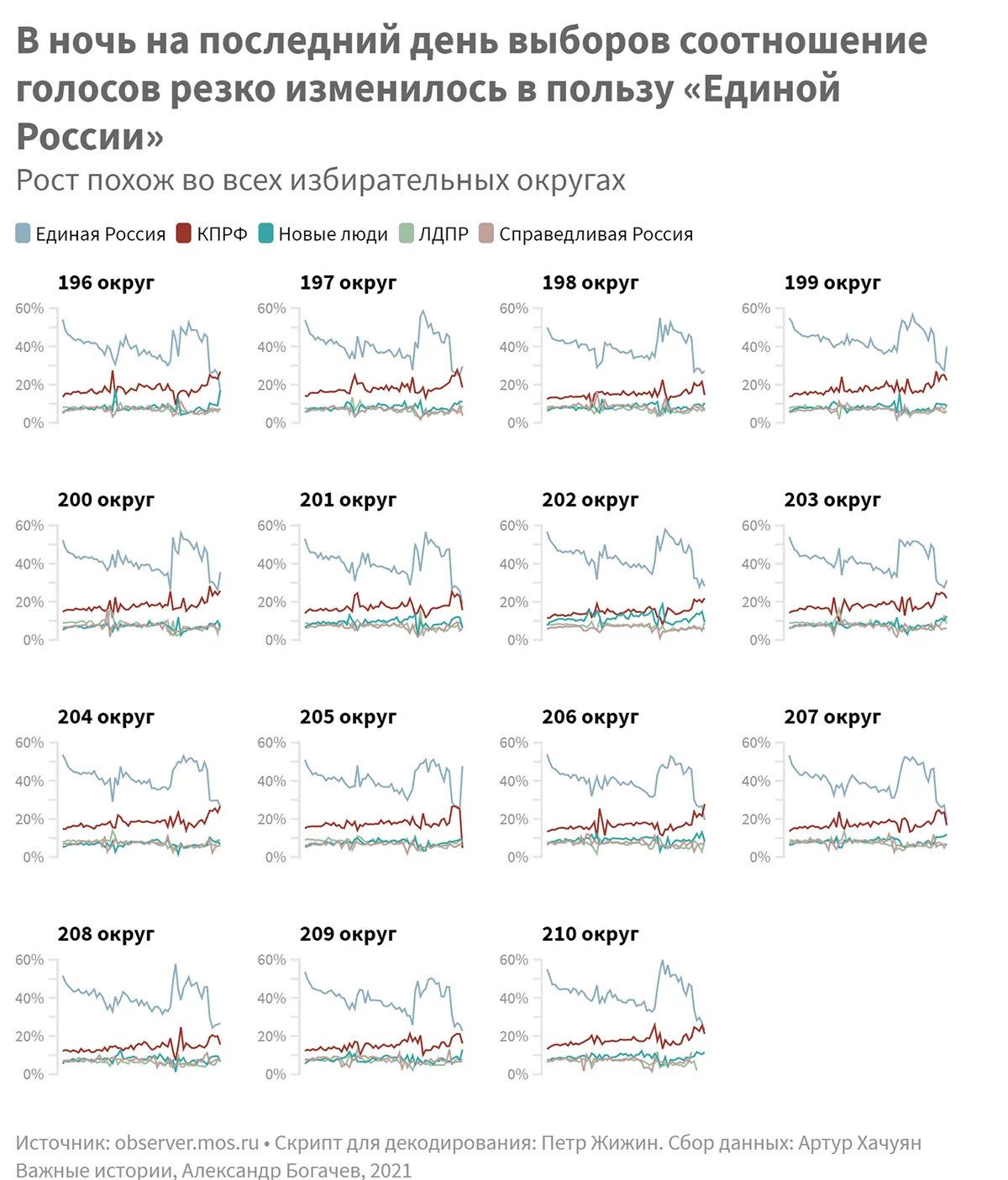
Such growth cannot be explained by technical reasons, an independent data analyst Boris Ovchinnikov is sure. “Technical reasons cannot affect the ratio of votes between candidates. I am also convinced that this growth cannot be explained by a feature of voter behavior. There is too sharp, swift changes. These are obvious traces of falsifications. There is an assumption that just another virtual voice was added for every real voice for the authorities. ”
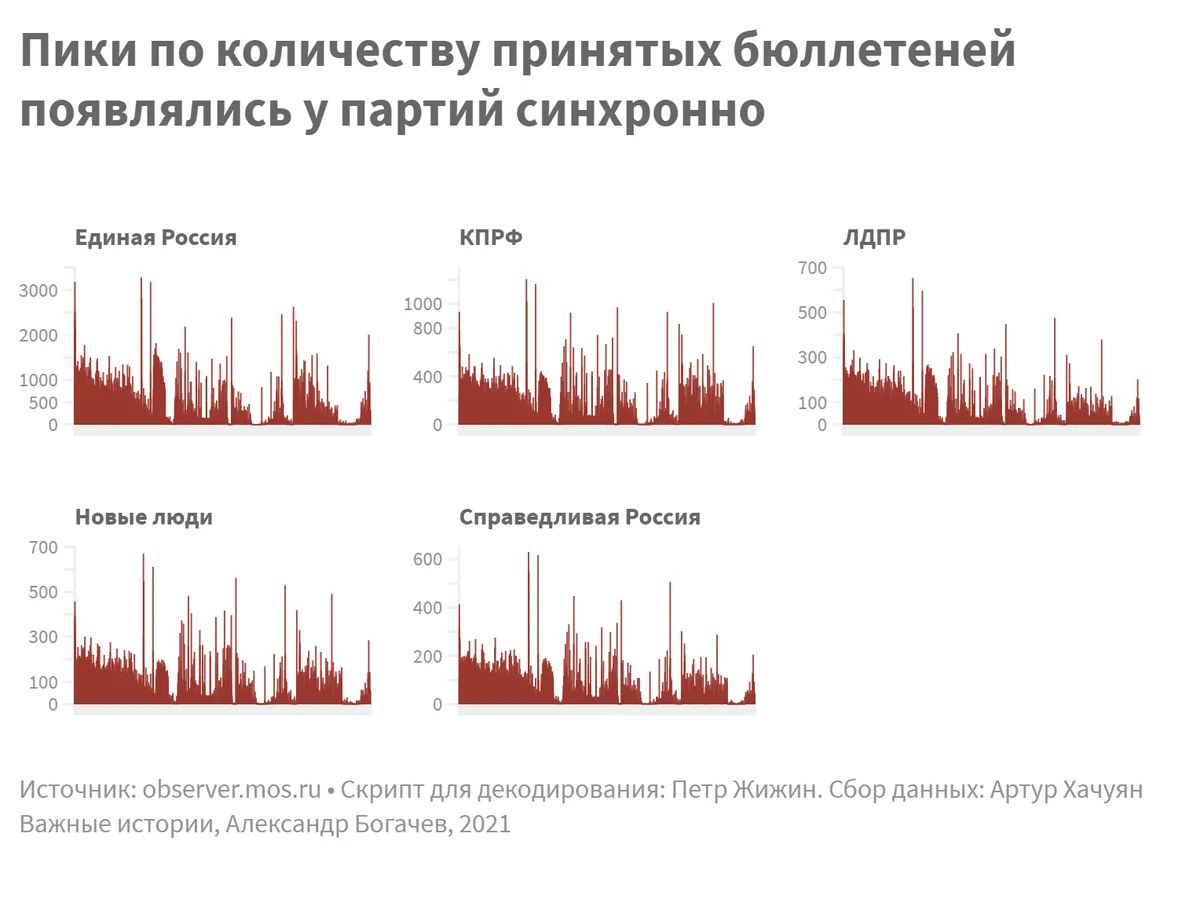
Support those who analyze the results of voting only public attention will allow you to make elections honestly supporting “important stories”According to the co -chair of the Voice* Grigory Melkonian, the peaks on the graph reflect the scale of the mobilization of voters for different parties, for example, the peak for the Communist Party in the last hours of voting fits into the opposition strategy to vote in the last hours. “As Russian experience shows, it is never possible to exclude falsifications in the elections. Moreover, this growth of votes cannot be unequivocally perceived as falsification, this is explainable and administrative mobilization, for example, pressure on voters from employers, which we observe with regard to classical voting. The main peaks of voting were the consequence of the pusk, and emails carried out by voters on September 18 at about 18: 00–19: 00, September 19 at about 10: 00–11: 00 and about 17: 00–18: 00, ”said Melkonian to“ important stories ”.
The growth of votes for pro -government candidates is also noticeable in voting in single -mandate districts. In the Kuntsevsky district on Friday, the share of votes for the candidate from United Russia Evgeny Popov sharply increased.
And in the Leningrad single -mandate district, the share of votes for Galina Khovanskaya from United Russia grew, the main rival of which was Anastasia Bryukhanova, a candidate of smart voting.
Combine
Voting data show the number of adopted ballots for each candidate in single -mandate districts and for each batch ( all transactions are taken into account in this set of data: if the voter is dispersed, all voting options will be visible. - Approx. Ed. ). On the graph, which shows the total number of voting at every minute, the peaks of activity are clearly visible: at some minutes, several times more voters voted than in the previous ones.
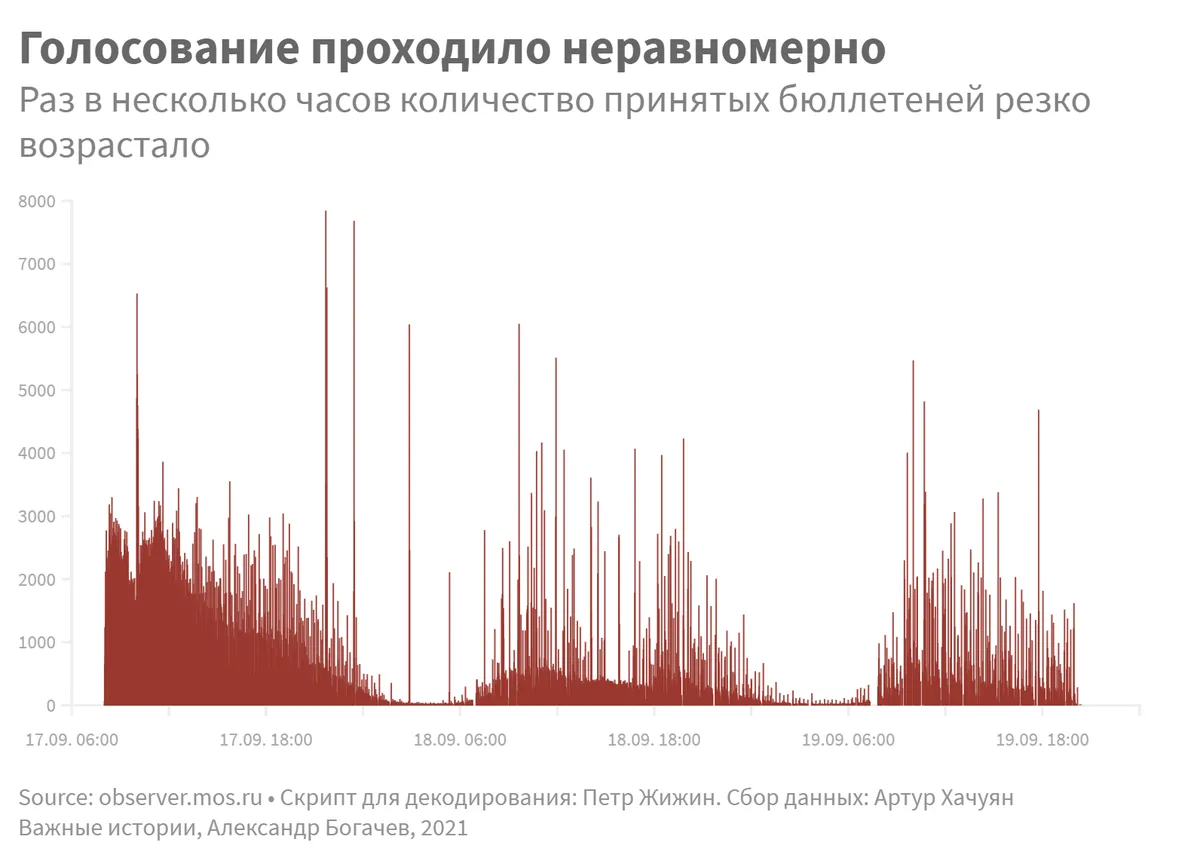
According to Kirill Pimenov, a data analyst and blockchain, the peaks may be associated with the special technology of the vote record, which the Moscow City Hall Department developed for the anonymization of voters. This technology - it was called the “combine” - records the voices not by the way, but in portions, so that according to the entrance to the portal for voting, it is impossible to establish how the specific voter voted. At the same time, how exactly the recording of the votes takes place is unknown. There is no open access documentation for electronic voting.
“In general, the entire electronic voting system is practically not spelled out in any regulatory acts. In fact, there is only a CEC resolution on an experiment that says that the Moscow City Hall is entrusted with electronic elections, encryption, blockchain should be used and the opportunity to vote aside. There is no technical documentation on the code either, there are only some video recording of a meeting of some working group, which is not even with an election commission, but right with a child, ”Pimenov said.
At the same time, in the moments of peaks, the number of those who voted for all parties grew. So, you cannot talk about stuffing. But the lack of documentation and an understandable algorithm raises questions to the transparency of the elections.
"In public systems, there are not enough data to summarize"
In the database from the Remote Electronic Voting website (DEG) Observer.mos.ru all the actions that were performed in the online election system are recorded. It contains 11 types of transactions, including “Creation of Voting”, “Registration of Voters”, “Issuing the Bulletin”, “Reception of Bulletin”, “Completion of Voting”, “Completion of Voting with the result”.
According to the programmer Peter Zhizhin in his analysis of DEG results, the data on single -mandate districts in the elections to the State Duma generally lack transactions with the type of “completion of voting” and “completion of voting with the result”. That is, despite the fact that the members of the election commissions received and signed protocols with the results of online voting the next morning after the completion of the elections, technically, the votes are still not calculated publicly.
“The calculation of votes due to the STATE system was carried out in some other systems, not controlled by observation, on the basis of data from the“ private ”blockchain. In public systems, there are not enough data to summarize, ” writes Peter Zhizhin.
Moreover, 34 % of the votes were not deciphered publicly, although the CEC reported on the processing of 100 % of the ballots, the programmer Petr Zhizhin discovered . According to him, the database contains more than two million transactions with the type of “reception of the ballot” and only 1.3 million transactions with the type “Deciphering the ballot”. The programmer himself deciphered the remaining 34 % of the ballots, according to them, candidates of “smart voting” also do not win. But it is not clear why these votes were not deciphered publicly.
Learn about new investigations first subscribe to the newsletter of “important stories”The programmer also drew attention to other oddities that make the DEG system opaque. According to public data, it is impossible to track which voice was a senction, and which is the only one for the voter. Because of this, it is impossible to calculate the results. The scale of the parties was serious. This can be judged by the ratio of issued and adopted ballots. The system gave each voter one bulletin, if he was septing, she already accepted several ballots. According to published data, it can be seen that the number of adopted ballots always turned out to be more than the number of issued. The possibility of blocking was positioned as protection against pressure on voters. But if this is true, the share of votes for opposition candidates was supposed to grow. And in practice, thanks to the percentage of votes and for administrative candidates, who had been distorted.
Experts agree that the main problem of the electronic voting system is its opacity. Typically, the network blockchain is open, any participant can connect to them and see the source code. And the basis of DEG is not a public, but a private blockchain, which is controlled by the Moscow City Hall, which means that if desired, it can rewrite all the blocks with information. The ability to rewrite the results of the elections was noted as the main vulnerability of electronic voting in the report of the Analysts team led by ex-candidate to deputies Roman Uneman.
With the participation of Julia Alykova, Alexander Bogachev
Editor: Ales Marokhov