
Translated material
Pain is life
The Nobel Prize in Physiology and Medicine explained where the most terrible and most pleasant sensations come from - heat, cold, pain, tender touch
In 2021, the Nobel Prize in Physiology and Medicine became professor at the University of California David Julius and professor of the Skripps Center (USA) Ardem Pataputyan. The current laureates received the award, according to the formulation of the Nobel Committee, "for opening temperature and touch receptors."
What are we talking about?
Behind the short formulation of the Nobel Committee, there are 25 years of work full of breakthrough ideas and subtle experiments. The work that was not alone in Delhi himself (although each of them made a completely measurable contribution, and often they worked together), and large laboratories, their employees and colleagues. No more than three people can receive the Nobel Prize on the same topic. But this is a kind of convention, because modern science, especially in the field of biology, is never done alone.
It is clear that neither Julius nor the Pataputians were the first researchers of this complex, vast, deeply coming into the philosophical territory of the topic. Questions about how a person in principle can feel something-warm or cold, pain or a sense of body position,-scientists have been engaged in almost from the time of Hippocrates. Rene Descartes, whom the Nobel Committee decided to celebrate in a press release separately, for example, proposed at one time a rather witty (and not so, in general, erroneous) theory that the heat, touching the skin, pulls the strings leading into the brain.
To understand what the Julius and Pataputians have changed in this great science, imagine aliens watching a large -scale battle, like Borodino, and studying how earthlings are waging a war. They have already found out in great detail how the war theater looks like. They investigated and put on the map the place where the Raevsky battery was located, drew the Bagrationovs of the flash drives, learned to distinguish Russians and French from each other, and in each army an ordinary from the general.
But one, to put it mildly, the aliens did not understand the important thing: why did some of the fighters suddenly fall to the Earth - and cease to participate in further events?
Following this metaphor, we can say that Julius and Pataputians explained the device of a gun and bullets - that is, they gave the whole intricate, abstract, high -level science of sensory sensations a specific physical meaning. They described the movement of specific atoms within specific molecules, for which specific genes are responsible.
Yes, as of 2021, our metaphorical aliens still do not understand why sometimes rifles give misfires, can not be repaired and do not even know what the commander in chief thinks about what is happening. Nevertheless, now the picture of what was happening has become clearer in some fundamentally new sense-and it is in this understanding that the merit of the current laureates is.
What exactly did they open?
Moving from metaphors to specific experiments of the laureates, you can limit yourself to only two: one was held by a group of Jilius and published in the authoritative scientific journal Nature in 1997, the other was made by the Pataputyan group 13 years later and was released in a competitor magazine, Science. These two key experiments are specifically what the current laureates received a reward for.
By the end of the 1990s, scientists have been well known for many decades that the “heat and cold receptor” should have a kind of “backdor”: in addition to, in fact, high temperature, such neurons were easily activated by one rather simple substance imitating pain-capsaicin. This fat -soluble compound is contained in acute pepper, and it is its concentration that determines how burning the pepper is. It was also known which neurons react to capsaicin, and it was clear that the effects of high temperature and pain at the level of neurons were the same thing. Just if the pain, for example, is localized in the language and is accompanied by eating halapeno, we perceive it as a kind of taste, and not as a burn. But, in fact, the difference is very superficial.
However, the Julius had a problem: even if neurons are known and there is a substance that can be specifically activated in order to truly understand the mechanism of sensitivity, it was necessary to find a molecular target of this substance. It was necessary to learn how to reproduce the process of activation in completely different cells, giving them pain sensitivity - then it could be argued that all the components of this system were known. In a sense, Julius had a house with thousands of castles, one of which could definitely be opened with an existing key. And although this key was in his hands, it was completely unclear where it needed to be inserted - and without this knowledge it was completely impossible to understand the device of the castle.
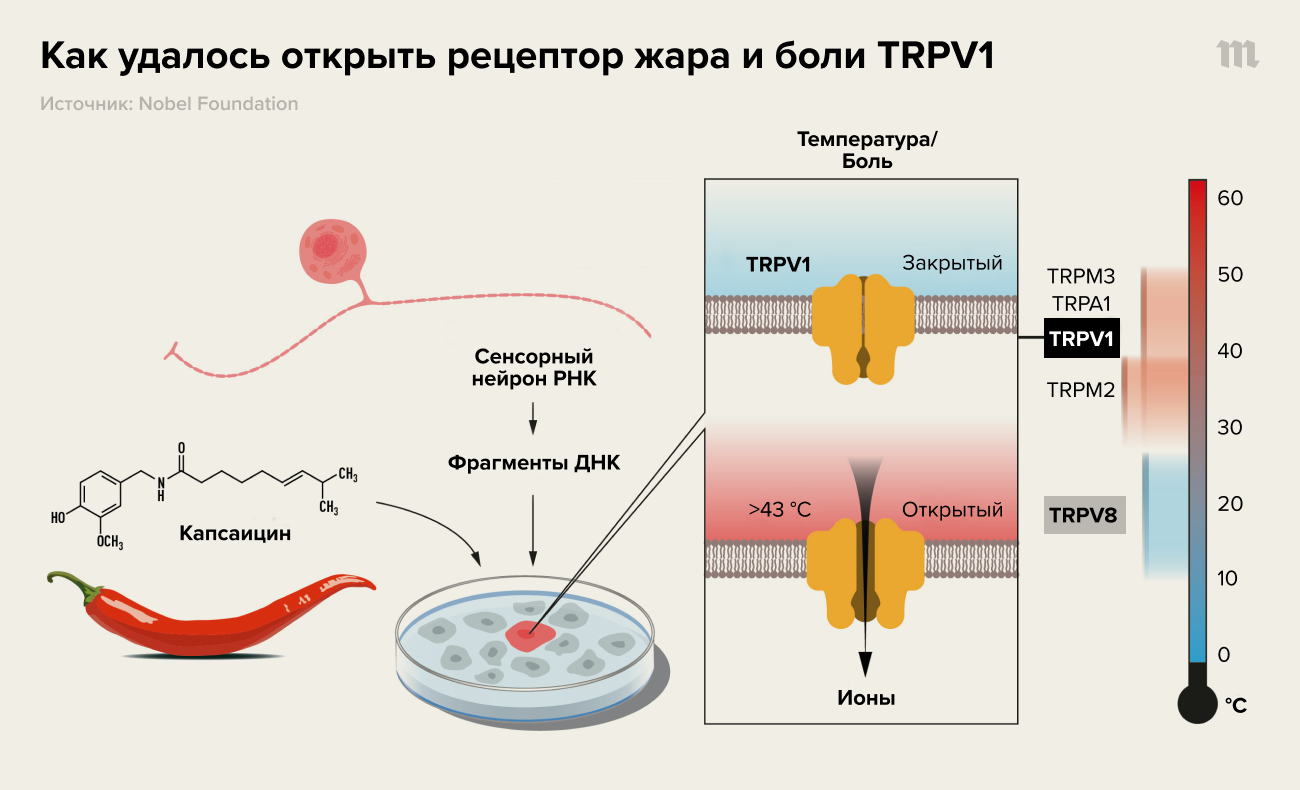
It was possible to solve this rebus with the help of great luck and the next experiment. Scientists suggested that for the sensitivity of neurons to heat and pain (and, of course, capsaicin), only one independent protein receptor is responsible for opening the flow of ions into the cage and leading to an electric impulse (it was here that they were lucky-there could be a lot of these proteins). If so, then the gene of this receptor, being transferred to a completely new cell, should give it the same sensitivity as the pain neurons and cells, which used to be, for example, simply cells of the kidney epithelium, had to begin to respond to heat and capsaicin.
Then, scientists, led by David Julius, allocated all the RNA from the well -known sensitive neurons to the capsaicin, thus receiving the “library” of all genes working in these cells. They did not take all the genes contained in the genome of a person in general (overkill of this scale would be very complex and potentially unsuccessful), and used only those genes that existed in neurons in the form of RNA. That is, those that really worked, and not “slept”. Then the genes from this library were inserted individually into the cups growing on the cups, a special marker substance was added, glowing with a high concentration of calcium ions , and acted on the cells with capsaicin. Of those samples that under the influence of capsaicin began to unexpectedly glow, then distinguished DNA, in which there was a gene of thermal sensitivity. It was called TRPV1: TRP is a structural family of receptors (the discovery of which Drosophil, made earlier, did not celebrate the Nobel Committee this time), and the V1 or VR1 is the name of the receptor.
Then, already knowing the nature of the first sensitive to the temperature of the gene, TRPV1, scientists discovered many of its “relatives” (“homologists”), which, as it turned out, provide subtle sensitivity to temperature due to small internal structural differences. The receptor of the same family, TRPM8, as it turned out, reacts not to the heat and not to pain, like trpv1, but to the cold. At the same time, oddly enough, it is very important for feeling normal heat - it occurs only when TRPV1 and his “colleagues” TRPA1 and TRPM2 work, and TRPM8 (normally constantly working) is temporarily disconnected.
Another key experiment - which led to the discovery of the mechanism of mechanism (touching, stretching, etc.) - was made by a group of the second laureate, Ardem Pataputyan. Just as in the first case, scientists had to observe the reaction of the cells to the influence, paying attention to the genes, which are needed for this reaction. Only instead of transferring genes from neurons to other cells, the Pataputyan group scrupulously turned off one variety of candidate genes in the culture of neuroblasts (immature neurons), while observing their reaction (or its absence). There was no convenient analogue of capsaicin for the study of mechanical mechanism, and scientists to observe the reaction had to poke in the very sense in the neurons with a “stick” and observe their reaction.
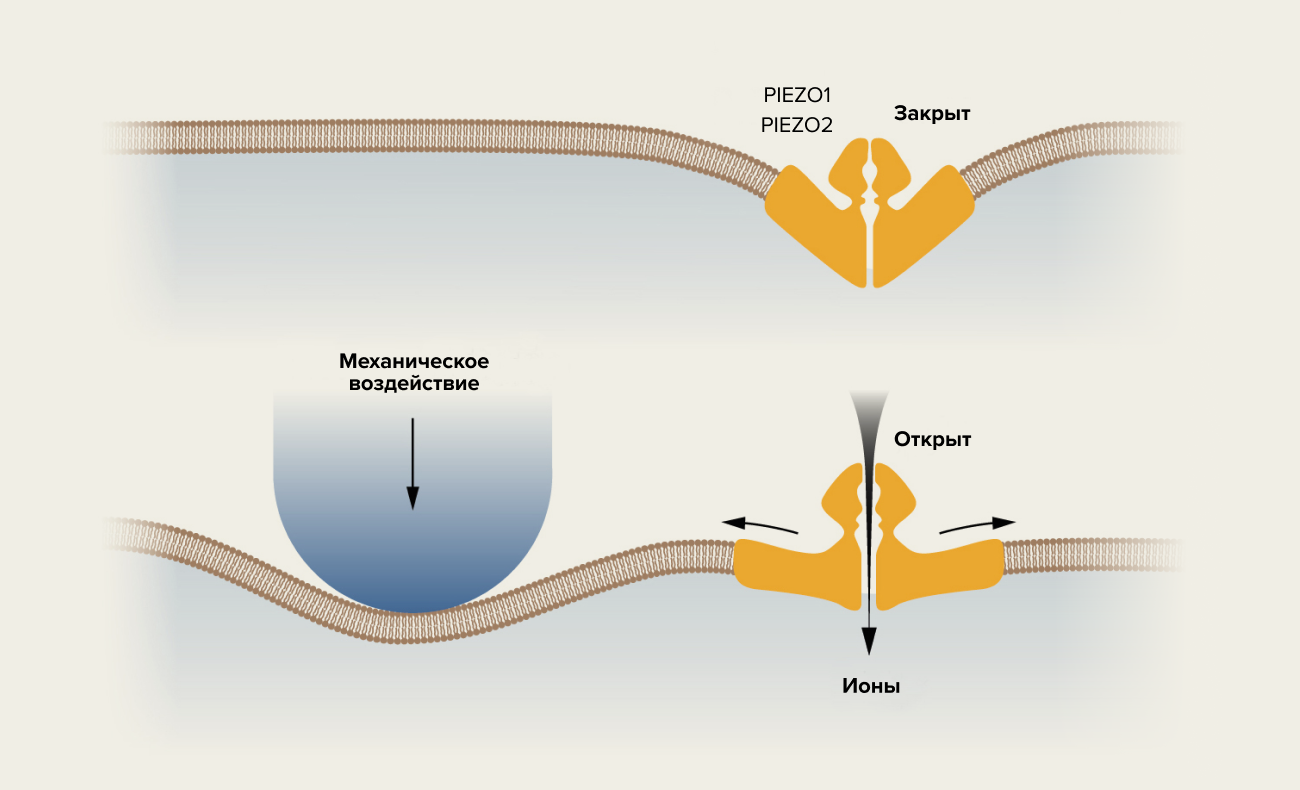
In this way, it was possible to detect a gene, the shutdown of which completely deprives the cage of the reaction to touch. More precisely, this is not one, but a whole family of genes, the first and main of which were Piezo1 and Piezo2. From further experiments in which it was possible to establish a three -dimensional structure of these receptors, it became clear how they work: when pressed, the cell membrane is stretched, and with it it stretches and begins to pass the receptor ions. The entry of ions into the nerve cell, of course, leads to its activation and the formation of a nerve impulse. Of course, there are still many unknown details about the work of Piezo1 and Piezo2, but this mechanical part has become much more understandable.
Why all this?
Ilya Kelmanson
Institute of Bioorganic Chemistry of the Russian Academy of Sciences, Russian National Research Medical University named after Pirogov
TRP is a fairly large family [receptors], there are quite a lot of different channels, they are everywhere, and how they participate in the development of diseases is a very big topic that is now very actively studied. These receptors take part in a huge number of physiological processes, and it is clear that for the "pharma" their research is very important. This applies primarily to pain mechanisms, migraines. In general, the treatment of migraines is just one of the hottest points in the study of these receptors.
In our laboratory, we are trying to use these receptors as “actuators” - similarly as in the optogenetics to manage neurons of light, photosensitive ion channels, canalor -psins are used. These are ion channels that open in response to the light and miss sodium ions. Similarly, you can use thermal -sensitive channels of the TRPV1 type - in order to, for example, affect the cell with infrared radiation, warmth, try to “turn it on” or “turn off” it too. This can be tried to do in cases where, for some reason, optogenetic tools are worse. For example, infrared radiation penetrates more deeply [into the nerve tissue] than visible light, respectively, you can [using TRP channels] try to influence deeper cells. In addition, TRP is three orders of magnitude better than canalor -ps, calcium is allowed, and with their help you can affect some calcium processes inside the cell, acting on them with heat.
Sergey Kozlov
Laboratory of neuroreceptors and neuro -regulators of the Institute of Bioorganic Chemistry of the Russian Academy of Sciences
In addition to the fact that [the TRP family] is thermal sensitive receptors, they are also the main receptors of the nocious, that is, pain. And it will be more important than [in itself] thermal sensitivity. [Inhibitors of these receptors] are an alternative to opioid analgesics. It is on this problem that we have been actively working for 12 years.
The task is to selective inhibiting these channels, but not in order to influence thermal sensitivity - this is not interesting - but in order to make new painkillers. There are many works in this area, from large and small pharmaceutical companies, from scientists and universities in different countries, but so far nothing has come to the market. Including we [some time ago] also proposed our peptides as potential inhibitors, and even conducted their preclinical research-but at some point we simply did not have enough money [to move on].
Alexander Ershov