
Translated material
Another Russia
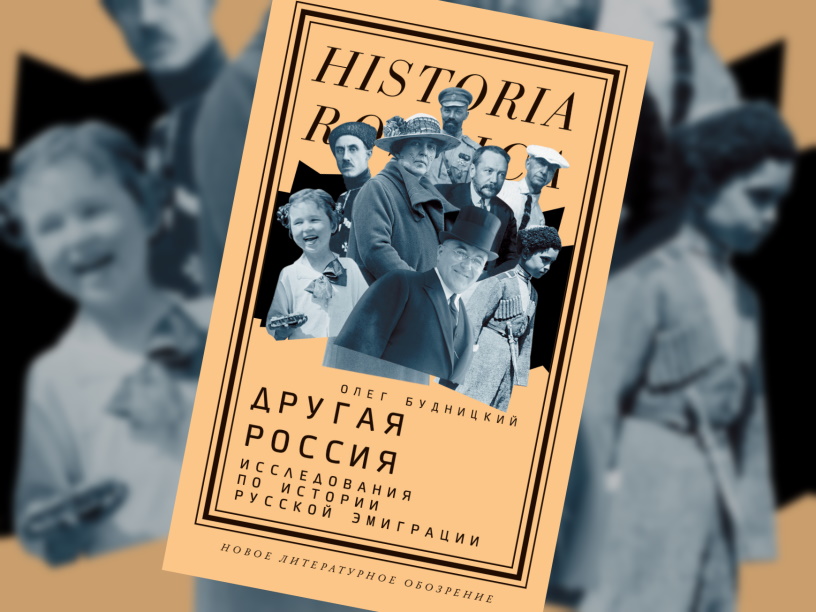
The publishing house "New Literary Review" represents the book of historian Oleg Budnitsky "Another Russia. Research on the history of Russian emigration. "
Contrary to the winged phrase of Georges Danton, “The Motherland cannot be taken with him on the soles of the boots” Russian emigrants of the “First Wave” (1918–1940) managed to create “Another Russia” abroad. Various aspects of its political and social life are considered in the book of the famous specialist in the history of Russian emigration Oleg Budnitsky. One of the plots of the book is the fate of “Russian money” abroad: the last part of the so -called Kolchak gold, the finance of the imperial surname, the Petrograd loan (silver) treasury, which found himself in the hands of General P.N. Wrangel and became a source of financing of his army. In another section, the author considers the searches by emigrants of ways to overcome Bolshevism - from the hope of its evolution or decomposition from the inside to the ideas of the transition to terror. The most extensive part of the volume is devoted to the history of emigration during the Second World War, when some professed the principle of “against the Bolsheviks at least with a line”, even if his name is Adolf Hitler, while others believed in the degeneration of the Soviet regime and tried to reconcile with it. The collection also included portraits of prominent figures of emigration - diplomats, lawyers, entrepreneurs, writers. The research included in the book is based mainly on the materials of foreign archives.
We offer to read the essay about Ariadne Tirkova-Vielms that has entered the book.
"First Lady" of London emigration (A.V. Tyrkov) [1]
On the occasion of her 70th anniversary on November 26, 1939, Ariadne Tyrkova-Vielms received many congratulations from different countries. One of them sent Taffy from Paris: “You are the smartest, most talented and most powerful woman that I had to meet on my life path,” admitted the most popular writer of Russian emigration, “I ask you to believe in the sincerity of my words, because I am not very generous for delight ...”
Such words from the lips of skeptical and stinging teffers are expensive. However, in her delights she was not alone. The artist Mstislav Dobuzhinsky, who met Tyrkov in the brilliant St. Petersburg of the Silver Age era, was remembered as "an unusually beautiful woman with fiery eyes and hot speech."
For more than 20 years she spent Tyrkov in England. She arrived here in March 1918, having a life behind him, which, in full event and passions, could have enough for ten. It is unlikely that anyone, and above all, she herself, might have thought that fate would take her for almost half a century, that they will be held in three countries-England, France and the USA, that her main books will be written ...
The life of Ariadna Vladimirovna Tirkova is almost half divided into Russian and emigrant periods. She was born in a landowner family in the Novgorod province. Her ancestors received the estate for participating in the campaigns of the governors of Skopin-Shuisky during the Time of Troubles, which ended with the reign of the Romanovs. Life at first developed quite traditionally. After graduating from the gymnasium in St. Petersburg, a student of the mathematical department of Bestuzhev courses at the age of 21 married a bribery engineer Adolf Bormann, gave birth to two children-son Arkady and daughter Sonya.
In the first years, the position of the wife of a successful engineer fascinates her. Bordemans leave a lot, are in theaters, dance. However, almost like in a fairy tale, through “magic” seven years, Ariadna Tyrkova has changed his life sharply. She does not want to be only the "wife of her husband." The young woman is divorced with her husband and, remaining with two children in her arms, begins to earn money to the existence of literary work: Tyrkova published articles and feuilletons in provincial newspapers. “They printed willingly, paid little,” she summed up later on the beginning of her journalistic activity.
However, over time, it becomes an increasingly popular author, readers are already waiting for the feuilletons of A. Vergezhsky (pseudonym Truckova). Gradually, she breaks through to the pages of the metropolitan press. However, the successful journalistic career was interrupted by political passions. She went to the demonstration in support of the students, was arrested on the street and sat in prison for ten days. The protocol on its liberation, drawn up by the gendarme officer, said: "Ten days of sitting in the Lithuanian castle, he will test the punishment for idle curiosity."
The next arrest in 1903 was by no means not only for curiosity - Tyrkov was arrested on the border for the transport of the illegal publication of liberals - the newspaper Liberation. She was tried and sentenced to 2.5 years in prison. Having received a delay in health reasons, Tyrkova ran abroad, taking both children with her. What brought her to the opposition camp? Half a century later, after the Second World War, she wrote in her book of memories:
Now, after what Europe suffers, what Russia is sick, I treat a lot differently, what happened then, in which I participated in one way or another. I know better our weaknesses, mistakes, errors. But I do not renounce my past, of the main ideals of law, freedom, humanity, respect for the person, to whom I served as possible.
Respect for the individual and the autocratic regime were incompatible. It is not surprising that Tyrkov was among his opponents. She settled abroad in Stuttgart, in the family of her classmate her classmate Nina Gerd - the editor of the “Liberation” of Peter Struve. Tyrkova took an active part in the preparation of the newspaper. Here, its commitment to the political ideals of liberalism, political and individual freedom took shape here.
Being abroad, Tyrkova took the opportunity and went to Geneva to visit another gymnasium girlfriend - Nadia Krupskaya. The visit was not pleasant. With Krupskaya’s husband, who obviously does not need performances, she immediately had a sharp debate about Marxism. Lenin went to spend her to the tram. On the way, the dispute continued. Farewell to Lenin, either as a joke, or seriously, noticed:
- Wait a minute, people like you, we will hang on lanterns.
Tyrkova laughed:
- No, I will not give you in your hands.
“We'll see this,” answered Lenin.
The seriousness of Lenin’s intentions could not be checked: fortunately, they never met again.
Another amazing meeting occurred abroad, which determined Tirkova’s life for the next quarter of a century, with New Zealand Garold Williams, a Russian correspondent of one of the English newspapers. Williams perfectly knew the Russian language - carried away by thickness, he learned it along Anna Karenina. In addition to Russian, he knew about 50 more languages and was even the author of the grammar of one of them - Polynesian. In Russia, Williams was called Garold Vasilievich. Subsequently, Tyrkov married him. The act, at first glance, is not very examined - after all, he was her younger for seven years. But the marriage was surprisingly happy.
In November 1905, after the amnesty of Tyrkov, he returned to Russia. Its "star period" begins. In 1906, she was elected to the Central Committee of the Constitutional Democratic Party-the main party of Russian liberals, it becomes the head of the Party Bureau of the press. Until 1917, when Countess S. N. Panin was elected to the Central Committee, Tyrkov was the only woman in the highest party organ. The power and decisive Tyrkov was called "the only man in the Cadet Central Committee."
In 1912, she became the first woman - the editor -in -chief of the daily newspaper Russian Rumor. She managed to attract many large writers to the newspaper - in particular, Alexander Blok was in charge of the literary department.
Once, already in the last years of her life in Washington, relaxing on a bench in a shady park, Tyrkova accidentally talked with a young woman who turned out to be the wife of a Soviet diplomat. The conversation was, of course, on “neutral” topics. Tyrkova asked which of the writers and poets of the early twentieth century is known in the Soviet Union. The young woman called several names.
“Besides Mayakovsky, they were all with me,” Tyrkova remarked.
"Diplomatha" asked in confusion:
- That is, how were you?
“Well, they just drank tea with me,” Tirkova explained with a grin.
In addition to journalism, Tyrkova paid tribute to fiction. Her stories and novels are printed in the best magazines of that time - “Bulletin of Europe” and “Russian Thought”. In separate publications, collections of her prose “Life Way” and “Night” are published, the book of the essays “Old and New Türkiye”, in “Russian Thought”, her great novel “Premotion” was published.
The special field of Trukova’s activity is the struggle for the emancipation of women. She was one of the leaders of the Russian feminists, wrote a lot on the “female question”, “tour” in Russia with lectures. Once, V.V. Rozanov, calling her in some kind of case and learning that Tyrkova went on a lecture tour, ironically remarked: “Well, again I went to the hives of raising its hind legs.” In fact, requiring equal rights for women, Tyrkov was by no means an extremist in this regard, as it was not “extreme” in politics. The struggle for women's rights was quite combined with her with commitment to family values. She was a rare example of a devoted daughter, wife and mother. In 1926, she managed to “pull out” her 87-year-old mother from Soviet Russia, who spent the last years of her life in the family of her daughter in London. Such a curious fact speaks of intimacy with children: only since 1918 she sent her son more than three thousand letters!
During the First World War, Tyrkov participated in organizing assistance to the wounded, went to the front, wrote from there correspondence to one of the most popular newspapers in Russia - “Exchange Vedomosti”. After the February Revolution, she was elected to the Petrograd City Duma and became the leader of the cadet faction there. After the October - immediately embarked on the path of struggle with Bolshevism; Under the threat of arrest in March 1918, with her husband and daughter, she left Petrograd to England through Murmansk.
The English period of life of restless Ariadne Vladimirovna began ...
Unlike many others, Tyrkov arrived on the shores of Albion not as an emigrant, but as an English subject. “But I cannot but be Russian,” she wrote later Baroness Maria Wrangel. - Yes, and my husband Dr. Harold Williams, or as the Russians called him, Garold Vasilyevich Williams, lived in Russia for 14 years, spoke Russian perfectly, knew Russia better than many Russians and loved it until the end of his life. ”
Almost the next day after the arrival of Tyrkov and Williams, they were invited out of town for breakfast at the editor of the influential Daily Kronikli Donald. After breakfast, the owner brought them “for tea” to the Prime Minister D. Lloyd George. The family spawksman had to speak to Williams, for the simple reason that Tyrkova had not yet known English. The following episode says about what vague ideas were in the heads of British statesmen about what was happening in Russia.
Lloyd George believed that one should agree with Trotsky, who, in his opinion, at that time was the only state -owned person in Russia.
Williams noticed about this:
- I don’t know what Trotsky statesman, but he is the enemy of England.
- How do you know that? Lloyd George asked quickly.
- From Trotsky himself. He informed me about this, ”Williams answered calmly.
Tyrkova began to clarify what was happening in Russia (of course, in her understanding) to the British. Together with the world famous Russian historian and archaeologist, academician M. I. Rostovtsev at the expense of a large entrepreneur N. Kh. Denisov, she organized the Russian liberation committee in London. The Committee published leaflets, brochures, sent information about Russia to newspapers, was a telegraph agency of all white armies in turn: Admiral A.V. Kolchak, generals A. I. Denikin, E.K. Miller and N. N. Yudenich. The Committee published political magazines: Russian Life (Russian Life) and New Russia (New Russia). In 1918, Tyrkova apparently wrote the world's first book about the Russian revolution. It was the story of the first year of the Russian Revolution, from February 1917 to February 1918. The book, entitled "From Freedom to Brest-Litovsk", was immediately released in English: from Liberty to Brest Litovsk. By Ariadna Tyrkova Williams (Macmillan & Co. London, 1919).
In those days, Tyrkov wrote:
I consider lost the day when I will not do anything for Russia. At least a step, at least a word, a new acquaintance, an extra repetition of tasks and thoughts. My mother is captured there, how can I not collect strength in order to free her. How can I not think only about this day and night.
After the departure of the Chairman of the Committee for the Liberation of Russia Rostovtsev in the United States, where he became a professor at Yale University, the committee actually headed Tyrkov. The activities of the committee continued after the defeat of the White Armies. But interest in Russia fell, funds were exhausted, and in 1929 the committee was liquidated.
In 1919, Tyrkov and her husband last time fell on Russian land, but already south, to the territory controlled by the Volunteer Army, where Williams was sent by the Times as a military correspondent. When Denikin was defeated, the Wiliamsov couple, along with Russian refugees, the English command evacuated to Constantinople. Then they returned to England - now "seriously and for a long time."
At this time, she writes her last novel - and one of the first art books about the Russian revolution. This, according to her, is "a novel from the Russian life of the beginning of Bolshevism." In the main characters, Tyrkov and Williams themselves are easily guessed. The book was written in Russian and was first called "Vasilisa Wise." However, it was only released in English translation in 1921 under the name "Hordes of Darkness" (Hosts of Darkness. By Ariadna & Harold Williams. Constable, 1921). Tyrkova considered the husband, translator and “generous interlocutor”, as she later called him, Tirkov considered it the co -author of this text.
Trukova’s “public temperament” determined its central role in the life of the Russian colony in England. And not only in England. In London, on her initiative, immediately after the Wrangel evacuation (in November 1920, at least 130 thousand people were taken out of Crimea to Turkey and Serbia) Tyrkov organized a society of assistance to Russian refugees outside England, whose permanent chairman she was until the mid-1930s. With her closest participation in 1923, the United Russian Committee was created by Russian emigrants, which included all non -political Russian organizations in London. It was almost the first initiative of the coordinated work in exile. These and other organizations created by Russian emigrants assisted refugees - first of all, of course, material.
I had to take care of the material situation of the family. On returning from Russia, Williams lost his job. His forecasts about the imminent fall of Bolshevism were not justified; The reputation as a political expert and the observer turned out to be undermined, and, of course, no one else wanted to keep him on the state. Since Williams was never a “miner”, Trkova, like 20 years ago, had to keep his family with literary work, and indeed to be, in his expression, “a family entrepreneur”. Moreover, a daughter and her husband lived with her, and at the very beginning of 1922 the first granddaughter was born - Ariadne.
However, the circumstances suddenly and miraculously changed. In the spring of 1922, Williams was invited to Times to the post of editor of the foreign department, and besides, he became a permanent author of advanced articles. His colossal erudition and the ability to clearly and consistently state thoughts were in demand.
Now the family could afford to rent a big house on Tayt Street in Chelsea. The Tirkovov-Vileams house became a literary and political salon, in which there were prominent British and Russian politicians, writers, artists. The happy and almost cloudless period ended on November 18, 1928, when Williams died after a fleeting disease. He had an operation when this did not make sense. Tyrkova remained to live in England.
Two books became a matter of her life: one about the deceased husband, the other about Pushkin. The book about Williams, entitled by her Cheerful Giver (“Generous Interlocutor”), was published in 1935 in London. She worked on the book about Pushkin for 20 years ...
But for now-about the "newspaper" work of Tirkova in the 1920-1930s. Its main topic was England. England in all its manifestations and trifles. Tyrkov wrote dozens of various aspects of English life, if not hundreds of articles. It was published in the Berlin “steering wheel”, the Parisian “Renaissance”, Riga “Today”. The intensity of her work is evidenced by this fact: only in the newspaper "Today" for incomplete one and a half years (1939–1940), the 70-year-old journalist printed 56 articles by that time!
Along with political articles, Tyrkov wrote on “household” topics, telling the “ordinary” reader about English children, schoolchildren, students, women, workers, priests, statesmen and members of the royal family. Tyrkova wrote about flowers, about jumps, about universities and schools. This is not a “book” description of England, but live conversations and sketches from nature.
Here, for example, a fragment from one of her “letters from England”. The “letter” is dedicated to the “housing issue”. Probably, the following lines written in January 1926 will be amused the modern Londoner:
An apartment of five bedrooms in a good quarter is appreciated by pounds of 400 per year or more. And the house can be found for 200, including considerable city taxes. At the same time, apartment houses are built without any ability to save place and light. Half of the rooms are usually dark, windows in narrow courtyards.
I so want to send English architects for training for our Russians, or in general for builders of apartments on the continent. By the way, he will have learned to heal the dwellings.
Tyrkova told her Parisian readers:
I recently had to have lunch in the house of millionaires, a poor mistress, who had a fortune on her neck, he was in a black lace dress in her black lace dress:
- This is horror, how cold we have.
It seems to her, the Englishwoman to the brain of the bones, that the cold in the house is the same spontaneous phenomenon as the cold on the street.
However, newspaper work was considered by Tirkova, nevertheless, as something secondary. The main thing in her life, we repeat, became a book about Pushkin. She was fond of the idea of writing his biography back in 1917. And - it's hard to imagine! - Once for some time in Moscow after the Bolshevik coup, she managed to find time to work in the manuscript department of the Rumyantsevsky Museum (later renamed Lenin’s library; now, instead of returning the name of its founder, it was “crossed” to the Russian State Library).
The style of her work can be presented by one of the fragments of a letter to her son of June 23, 1927: Arkady asked about Pushkin’s novel with Maria Raevskaya. “So much nothing has been written about this,” Tyrkov responded to the question. “We must forget them all and stay only with Pushkin and with her.”
The first volume of Pushkin’s Life, covering 1799-1824, was published in Russian in Paris in 1929. The book received very good reviews in the press. Perhaps the best and most short of them remained unpublished: Sasha Black sent her his book with the inscription: "The author of the noble and heart book about Pushkin."
Work on the second volume, also completed in England, demanded another 10 years. However, he came out only in 1948, also in Paris. By that time, Tyrkov had been living in France for 10 years. Arriving at the end of 1939 to stay with her son, who lived in Medon near Paris, she was stuck here in connection with the war. And then she remained to live in the family of her son, surrounded by universal care, and very attached to another granddaughter - Natasha. During the war, the former “Novgorod landowner”, as she called herself ironically, sometimes had to earn extra money in a way for civilized Europe: she gathered saucers and sold them to half -starved Frenchmen, who did not know how to live on “leap food”. After the war, she came to England several times, and in 1951, along with her son's family, she moved to the United States.
Tyrkova did not turn into a grandmother, surviving her age surrounded by children and households. Any writer in the prime of physical strength could envy its creative productivity. At the age of 83, she publishes the book of memoirs “On the Paths to Freedom” (1952), in 85-year-old-the new volume of memoirs “What will no longer happen” (1954), in the second half of the 1950s, the third volume was printed in the magazine “The Renaissance”-“Lifting and the Complex”. And this is not counting numerous articles and huge correspondence. At the 92nd year of life, she publishes memories of Leo Tolstoy (Renaissance, November 1961). Apparently, this was her last lifetime article.
On January 12, 1962, at the 93rd year of her life, Ariadne Tyrkova-Vielms died in Washington.
She was by no means belonging to those emigrants who had hopes for the evolution of Soviet power. But still, in 1945, the hope slips in her letters that maybe her “Pushkin” will be published in Moscow. Then this did not happen and could not happen. Half a century later, interest in Trukova’s “Labor and Days” broke out in her homeland. Articles about her appeared in almost all newly published encyclopedias. Her diary and extensive correspondence were published. In the excellent (not a couple of “paper” New York and London), two books of memoirs were published. Finally, in the Jubilee Pushkin year in the series “Life of wonderful people”, her “Pushkin’s Life” was reprinted.
The return took place.
[1] Budnitsky O. V. “The First Lady” of London Emigration // Knowledge - Power. 2003. No. 4. S. 109–114.