
Translated material
Where love lives
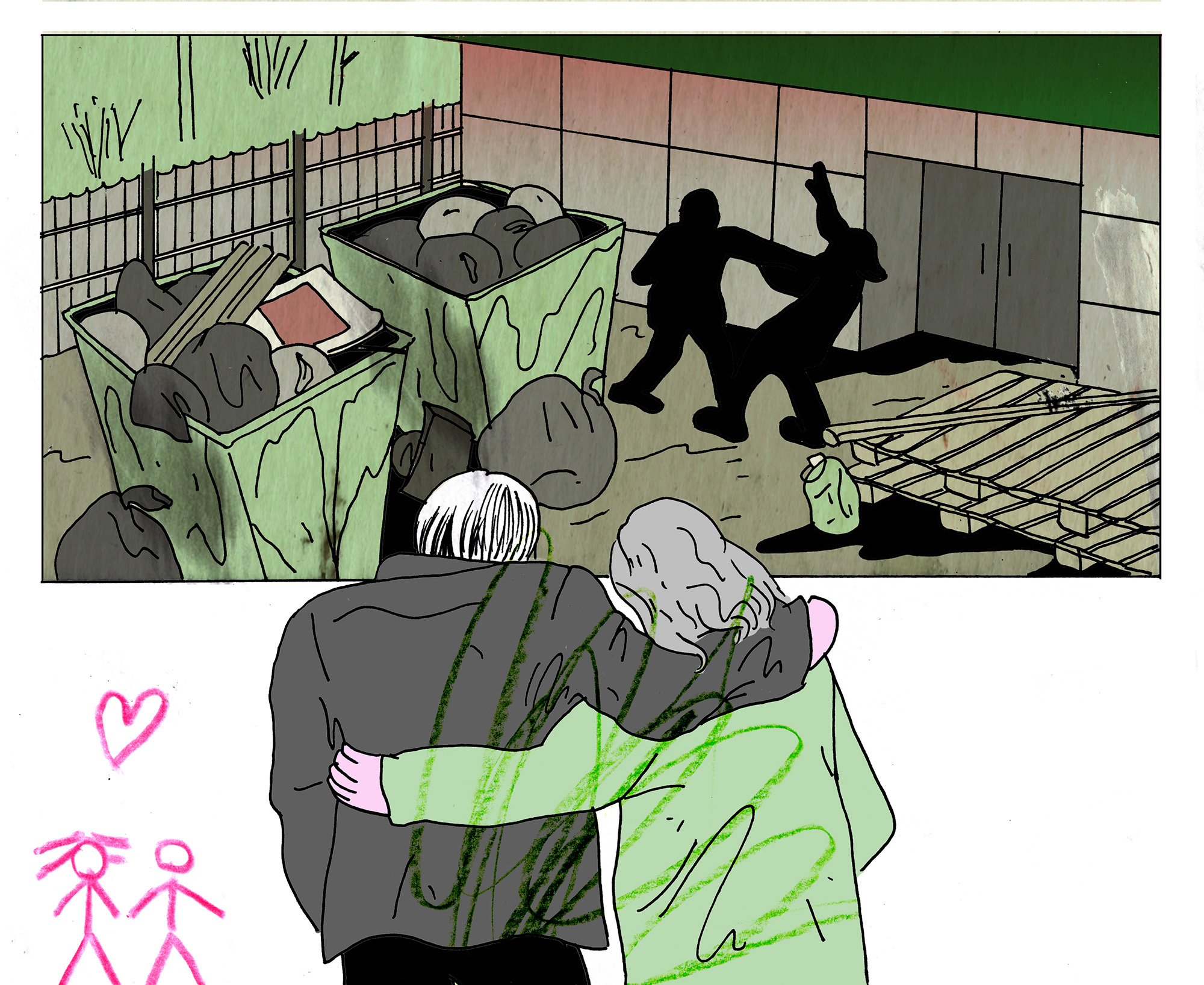
“Such things” talked with a variety of people who have no home now or had the experience of homelessness in the past. All of them converge in one thing: you cannot contrast the relations of homeless and home, love everything the same
Olga and Glory
Astrid turns in his hands a small bottle of glass.
“A means for cleaning diamonds,” she reads. Astrid (as it seems) is a short purple-turquoise Iroquois and the experience of life in abandonment. Now she is a psychologist in the support group for homeless women.
I came to the group of support in the “Cultural Laundry” (the project of the Overchka Charitable organization, where the homeless can wash and dry their clothes for free) I arrived with a dozen Doshirak boxes and chocolate waffles. I was planted next to an electric stove, gave out a Turk and instructed to cook coffee.
In addition to me and Astrid, four more women came. Each of them has its own causes of homelessness, life experience on the street and the history of relations with men. Only Olga agreed to talk to me.
Olga has a pants in red roses, a smoky voice and a armored crutch (a cane with support under the elbow): when she crossed the road to the green light, she was shot down by the car. Even having made a discount on the twenty -year experience of homelessness, I do not dare to give her less than fifty -five years. It turned out forty -three. The last three years are Slavka next to her.
In the past, both have an unsuccessful relationship. Glory was abandoned by a girl, also homeless. He, like Olga, fell under the car. While lying in the hospital, the girl went to another. “She did not like that he could not walk normally, and she went to the old grandfather. When he called her, did not take the phone or took this grandfather, said: “Once again you call, I’m from *** (I’ll hang it around),” says Olya.
Olga was betrayed by the guy. At fifteen, she gave birth to a child from him. “He wanted a son. On, get it. Received. He put us on the street at night, in winter, there were then. Then we reconciled. They lived unfortunately, just lived. The second son was born six years later, he did not even come close to us, ”Olga still has not forgiven. Now the sons of Olga do not help, but both have a good relationship with both of them.
Olga and Glory lived in basements, in attics, in a hut, which they themselves built. Due to the injury, Olga cannot go far, so Glory went to work alone: he collected bottles and jars. Now he works at the construction site of the house in the Leningrad region, he lives there. On weekends, he comes to Olya in the "night". It brings her favorite coffee and gives all the earnings so as not to drink. “Sometimes it thumps. I can’t stand it like that, ”says Olga. “I don’t want him to get drunk, because winter is on the nose, you need to look for the room so that it is under the roof.” So they care about each other. But this is not love.
“After betrayal, I simply do not understand this love. There were connections, but there were no sincere relations. I didn’t tell anyone “love”, I just answered: “Do not get used to me.” But for some reason everyone gets used to it. Glory is also used to it. In vain ".
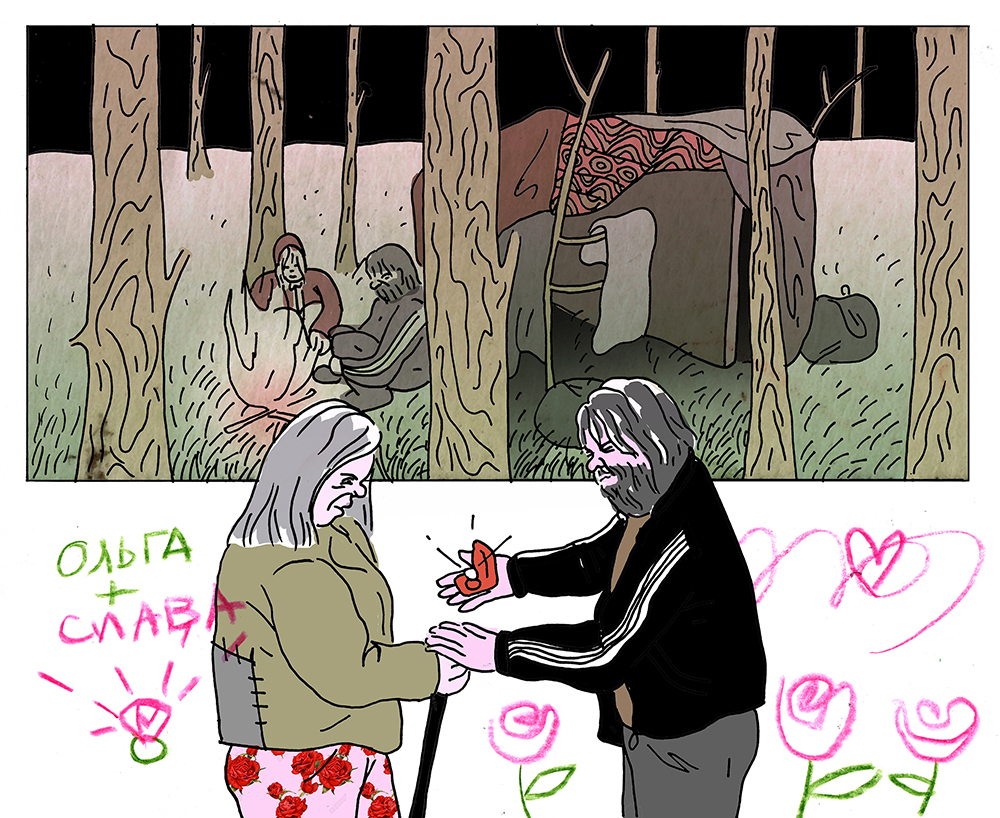 Illustration: kameeellah for TD
Olga has exclusively friendly relations with Slavka: “We have no sex. Do not even kiss. It annoys me - kiss. I just hate guys. " At the support group at Astrid, you can take condoms. True, most often balls are inflated from them. Olga says: "I do not need condoms in FIG, I do not get married."
Three months ago, Glory made Ole an offer. A ring with pebbles shines on her finger. But she does not dream of neither about family nor love. He dreams of one thing - to live, not to survive.
The creation of a family or its appearance is solved not only of security, but also to emotional closeness, which psychologically supports both. The sociologist and interior-research of the Center for Youth Research, Evgeny Kuziner, says that in conditions of homelessness, people unite and come closer to support each other: “Pars are formed, not only love, but also friendship arises. It’s easier to be with someone than fighting alone. This is security, support, and care for each other. Therefore, homeless people often call each other “husband” and “wife”. For them, this is a way to emphasize the degree of proximity, to indicate that they are a couple, and to hold on to each other. ” Astrid adds that people, between whom there is no sex and even kisses, can also call each other husband and wife. At the same time, they sleep together, for example, in an abandonment, he protects her, she takes care of him, flirts with him. And they also take such a pair seriously everyone.
Olga says that people on the street do not throw each other, because they are in the same situation. They survive, and the two of them are easier to do: “If I had not met Slavka, I don’t know what would have happened to me at the moment. Maybe she hanged herself, maybe he drank herself. Life is a hard thing. But there is support, there is a wing, there is someone to cry. ”
Brother Olya died, poisoned by smoke during a fire at home. Mank's sister went missing, then mother died. After that, Olga went into a binge - and she was deprived of parental rights to her sons. Slava brought her in the "night" six months ago. Here she is helped to arrange disability and return the grandmother's house in the Leningrad region.
“I hated dad for how he treated his mother, his brother’s wife was for how she acted with him, and the Mankin groom who beat her and forced her to work for him. I never had love as such. Here's how to explain, sho is such love? You explain to me. "
Tatyana and Seryozha
Homeless people do not necessarily live right on the street. They build a hut like Olga and Glory, or equip the basement, and in abandoned houses of married couples, there are often separate rooms - like any other couples, personal space is important. Any of these places will be called home.
“At the age of twenty, everything has already been done: prostitution and drug addiction. Mother worked at a meat processing plant, I am at a candy factory. Stole. Customers were-oo-ok. There was enough money. The daughter was completely on the mother’s neck, I was thumping, ”says Tatyana.
With her, we also communicate in the “night”, where Tatyana has been living for the past two years - in the room for more than ten women. Tatyana is fifty -three, she has curly hair to the shoulders of the color of salt with pepper, but more salt. A dark red cardigan is wearing a dark red cardigan on top of a t-shirt with a print in the form of pink. At first, Tatyana did not want to remember the past, but in the process of conversation she was very frank.
She got a classic story with an apartment. They wanted to exchange with a surcharge on Piskarevsky Prospekt - this was done by the friend of his son's son's son. But for one month, Tatyana was left without an apartment, without a mother, without a daughter and without an additional payment.
“What I signed, I have not read a single document. On the tent of May of the first year (2001.-Note. TD) we were brought to a new apartment, but not on Piskarevsky Prospekt, but to the village of Skanka, this is the 101st kilometer, bandits. Mother died on May 1. Naturally, I thumped every day. I will lay a passport for the bottle [seller of vodka], then documents for the apartment. I’ll get money - I’ll buy it out. ”
A year later, Tatyana and her nine -year -old daughter Masha arrived back to St. Petersburg, to the area where they lived before the move, Vyborgsky. Tatyana immediately met “with the girls”, they invited her to live with them in the basement. She agreed, since she did not have housing in St. Petersburg, and she never wanted to return to the village. Almost immediately Masha disappeared. Tatyana did not look for her daughter.
Tatyana and other homeless products were taken at the Perekrestok and Pyaterochka station wagons. Employees took them out expired for a day or two goods, all in packages, so it did not rummage in the garbage dumps. He says that they ate "God forbid to every home man." She even had her own customers among domestic - grandmothers, women. It was enough to sell and eat.
She met Seryozha in the trash for the "intersection". He was twenty -four, she was thirty -five. He immediately offered to live together.
“Seryozha already had a basement in the mind, and we began to equip. I don’t know how the homeless live now, but we lived gorgeously. There was electricity in the basement, hot and cold water - I could not live without water. We had a TV, tile, I cooked. There was bedding, I washed. Like in an apartment, just here are pipes. ”
At least the illusion of the house is important to the homeless. Therefore, a woman creates an atmosphere of comfort in a place of residence. “In our patriarchal society, it is believed that a woman is a mother, wife and mistress of the hearth. Therefore, even in a situation of homelessness, it is important for her to show her role - her beloved woman, ”says Evgenia Kuziner. - When men go to work, for example, collecting iron, they do not take women with them. A woman should sit at home, even if a house is a tent in a city park. ”
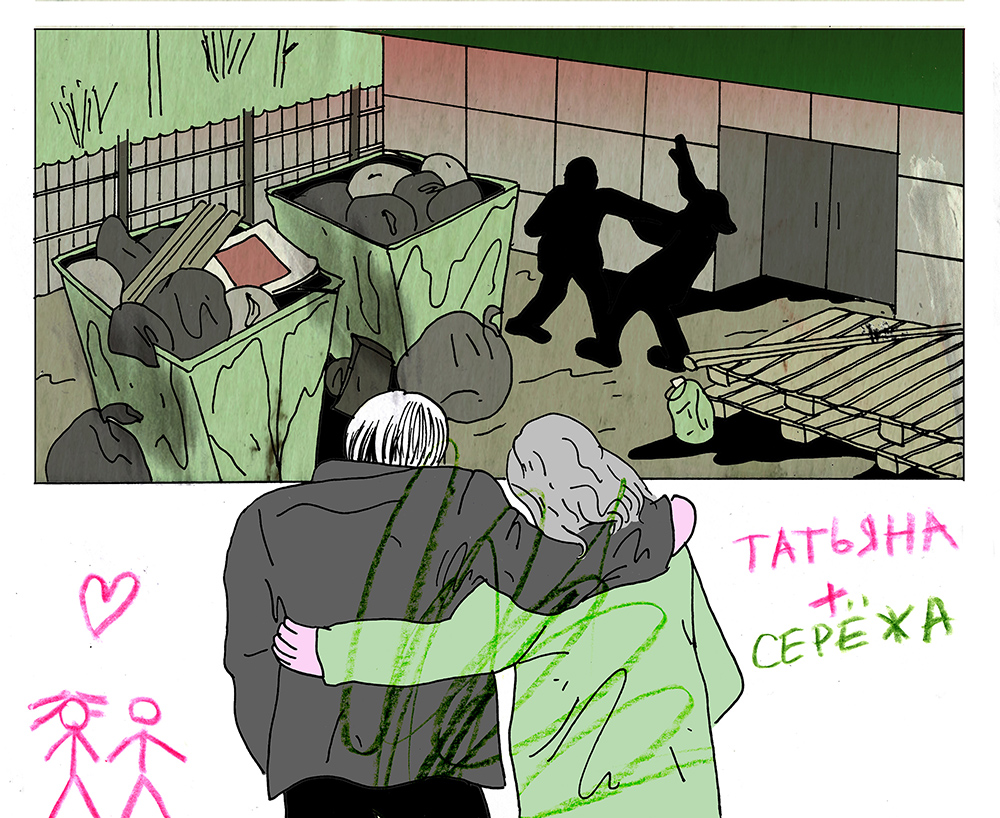 Illustration: kameeellah for TD
This does not always happen. Often, a woman lies with several social roles: she goes to work on a par with a man (and sometimes instead of him) and conducts households. “This is a patriarchy in a square, because a man is valuable in itself,” Astrid believes.
So that the janitor does not drive out of the basement, they also had a hack: Tatyana washed the stairs, Seryozha helped to remove the courtyard.
In the family of Tatyana and Sergey, both did not sit idle. Together collected banks, metal. Sergey had unofficial work (assistant chief of repair of industrial refrigerators), and also drug addiction. He breathed gasoline, glue, varnish. At such moments, he “demolished the tower”, he beat the roommate. The bruises did not have time to heal, even in winter Tatyana walked in black glasses. I did not think to get away from him: “Where to go? To friends in another basement? I loved him, Seryozha. How would I be alone? No no".
On the one hand, being with a man is a strategy for survival on the streets: there is less chance of becoming a victim of physical and sexual violence from homeless men. On the other hand, the presence of a partner does not guarantee a woman security from himself. “The woman believes that now she has a protector, but often faces an abuser,” Astrid explains. -Moreover, due to domestic violence on the street is a huge percentage of women. If they have unusual injuries from previous relationships, mental and physical health is shaken, confidence in the world as a whole is lost, they again get to the abutures. And the cycle of violence is repeated. "
As calmly as the beating of a civil husband, Tatyana describes sexual relations: “With Pentors, I only fucked two times in my life. When we slept with Seryozha, he’s just not the same thing in me. ” It seems that the street is the most inappropriate place for sex, and, according to the cousin, many do not believe that the homeless can have sex. “The homeless exotizes: they cannot have sex, cannot love, because they live on the street. But in this regard, they are the same as we also experience feelings and can desire someone, ”says the cousin.
Sex is a normal need, and who is looking for, a place for sex will always find. There is sexual relations, even if both live in an abandoned building without windows and roof, at the station or right on the street. “And when there is money, the couple rents a room for one and a half thousand rubles. This is a common practice, ”says Astrid.
When there is no partner or partner, but there is still money, they turn to the services of sex workers. Homeless men, like others, are also consumers of commercial sex. “A year ago, a toilet prostitute cost one and a half thousand rubles. Toilet is which a blowjob in the toilet booth, ”Astrid explains. “And recently, a man in the group complained that prostitutes have risen in price - now five thousand per hour.”
Due to the constant use of alcohol, Tatyana did not notice the lack of menstruation.
“I feel the lower abdomen pulls. I take off my pants, there is a plow. I was so scared. Seryozha I say: Come on a rag soon. Pressed on the stomach. There was a finished boy, - Tatyana spreads her palms twenty centimeters. - Already with a pussy. With pens, with legs. Well, I squeezed out a place (placenta. - Approx. TD) , I pressed on the lower abdomen in intuition. I threw it, it means that it pleased God. Even if I were born alive, where would I leave it? "
A few years ago, Tatyana found her daughter Masha. After she was lost, some people helped her return home. She graduated from school, learned to the hairdresser, moved to her husband. The husband takes drugs and hits Mary. Tatyana saw the eldest grandson when he was two years old, now there are as many younger granddaughter. I have not seen her yet.
Tatyana and Sergey lived together for eleven years. They did not change each other. Until Vika appeared. Sergei called the reasons for the breakup: "I'm tired of that you are thumping." For homeless men, it is generally important that the woman is nonsense, watching herself, use cosmetics, and most importantly, was pure in terms of hygiene - this is especially appreciated on the street. On themselves, the requirements of “do not drink” and “take a shower” are rarely distributed. Again, any man is value.
After that, Tatyana moved to her home man: “I did not like Kolya. Drive, and that's it. Of course, he did not open his hands so [like Seryozha]. Bukhau, but was a hard worker. Then Kolya began to eat poorly, dry by the day, but by the clock. In the hospital, he died: cancer. I didn’t go to the funeral, I do not like these procedures. ”
Tatyana lived in the basements for fifteen years. Constant beatings from Seryozha are only the top of the iceberg. “The right hand does not rise after a stroke. In general, I am all interrupted. The head is like a sieve. The car knocked down three times. He will get, they will give money, drink - and nothing hurts. I had my own anesthesia. I have never contacted doctors. ”
After the death of Kolya, Tatyana moved to the "cottage". So she calls the fenced territory behind the "intersection" - thereby where she first met with Seryozha. She had a mattress and a blanket, there she slept in the summer of 2018. “But the mattress is about nothing, it still pulls from the ground. My legs refused. I was lying, they brought me to drink, smoke, eat, ”she says.
Someone called an ambulance. From the Botkin Hospital, a woman fell into the house of mercy of the mother of Teresa, where 12 steps of anonymous alcoholics passed, after which she got into the "night". There she found out that her Seryozha was deported to her homeland, to Odessa. For two years now there is no news from him. Tatyana is worried so that he is not imprisoned. But he doesn’t want to converge again: he is afraid that he will trudge and his legs will refuse.
“I don't want any man. I want my daughter to have real female happiness. And for myself, I don't think about it. The teeth need to be inserted. ”
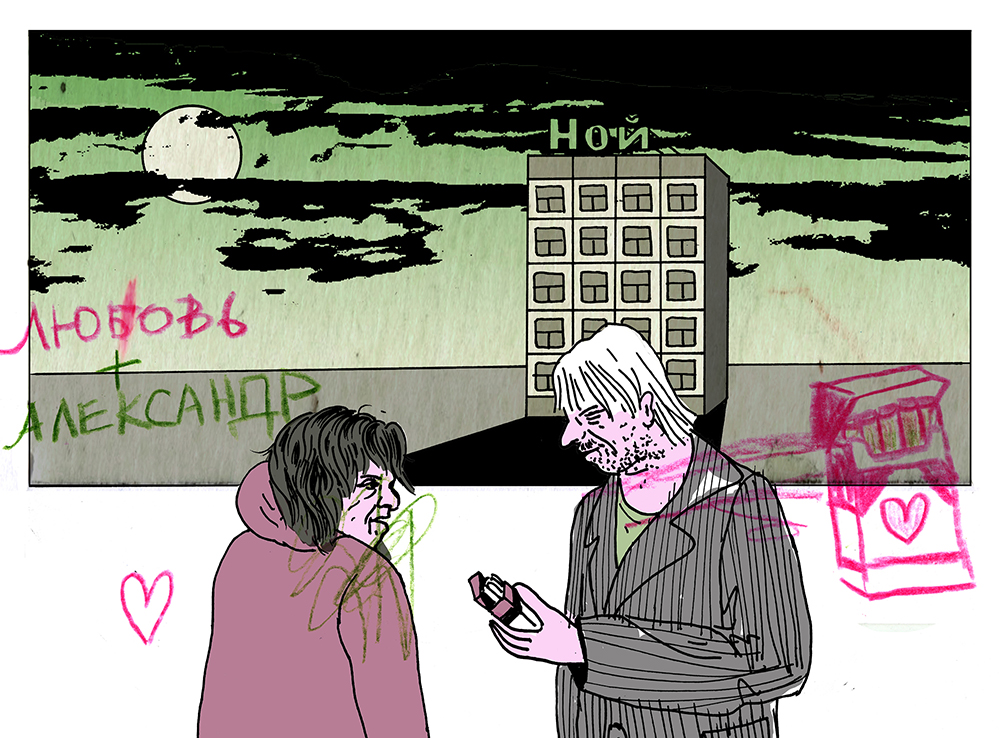 Illustration: kameeellah for TD
Love and Alexander
Moreover, many homeless people seek to create a family, they are not in a hurry to form a relationship officially. Sometimes the matter is the absence of a passport, but more often they simply do not think about such formalities. When there is no official place of residence and work, the marriage certificate also seems like an unnecessary piece of paper.
Marriages are concluded in exceptional cases. In the house of hard work, “no” marriage is one of the rules of residence. This is the largest charitable organization of assistance to the homeless in Moscow and the Moscow region, more than a thousand people live in the houses of Noah.
Romantic relations are allowed here only if this concept includes joint walks and any other contactless communication methods. The strict ban on sex is explained by the founder and head of Noah Emil Sosinsky: “Our workers are under the spiritual leadership of the Orthodox Church, and if people have not officially registered marriage, then this is fornication, they will not lead to anything good. If people begin to cohabit without marriage, we announce to them penalties - we scatter on different houses. They will not be able to live in our house until they officially sign. ”
When the couple decides to get married, he reports on his decision to the head of the house in which he lives. “The marriage is required, but the wedding is not. It is generally harmful to unbelievers. We have few crowned couples, ”says Sosinsky.
There are also divorces in “Noy”, but there are an order of magnitude less than “in the world”. Here they try to keep the family with all their might. Family pays for work 10 percent more than loners. If the couple is “deserved” and necessary for a shelter, for example, she is a cook, and he is a foreman, then they will most likely give them a separate room. This is possible in the presence of free places, because each room allocated to the family is a minus space for other homeless people. Now well -deserved steam on the NOI network of about thirty. If one of the couple or both begin to drink or do not go to work, they lose the room. To return to it, you need to undergo rehabilitation. Sosinsky notes that most of the wards who have entered into marriage, as they say, are settled, that is, they drink a separate housing less.
When “undeserved” wards enter marriage, they are not given a room. The wife continues to live in a common female room, the husband in a male room. Sometimes they are given the opportunity to close in some room to be alone. If a child is born after such dates, the mother continues to live with women or moves to a separate house, where only mothers with children live. Emil Sosinsky believes that they are better there.
If the pregnancy occurs outside the marriage, penalties are waiting for a couple again: a woman and a man are settled in different houses until they get married. If a woman does not say who the father of her child, the fine applies only to her. Abortion in "Noy" is prohibited. A woman who has an abortion is kicked out into the street.
Despite the "privileged" attitude, not everyone enters into marriage. Some couples leave Noah and live in a civil marriage.
The reasons why Alexander was on the street, he does not like to remember, mentions only family affairs, his ex -wife and wine. He was not at home for about four years, but on the street he spent only one summer - real luck in terms of homelessness. Жил в 90 километрах от Москвы, то один, то с компанией, ночевал «на трубах» (теплотрасса. — Прим. ТД). О женщинах не думал. «Понимаете, все эти мысли заливаются вином», — говорит он. Оказавшись в «Ное», Александр вылечился от алкогольной зависимости и встретил любовь — буквально. Его нынешнюю партнершу зовут Любовь.
Александр и Любовь познакомились, когда обоим было под пятьдесят. Люба к тому моменту около трех лет жила в «Ное», Саша немного дольше. «До этого у меня была плохая жизнь. Я убежала от мужа, побоев, скандалов, пьянок», — рассказывает Люба. В «Ное» она сначала была уборщицей, потом стала поваром на кухне.
Общались, вместе ходили по магазинам, Саша приносил Любе сигареты — у бездомных людей они ценятся больше, чем еда. «В доме все знали, что мы вместе гуляем, вместе ходим. Никакой другой мужчина уже ко мне не мог подойти, потому что знал, что у меня Саша есть, а у Саши есть я, — говорит Люба. — Дружба переросла в любовь». Через полгода Александр предложил Любе жить вместе.
Из «Ноя» они ушли год назад, снимают однокомнатную квартиру в Тульской области. Работают: Люба на фармацевтической фабрике, Саша охранником. «В квартире сначала была разруха, но я полностью ее обставила, купила холодильник, микроволновку, стиральную машину — все это нужно для совместной жизни. Сейчас у нас настоящая семья», — несмотря на отсутствие штампа на четырнадцатой странице паспорта, друг друга они называют «муж» и «жена».
«Я хотела создать семью, но не хотела оформлять отношения. Я несколько раз была замужем, Саша тоже был женат. Все у нас по-человечески. Поужинали сейчас. Саша сходил арбуз купил, телевизор смотрим — “Глухаря”. Everything is fine with us. Но даже если плохо будет, я все равно буду с ним».
Свадебную статистику в «Ное» не ведут. Сосинский перестал считать года три назад, когда свадеб среди подопечных дома трудолюбия (а их около тысячи) стало больше сотни. Чаще всего это браки между бездомными, но есть и другие варианты: «Бывает, что мужчина живет у нас, а женщина, что называется, “из мира”. Тогда либо она его забирает к себе, либо приходит жить к нему в “Ной”, такие случаи тоже были».
Чтобы женатым парам было комфортнее, Сосинский собирается открывать первый в сети «Ной» семейный дом. В нем те, кто расписался, сразу получат комнату: «Сейчас мы ищем подходящий дом. В нем должно быть 10—15 комнат, много санузлов и душей. Прибыль семейный дом приносить не будет, но надо, чтобы он хотя бы выходил в ноль».
«Среди бездомных примерно 15 процентов женщин. Поскольку женщин меньше, им легче выйти замуж и найти дом. Часто мамы с детьми выходят замуж за тех, кто их прилично старше. У нас выйдет замуж любая, вне зависимости от возраста и состояния», — уверен Сосинский.
Не все приюты обязывают вступать в брак, но и семейные комнаты, скорее, исключение. В «Ночлежку» семейные пары заселяются на общих основаниях, то есть в разные комнаты, а то и на разные этажи. Мужчины вместе с женщинами могут оказаться только в местах общего пользования: в библиотеке, во дворе или в прачечной. По этой причине многие не готовы идти в приют, а предпочитают остаться в подвале или другом временном месте проживания. Зато правила «Ночлежки» не предусматривают жестких наказаний за сексуальные отношения. Сексуальные вопросы — не важно, оформлен брак или нет — решаются вне стен проектов «Ночлежки». Жильцы не ограничены в передвижениях и, предупредив своего соцработника, могут не ночевать в приюте, а, например, снять комнату в хостеле.
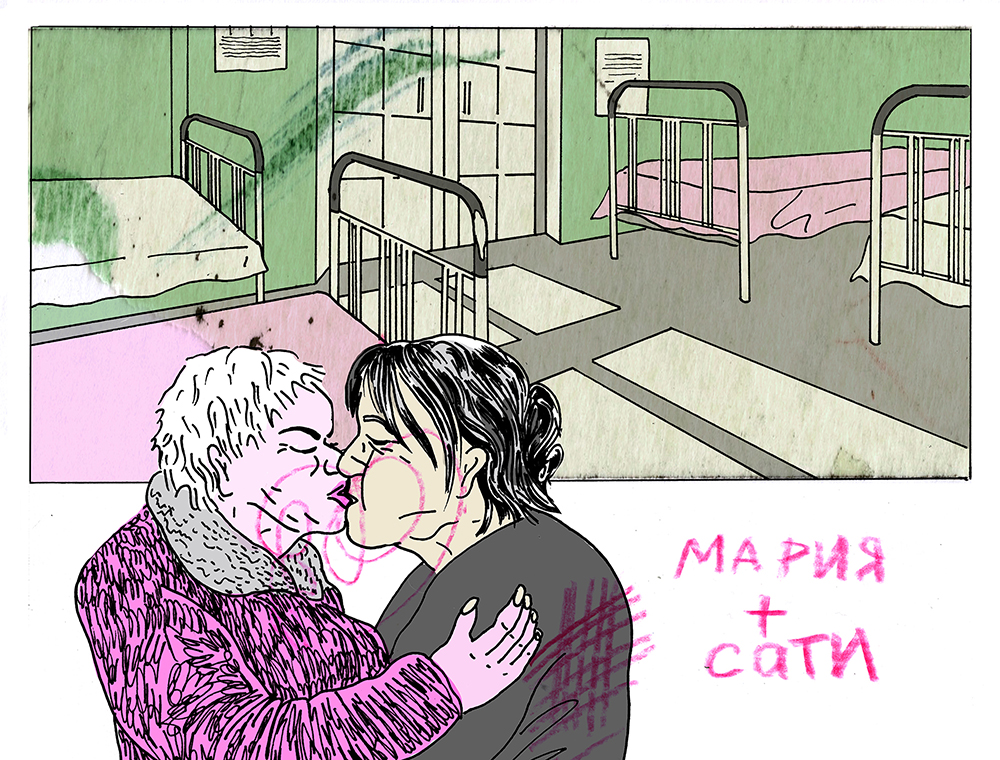 Иллюстрация: kameeellah для ТД
Мария и Сати
Среди бездомных людей встречаются не только традиционные пары. Гомосексуальные отношения тоже есть, просто не все готовы их афишировать — впрочем, как и в обычной жизни. Но улица — среда более агрессивная еще и потому, что среди бездомных много бывших заключенных, которые к однополым отношениям относятся без понимания: за это могут убить.
Мария Власова — личность среди бездомных известная. Вместе с ней «Новая газета» снимала фильм про бездомных «Другая сторона улицы» . Без жилья и прописки Мария осталась в 2018-м. Сама она с насилием на улице не сталкивалась, но подтверждает, что другие женщины часто подвергаются агрессии, изнасилованиям, побоям со стороны мужчин: «Я лежала в туберкулезной больнице в Москве, она для бомжей специально. Там соседки были, которые по двадцать, по тридцать лет на улице. Вот они рассказывали: одну “розочкой” порезали. Какую-то девчонку хотели изнасиловать, она за нее полезла вступаться — и ее порезали, до реанимации дело дошло».
До того как оказаться на улице, Маша жила во Владимирской области, работала то почтальоном, то ревизором наземного транспорта и пила водку. Без дома осталась в тридцать три года. Лежала в больнице, врачи поставили диагноз СПИД и посоветовали готовить себе место на кладбище.
«Когда тебе это говорит врач, ты реально начинаешь готовиться к смерти. Вопрос похорон стоял остро. Родственников у меня нет, и одна знакомая обещала ухаживать за мной, пока я не умру, а потом похоронить. И чтобы моя квартира во Владимирской области не досталась государству, я переписала квартиру на нее».
Мария не умерла, а пошла на поправку. Но осталась без жилья. «Человек, который в пятнадцать лет забил до смерти другого человека и отсидел десять лет в тюрьме, вряд ли может поступать порядочно, — говорит про ту знакомую Мария. — Ну нет и нет жилья, чего уж. Это ж не руку отрубили. Выходы надо искать, чтобы не жить на улице».
И она все время находила где жить, когда не в больнице. «У знакомых, в питерской “Ночлежке”, в Москве жила — в шелтере для ЛГБТ, — перечисляет Маша и делится главной новостью: в сентябре у нее наконец-то появилась прописка. — И все, больше не смогу называть себя бомжом официально».
В том же году Мария встретила Сати. Они лежали в одной палате в туберкулезной больнице. «Туберкулез объединяет людей, — смеется Маша. — У нас любовь. Трудно поверить, что так бывает, но есть такое».
Сати домашняя. После выписки у них были отношения на расстоянии: Сати жила дома, в Москве, а Маша — в Петербурге в «Ночлежке». По словам Маши, бездомные не только сильнее друг за друга цепляются, но и лучше заботятся. Недавно Сати купила квартиру в Москве. Теперь они живут втроем — завели собаку, йоркширского терьера Микки.
Пообщаться с «Такими делами» по телефону Сати отказалась, но отвечала на вопросы через Машу.
«А тебя не смутило, что я бездомная, когда мы стали встречаться? — кричит Маша куда-то вглубь квартиры и передает ответ: — Нет, ее не смутило, она же полюбила меня. А там уже не важно, живешь ты дома или нет».
Проведя на улице четыре года, Маша называет бездомных женщин невидимками. И говорит, что мужская иерархия среди бездомных имеет большое значение.
«Бабу на вокзале в толпе бездомных слушать никто не будет, а мужика будут. Когда я тусовалась с бомжами на Курском вокзале, женщины закуску к водке делали — разводили пюрешку. Еще денег стреляли на выпивку — по два, по три рубля. Банки собирали, на “ алюмишке ” сдавать. Если она ходячая, может ходить по улицам, собирать металлолом, сдавать, приносить деньги. Поесть что-то приготовить. Что делают мужчины? Бухают. Серьезно, бухают. All. Женщины тоже бухают. Очень трудно не пить на улице».
Сейчас Мария и Сати не работают. «Мы семья инвалидов по туберкулезу, просто в Москве пенсии побольше. На работу, конечно, устроюсь. Работать — это в порядке вещей. Опять хочу пойти ревизором, потому что я эту работу знаю и там тяжести не надо поднимать. Все на самом деле здорово. Главное — не опускаться на самое дно».
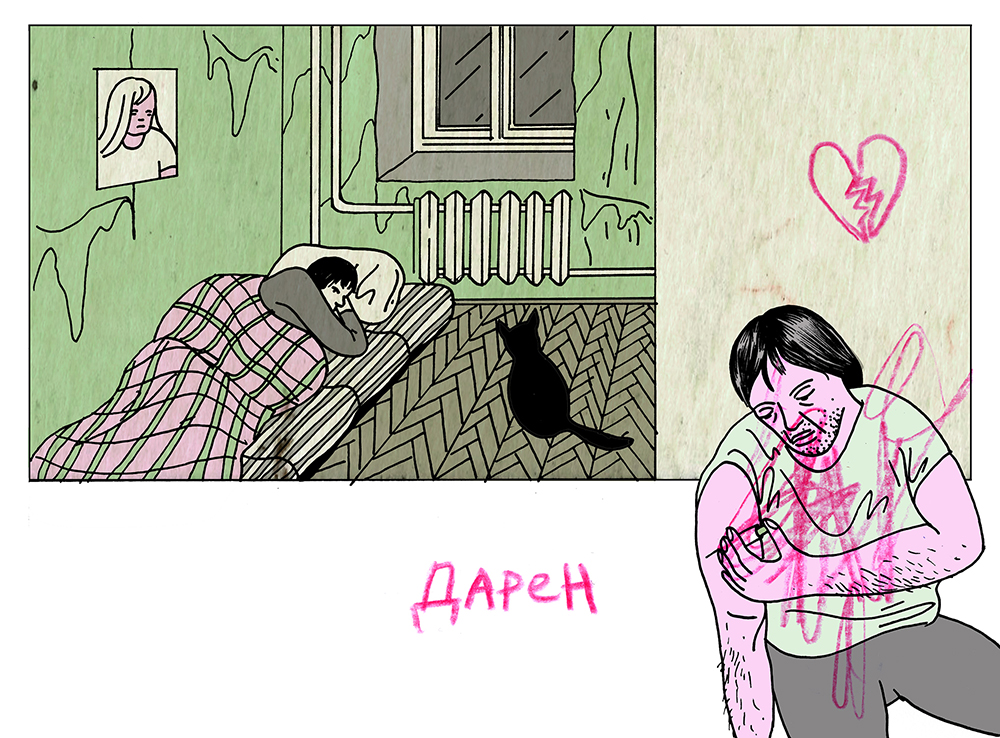 Иллюстрация: kameeellah для ТД
Дарен
Дарен сразу говорит: «У меня ужасная история про отношения — как с домом, так и с человеком».
Дом сейчас — это комната в коммуналке в центре Петербурга. В комнате два окна с видом на крышу, изразцовая печь с перекрытым дымоходом, стол с фанерной столешницей, вместо кровати — матрас с постельным бельем. И клопы, которых не удалось вытравить за четыре года. В борьбе с ними пол посыпан белым порошком. Здесь Дарен живет без ведома хозяйки комнаты.
«Мы со второй женой жили здесь шесть лет, до прошлого года. Дома и в браке мне все время было нервно, мучительно, одиноко, тревожно, страшно, неспокойно, злобно. Жена меня била, я ответил ей только раз — мне не понравилось. Я прятался от жены на кухне. Но все равно пытался построить в этой комнате дом, мне это было очень важно».
Бывшую жену Дарен все еще любит. Но сейчас с ним живет только канадский сфинкс Чит. Сидит у хозяина на коленях, вылизывает его щетину, уши и коротко стриженную голову с залысинами.
Дарен родился на Украине — в теле девочки. Уже года в четыре стал понимать, что это тело чужое. В 2006-м сделал двойную мастэктомию, через год — гистерэктомию . И получил новые документы — на имя, которое выбрал себе сам, Дарен.
До этого он учился в МГТУ им. Н. Э. Баумана на физика-ядерщика. На третьем курсе бросил, потому что не мог больше терпеть обращение в женском роде. Тогда он стал бездомным: съезжать из университетской общаги было некуда. Началось долгое путешествие по знакомым.
Дарен говорит, что нравится людям, поэтому всегда находит, у кого остаться, хотя такой способ жизни выматывает и психологически, и физически. Самый долгий период, который Дарен жил у чужих, — полтора года, самый короткий — неделя. Однажды ночевал в лесу, две ночи провел на вокзале — и те не подряд, бывало, просто ходил по городу ночью, то есть ночевал на ногах. Такое состояние называется «скрытой» бездомностью. «В том месте, где люди знают, что такое дом, у меня дырка. И я не знаю, чем ее закрыть», — в особо болезненных для обсуждения моментах Дарен заикается.
С постоянной работой у него не складывается. Делал украшения из проволоки с камнями, кожаные переплеты для книг, занимался переводами эзотерической литературы (так и заработал 17 тысяч на первую операцию). На преподавателя йоги недоучился, поскольку домашняя практика подразумевает дом, а дома у него нет. Сейчас работает на треть ставки в центре выдачи одежды малоимущим «Спасибо!», хотя уверен, что больше похож на того, кому раздают бесплатные вещи. Иногда деньги ему переводит мама, иногда сестра. Поскольку раньше Дарен жил в зоне, затронутой чернобыльской катастрофой, ему полагается ежемесячная социальная выплата в размере 772 рублей. На эти деньги он покупает ампулу препарата на основе тестостерона — трансгендерным мужчинам такие уколы нужно делать всю жизнь.
Дарен говорит, что транс-люди обычно не акцентируют внимание на том, что при рождении у них был другой пол. И на улице их задача не проявлять себя, а мимикрировать, выжить, поэтому трансгендерные люди скрывают свою идентичность. «В штаны к транс-мужчине проверять никто не полезет, потому что это будет признаком того, что лезущий в штаны сам более-менее гей. Что касается транс-женщин, я уверен, что это ад, потому что им редко удается добиться по-настоящему женственной внешности и голоса. Мне кажется, на улице они выживают недолго», — делится он своими соображениями.
Дарен выбирает девушек, которые «очень заморочены на секс». Жена знала, что он — трансгендерный мужчина, и принимала это. Но он избегал интимной близости: «У меня есть сексуальные желания, но нет возможности их реализовывать, потому что есть серьезное неприятие своего тела. Считаю его чрезмерно женским».
Дольше всего на одном месте Дарен жил в этой коммунальной комнате, с бывшей женой: «Бывшая жена обвиняла меня в том, что мне нужна не она, а эта комната. И это было обосновано. Я ее любил, но при этом хотел жить в доме».
Чтобы не сидеть у жены на шее, он стал добывать еду — любыми способами: «От голода люди умирают в Африке, а у нас голодают только бомжи без рук, без ног и социальных связей. А те, кто может подойти к помойке, голодать не будут».
В доказательство своих слов Дарен приглашает меня на общую кухню. Открывает холодильник. А дальше — как в сказке про скатерть-самобранку. Достает пластиковый бокс с обрезками жареного куриного мяса из шавермы. Сладости без сахара, которые выбрасывают в магазине «Нолькалорий» на Лиговском проспекте. Срезанные корочки пармезана, его выбрасывает пиццерия на углу улиц Восстания и Жуковского. Четыре десятка яиц — списание «Дикси» на 7-й Советской, и несколько бутылок молока оттуда же. Крупное и свежее соцветие брокколи выбросил Мальцевский рынок. В больших черных мешках «ВкусВилл» выбрасывает самые разные продукты, оставшиеся после акции «Минус 40 процентов». Начатая коробка масла «Президент», творог, колбаса, индейка — их выбросили люди.
Когда мы возвращаемся в комнату, на столе не хватает двух кусков шоколадного рулета, а в углу облизывается Чит.
Дарен признается, что странно заводить домашнее животное, когда у тебя нет дома. Он завидует бездомным, которые называют домом любую крышу над головой и считают себя домными. Но когда я спрашиваю его о целях и мечтах, в ответах нет ничего о доме: «Я сам с собой не могу ужиться. При чем тут дом?» И объясняет: «Это сначала кажется: что угодно лучше, чем улица. А потом можно даже гордиться — я не сдох, я выжил в том, что казалось адом. Навык выживания на улице или навык выживания без денег, который есть у меня, — это ценность. У меня это получается, я этому даже научить могу. И если у меня нет дома, но меня любят — мне теплее. А если не любят, то пропадай моя телега, можно и замерзать».
Через несколько дней Дарен присылает сообщение, что в конце недели переезжает в комнату дальней знакомой, куда его пустили жить за квартплату. С собой он забрал вещи в картонной коробке, тубус с рисунками, кота и любовь к бывшим — жене и комнате.
бездомные психология