
Translated material
In the meantime, it was raining
Jean morality took off happiness. Half a step before the war, he took off the laughing girl in a fashionable cloak and the sailors looking at her feet are fascinated
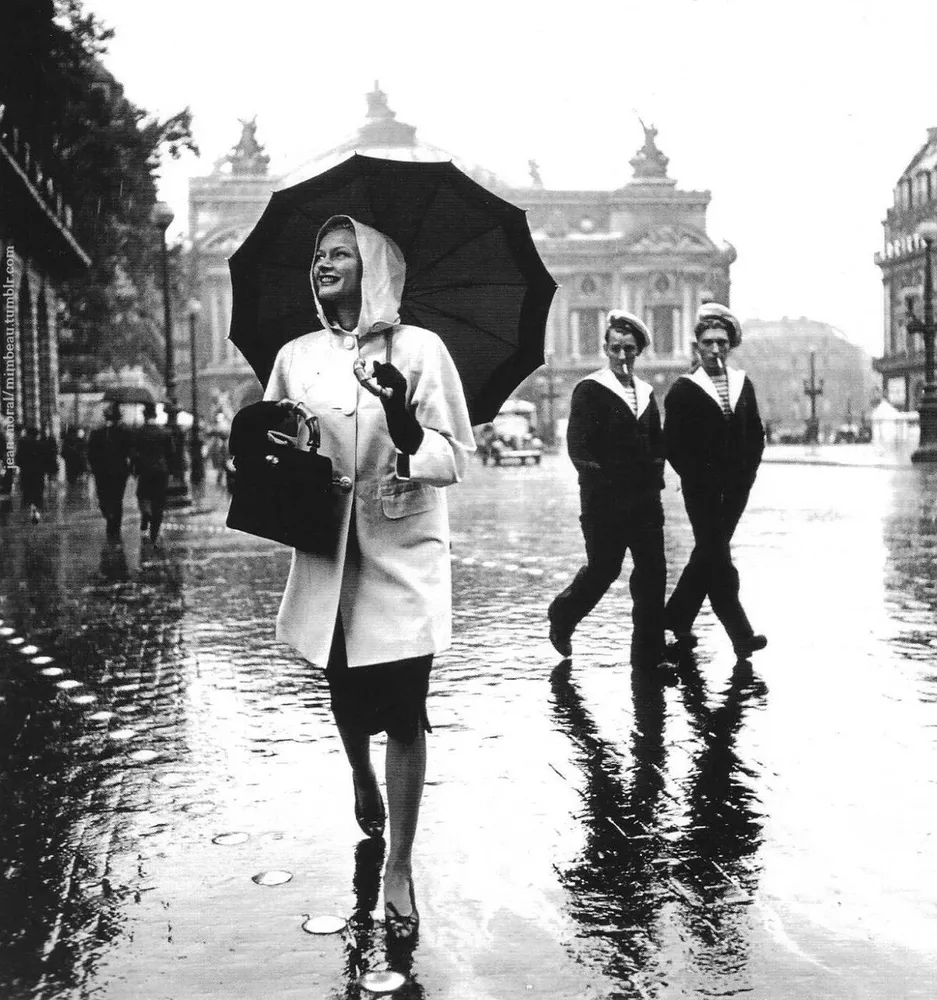
This is Paris, and it rains in the Opera Square. Under his streams, paving stones shine dazzlingly. Where does the girl in a white cloak look and what shinely smiling, holding a fashionable bag in a black glove with her hand? We do not know this, but where the sailors look in the dishevefers, dashingly shifted in the ear, and we understand with cigarettes in the teeth without explanation. In the left side of the frame, two solid men in hats and umbrellas slowly move away from us. Everything is fine in Paris this fall, and nothing portends dangers. And if you bow over the photograph and look at it for a long time, you will feel how the face is enveloping the wet air of the distant day.
To understand this frame, one must subtract the war from consciousness. After all, the photographer Jean morality, and the nameless model, and two men whose figures indicate the unshakable strength of life, and the sailors walking in the leg, enchanted by the thin caviar of the fashion model, they all know that there will be war soon. They do not know anything about shooting at people, about bombs and tanks, about burning houses and concentration camps, about the armades of aircraft over cities, about the highway refugee. All this has not yet happened, and therefore all this is not for them on that rainy day of 1939 on the Opera Square in Paris.
Much should be subtracted from consciousness in order to freely and happily go into this black-and-white, pierced damp, sounding with a knock of drops on the dense fabric of the umbrellas of the frame. After all, people did not know the Internet then, the virtual world did not exist, and no problem could be solved by clicking. Thousands of things and phenomena that are familiar to us were absent in the life of the photographer Jean morality and fashion model, hired to shoot Harper's Bazaar magazine, by our experience, our consciousness, we are cut off from that time. And therefore it is a secret for us.
And the car in the background under a high hood has a carburetor. Now, probably, not all motorists know what it is.
Only the rain is the same rain, the same autumn rain that brings sadness and happiness.
Jean moral was one of those photographers who in the 30s re-opened the texture of the world: slippery bridges, rough walls, bright lights on the planes of houses, corrugated sheathing of the aircraft, but most importantly-people and their strange beauty. He brought a fashionable filming from studios and pavilions to the street-not to any, but to Parisian! - And he plunged his models into a daily city, filled with crowds, living on schedule, permeated by the sobs of the horn, running after buses, reading newspapers. In the texture of female stockings, photographed by him, more erotica than in many nude of the following times. In his double portrait - Coco Chanel and Serge Lifar in an embrace, she is in a turban, with beads and in white pants, and both with cigarettes - he caught eternal bohemia with her careless chic and lightness, which advancing after a couple of bottles of Avignon. He took his wife Juliettu naked on the beach and relaxed in the sunny stream on the side of the Villa Lusa pool on the Mallorca - a maniac of a photo camera, who sees everything through the lens, even himself and his love.
The task given to the moral editor of Harper's magazine was to make an advertising shooting of a white cloak created by the designer and the head of the fashion house Elsa Schiaparelli. The photographer completed the task-here he is, a raincoat, comfortable, comfortable, fashionable, with large buttons and an excellent hood-but he took off something else. In a drop, he saw the world, in a second beauty, in rain happiness.
But he also took off, caught, caught and kept life itself for a moment - in all its brevity.
The second, caught on the fly and in motion, will end now. Everything will end. The fashion model will now stop laughing and will tell the photographer displeased that she has wet legs, because she was given summer shoes for shooting with slots. The sailors will be resolutely stepped behind the edge of the frame - maybe in the bistro, maybe in the brothel, or maybe to death in a close war, which is already around the corner, but has not yet come out of there at all its growth. Two reputable men walking under umbrellas in the minds of dignity and with a sense of solidity, during the years of defeat and occupation will be deprived of dignity, and viability, money in the accounts, and pleasant roundness of faces and stomachs. Only their umbrellas will stand in the corners of inaccessed Parisian apartments, recalling a walk in the rain in the Opera Square in an drunk era.
Jean moral, fashion photographer Harper's magazine, will leave to the south of France and hold years of the war in the apartment of a friend who will shelter him. What will he do there? Look at the sea, walk on the beaches, survive in difficult times? Journalism is almost entirely consists of stories about the people who fought, made feats, died, the story is filled with stories about politicians, generals, ministers, victims and martyrs. But he will be neither one nor the other, nor the third - this person with another arranged eyes, who knew how to see eternity in a barge floating under the bridge. He did not keep diaries, and it is difficult for us to read his thoughts, but it may be that he perceived the war as an annoying circumstance, as an idiotic abyss that divided him with his business. As soon as the war ended, he - as if he were waiting - again became the fashion photographer of Harper's magazine.
Everyone as much as possible paves their own path in the thickness of the time, through its compression and voids. With his beloved Juliet, he will divorce, the photograph will bother him, and 15 years after the war he will leave France to the Swiss Montreo to become an artist on the shores of the lake. What did you do during the years of disaster and horror, what did you do, Jean, when there was a war and when the world departed from the war and fell into a new shaking, into a new nonsense, into new crises? 150 years before Jean morality, such a question was asked by Abbot Siyes, who disappeared somewhere in the years of revolutionary terror. Where have you been all this time, abbot, and what did you do? "I lived."
So what did he take off on this frame, taking off his fashionable white cloak on the fashion model? Jean morality took off his life and took off happiness. On the threshold of a worldwide catastrophe, half a step with its innumerable horrors, he took off the laughing girl in a fashionable cloak and with an expensive bag in his hands - how tightly he tightens her hand on a large umbrella handle of an elegant long glove! - And fascinated by the sailors looking at her legs, and he also removed the rain and Paris, Paris and the rain, and if you now lean closer to the photograph, your face will become wet.