
Translated material
Small graves and small crosses
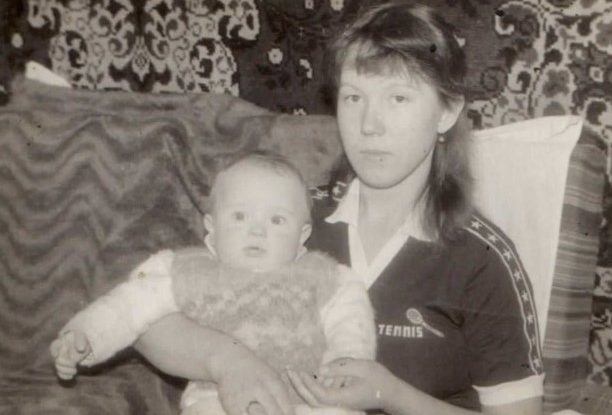
Kristina Proshkina's mother lost her child. For her, her daughter created a project on perinatal losses
Kristina Proshkina's mother lost her just born son 34 years ago. Christina found out about this in childhood when she and her mother went to the cemetery. Since then, Christina often asked her mother about this, and at 20 she decided to comprehend the experience of her family and talk with other mothers who lost children. Especially for the heading “From her words”, Christina talks about how the story of her family led her to create a project about women who survived perinatal losses - “ The children who were .”
When his mother was 20 years old, she and dad already had Artem’s son and they were expecting a second child. Then she worked in the dispensary of the village of Dolganka in the north of the Altai Territory, her day was built on the principle of the house-work-house. Mom was preparing to go on maternity leave.
She recalls that one morning, as usual, she got a cow on a wooden chair in Prigon, and suddenly the waters left her. She was in the seventh month of pregnancy. In the district center where the ambulance brought her mother, she was given a powder, which caused a fight. Before giving birth, mom and dad did not know that they would have a son, although they hoped for it. “There was no ultrasound apparatus in the district center,” the mother explains.

By dinner, she gave birth to a child to be held and immediately carried away. The boy was alive, but, as the doctors said, he did not have a swallowing reflex. “In the evening I was allowed to go to the children's department and look at it. He was tiny, lay in an iron crib, ”says mother. She does not know exactly what and how her son was fed, but for three days she expressed milk and thinks that the boy was fed from a syringe. On the third day, according to the memoirs of my mother, the chief physician and gynecologist came to her: "I understood everything in their eyes." The gynecologist helped the mother tightly pull her breasts so that the milk would no longer come. “They said there is no one to feed more,” says mother in a trembling voice. “Maybe if I lived in the city, it would be possible to save him,” she adds.
The dad was allowed to come and pick up my brother’s body, and my mother should have remained under supervision. But she refused. According to mom’s stories, dad did not immediately dare to come and take the body - for him it was a shock. His older brother convinced his dad, saying that this needs to be done, because otherwise the body of his deceased son "is thrown out there." And dad arrived at Kamaz, who could only drive 20 kilometers to the district center to pick up his mother and box with the body - as his mother says, "it was autumn 1987, terrible dirt."
“When we arrived home, no one came, except for your grandfather and grandmother from the pope,” says mom. Mom’s parents were not near her: the dad was killed, my mother lived far. Dad’s grandfather, who was a carpenter and built many houses in the village, shot down a small coffin for the dead grandson. Grandmother called the child a vanyushka and put him in the braces. "Why Vanya?" I ask my mother. “Grandma also lost the child, the girl Tanya, perhaps these names echoed for her,” she replies. Grandmother’s girl lived longer: her mother said that her grandmother told her how she “sat with her on the stove” for nine months, because Tanya was painful, she needed warmth.

Grandfather, grandmother, parents and two -year themes sat on a walker ( a cart drawn by a horse. - approx. "Cold" ) and went to the cemetery. They decided to bury Vanya next to Tanya under a wooden cross without a signature. After the modest funeral, everyone diverged home, and my mother immediately again joined the house of the house-work-house. “There used to be such a philosophy: gave birth, the child died - you will give birth again. Nobody emphasized me, ”my mother recalls. After the death of Vanya, parents wanted to try to give birth to a child again. “I was not afraid, I was a healthy girl,” says mom. They succeeded: a year later my older sister Nastya, very similar to dad, was born. And after 13 years I was born.
I did not have to live in these events like Artem. I did not have to, like Nastya, become a happy outcome immediately after Vanya loss. I just saw a small hill, a cross and an overgrown lilac bush on the grave that my grandmother planted. As a child, I often went with my mother in the cemetery in order to paint something, remove, fix, visit the dead relatives. I asked questions and found out about Vanya. I was struck that the children were dying, that there were small graves and small crosses - it remained in me for a long time. When I became older, I often talked with my mother about Vanya. This happened when the weather was bad, my mother slowed down a quick rural pace of life, and she could pour tea and calmly talk to me.
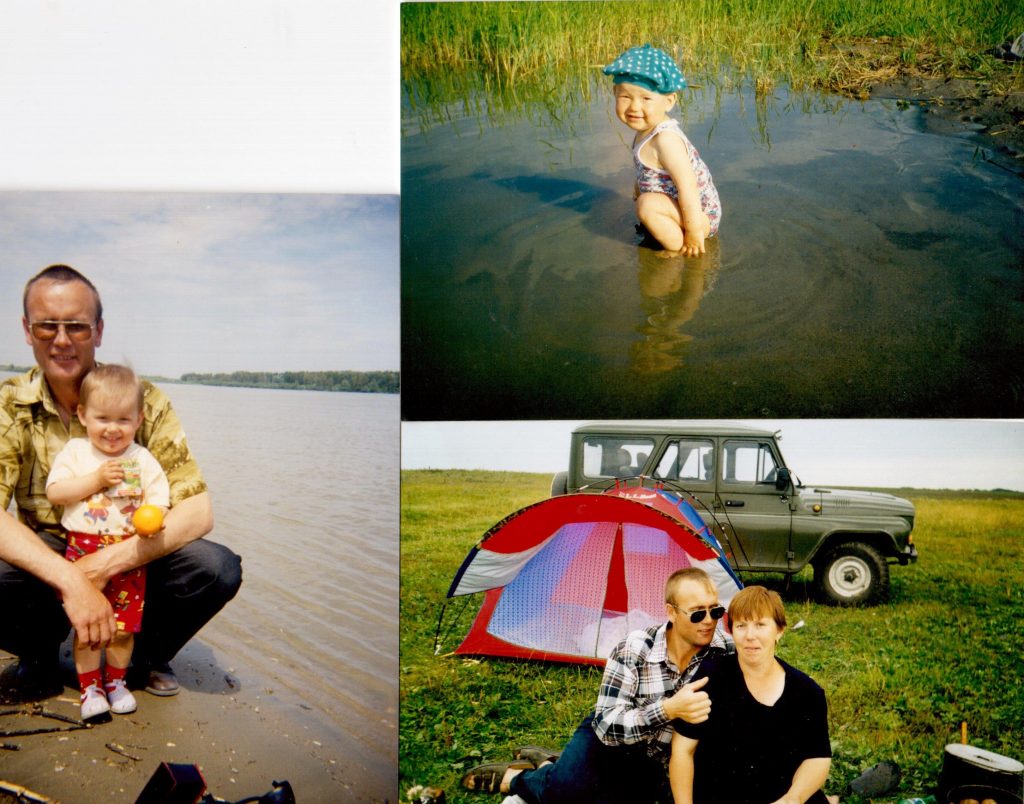
Now I am 20, and my mother is 54. 34 years have passed since Vanya’s death, and nothing has left in memory of him. “Previously, there were diapers and covers, icon, and then your brother and sister pulled everything,” says mother. In the church, she puts a candle for the rest of Vani's soul. With age, her pace of life slows down, because the children grew up. “Thoughts are freer, I am increasingly thinking about those events,” she says. Mom blames herself for “having not given a life to the child,” and mentally asks him for forgiveness. When she tells me this, we cry together. Dad increasingly says that he lacks his second son.
Now I live in Tomsk, far from my parents, and come for holidays and in the summer. In the spring, I arrived in Dolganka to celebrate my birthday, which coincides with the day of my grandmother’s death in my mother’s line. I thought not only about my grandmother, but also about all the members of our family who died, who are not with us. I thought about Van. When I returned to Tomsk, it occurred to me to make an idea to make a project about mothers who survived perinatal losses. I conceived him as a tribute to my brother, whom I had never seen, and I wanted my mother to see this project and, perhaps, found the empathy in the stories of women that she lacked when she lost Vanya.

I wanted her not to feel guilty. I was looking for women in different cities of Russia through friends, on forums, on social networks, I interviewed, told them about my mother. I saw the children who were born in their families after perinatal losses and associated myself with them. I also compared myself with my mother and other mothers with whom I talked a lot. They told stories about unexpected losses, unspokenness, indifferent doctors, stereotypes. It began to seem to me that I could also lose a child in the future, and then I worked out this irrational fear with a psychologist.
Fear left, instead of him came the understanding that no one was safe from the loss of the child. Moms who have lost their children can cry or not can grieve openly or be in themselves, not show their pain. Neither one nor the other is anomalies. The dead children should not be resurrected, but I accepted the idea that I also had a loss.
A month ago, I showed my mother a finished project. She silently read and cried. “The weather will get up - you will need to go to the cemetery,” said mother at the end.