
Translated material
How Valentin Gaponsev went from the Soviet Research Institute to the Forbes list and won the US Ministry of Finance
On October 22, physicist-billionaire Valentin Gaponsev, the founder of one of the leading international companies in the field of laser technology IPG Photonics, died. The Russian-American scientist and entrepreneur was one of the few business representatives who retained an impeccable reputation in both countries even during the new Cold War. This allowed him to become the only Russian who achieved the US Treasury from the so -called “Kremlin list” - the list of participants in the Russian Forbes list, against which the American authorities considered the possibility of imposing sanctions.
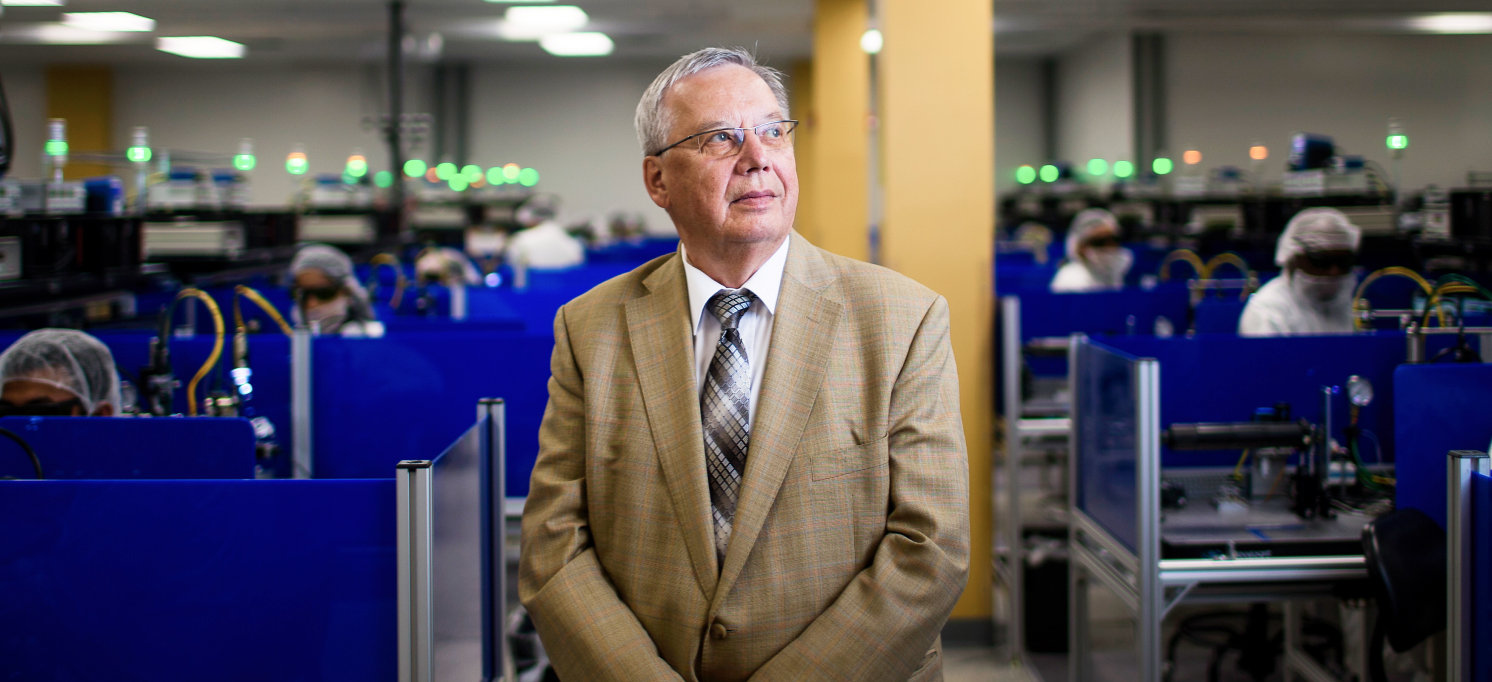
What's happened
The Russian-American scientist-physicist and entrepreneur, founder and co-owner of the American IPG Photonics company Valentin Gaponsev died on October 22 at the age of 82. For several years, he fought on oncological disease.
According to the latest Forbes calculations , Gapontsev is estimated at $ 2.8 billion-the entrepreneur ranked 54th in the ranking of 200 richest Russians. He belonged to about 23% IPG Photonics - one of the leaders of the global laser market, which are used for welding, cutting, engraving and other work with metals.
At the opening of trading on the Nasdaq on October 24, the IPG Photonics shares collapsed, but after a little more than an hour almost completely played the fall.
Unique technology
Valentine Gaponsev devoted most of his life to science - in the Soviet years, he worked at the Research Institute of Radio Engineering and Electronics in the city of Fryazino near Moscow. However, in the early 1990s, immediately after the collapse of the USSR, the future billionaire, together with the Pole employee, the Ministry of Electronic Industry Alexander Shestakov, decided to do business.
Gaponsev created LLC NTO IRE -POLUS, which later became part of the IPG Photonics. In the Ire-Polus, a physicist, who has already exceeded 50, developed the concept of creating quantum optical generators, thanks to which highly effective laser phosphate glasses were introduced into mass production, fiber laser and amplifiers were created, and the production of fiber-optical fixed communication systems was organized.
Fiber lasers were not widely used to Gaponsev, because they were considered low -power. The founder of the IPG Photonics has developed a system in which optical amplifiers convert a weak light signal into a powerful beam. In 2018, these amplifiers are used in telecommunication and Internet networks to transmit fiber data.
In the mid-1990s, the Gaponites begin to spread unique technology abroad. First, production opens in Italy, then in Germany. At the end of the decade, the entrepreneur registered the IPG company in the United States, which by the beginning of the 2010s took control of 80% of the global market for industrial fiber lasers. Since the founding of the IPG, the Gaponians lived in the United States, it had American citizenship along with the Russian one. The IPG headquarters is located in Massachusetts.
In 2006, Gapontseva conducted an IPO on the NASDAQ exchange, where it attracted about $ 90 million. After that, IPG began to actively grow and attract serious customers. By 2000, the company entered into contracts with technological giants Alcatel, Fujitsu, Lucent, Siemens. In 2011, IPG lasers welded the housing elements of 200 thousand Volkswagen cars, and also created an automated cylinder welding system for General Motors.
In 2017, IPG revenue increased to $ 1.4 billion, and in 2018 the company was included in the S&P 500 index. At the same time, the Gaponites according to the results of the same year, having received a salary and premium in the amount of $ 1.7 million, was the last in the list of companies from S&P 500 in terms of reward. His “neighbor”, by modesty requests, was then the legendary founder of Berkshire Hathaway Warren Buffett.
Gaponites against the United States
In 2010, Valentin Gapontsev received in Russia the State Prize “For a set of innovative developments and the creation of high-tech production of fiber lasers and systems of fiber-optic trunk and local communications”. The Kremlin’s website states that the entrepreneur is “a leading specialist in the field of laser physics and technology”, and among his merits “social and educational work in the scientific and educational centers of laser technologies, where he trained young Russian scientists and specialists in the field of laser physics.”
In the same year, Gapontseva invested Rusnano-the share in Ire-Polus cost a state corporation of $ 45 million. According to Rusnano, due to the Ire Polus investments in Russia, having built new buildings with an area of 45 thousand square meters. m. In 2012, the state corporation left the project.
A few years later, the Kremlin’s award and state investigation will come out for the side: in 2018, the physicist became a defendant in the “Kremlin list” in the wake of the US sanctions war with Russia: his name, along with all other Russian owners of $ 1 billion, included the American authorities “close to Vladimir Putin”.
Gapontsev’s hit was unexpected. The column of the senior adviser to the investment company TA Associates Michael Child, where he wrote: “If there was a person who does not fall under the definition of the Russian oligarch, then he (Valentin Gaponsev. - The Bell ).” In the material, the physicist was called a "US citizen", who "contributes to the development of this country" for many years. “IPG is conducting production and research operations in 11 states. <...> The company has created thousands of research and production jobs in the United States and provides the best margin in the industry. <...> He (Gaponsev. - The Bell ) avoids sending technologies to China, although this is its largest market, ”Child listed the arguments in favor of the entrepreneur.
The Gaponsev himself immediately after inclusion in the list personally filed a lawsuit against the US Treasury and personally to the head of the department Steven Mnuchin - in the document he complained that the American authorities did not conduct a serious investigation when drawing up a document, but simply reprinted the first hundred of the Russian Forbes list. The businessman also resembled officials responsible for sanctions that since 1998 he has been living in the United States and is least suitable for the role of an “oligarch close to Putin”. According to Gapontsev, he personally saw with the Russian president once in his life, when he handed him a reward for scientific achievements. And as a result of getting on the list, the billionaire had problems with American counterparties and officials who considered that they could no longer work with the IPG Photonics.
Forbes magazine instantly responded to Gapontsev’s complaint, whose rating supposedly formed the basis of the “Kremlin report”. The publication ceased to include a billionaire in the Russian version and placed it in the rating of American businessmen-then his fortune was estimated at $ 3 billion. And soon the Ministry of Finance also responded-a year later, in 2019, the department agreed to conclude a settlement agreement that was supposed to withdraw the plaintiff's claims. So Gaponsev turned out to be the only Russian who achieved an exception from the Kremlin List.
What's next
At first glance, Valentin Gaponsev left the IPG in good financial condition: according to the results of the second quarter of 2021 (this is the latest data; the report for the third quarter will be published on November 3), the revenue and profit per share have increased by 25.4% and 81.7%, respectively. However, after the publication of the report for the second quarter, the shares collapsed immediately by 17%, and since the beginning of the year the company lost a quarter of capitalization. The cause of the collapse was China: this is the largest market for IPG Photonics products, it accounts for 43% of sales, and the economy of an Asian country is growing not as fast as analysts expected. “IPG is largely relied on to the Chinese market, which means that the state [Bines IPG] can grow and fall depending on what is happening there,” wrote the financial service of SEEKING ALPHA.
Another reason for the negative dynamics of quotes is that the IPG itself admitted: Chinese competitors begin to represent laser products with higher power levels and pressed using low prices. Although at a press conference, after the publication of the last reporting of the Gaponians, he emphasized that “Chinese products are absolutely low-quality”, investors interpreted the very discussion of this topic as a signal of anxiety: in Seyeking Alpha noted that “hard competition will either force the IPG either to reduce prices to compete and give up the market share (from China.-The Bell) ".
Another risk to business is the lack of continuity in the IPG top management. Back in 2011, in an interview with the Russian Forbes, the Gaponites admitted that he could not choose the successor: “There is no one to whom I could refer the case, knowing that it will be at least not worse than me. Rarely someone is ready to invest in business all their lives, otherwise it is impossible. ” At first, the son of Denis helped the entrepreneur, but then he left the company and returned to Russia. “Rarely, two generations manage to find a common language,” the Gaponians' decisions explained succinctly. Now Denis is not one of the IPG directors.
In the report for investors, according to the results of 2020, the company in the description of the risks separately issued a clause on the problem of heirs: “We are very dependent on the work of our leading employees, in particular, Dr. Valentin Gapontsev (CEO, 81 years old) and Dr. Evgeny Shcherbakov (COO, 73 years old, has been working with Gapontsev since the 1990s-The Bell). <...> The absence of one of them can damage the business and violate operating activities. ”
According to the official IPG website , after the death of Gapontsev, Sherbakov began to perform the duties of CEO.
Photo on the cover of the material: Getty images