
Translated material
"Girls and Institutions": six stories about the relations of state institutions and their employees
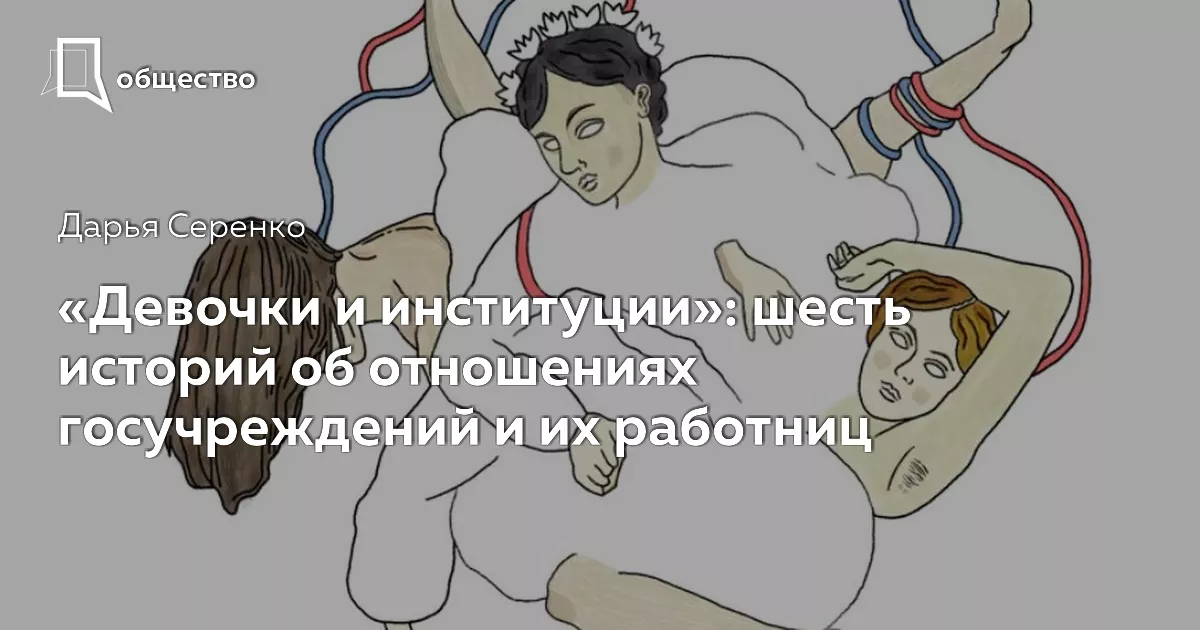
The state system of Russian culture rests on many inconspicuous workers, most of whom are women. They “ bring paints and brushes, serve as museums, remove the room for the exhibition, prepare food, fill out strict reporting forms, fake people and animals attendance statistics, work in accounting, go to prison in case of waste”, and so replace each other for her forth. About the everyday life of the employees of state institutions in the book “ Girls and Institutions”, published in the publishing house No Kidding Press, says the poetess and public figure Daria Serenko, who worked for several years in the small district library, and then at other cultural state institutions, galleries and universities.
In documentary stories from life, Daria describes small joys, adventures and difficulties of the work of “girls” from institutions. Together they experience monotonous everyday life - they hang up Russian flags on the streets for holidays and drive round dances with citizens, meet with merchants, perfumes and jerked meat, find out the secrets of the past and escort colleagues both into new life and in the last journey. Talking about the routine of the state workers, the writer breaks the covers from the non -reflected theme of cultural collaboration and discusses how institutions force people to be humble, encroaching on their freedom, and bureaucracy fights life in the state of state state, whose screws are easily replaced.
When I first came to work in a state institution, at first I saw only girls. They called themselves so - “girls”, switching the intonation from the exclamation to the interrogative depending on which disaster was unfolding around. And disasters - I also understood this at once - were an integral part of our unstable everyday cosmogony, with all his might trying to take root in the working schedule of the day.
We worked in a small district library in an office without windows. The computers of the girls looked more than the girls themselves. Sometimes, behind the wide monitors and buzzing of system blocks of girls, it was not visible or audible - I had to get up from the chair in order to make sure of live human contact. The absence of windows in the room, apparently, was compensated by the murals glued throughout the wall: tropical greens and a stormy sheer waterfall, carrying its foamed streams from top to bottom - a picture resembling daily not about fresh air, but about the verticality of hierarchies.
The girls accepted me like their own. I still tried for some time out of habit to maintain bodily autonomy: to dinner separately, to get to the metro on the bus separately-but very soon the value of this individual has lost all meaning for me. My life at that moment as a whole was also a disaster, so at work I felt at home: it was fun and scary, and the boundaries
Private and public were blocked by alcohol and deadlines. With girls, we often turned into one functional multi -handed and multi -legged creature, mudding, omnipotent and crushing - at such moments I ceased to feel my own weakness and weakness in the legs.
But at the same time, studying the girls, watching them from my spider corner, I caught myself many times on the automatism of my own gaze-slightly arrogant, ironic, diminutive, mythologizing female collectivity as a whole. I justified this by the fact that I have a special status - I am temporarily here. Sometimes, when I looked at everyone, being in a gloomy and imaginary mood, it seemed to me that girls exist only to the waist-but under the table they were not there, there was only the interweaving of multi-colored wires that transmit signals somewhere further. Perhaps, of course, I still just hated women, and not just stretched to them. Or, perhaps, there was no me under the table in those days.
***
Once, the girls and I silently walked along the autumn municipal park. “It became more difficult for me to hate my state,” I said on the go without thinking. “You become one of us,” one of them answered.
We did not always work from the office: sometimes we arranged old books on the streets of the city, hung up the newly purchased Russian flags for trees and drove round dances around them with bewildered citizens. We constantly stumbled in our reality on some new portals-and hit
On endless festivals, the estimates of which have never been seen. At the festivals, we performed state assignment: with their bare hands, they built pavilions from sticks, dirt and shit, faked the attendance statistics of people and animals, and also accidentally looked into institutional abysses, usually covered with papers and rags on top.
There was a lot of abyss. If you do not take everything that is happening close to heart, it was possible to spend time quite well.
The girls and I went out to smoke every twenty minutes. In our library refrigerator, there were two bottles of vodka - one for extreme cases, the other for a rainy day. So it turned out that both happened at the same time.
This was my first day of cultural worker. We were taken to a local recreation center and strictly forbidden to leave the room. We thought it was a joke, so the room did not leave and remained in a festive mood. Finally, men in tight suits pushed us into a small concert hall and closed the door. The light went out.
The presenter with a lush hairstyle came to the alarm sounds of Fanfar and with expression read congratulatory verses for us. The group of our youth was invited to the stage, at least it was announced from the stage
That's right. We froze at least in anticipation of the Tattoo group.
I was mutated all day-and on the third song of VIA "Singing Hearts" I still started menstruation. I began to make my way between the rows. At the exit from the concert hall, two guards stopped me: they were told not to let anyone out under any pretext, since the artists work out state money. Workers should not leave, but enjoy.
After I had to leave a spot of my own blood in the state velvet seat, the girls and I returned to the office and took out both bottles. It is worth admitting that now I really remember the songs heard as the music of our youth. And I enjoy.
***
Once I cut off on a salary twist. The red spot broke over the modest numbers of my salary. The girls said that now it was really my blood money.
I quickly figured out how many other blood in me, and I thought that perhaps the next time I was cut a little stronger, the sum of the salary will grow magically. And although a month later, a day of advance was synchronized with my cycle, there was still little money.
Girls knew how to handle small amounts. Since the summer, they put money on winter shoes. They brought food with them in small containers and ate twice a day.
Sometimes salesmen came to our office: so I found out that this word is still being used in relation to living people. Commanders laid out tights, socks, beads, perfumes and panties on our tables. If we did not like anything, they opened another suitcase and took out long flaps of jerky and fish.
Every day there was a moment when the girls undressed: they lifted the skirts and pulled the sliding tights. They took off their jackets, threw off shoes under the table, opened their hair. This relaxation was contagious: the poses became more informal, and the faces were increasingly focused. It was evident that the girls would be at home soon. And they will have exactly three hours before bedtime to prepare food for their own next day, calculate the costs of the second half of the month, go on a date, check the lessons, drink a glass of wine, to fight with the mistress of the apartment, walk the dog, make a mastery, and call the girls.
***
Marina was escorted by the whole department. The crematorium’s building was somehow calm: there probably have their own girls inside, and they will deal with everything.
The state crematorium resembled the Palace of Culture from my childhood - three times a week I went there to dance Russian folk dances. I still remember the severity of the kokoshnik and the feeling of crawling white tights under an embroidered, starchy dress.
Everyone loved Marina. Marina worked as an administrator of our hall. Marina met and escorted people, sold them tickets and souvenirs, made sure that no one would steal magnets and did not touch the exhibits with her hands. Marina loved to drink tea, standing over her soul. In her youth, Marina worked as a designer of tanks, but all her life she was faithful to GOSTain and did not tell us anything, despite our ironic persuasions. Marina loved the “Battle of Psychics” and believed in the Zionist conspiracy.
Marina died at the end of the working day. The rest of the girls thought that she was dozing in an armchair, and did not disturb her.
Death distorted Marina not very much: in the hall of the crematorium she lay almost as living, only dressed her for some reason in an embroidered, stolen dress and a white handkerchief. One would think that Marina also goes to dancing in the recreation center and we have a performance soon.
The female administrator of the ritual hall approached the coffin and gave a signal to someone to turn on the music. In a monotonous voice, she expressed condolences to the relatives of the deceased and invited those present to say the last word before cremation. I was grateful to this woman - her semi -automatic orders resembled Marina, resurrected her intonations, set people in motion and space.
The female administrator followed the time. After thirty minutes of farewell words, workers appeared, and a red bulb caught fire above the door leading to the furnace. The girls cried, and I looked at the marble floor. So I hear how he would click under our dance shoes with Marina.
***
We girls pretend that we do not understand anything in politics. We are talking to birds, and birds, as you know, are above all this. We chirp, and no one suspects that we have on our minds. If you only knew what underground in our head, you would most likely keep your miserable compliments with you.
At the general meeting of the labor collective, we were reminded that we must go to the polls and vote for the right candidate. Do not forget to send a photo of the filled ballot. Do not forget about your civic duty to the country, otherwise how you will look into the eyes of your children.
And we, frankly, will no longer have any children with the girls. We do not have the strength to give you new people, this new army of girls, shut up your bodies with their bodies spreading at the seams of the abyss. Look for other fools, and I will silently throw your ballots in empty night schools, which will soon go to. All this will end with us, we are the last of the girls.
I often dream that I am pregnant. Our country is full of sleeping institutions - I wonder what institutions see in a dream? Who sits near their beds, who changes the sheets soaked with feverish then, who listens to them, how they rave in their mournful children's language? I hope they dream of mocking girls, a polyphonic echo, a puny choir-the last signal in front of an exploding underground.
Although sometimes it seems to me that I love all the girls the same, but among them, of course, there are those whom I will love an order of magnitude more-and these are, as a rule, real girls, and not generalized, sorted. You know, there are such shoes, shoes, girls, girls who are behind a stone wall. Oksana is from such girls. Of the real ones.
Of all of us, Oksana quit the first. Formally, we submitted applications at the same time, but Oksana actually left six months ago: we remember this day when her gaze went out. She had not been up to us for a long time, and she sat at her table as a quiet and active shadow, raking either a funeral routine after the death of her mother, then our non -permanent monthly accounting department. Oksana always had everything clear: clear calls, clear showdowns, clear texts, clear funerals.
The fired Oksana quickly went uphill: she received a bonus, wrote a novel, raised a garden on the window, gathered with her wife. We all prophesied her a great future: Oksanina Biography itself took shape in a literary narrative. It seems to be either a pretext, or to a self -filled prophecy, as if you take a fresh piece of fabric, and there you can already see the lines of the bends, as the cut was originally composed.
Our Oksana is a lesbian. Recently, a whole literary festival was canceled in which she was supposed to give her lecture. Concerned and patriotic citizens broke the Governor’s hot line. Oksana is a pervert, lesbukha, aunt, homosexual, sodomitka, witch, destroyer of traditions. “I don’t understand why my homeland is not proud of me,” says Oksana.
Oksana, we also do not understand, so we call the same hot line to convey to the governor of the Tula region that there are such girls: shewn girls, girls, girls who are behind a stone wall. To convey how sorry we are that the festival was canceled on the day of the Tula gingerbread, overshadowing such a bright holiday with its whip.
Illustration : Ksenia Charyeva