
Translated material
The Swiss seems to have watched “Kin-dza-dzu!” And came up with a plate that makes alcohol from the air and sunlight
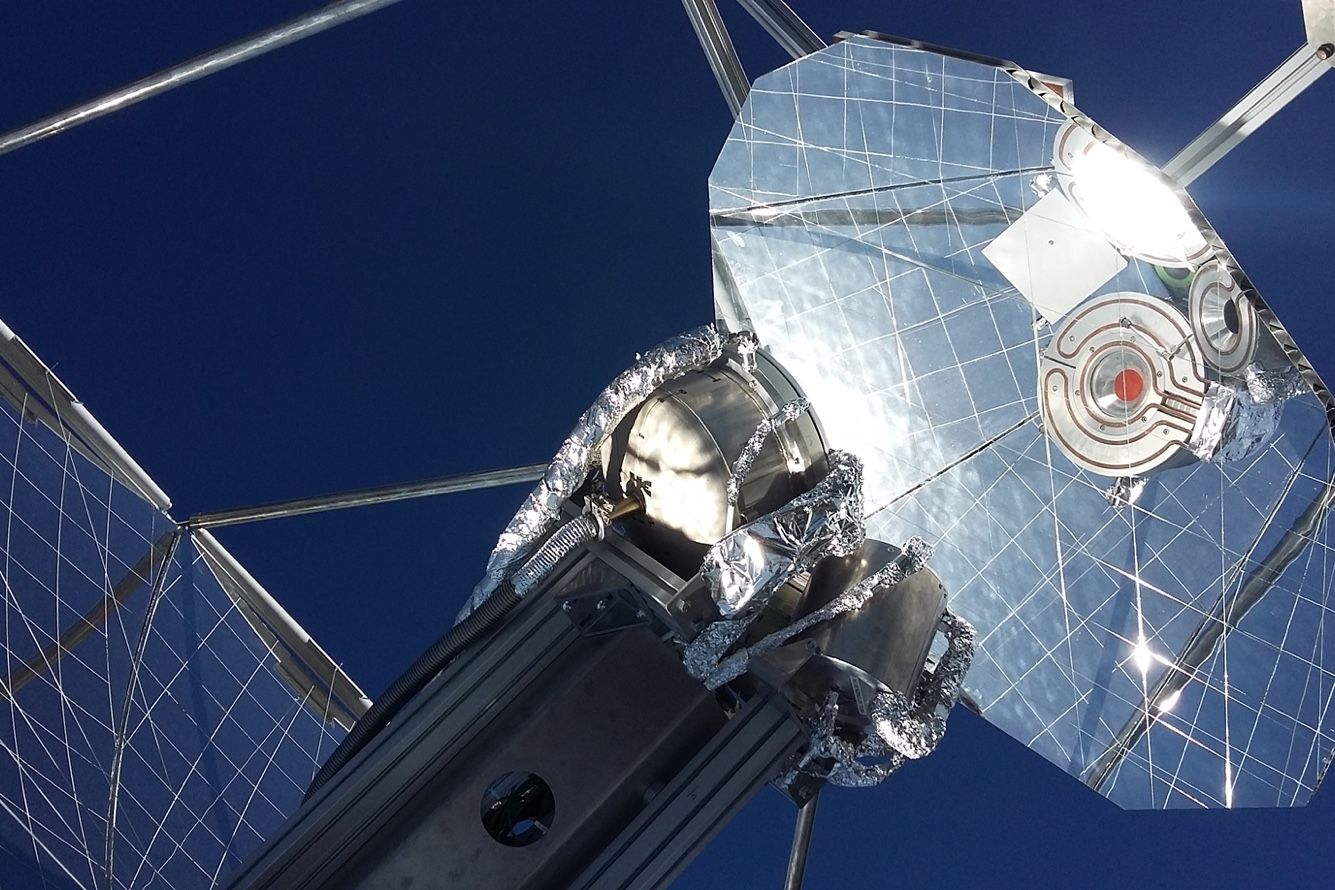
The combined group of Swiss and German engineers developed an autonomous installation for the production of alcohol (well, or other green fuel) from almost nothing - from air and sunlight.
We warn, this is a real scientific article, but really about the production of alcohol from the air.
The installation is something like a satellite plate with a “appendage” from a pair of tablets fixed on it. The “plate” part is a parabolic reflector and is responsible for the collection and concentration of solar energy on one of the two reactor chambers. In the reactors themselves, the CO₂-assembled from the air into the so-called synthesis gaz is converted-the precursor of green fuel.
Two reactors are necessary for installation, because it works in two -stroke mode. First, the cerium oxide reactor is heated by a powerful stream of sunlight to 1,500 degrees Celsius, as a result of which the cerium is freed from oxygen. Then the beam of light is transferred to the second reactor, and carbon dioxide dissolved in water is entered in the first. Co₂ gives oxygen to a ceria, which again turns into oxide, and the dissolved gas itself is converted into a mixture of CO and hydrogen (this mixture, in fact, is called synthesis gas). Then the reactors change roles and everything is repeated again.
The transfer of synthesis gas into methane, methanol or even aviation kerosene does the installation itself, as well as Co₂'s fixation from the air. In such autonomy and complete independence from other sources of energy, its uniqueness is (the nearest analogue, for example , produced only hydrogen). You can configure the process in different ways and, accordingly, produce different fuel.
What turns out in the end, the creators of the installation are called "drip fuel." The name corresponds to current productivity: the only still existing prototype installed on the roof of the Laboratory of the Higher Technical School of Zurich, in 7 hours of work, if there is good weather, it produces an average of 32 milliliters of methanol per day, that is, about a liter per month.
The developers, however, have large ambitions on scaling. In the article from the fresh issue of Nature, which describes the principle of operation of the device, they argue that such devices could be used to complete the global need for aviation kerosene. According to the authors, for this it will be necessary to cover with such plates about 45 thousand square kilometers of sugar, which is only half a percent of its area.
However, the authors themselves admit that if this is done right now, such a “conditionally free” fuel-air-air will actually be too expensive due to the cost of the production of plates themselves-significantly more expensive than traditional kerosene. Only scaling production and political support for the project will be able to reduce the cost of “air” fuel in the future.
Alexander Ershov , Scientific editor "Medusa" specifically for the heading "Shapito"