
Translated material
Man of the day: Konstantin Tone

On November 6, 1794, architect Konstantin Tone was born.
Personal business
Konstantin Andreevich Ton (1794-1881) was born in St. Petersburg in a German family. His father owned a jewelry workshop. Konstantin was the middle of the three brothers. The boys studied at the German school of Petrishul. In 1804, Konstantin entered the Academy of Arts, and since 1808, under the leadership of Andrei Voronikhin, he began to receive a specialty of the architect there.
Over the years of study, he prepared several projects: “A magnificent and extensive building among the garden, convenient for placing all kinds of rarities in it” (1811), “A plan for the public amusement of the inhabitants of the metropolitan city” (1812), a wheelchair (1812), a monastery (1813), the project “Senate buildings in the place where it is located” (1815). Having received a gold medal for the last of these works, at the end of the Academy he was left under her “on the rights and obligations of students to continue education”. In the same year, he began work in the committee for the buildings and hydraulic works of St. Petersburg.
In 1819, Konstantin tone was sent on a trip abroad to deepen architectural education. He visited Berlin, Dresden, Vienna, Venice, Pado, Florence, Sienna, Naples, Bologna, Ravenna, Milan, Geno and Pavia. Most of his time he lived in Rome, studying ancient monuments.
Upon returning to his homeland in 1828, the tone for the restoration project of the Caesare Palace was enrolled in his Majesty's office. His first work was a restructuring in the building of the Academy of Arts. The old conference hall of the Academy had to be converted into a gallery to accommodate gypsum casts, and at the same time arrange a new conference room. In 1830, Konstantin tone received the title of academician of the Academy of Arts and professor of architecture.
Soon, the tone builds the new church of St. Catherine in St. Petersburg instead of the dilapidated building, as well as the temple of St. Mitrofan in Voronezh. In the same years, he is preparing the project of the Cathedral of Christ the Savior, which should be built in Moscow in memory of the war of 1812. Nicholas I approved the draft of tone on April 10, 1832, since then the construction of the Cathedral of Christ the Savior became the main business of the architect.
But performs tone and other work. In the same 1832, he won at the competition of projects of the monument to Gabriel Derzhavin in Kazan (the statue and bas -reliefs of the monument were performed by the sculptor Samuel Galberg). He created the projects of St. Catherine's Cathedrals in Tsarskoye Selo, the Apostles of Peter and Paul in Peterhof, the Church of the Virgin in St. Petersburg, the Church of the Russian Embassy in Tabriz, the Cathedral in Sveaborg, the House of the Nobility in Novgorod, the main facade of the Forest Institute in St. Petersburg and the rural church on the Senyavin estate.
Since 1837, Konstantin, on the orders of Nicholas I, has been working on the Great Kremlin Palace. Along the way, he continued to design churches in St. Petersburg (including a number of regimental churches), Moscow, Tsarskoye Selo, Yelce, Krasnoyarsk, Kostroma. On March 17, 1844, the architect was granted the hereditary nobility "into account to excellent talents and his merits." In 1838, an album of tone drawings contained plans, facades and cuts of the Cathedral of Christ the Savior and other churches built according to his projects, and in 1844 an addition to the album appeared with the plans of wooden churches. Active work did not prevent Konstantin from teaching in the architectural class of the Academy of Arts for more than twenty years. Since 1854, he served as the rector of the Academy. Significant tones also became stations and travel buildings of the Nikolaev railway.
Konstantin Konstantin tone on January 25 (February 6) of 1881 in St. Petersburg.
What is famous
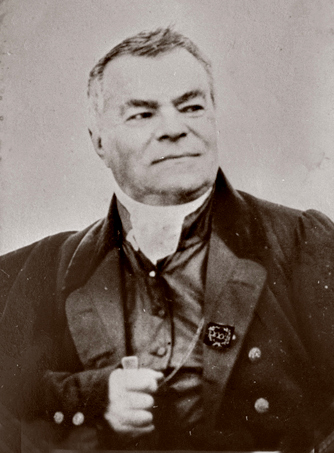 Konstantin Tone. 1870s
Konstantin Tone, whose first works were performed in the style of classicism, developed a new architectural style, which became a known as the "Russian-Byzantine". Nicholas I approved the style chosen by the architect, as a result of the tone, they had a huge impact on the Russian architecture of the second half of the 19th century, becoming something like an official canon. This influence was fixed after the publication of albums with typical drawings.
The most famous building of Constantine Tone is the Moscow Cathedral of Christ the Savior. The prototype of a magnificent building 102 meters high, became the Assumption Cathedral of the Moscow Kremlin. The temple had a Byzantine cross-domed structure, in plan it was an equivalent cross with ledges in the corners. The central helmet -shaped dome rested on four pillars, and four belfries crowned with the same smaller dome were elevated in the corners. The construction of the temple ended in 1883, two years after the death of Konstantin Ton. On December 5, 1931, the temple was blown up. Reviewed in 1994 - 1997.
What you need to know about
Another large -scale tone project was the Great Kremlin Palace. The palace goes to the Kremlin embankment with its main facade. In his building, the classic composition was organically connected with the surrounding ancient buildings. The architect achieved this, using a number of "ancient Russian" details: windows with double arches and "weight" in the middle, decorative platbands and kokoshniki. The transitions connected a new palace with the Granovite Chamber, the Terem Palace, the Golden Tsaritsyna Chamber and the palace churches of the XIV - XVII centuries. Five front halls of the palace were named according to the orders of the Russian Empire: Georgievsky, Vladimir, Aleksandrovsky, Andreevsky and Yekaterininsky. Architects F.F. Richter and N. I. Chichagov were engaged in the design of interiors and interior decoration. Construction was completed in 1849. In 1851, the arms chamber was built by Konstantin tone.
Direct speech
“The creative heritage of Constantine tone is contradictory, but very characteristic of his time - borderline between two large architectural eras - classicism and eclecticism. But there is no doubt that the pier with the Sphinxes on the Neva, the Great Kremlin Palace and the stations of the Nikolaev railway are destined, if not eternal, then a long life. ”
V. G. Lisovsky "Archives of St. Petersburg of the XIX - early XX centuries"
“Having developed this style, the tone tried not only to return to the general forms and details of the ancient national-Russian buildings, especially the temples, but also to inform them of greater correctness, harmony and compliance with the latest needs and artistic principles. This required, in addition to innate talent, imbued with purely Russian spirit, hot love for Russian antiquity and close acquaintance with its monuments. The German by origin, which developed under the eclectic ferals of the St. Petersburg Academy and in foreign lands, the tone, with all his talent, was not able to satisfyly solve the task of the boldly taken-to restore our ancient architecture in the new brilliance, especially since the systematic study of the works that survived him at that time barely began. Ton buildings are supposedly in the Russian style, of which many are very remarkable in constructively, generally represents a mixture of incorrectly understood and inappropriately applied forms and motives of our ancient architecture with arbitrary fabrications of the builder; They sin with coldness, dryness, lack of true beauty and true greatness. For all that, the tone belongs to the merit that he was the first to turn away from blind imitation of Western European patterns and pointed out Russian architects to a rich source of inspiration, which lies in the monuments of their native antiquity. ”
"Enciclopedic Dictionary of Brockhaus and Efron"
“Konstantin tone in the eyes of many people of that time was an architect who owned the honor of the revival of the national principle in architecture. On the other hand, the rare unanimity in the assessment of his work was shown by representatives of the unofficial, radically thinking Russia, who rejected the creativity of tone exclusively from ideological reasons. They did not oppose the “Russian” style, but against certain forms of expression of nationality and nationality in architecture and, most importantly, against the socio-political content associated with these forms. It is enough to name among them the names of the first creator of the project of the Cathedral of Christ the Savior A. L. Vitberg, the revolutionary democrat A. I. Herzen, the poet T. G. Shevchenko, the great artist Alexander Ivanov, finally, the remarkable Russian critic of the second half of the 19th century V.V. Stasov and others. ”
E. I. Kirichenko "Essay on the history of Moscow architecture of the second third of the XIX - early XX centuries"
13 facts about Konstantin Tone
- In German, the name of the architect is written Thon.
- One of the first buildings erected according to the projects of Konstantin Tone was the “steam greenhouse” on Krestovsky Island. The greenhouse for pineapples was heated by a ferry used immediately in the laundry nearby.
- During his life in Rome, Konstantin prepared the restoration projects of the Caesare Palace on the Palatine Hill and the Temple of Fortune in Prevent. The first of them brought the title of academician of the Roman Archaeological Academy. The tone also designed a church in the form of a Gothic temple adapted to the needs of Orthodox worship.
- Nicholas I personally chose a place for the construction of the Cathedral of Christ the Savior from the three options presented to him by the architect. The temple could be behind the educational house, on Tverskaya Street on the site of the passionate monastery, but a place on the Volkhonka was chosen, on the site of the Alekseevsky monastery.
- In the 1830s, on behalf of the Government, Konstantin tone created typical projects of churches for 1000, 500 and 200 people, and in the 1840s typical drawings for peasant houses in state villages.
- Konstantin Tone developed a project of the iconostasis of the Kazan Cathedral in St. Petersburg from silver, repulsed by the Don Cossacks from the French in the Patriotic War.
- Another work of tone is the project of the famous embankment with the Egyptian Sphinxes at the Academy of Arts in St. Petersburg.
- К концу карьеры Тон имел высокий гражданский чин – тайного советника и был награжден орденами святой Анны 2-й степени с императорской короной (1839), святого Владимира 3-й степени (1839), святого Станислава 1-й степени (1849), святой Анны 1-й степени (1855; с императорской короной – 1858), святого Владимира 2-й степени (1865) и Белого Орла (1869).
- On Constantine granted Constantine, the tone of the coat of arms were depicted “in the azure field a rainbow in the band to the left, accompanied in the upper right corner of the shield with the outing gold with the face of the sun, and in the end of the shield - a silver anthill, crowned with a golden ant”.
- The portrait of the wife of the architect Elena Ivanovna Tone (nee Berg) is one of the famous works of Karl Bryullov.
- Memorial boards in honor of Constantine Ton are installed at the Moscow Station in St. Petersburg and at the Leningrad station in Moscow.
- The artist Vasily Vereshchagin believed that the Cathedral of Christ the Savior "is a direct reproduction of the famous Taj Mahal in the city of agra."
- During the rectorship of tones, the Museum of Old Russian Art was founded at the Academy of Arts, which served as the basis of the collection of the Russian Museum.
Materials about Konstantin Tone
Article about Constantine Tone on Russian Wikipedia
Konstantin tone in the project "Chronos"
Article about Konstantin Tone in the Encyclopedia "Circumspices"
Konstantin tone on the website of the Cathedral of Christ the Savior