
Translated material
Competent "unicorn". How three programmers from Kyiv built a startup with an estimate of $ 13 billion
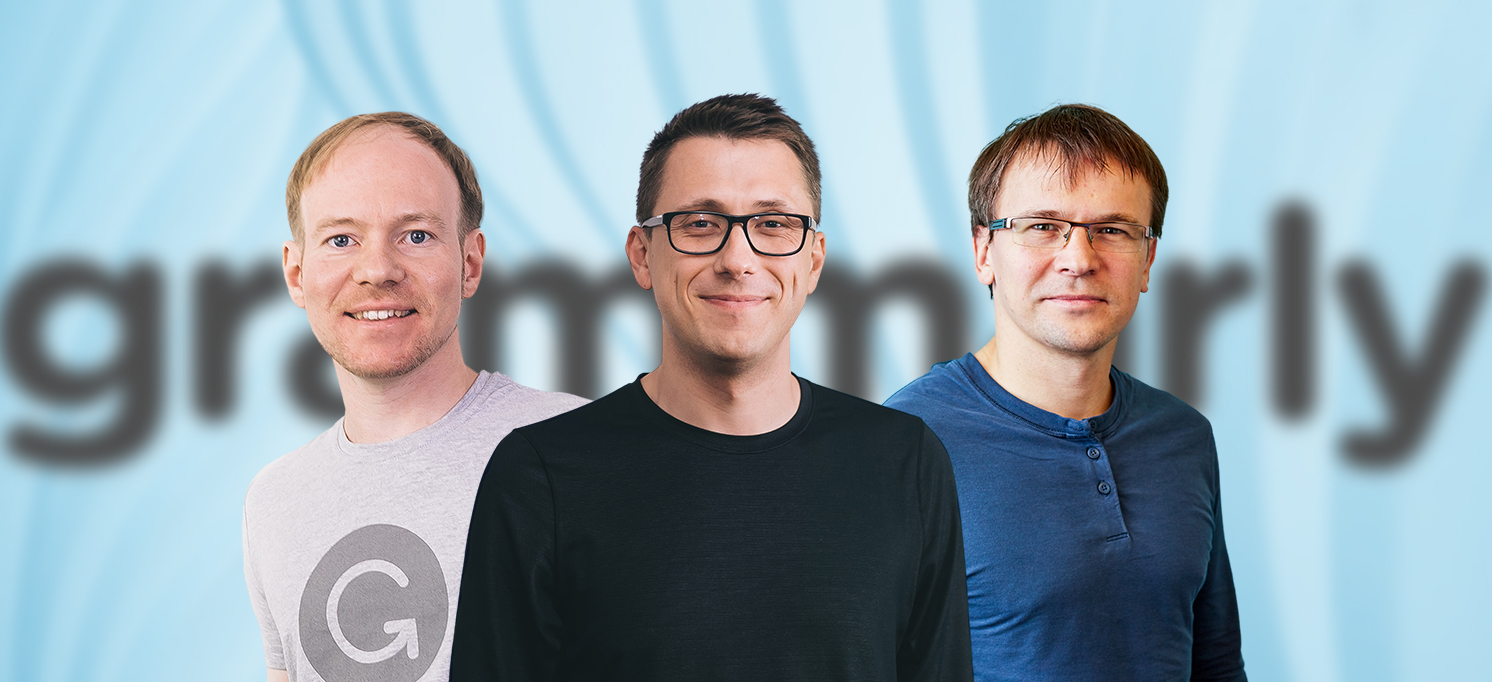
Maxim Litvin, Alexei Shevchenko and Dmitry Leader came up with a service for checking the spelling and punctuation of Grammarly back in the late 2000s and almost ten years raised business without external investments. However, over the past four years, their company has closed three large rounds at once - a total of $ 400 million - and received an estimate of $ 13 billion. The Bell recalled the story of the most expensive startup with Ukrainian roots - from acquaintance of the founders at the Kiev University to the status of a cross -platform project with a daily audience of 30 million users and corporate clients of ZOOM and corporate clients of ZOOM. Cisco.
Editor for millions
On November 18, the Grammarly spelling service has closed the third investment round over the past four years. The startup founded in 2009 attracted $ 200 million from the Baillie Gifford, BlackRock and General Catalyst funds. The project assessment reached $ 13 billion-compared with 2019, when Grammarly received the status of the “unicorn”, the indicator grew 13 times. This time, the company plans to spend on the introduction of innovations and scaling the raised funds, the Grammarly director of Rahul Roy Roy Chuduri said TechCrunch.
As of 2021, the Grammarly is a cross-platform online editor. The service checks English -language texts not only on spelling and punctuation errors, but also helps users to competently build offers and save them from complex structures. All advice on editors Grammarly gives "on the fly." Also, the service can find plagiarism in texts.
In the aggregate, Grammarly is compatible with more than half a million applications and sites. You can use it as a separate desktop or mobile application or extension for a browser. A separate version of the service is available for a package of Microsoft Office programs. Grammarly also works in all postal clients, Google applications, popular social networks and platforms for communication and joint work, such as Slack, Discord and Jira.
The startup on Freemium models: the service has a free version with a limited set of functions (it is most often used as a browser extension), as well as several paid versions-for individual and corporate users. The first “full -fledged” Grammarly will cost the amount of $ 12 to $ 30 per month (depending on the duration of the subscription), the second - up to $ 25 for each employee (for large corporate customers and non -profit organizations, the discount system operates).
According to the company itself, today the service has more than 30 million daily users and more than 30 thousand - corporate ones. Grammarly does not disclose financial indicators. According to Roya Chuduri, business is a profitable business from the first days of existence. The specialized resources of the Growjo and OWLER business analytics and OWLER evaluate the revenue of Grammarly at the end of last year at about $ 70 million. The entire global software market to help in writing texts, according to the Dataintelo forecast, will grow from the indicator of $ 1.2 billion in 2018 by an average of 28% until 2028.
Anti -plagiarism system
The founders of Grammarly Maxim Litvin and Alexei Shevchenko passed the path traditional for IT entrepreneurs from the post-Soviet space: a teenage passion for “iron” and programming in the dysfunctional 90s and a dream to launch their own startup by the time of entering the university at the beginning of the “zero”. It was the university who connected future business partners: both entered the private international Christian university in Kiev (now closed ). This was one of the first institutes in Ukraine, where training was carried out completely in English with the participation of language-class teachers and the prospect of continuing education in the West.
The constant stay in the English -speaking environment pushed Litvin and Shevchenko to the idea of the first business: they noticed that in the student environment, there was a dominance of plagiarism, and there are no quality services for checking texts for originality on the Internet. Beginning entrepreneurs decided to fill this niche with their own product. So in 2004, the MyDropbox project was born - a few years before the creation of a more eminent “namesake”, the cloud service of Dropbox.
Litvin and Shevchenko had already moved to the ocean by that time: the first one entered the MBA program to the University of Vanderbilt at Tennessee, the second to the Toronto University. MyDropbox had no investment, so the founders themselves wrote the entire software part with the support of just one system administrator. After they took up sales : “cold” calls from Ukraine did not work, so they were looking mainly at the North American conferences on educational technologies.
The calculation turned out to be true - the product fell into the target audience. The license for MyDropbox began to rapidly disconnect American universities, as well as publishers of textbooks. By 2007, about 800 universities and 2 million students used the program, and several dozen people were already working in the startup, including the future co-founder of Grammarly, a graduate of the Kyiv National Aviation University Dmitry Leader.
Among the partners, MyDropbox was the largest at that time by the American developer of online management systems by the Blackboard educational process (in 2021, it was absorbed by Anthology). In 2007, Blackboard bought MyDropbox-according to Shevchenko , for a “relatively small” amount.
According to the terms of the transaction, Litvin, after the absorption was completed, had to work out in the Blackboard Washington office for two more years, overseeing the integration of the product into a new ecosystem, and Shevchenko took on the product competing with MyDropbox. As a result, having paused for the agreed period, in 2009, partners-now in the company of the leader-founded Grammarly.
Business for your own
The Grammarly idea was rooted in the history of MyDropbox: during the time of work at the first startup, Litvin and Shevchenko realized that students often resort to plagiarism not because of laziness or time deficiency, but simply because they are faced with problems when writing a text. Spelling, punctuation, style - when creating a new content, the authors stumble about many questions, the answers to which are difficult to find in one place.
This place entrepreneurs decided to make their new product. For its run -in, they had almost perfect starting conditions: gained ties with hundreds of leading universities in North America and the rich experience in analyzing large text massifs. Universities again became the first clients of the company (initially it wore a more complex name Sentenceworks, then - Essayrator).
But they were not enough to scaling the product: the too slow process of concluding contracts from universities inhibited the development of the project. Then in 2010, the founders of the startup decided to change the strategy and reorient to direct, rather than mediated interaction with the audience: Grammarly became available to students, that is, he changed the B2B model to B2C.
At first, it was a simple online editor to which the text under study could be transferred. The team paid special attention to feedback: users actively reported the discovered bugs and qualitative shortcomings of the service, so Grammarly studied on the experience of his own audience. The latter liked this: thanks to the minimum investments in marketing and the “sundress” effect by the end of 2010, 150 thousand university students used the editor.
The organic growth of business allowed the founders to maintain full control over the project and do without external investments. At the same time, the interest of the venture market in Grammarly existed: so, in the same year, the partner of the General Catalyst venture fund, Bred Hoover, entered the startup. He was so imbued with the prospects of Grammarly that at first he became a company consultant, and then at all took the post of CEO, and also initiated the relay of the head office from Toronto and San Francisco. The founders, having received an experienced manager with a good knowledge of the EdTech market, focused on the development of the product.
Such a managerial configuration turned out to be optimal: in 2011, Grammarly doubled the student audience - up to 300 thousand users - reached profitability and came to the idea that the product is suitable not only to people studying English, but also to people using language for personal and working purposes. This allowed the company to scale from year to year: in 2012, it took a mark of 1 million users, in 2013-at 3 million, in 2017-8 million, in 2019-at 20 million.
The product also developed in parallel: at first the editor became available as a client for the Microsoft ecosystem, then he received a free version and form of expansion for the browser, afterwards appeared in a version for corporate customers and finally turned into a full desktop and mobile application. In the 2021th, Grammarly also released an application for developers, which allows you to introduce a service into the code of almost any project.
Investments for the sake of AI
Without the external injections of Shevchenko, Litvin and the leader cost almost ten years. They decided to attract the first investments only in 2017. The first round was immediately large - for $ 110 million. It was headed by its former employer of the General Catalyst Hoover, as well as IVP and Spark Capital funds. Two years later, in 2019, the pool, led by General Catalyst, added another $ 90 million and gave the startup with the status of the Unicorn, that is, a private company with a venture assessment of a business from $ 1 billion.
The funds were necessary not only to maintain growth, but also for the introduction of innovation. In recent years, Grammarly follows in line with the advanced trends of the technological market - actively introduces artificial intelligence algorithms (AI). The latter are able to rapidly analyze huge arrays of information, which is especially convenient for projects working with texts.
AI algorithms and other innovations are designed to make the service even more “smart”: in addition to finding errors and stylistic editing, Grammarly today learns to configure the tone of the text, conduct contextual analysis, regulate the style depending on the set business and even to predict the impressions of the addressee from reading.
The company is also intensively invested in personnel. Today, the Grammarly team consists of more than 600 specialists, its offices are located in San Francisco, Vancouver and Kiev. Litvin and Shevchenko work in North America, the leader in Ukraine. In 2021, the company entered the rating of the best US employers according to Inc. magazine.
The new round of 200 million will help Grammarly follow the course taken in conditions of tighter competition. In addition to the functions of Microsoft and Google, similar to the set of functions of their own services, the market-analogues of Writesonic, Rytr, Jarvis and other Grammarly trump card and a huge audience, including large corporate customers Dell, Zoom, ExpeDia, are also fighting the market share. Cisco and others. It was these advantages of the startup in the third round that such influential investors as Baillie Gifford and BlackRock funds appreciated. The first is known as one of the largest shareholders of Tesla, and this year he managed to participate in the round at $ 500 million in the Discord messenger. BlackRock is completely considered one of the world's main institutional investors, under the management of funds - assets for almost $ 10 trillion .
According to the forecast of the venture investor Denis Dovgopologist, the most likely development scenario for Grammarly is an exit to the exchange. Although the General Director of the Startup plans for IPO so far refutes. Against this background, it remains unclear what the assessment of the state of Shevchenko and Litvin today. As Ain.ua found out , the leader as a younger partner owns less than 1% of the company. Two other founders belonged to the third round of about 77%. According to the results of the round, Ukrainian Forbes estimates their shares of $ 9 billion in total. Whether they preserved the citizenship of Ukraine, they did not answer Grammarly.