
Translated material
An intellectual who survived the war
Nikita Eliseev - about the book by Andrzej Bobkowski “Pen Sketches (France 1940–1944)”
For all thinking residents of Europe, the 1930s and 1940s were a very difficult time - they were asked to accept as the norm what was by no means normal. What the life of one intellectual of those years, the Pole Andrzej Bobkowski, who found himself in Nazi-occupied France, was like is described in his diary entitled “Pen Sketches.” Read about this book, recently published in Russian, in the material by Nikita Eliseev.
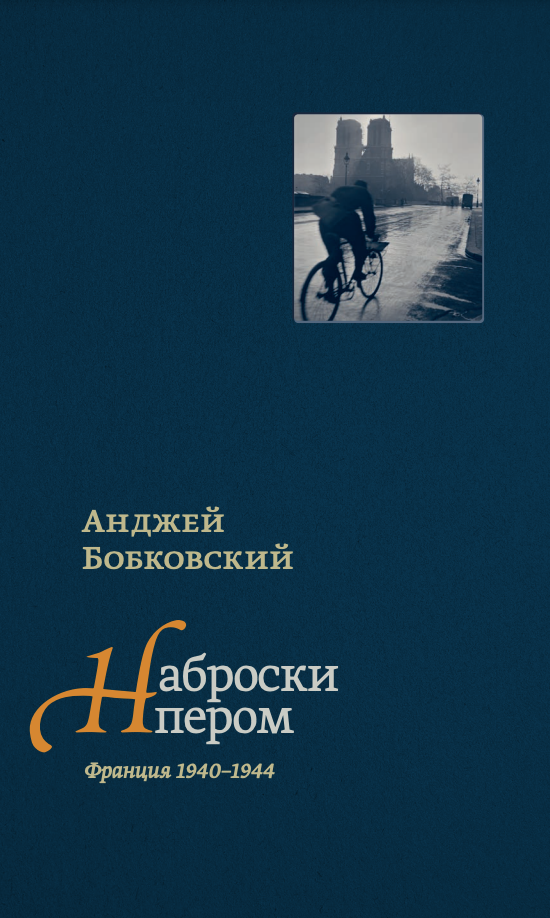
Andrzej Bobkowski. Pen sketches. France 1940–1944. St. Petersburg: Ivan Limbach Publishing House, 2021. Translation from Polish by Irina Kiseleva. Content . Fragment
At the very peak of the victories of red and brown totalitarianism, at the hour “when all the lights went out in the world,” this special, special human type, previously unprecedented, appeared: the intellectuals of the 30s and 40s. They were very different in their views, aesthetic preferences, origin, life (even!) experience. But there was something in common that connected them, something akin to them all.
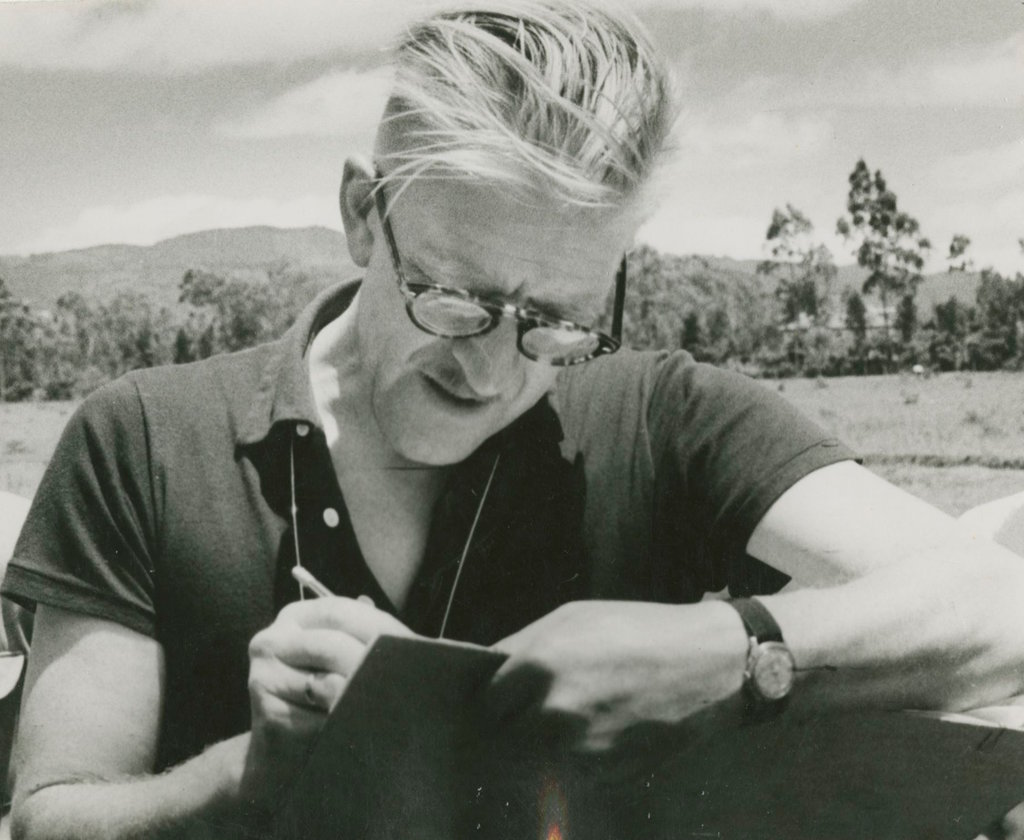
In order to make it clear how different they were, I will name their most prominent representatives/spokesmen: the German democrat Sebastian Hafner, the English democratic socialist George Orwell, who carefully emphasizes his apoliticality, the Russian-American liberal Vladimir Nabokov, the cheerful and wise Yuri Dombrowski, the Polish emigrant I recently recognized who survived the Nazi occupation of France, Andrzej Bobkowski (1913-1961), in love for the book of which I am about to confess.
What did such different people have in common? The first commonality, oddly enough, was very clearly outlined by the most (seemingly) apolitical of them, Vladimir Nabokov. This is the ability to immediately reject what was unacceptable and hateful to them: “I,” writes Nabokov in 1954, “by the way, am proud that even then, in my foggy but independent youth, I saw signs of what has become so terribly obvious now, when a certain family circle gradually formed, connecting representatives of all nations: the jovial empire builders in their clearings in the jungle; German mystics and executioners; seasoned pogrom-mongers from the Slavs; a wiry American lyncher; and, in the continuation of the same family circle, those identical, big-faced, rather pale and plump automata with broad, square shoulders, which the Soviet government is now producing in such abundance after more than thirty years of artificial selection.”
The second common, related... was outlined elusively, but definitely by the wife of one of them, George Orwell, the beautiful Sonya Orwell. A friend once asked her: “You had so many candidates, why did you choose Orwell?” Sonya replied: “You see, he was the only one of all my suitors who could fix the stool and the electrical wiring.” Wise woman, what can you say. That is, of course, the great English artist Lucian Freud (grandson of Sigmund Freud) or the great French philosopher Merleau-Ponty are good, but with them a minor everyday nuisance turns into a disaster. “Sonya! Sonya! Nightmare! The lights went out! And I need to finish writing a treatise (option: a painting)! Call Londonenergo quickly!” - “Oh, yo-oh-oh...” And here she knocked on the door: “George, the light has gone out (option: the stool is broken), do it, okay?” George will look up from writing an article, review, short story, novel, fairy tale - quickly and skillfully. Do you understand? Given: an intellectual - he will write an article and a review, and it will be interesting to talk with him. However, it’s not that he can’t drive a nail into a wall or put a worm on a fishhook, no, he can, only he’ll beat off all his fingers with a hammer or stab him with a fishhook. Give him bills from housing and communal services, he will get confused in them. God forbid someone like that ends up there and then, where everyday difficulties become truly catastrophic, in conditions of war, occupation, totalitarianism - he will die, and he will destroy you. Or given: a dashing craftsman guy, with a familiar way of life. But talk to him about politics, ideology, art, religion, economics - your hair will stand on end.
So, in the thirties and forties, these special, special intellectuals appeared, excellently versed in complex intellectual problems and equally excellently versed in “the concerns of the vain world.” It was equally interesting and reliable with them. Such was the Polish emigrant, a Polish engineer at a Parisian factory, Andrzej Bobkowski, whose diary from the time of the Parisian occupation was published in Russian this year in an excellent translation by Irina Kiseleva.
A picaresque novel?
So, diary. A man (under the slogan: “A good writer is not one who writes well, but one who notices a lot”) writes down almost daily everything that he noticed in the everyday life of occupied France, everything that he read in newspapers, heard in queues or on the London radio. No, he writes well, beautifully. “It’s impossible to talk about the Cote d’Azur. It’s like drawing the sun with ink.” But... beautiful descriptions and “much-precisely-noted” are far from what can arouse sustained reader interest. And Bobkovsky’s diary is interesting to read. Captivating , as Solzhenitsyn would write.
Why? One answer is on the surface. Life and everyday life, accurately observed and well described by Bobkovsky, are so exciting that God forbid you end up in such a life, in such a way of life, but it is interesting to read about them. Let's say Bobkovsky describes the evacuation of his plant from Paris during the defeat of France, describes the mass exodus of Parisians to the south of the country, which had not yet been captured by the Germans. Quite an adventure, right?
(By the way, the difference in the perception of this disaster by different people is curious. I read three descriptions of this flight. In the memoirs of Francois Cavanna (the creator and first editor of Charlie Hebdo), in the memoirs of Georgy Fedotov (Russian philosopher and theologian) and in the diary of Andrzej Bobkowski. The Frenchman Francois Cavanna describes this flight as a catastrophe, Armageddon, the death of the world. Russian philosopher Fedotov (who survived the revolution and the Civil War in Russia) is surprised: “The blessed country of France, even fleeing from the enemy, evacuation here turns into a bicycle ride with picnics on the side of the roads.” Pole Andrzej Bobkowski is exactly in the middle. In principle, nothing good, but it could be much worse).
Let’s say that after the defeat of France, Andrzej Bobkowski and his friend, the Polish worker Tadeusz, having received 2,400 francs from the plant management (yes, evacuated non-working employees of French factories received significant allowances), decide not to bother with trains in the conditions of military confusion, but to return to Paris... on bicycles. Ride from Marseille to Paris - along the Cote d'Azur coast to Nice, relax there, ride (by bicycle) to Monte Carlo, play in the casino and continue the journey... through the Alpes-Maritimes. Adventures? And what kind!
Or, say, a Polish worker at a Parisian factory somehow falsified the date on his passport. Made myself a year younger. The French police discovered the fake and put him in jail to await trial. The director of the plant calls Polish engineer Andrzej Bobkowski: “Jendrus, this is the case... You know French, you know Polish, you know German perfectly. You understand the laws and know how to communicate with people. They took yours. Figure it out, okay? Endrus goes and sorts it out. And the worker gets off with a fine, but he was facing a concentration camp; the French police had already handed him over to the Gestapo.
(By the way, there is a very touching scene in the diary. Andrzej Bobkowski helps many during the occupation. He writes about this help only if he needs to describe the police station, the Parisian Gestapo, the law office, the lair of the always drunk “king of the Parisian black market,” the farm where Andrzej helps to slaughter a pig and make sausages out of it to supply his family and friends... In the winter of 1944, Andrzej falls ill. Lungs. Lying down in the hospital. Somehow he gets out. He returns home and finds out that all his friends, while he was being treated, helped his wife. And upon his return they brought gifts - food, of course. And he writes: “How good, how joyful... I didn’t know that they loved me so much...”
Here the reviewer (who confesses his love for the book by Andrzej Bobkowski) is in danger. The reader of the review may think that this book is a picaresque novel, and the main character in it is something like Ostap Bender. There is no big mistake here. You can take “Pen Sketches” that way. In the end, there was plenty of Benderism in the intellectuals of the 30s and 40s. Otherwise, they simply would not have survived the troubles that befell them, their immediate family. And they didn't just survive. They also helped others survive. It is not for nothing that one of these intellectuals, Nabokov, was so fond of Ilf/Petrov in general, and “The Twelve Chairs” in particular. However... the most interesting and most important thing in Bobkovsky’s book is different. And this other thing is difficult to formulate. I'll try.
The most interesting
The most interesting thing in Bobkovsky’s diary is his reasoning and reflections. After all, he is an intellectual. Anything he noticed was not just noticed, but reflected on. Placed in a certain picture of the world. He doesn't just record some domestic quarrel in the queue. Everyday life leads him to reasoning about the peculiarities of the French national character. He doesn't just describe the wealthy farm of a Polish emigrant (whom he helps slaughter a pig); he talks about the peculiarities of the Polish national character. (By the way, these arguments are by no means complimentary towards the Poles.) He does not simply record the emphasized politeness of the Gestapo nits towards him, a Polish engineer, and towards a French lawyer ( “Well, well, we all understand... yes... your employee (you say: he is an excellent worker?) and your client made a mistake... we understand... yes, perhaps, perhaps not our client... And, by the way, why don’t you are you returning to Poland? I assure you, there is now... a revival..." ), he thinks about the peculiarities of the occupation policy in Western Europe.
He is a real intellectual. Well versed in military affairs, literature, sociology, and economics. For relaxation, it’s good for him to read not stupid detective stories (however, he also reads good detective stories), but Balzac, de Maistre, Keyserling, the report of the French National Bank for 1941. He is interested in solving complex problems, just like making airplane models. Regarding the report of the National Bank. I don’t know anything about economics, but I read Bobkovsky’s two-page analysis of the report with interest. Huge. Moreover, while I was reading, I understood why (Bobkovsky explained) inflation should have started in France already in 1942, but it did not, and after some time I no longer understood it and could not explain it as neatly and clearly as Bobkovsky.
To check my feelings (maybe I’m wrong? Maybe Bobkovsky is talking nonsense?), I gave these two pages to my friend, an educated economist, to read. He read these pages very carefully, looked at the date of entry, and then at me: “Amazing,” he said, “what a clever girl!” To do such an analysis in 1942? You see, what he writes here is now twice two, but then... then it was higher mathematics.”
The main problem that Andrzej Bobkowski is thinking about is totalitarianism, which has already captured the west of Europe to the English Channel, and since 1944 has been victoriously pressing into its east. Bobkovsky is irritated by the soothing words of his left-wing, pro-Soviet (not yet! in 41–44!) French and Polish friends: they say, don’t panic, a military alliance with the democracies will cause positive changes in the USSR; You'll see, after the war, socialism in Russia will take on a human face. Moreover, Bobkovsky sadly admits: his contemporary democracies have not developed an effective antidote against modern dictatorships, against the stupefaction and stupefaction of the population by demagoguery, propaganda, against pumping into the population massive doses of xenophobia, misanthropy, hysterical hatred and lies.
For this reason, the book should have been gloomy, joyless, desperate, but it is warm, humane, giving hope. On the advice of Silouan of Athos, unknown to him, Andrzej “keeps his mind in hell and does not despair.” But there is something to despair about: Bobkovsky understands everything so correctly, formulates his understanding so accurately, but he has nowhere to put his understanding. He is on the sidelines. He is an outsider. Marginal. No, in the everyday, everyday sense, he’s not really an outsider, but in the social and political sense, of course, he’s a marginal and an outsider.
There's a twist here. Encouraging. Andrzej Bobkowski cannot know that there are many people like him. He also cannot know that the thoughts of intellectuals like him in the 30s and 40s will help the post-war world develop at least some kind of antidote against modern dictatorships.