
Translated material
Liquidation of conscience
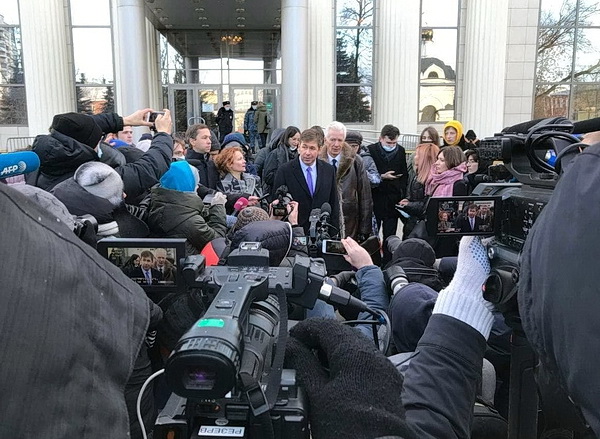
The struggle for the "memorial" continues. The fate of the international memorial will be decided tomorrow, the Moscow City Court extended the pre -trial consideration of the case of the liquidation of the Memorial human rights center until November 29. What exactly do they want to eliminate? The Abakan court of Khakassia banned the book “A Woman in Berlin. Diary - from April 20 to June 22, 1945. " What is next in line?
84 years ago on this day, November 24, 1937, 12 orientalists were shot in Leningrad. Japanists, Indologists, specialists in Mongolia in the field of history, language and modern state of the countries of the East. The number 12 seems small against the background of many thousands of executed and millions of deaths from hunger and turned into camp dust. But the orientalist is not a mass profession. Therefore, the destruction in the 30s of several dozen scientists became an irreparable scientific catastrophe. Moreover, the best were destroyed ...
The struggle for the "memorial" continues. It is possible that the fate of the international memorial and the human rights center "Memorial" will be different. In the Moscow City Court on Tuesday, preliminary hearings were held on the claim of the prosecutor's office on the liquidation of the human rights center "Memorial". According to the results of the meeting, the judge decided to extend the pre -trial stage of the consideration of the case. Representatives of the prosecutor's office could not answer all the questions asked as part of the defense petitions. Another preliminary hearing has been appointed - they will be held on November 29. The meeting, of course, was held closed.
Tomorrow, November 25, at 11:00 in the Supreme Court of Russia, the claim against the international memorial will begin. We are talking about the meeting on the merits, and not about preliminary hearings.
The human rights center "Memorial" is protected by lawyers led by Ilya Novikov, the team of defenders of the international memorial is headed by Henry Reznik. However, in Putin's Russia, the outcome of political affairs practically does not depend on the professional skill and talent of a lawyer. Moreover, the lawyer himself can follow the traces of his client, as happened with the lawyer Ivan Safronov Ivan Pavlov, against whom a criminal case was instituted, he is forbidden to use the Internet and communicate with anyone. Another lawyer Ivan Safronov Evgeny Smirnov, in order to avoid persecution, was forced to leave Russia.
“Memorial” is over 3 million names of victims of Stalinist repressions. And not only the surnames of the victims, but also the circumstances of the case, the surname of the investigators. Millions of descendants of the victims can find out and find out in the "Memorial" the story of their family. Without exaggeration, we can say that the “memorial” is the collective memory of Russia and other post -Soviet countries and the collective living conscience of the people. It is this - collective memory and a collective conscience - and are trying to destroy today.
In the meantime, with the living Memorial, other Russian courts destroy individual fragments of memory by destroying their material media.
The Abakan court of Khakassia, without explanation, banned the book “A Woman in Berlin. Diary - from April 20 to June 22, 1945. " The Ministry of Justice introduced these memoirs, written by the German Marta Hillers, to the register of extremist materials. This book is a report from the hell that was the fate of many women who became the prey of the “winners” in the destroyed Berlin at the very end of the Second World War. In the version of the story that is considered the only correct in Putin Russia, Soviet soldiers carried the peoples of Europe exclusively liberation, and if a living witness describes blood pressure arranged by Soviet soldiers, then this is not memoirs, but extremist material.
To understand the scale of the destruction of memory, you need to know two digits.
The first number. In Russia, at the beginning of this year, there were 2337 federal courts of general jurisdiction, each of which can ban any number of books, articles, films. Tomorrow, some district judge will not like how the Stalinist repressions of Solzhenitsyn or Shalamov describe. And the other district judge will insult the phrase of Vasily Grossman to the core: “Stalin picked up a sword that had fallen from Hitler and brought him over the surviving and Jews of the USSR,” and this district judge will ban “life and fate”.
The second digit. The federal list of extremist materials, which is compiled by the Ministry of Justice of Russia on the basis of court decisions, as of June 25, 2021 contains 5187 points, each of them is a book, film or author whose works are recognized as extremist.
Among them, for example, the text of the appeal of the public organization “Voice of Beslan” “to everyone who sympathizes with the victims of the Beslan attack!” To the President and Congress of the United States, the leaders of the EU countries and members of the European Parliament. In addition to the memory of the crimes of terrorists, the Beslan’s tragedy also stores the memory of the crime of the leadership of the Russian special services, whose faults of which several hundred hostages died. That is why the appeal of the Voices of Beslan is trying to erase from memory.
The list of extremist materials includes Russian translations of books of the Islamic theologian Said Nursi. So decided the Koptevsky court of Moscow on the basis of the “examination” conducted by the employees of the Institute of the Middle East (president-Yevgeny Satanovsky, a regular participant in the current show of hatred Vladimir Solovyov). Tafsir Said Nursi - the interpretation of the Qur'an - is translated into 50 languages, printed in many countries of the world. The books of Said Nursi reject all the forms of enmity and violence, the Islamic theologian himself constantly advocated the dialogue between religions. The works of Said Nursi are banned in Russia, despite the numerous protests of authoritative religious experts, despite the decision of the ECHR, who admitted that the Russian court did not cite a single evidence of extremism in the works of this author ...
In the struggle for memory there are counter -processes. The Council of Deputies of the Gagarinsky municipal district of Moscow supported the installation of the monument to Sakharov in its area. In many ways, this is the merit of the Chairman of the Council of Elena Rusakova, who was excluded from the Yabloko party on November 22, along with 488 members of the metropolitan branch of this party as part of the intra -party struggle against Catcism and Navalnism. The head of the Moscow Yabloko, Sergei Ivanenko, called this decision to exclude 488 members of the metropolitan organization - a “technical procedure” ...
It is unsafe to protect the "memorial" in Russia. On November 22, the court in Moscow fined the participants of single pickets in support of the Memorial - journalist Victoria Ivlev and human rights activist Yuri Samodurov - 150 thousand and 20 thousand rubles, respectively. Ivlev was accused of repeated violation of the rules of holding. A little more, and the world -famous journalist and human rights activist Victoria Ivlev will become a defendant in a criminal case ...
Since the result of trials to eliminate both “memorials” is in no way connected with the right, but depends exclusively on political arbitrariness, it is pointless to try to predict their result. But, in any case, they will not be able to liquidate the “memorial”. You can create problems and complicate the work of specific people, but it is impossible to erase historical memory.
Photo: Russia. Moscow. 11/23/2021. Lawyer Ilya Novikov near the building of the Moscow City Court after a preliminary meeting on the claim for the liquidation of the Memorial human rights center. Photo of the Human Rights Center "Memorial" (entered into the register of NKO-foreigners).