
Translated material
Rules for land use and development of Voronezh - a pig in a poke

Epigraph
In one of his speeches, the head of the city said that the widest sections of the public should be involved in the discussion of one of the main urban planning documents - industry public activists, experts, interested citizens and the deputy corps.
Well, now my assessment of how the consideration of the PZP took place, or rather, continues until the first days of December 2021.
Public discussions on the draft land use and development rules (PLR) of Voronezh started on October 5.
As reported in the press , participants in the discussions can make their suggestions and comments through the feedback form on the Internet resource " Active Electronic Citizen ", as well as through the electronic reception of the mayor's office , in writing to the organizer of the land use and development commission or through an entry in the visitor register in the office of the chief architect of the Voronezh administration on Koltsovskaya street, 45. Telephones: 228-36-58, 228-36-99, email address: uga@cityhall.voronezh-city.ru , office hours from 09:00 to 18:00.
Then came the harsh present.
In the Russian Federation, restrictions were introduced on public events and access to institutions and public spaces was closed
Our organization VPOOO “Our Region” has been analyzing urban development and a comfortable environment for several years, doing qualitative research on the state of individual areas of the city, working with public associations and communities, and therefore we can easily draw conclusions about the need or importance of certain processes important for the development of conditions so that Voronezh residents receive and create the best. It may be a little pretentious, but let’s assume that we are still doing a lot in this direction.
So, the proactive citizens “Citizens Are Here” planned a series of Thursdays at the House of Architects, thanking Konstantin Kuznetsov and Ekaterina Belous personally for hosting us, warming us up, giving us tea and allowing us to hold several events. But then the irreparable happened - Covid restrictions. And as usually happens, the event planned to discuss the PZZ began to be postponed, postponed, postponed. We understood that there was nowhere to wait any longer, and the next date turned out to be November 18, after the deadline for accepting applications. This is the first.
Secondly, we informed, invited a significant number of city council deputies, and many immediately responded: this is the head of the specialized commission on urban planning and land relations - Ivan Vladimirovich Kandybin, a member of the commission - Denis Olegovich Zakharov, as well as the deputy chairman of the standing commission on the development of small and medium-sized businesses, trade, public catering and consumer services Alexander Valentinovich Chufinev.
One way or another, we notified and invited the deputies of these two commissions, as well as the commission for working with municipal enterprises and developing the infrastructure of certain territories of the urban district. Not everyone responded or showed any interest. Well, okay, let their voters ask how they defended the interests of property owners in their districts.
The Voronezh Urban District Administration also considered that participation in this event was irrelevant. And I am ready to understand why they should participate in some event, because it takes place after the completion date.
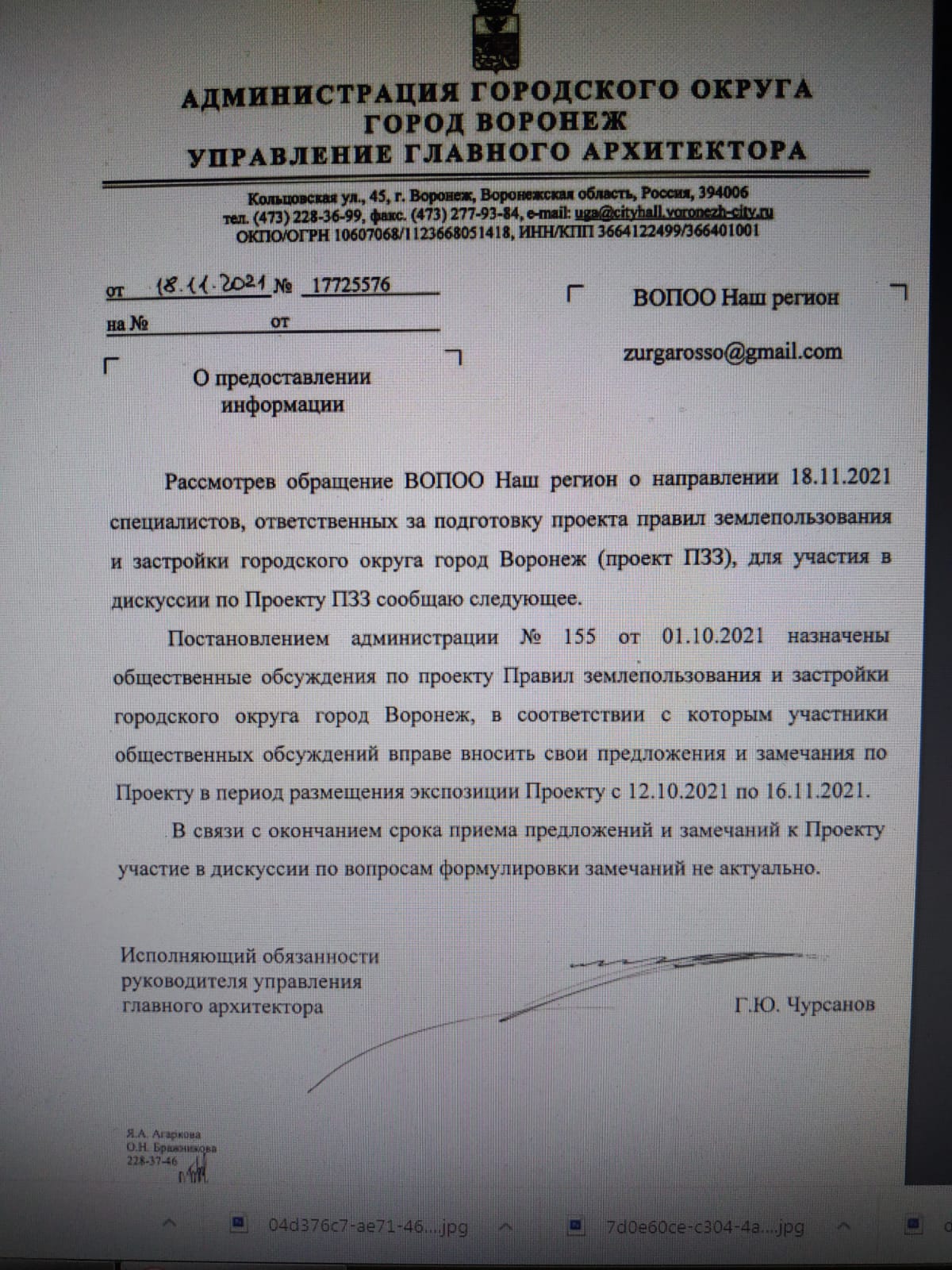
Formally, management is absolutely right. Like a purely bureaucratic structure, for sure, where everything is regulated.
What are public discussions?
But let's use common sense. Let's answer the only question: what are public discussions?
Discussion is a process in which various parties simultaneously participate, where the question-answer mode works. Not an answer almost three weeks after the closure of citizens’ comments, but DIALOGUE and TRAINING in basic things. How to write an application, typical mistakes, how you can exercise your rights.
No, none of this happened. There were no public discussions. The document will be of poor quality. The adopted document will contain errors related to zoning. I believe that conflicts over green areas right next to the Northern Forest WILL CONTINUE.
Next.
Taking into account the considered zones where green areas for public use can be located, or, speaking in simple layman’s language, in the Kominternovsky district there are no significant areas where urban parks and squares will be laid out. Thus, I do not know how the greening standards per person will be achieved in the very next 5–10 years. This applies to the entire city as a whole, with the exception of the Central District. But this is not the merit of the city and its citizens, but the merit of the citizens of the USSR era, who created public gardens and parks in the central region. First of all, the forest park area around the Dynamo stadium, the Berezka microdistrict and the Lestekh and Agricultural Institute institutes, as well as the specially protected area of VNIIGILS and the Botanical Garden of VSU.
Over the past 20 years, we cannot be pleased with such innovations in the field of green infrastructure in the city of Voronezh. I would add, and they won’t be able to. The only thing they can do is to put individual micro-zones in order, creating well-equipped public spaces; perhaps several public gardens will appear. By public gardens we mean areas smaller than 1 hectare.
An event was held at the House of Architects dedicated to the consideration of amendments to the PZZ
So, on November 25, an event was held at the House of Architects dedicated to the consideration of amendments to the PZZ. This is the second and most important document necessary for the development and planning of the city after the master plan.
PZZ is a document of direct effect that defines the permissible types of permitted use of land plots and establishes regulations for their development. PZZ is a document that works only if there is a general plan.
The master plan itself is a project document on the basis of which planning, development, reconstruction and other types of urban development of territories are carried out.
The functional zoning map of the GP (together with the provisions on territorial planning) shows the moment of the physical state of the city, which, according to the will of the collective planning entity, should occur after a long period of time (after 15, 20, 30 years), as the achieved mutual coordination of two components:
a) future volumes of development,
b) future capabilities (volumes/capacity) of infrastructure that ensures the existence and functioning of future volumes of development.
At the event, documents prepared by the Moscow General Plan Institute were reviewed, on the basis of which the master plan was formed. You can download the required document here .
For the average user, it’s easier to watch without downloading here .
Invitations to the event were sent to deputies of the relevant committees of the City Duma: the commission on urban planning and land relations, the commission on the development of small and medium-sized businesses, trade, public catering and consumer services, the commission on work with municipal enterprises and the development of infrastructure of certain territories of the city district.
This was done through the electronic reception of the City Duma and to the addresses indicated by the deputies on their personal pages, for example , the city of Koliukh, whose email DOES NOT WORK.
During the speech, the speaker quickly, non-stop, went through the subzones that are defined within the framework of the PZZ. A subzone is a part of a territorial zone where the same types of permitted use of real estate are established as for the entire territorial zone, but other maximum parameters for permitted construction are established.
He made several comments about the conflicts that arise between the GP and the PZZ when placing sports facilities in recreational areas.
Considerable attention was paid to the analysis of infrastructure on the periphery and especially the Kominternovsky region.
Several remarks and comments were made by the representative of the Department of Ecology and Natural Resources of the Voronezh Region, Irina Nikolaevna Mikhailova.
I tried to pay special attention to zoning, relying on reference documents of the general plan; we touched upon the provision of the city with public and business zones.
Round table video: Discussion "PZZ Voronezh"
In conclusion, let us remind you that the Land Use and Development Rules are developed for the purposes of:
- creating conditions for the sustainable development of municipal territories, preserving the environment and cultural heritage sites;
- creating conditions for planning the territories of municipalities;
- ensuring the rights and legitimate interests of individuals and legal entities, including legal holders of land plots and capital construction projects;
- creating conditions for attracting investment, including by providing the opportunity to choose the most effective types of permitted use of land plots and capital construction projects.
How to get feedback if the process of informing citizens imitated openness and accessibility?