
Translated material
The strength of the straw breaks
What Putin, Aliyev and Pashinyan agreed on the Black Sea
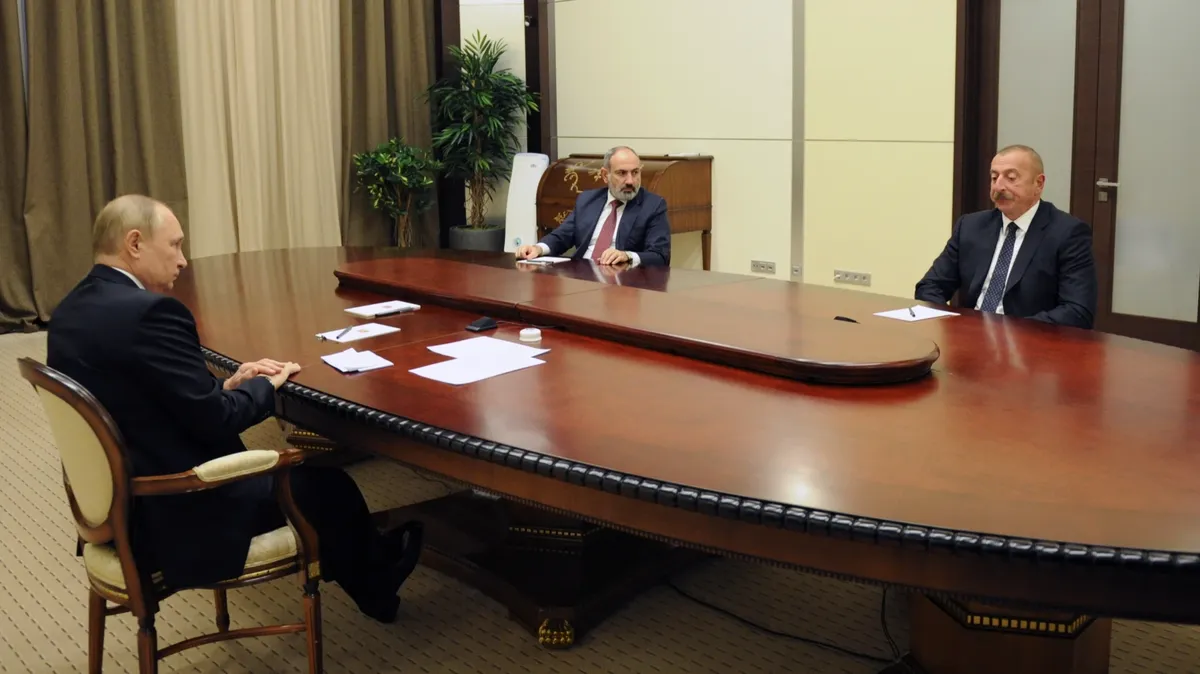
“Very constructive” called a triple meeting with the leaders of Armenia and Azerbaijan, held in Sochi on November 26, the Russian president. Nikol Pashinyan and Ilham Aliyev were also satisfied. Moreover, from Sochi they took away the olive branch donated by him by Vladimir Putin. Obviously an advance ...
Peace negotiations were possible only after a large armed incident that happened on November 16 in the Syunik district of Armenia. That is how - “the troops of Azerbaijan invaded the sovereign territory of Armenia,” Pashinyan said in Sochi, and none of the interlocutors began to refute this wording, it would be difficult to argue with the obvious. Another thing is important here: the readiness for the world in the South Caucasus can be found only as a result of the use of force that Azerbaijan demonstrated by breaking the status quo in the region as a result of last year's 44-day war in Nagorno-Karabakh.
They tried to preserve this status quo in Moscow, regarding it in their desire to keep conflicts in the post-Soviet space as long as possible in a frozen state.
This status quo was cherished in Yerevan, considering him his well-deserved prize for victory in the First Karabakh war of the early 1990s, hoping to keep him in his hands for as long as possible.
In a word, the strength of the straw breaks, and the effectiveness of this worldly wisdom was used in Baku, regardless of losses. And now, after the second reminder of this wisdom, Azerbaijanis present the Armenians as beneficiaries. In the way, we note that the forceful solution of territorial and other problems between the post -Soviet countries and their neighbors remains the hallmark of the regimes ruling there, starting from the most western points of the former union and ending with the border with China East. The rich mental legacy of the "great friendship" of the Soviet peoples ...
Preparation for the Sochi summit was conducted in the most urgent way. Especially after Aliyev and Pashinyan agreed to meet each other in Brussels on December 15 at the invitation of the Chairman of the European Council Charles Michel. Despite the fact that Europeans made it clear that they are unlikely to count on a breakthrough in the settlement of the Armenian-Azerbaijani conflict as a result of the Brussels meeting and intend to only contribute to the creation of investment conditions for the implementation of infrastructure projects in the South Caucasus,
In Moscow, it was not without reason to regard the Brussels initiative as an attempt on its right to be a monopoly operator to resolve the conflict in the region.
Both Yerevan and Baku were preparing for the meeting. The Armenian prime minister was especially impressed in this regard. Speaking on the eve of the departure in Sochi in front of the leaders of communities in Syunika, Nikol Pashinyan, according to the Armenian press, said: "Karabakh is Azerbaijani, we just deceived ourselves for thirty years, and in the end it was necessary to happen." In addition, Pashinyan emphasized that in Karabakh the roads that lead from Azerbaijan to Nakhichevan should be unlocked, since there are no other outputs in this situation.
And the day before the meeting in Sunik, the Armenian Prime Minister at a press conference made it clear that the issue of recognizing the independence of the Independence of the Nagorno-Karabakh Republic is not on the agenda: “We need a speedy resumption of the negotiation process, we must understand that Karabakh will give recognition. For thirty years this issue was discussed, and the decision was not made. Why? Because everyone understood that Armenia should at least not be the first and only country to make such a decision ... "
Also, a few days before Sochi, it became known about the resolution of the Armenian authorities to give an air corridor over the Armenia of the Greek airline Aegean Airlines, which made a flight from Larnaki (Cyprus) to Baku.
Moreover, on the same days, the Azerbaijani Airlines (AZAL) plane flew in the sky of Armenia from Nakhichevan to Baku.
Syunik rhetoric Pashinyan, coupled with Yerevan’s air discharge, looked like a sensational prelude
To the tripartite summit and demonstrations of readiness for concessions, which makes it possible to cynically recall another “power” saying: there is no reception against scrap.
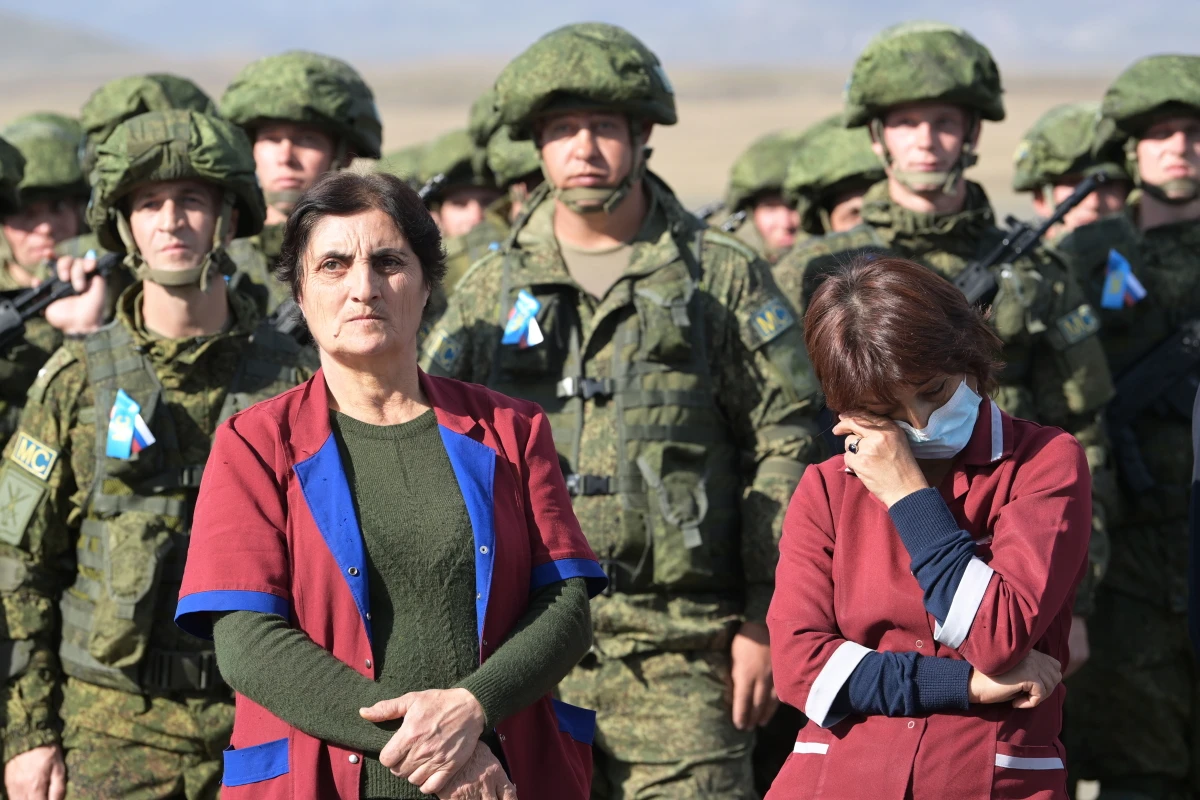
They answered Baku condescendingly, returning to Yerevan on the eve of Sochi two Armenian prisoners of war, one of which was captured during the fighting on November 16 ...
The meeting was multi -level. At first, Putin talked with Aliyev. Then Pashinyan joined them, and the three of them talked about three hours, after which Putin warned that in conclusion he would meet with Pashinyan.
If you carefully read the transcript of the open part of the meeting, then you can find remarkable details.
In the speeches of both Putin and Aliyev, Nagorny Karabakh was never mentioned, even when the Russian peacekeepers are mentioned, who, as you know, are deployed there. It is said only about their "zone of responsibility."
It is natural to assume that such a silence is not by chance. In Moscow, obviously, thus tend to ignore Baku to close the issue of the status of Nagorno -Karabakh, they say, last year’s war returned the territory of Azerbaijan and most of the Karabakh region. Consequently, a feature is brought under the relevance of the problem of status, they say in Baku.
In Moscow, they do not think so, but today is not yet too relevant to the positions of Russia and Azerbaijan, and Putin today seeks to not advertise it once again, while Russian peacekeepers occupy their positions in Karabakh, providing the Armenian administration there the opportunity to manage a significantly festivable territory. It has to be remembered that Moscow needs to maintain Baku’s loyalty if it wants to extend the five -year agreement on the stay of its peacekeepers, which has expired in less than four years.
But Pashinyan, in his speech, mentioned the Nagorno-Karabakh and twice the Nagorno-Karabakh settlement, also emphasizing the role that the Minsk group (MG) plays in it.
This detail shades the approach of the conflicting parties to the OSCE in solving the conflict. In Baku, they do not hide their skepticism in relation to the Minsk group, seeing in it a significant share of the influence of the Armenian lobby in France and the USA, which are along with Russia MGs.
Nevertheless, the excretion of the Karabakh problem, apparently, made it possible to circumvent the nodal contradictions of the Armenian-Azerbaijani conflict and focus on those issues that can be resolved today. After all, as the Armenians themselves recognize today, in any case, their significant part,
The unification of mainland Armenia and Nagorno -Karabakh into a single Armenian state, which has become a national Armenian idea more than 30 years ago, today ceased to occupy the minds of people with the same force.
The Karabakh discourse, speaking of the academic language, no longer dominates in Armenian politics.
And this conclusion also follows at least from those in Sochi, which became publicly known.
Judging, according to the said Armenian and Azerbaijani leaders already in Sochi, the meeting turned out to be constructive.
“In Azerbaijan, they are configured to turn the page of a long -term confrontation with Armenia, to begin the stage of normal interaction,” Aliyev said.
“The positions were clarified on many issues, and it turned out that some of them have no discrepancies,” Pashinyan said. It would be good to clarify what he had in mind. But this will already be important from the prime minister by the Armenians themselves ...
In any case, it is not yet clear how the problem of hostages and persons held by Azerbaijan will be finally solved. Pashinyan drew attention to this, answering Aliyev to his statement that almost all clauses of the triple agreement of January 11, 2021 were resolved, with the exception of the issue of release of transport communications.
Putin, summarizing the summit, listed three main results: creating the mechanisms of demarcation and division of the boundaries between Armenia and Azerbaijan, a noticeable advance forward on humanitarian issues and the intended steps to unlock transport corridors. Whether we are talking about the opening of the Zangezur corridor, designed to connect the mainland Azerbaijan with his nachchevan, which is especially insisted by Baku and an extremely interested in this Ankara, who will receive an exit to the Caspian in this way, or Baku also promises to fulfill its obligations to release Armenia’s exit in the north to Russia.