
Translated material
Alexander Gradsky as a natural phenomenon
Yuri Saprykin talks about the music and the life of one of the most incredible Russian musicians of the last decades
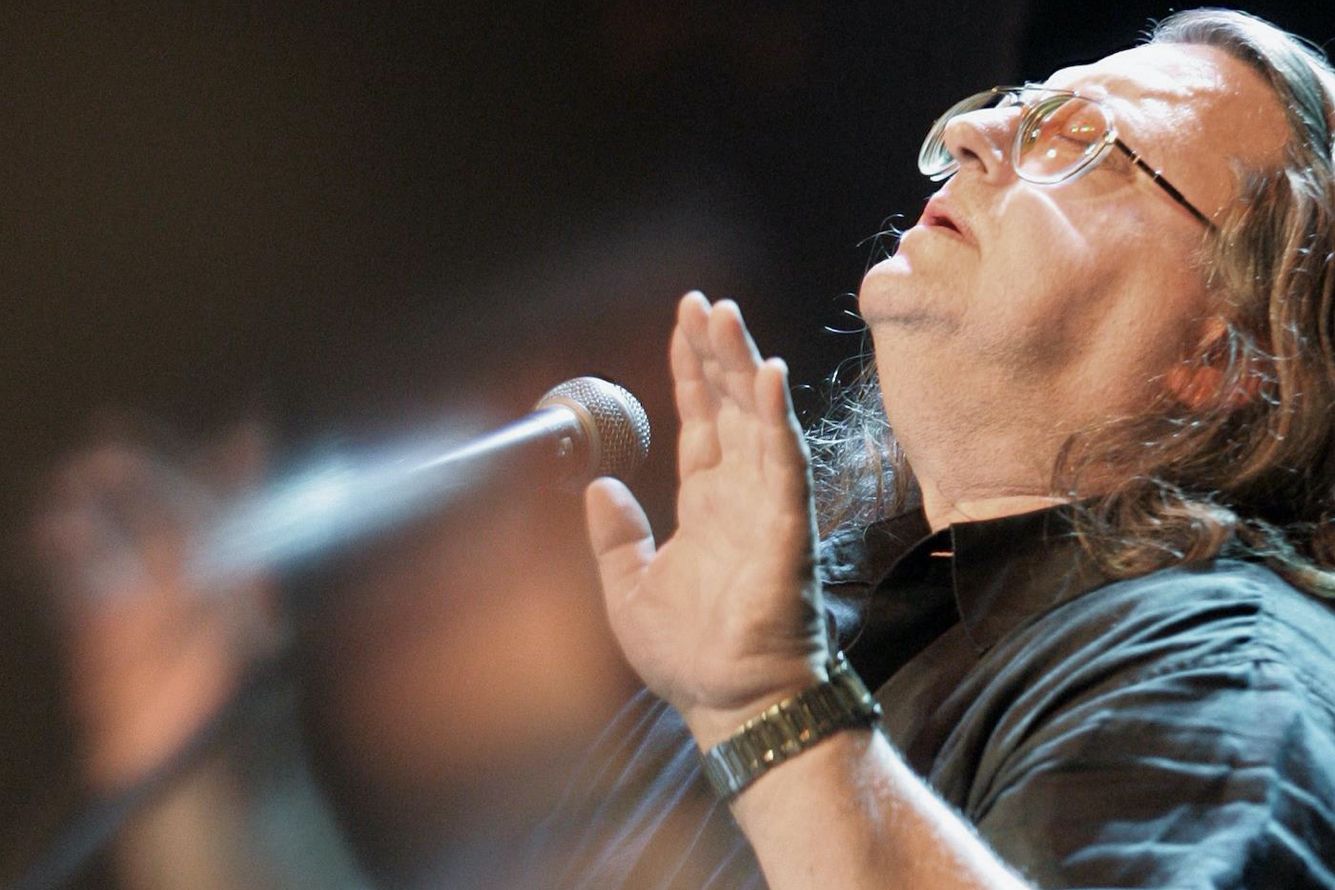
Alexander Gradsky died , and it sounds as if a huge iceberg broke away from continent ice and went into a distant drift. There was always such a feeling from him-something endlessly of his own, firmly soldered into the local context, well-known and never disappeared from the eyes, but not studied, too large, completely separate. Phenomena are not culture, but nature.
The fact that in a conversation about Gradsky there are immediately hydrological metaphors is not by chance: a water-bore-made theme in his work, as they say, is disclosed. The song about the boat from “His among strangers”, the song of the sailor from the “Blue Puppy”, the unexpected late cover of “OL ''55” by Tom Waits-“Livins at the Sea”, the song of the Pila fish , in the end (“In some ways, I myself have a pile fish,” he once admitted in an interview with Ilya Ovchinnikov). Gradsky - like a giant cruise liner, which has nowhere to rush; Wherever he is, he is always in his only right place.
The voice in three and a half octave, the faculty of academic singing in Gnesinka and the composition class in the conservatory, the status of historically the first Soviet rock star, multiplied by large-scale composer-performing abilities (a list of tools on which Gradsky plays on its solo records, invariably occupies several lines on the envelope). This is probably the only person who could-almost simultaneously-to sing at the concert of Bashlachev’s memory and in the opera Rimsky-Korsakov on the Great Stage, playing in any context in his game (as at the Pakhmutova television concerts in the House of Unions, where he was allowed to perform with long hair and dark glasses). Gradsky knew his price, and this price was always at the historical maximum - hence his charming barking, and disarming kindness, and a cool disposition, which acquaintances and eyewitnesses now recall.
There is an episode in the book about the city journalist Yevgeny Dodolev when the hero of the narrative is on the air of the Press Club program, where the metropolitan journalists are amazing together, which the Gradsky who gathered to apologize to the invited politicians, and then defiantly leaves the studio. In 1994, this “anti -democratic” demarche demanded a certain courage. Gradsky had an uncomfortable opinion on any reason that he was not shy about sharing - there is no doubt that he would have set up all our current necologists so that the editors could not publish a comment on censorship reasons.
Makarevich once had a song about the old combat sailboat, turned into entertainment for tourists-with the moral "in order not to become a sort of museum, at the right time it is better to go to the bottom." Contrary to this maxim, Gradsky quickly became a museum of himself, but at the same time continued to urgently plow the open spaces. It is amazing how early and how soon he did everything the main thing: the Pakhmutov song in the life results about “the first half we have already played out” he first performs in 26; At the time of recording the track “Closing Circle” - the combined choir of officially recognized rock, where Gradsky is on the rights of the unconditional patriarch - he is 38.
Already in this patriarchal status, he endlessly rushes with the new generation of artists, for whom he is not only boomer, but by the then standards-just a fossil dinosaur, he takes away rock laboratory youth to the Rock-Panorama festivals, writes in Yunost the necrologue of Bashlachev (we have been preserved, let’s say, melting memories of A.'s visits. B. to A. G., but the acquaintance was undoubtedly, and sympathy definitely remained), launches on the first button of the All-Union radio “hit parade Alexander Gradsky”, through which “cinema”, “Alice” and even Yuri Naumov that have not yet entered all the radios of the country. And already in the new era-many hours of concerts-dermatrospectives, its own theater with an endless construction and unfulfilled megalomanian plans; Finally, meetings in the jury of the show “Voice”, where Gradsky, seemed to overshadow all the participants in any seasons-speaking in the role of not grandfather, not the father of his native, but some “my American uncle”, combining sarcasm and causticity with the most sincere participation.
I recall another ship -model image: a dreadnought, a perfectly equipped and perfectly protected sea machine, which turned out to be too cumbersome for the battles of the First World War.
Gradsky - from the first generation of musicians infected with The Beatles, and apparently found the most spectacular stage embodiment for this influence. But for people, for age -related or geographical reasons, the Slavs and buffoons did not find the performances of his first groups, there was no evidence left. “Blue Forest” or “in the fields under snow and rain” fired later on the “melodies” are amazing samples of the Soviet baroque fulf, however, in the record they clearly do not convey the impressions that witnesses now recall on Facebook: “When the group played and Gradsky sang“ Tsar and God, I flew from where I still can’t and I wish [not] [not] Return. "
The corps of its conceptual albums of the 1980s, regularly published on the “melody”, are song cycles (the author himself called them suits) on the poems of Beranda and Burns, Rubtsov and Elyuar, Mayakovsky and Pasternak, Nabokov and Sasha Black, plus the individual “Russian songs” of 1980-rich, flowerful music, to which the prefix “symph and”, are attached to the symph and symphort. “Art-” and “progressive”; Music, as if specially recorded so that future generations put it on a desktop in a separate folder, requiring a careful study, but forever postponed for later. (As it seems now, Gradsky is making an impossible attempt-to compose a certain imaginary Russian-European rock canon alone, in which Rubtsov and Eluer can really go through a comma, and enlightened soils and Russian longing are connected with art-row sophistication, and with the lunar melancholy of Robert Wayette, and with the enlightened calm of Brian Ino.
Those works that he himself obviously considered the main ones-the monumental rock opera “Stadium” and “Master and Margarita”-came out at a time when for this monumentality there was no longer his listener (if he was once at all). In 1985, Gradsky publishes in his youth the preliminary memoir “Notes of the elderly youth”-he has been writing “Stadium” for a year and a half, and at some point, being distracted from the description of the studio process, notes with bitterness: “My little son cunningly glances at me. What music will captivate him? Will he tell me the next to me: “Dad, you don’t understand anything, because this is the most modern: the boars, chi-chims, the same-lip, Chilacotupotap. You were, papula, it is time for you in the circulation“ ... ”(36 years old, and this“ Chilacotupotap ”I remember without Google. In general, when re-reading“ Notes ”it becomes terribly sorry that there is so little. I was engaged in prose).
Probably, this is the influence of mourning news, but only now it becomes noticeable how much Gradsky about death is much more than about the sea and ships. Requiem along Vysotsky - "His heights in heaven, but the body in the earth." “Song about birds” , “I will die in baptismal frosts” , “You fell victim” , the track about “The Grave in the fence of indifferent” from the incredible album “Life itself”. “I lived, I was,” the song of David Tukhmanov on verses, already composed by hopelessly sick Semen Kirsanov. My finish ribbon , everything will pass and you will take me.
Gradsky sings about this - as often and about much more - with tired detachment; He generally works a lot in a cold spectrum, in the range from sadness to contempt, just hear how he clings through his teeth the text of Voznesensky in the song “I Goya” - “The eye sockets of the funnels excited the raven flooded on the Nagoy field”; This is just an ice embodied in music. And then - a frozen voice seems to make an act of self -immolation, rushing up, goes into a vertical take -off. The feeling of a sudden and uncontrollable flight is the most exciting in the music and voice of Gradsky, this skill is difficult to find analogues. Switching from the position of the cooled fire to the firing focusing mode occurs in a fraction of a second, you can physically feel how the soul that has become the sound is torn out, overcoming the resistance of the atmosphere, somewhere on the world ether. Breaks up, rises, flies away.
Now forever.
Yuri Saprykin