
Translated material
Tram "reluctance"
Is silence possible in Moscow? Residents of the east of the capital are protesting against the new tram branch. The authorities say that the city needs development
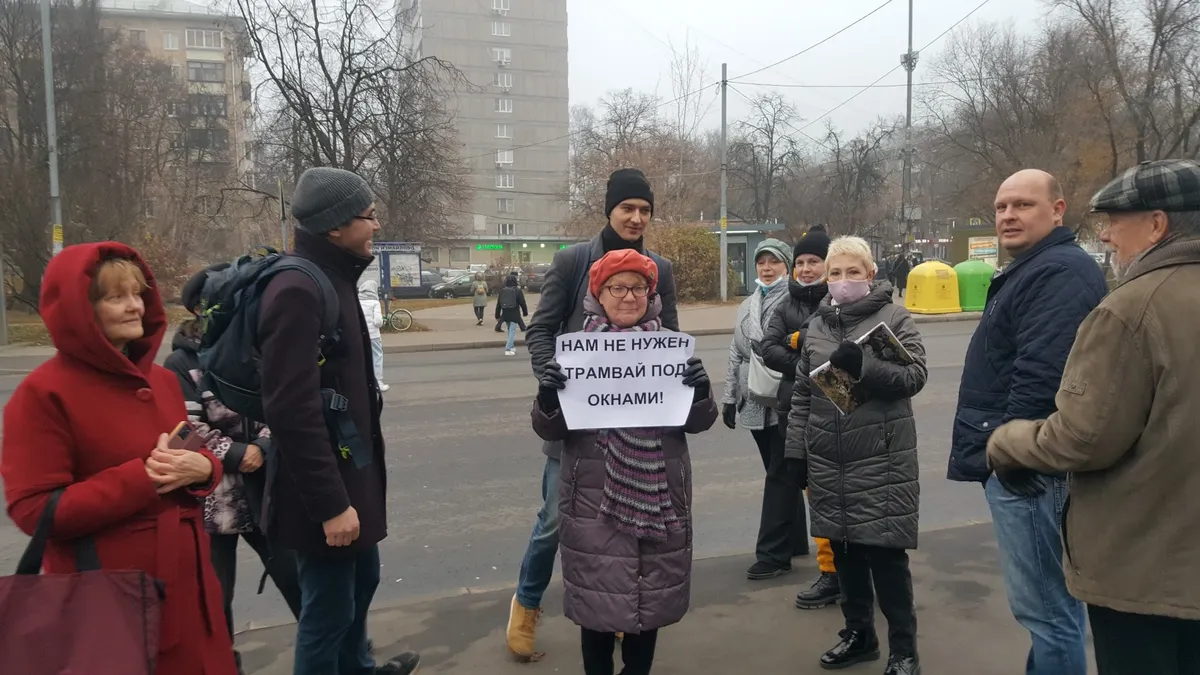
“We are residents of the Izmailovo, North Izmailovo, East Izmailovo, Golyanovo and metro -horsemen demand to abandon the construction plans under our windows of the tram line,” a man dressed in a long black jacket says. Behind him, two dozen people stand in a semicircle.
The Izmailovo district in general and the 3rd Park Street in particular is mainly Soviet development. Quiet yards. Calm "sleeping bag". But now a lot can change here. At the end of September, the Moscow authorities announced the beginning of public discussions on the project “Planning the territory of the linear facility of the street-road network from the open highway to Pervomaiskaya Street”. Simply put - a tram line designed to connect four districts in the east of the capital. The inhabitants were worried and went to look for the truth immediately to the highest instance - to the president. Recorded an appeal to him.
“If you still connect the areas with a route, it is enough to start another flight of the electric bus, which requires smaller investments, and will not cause such radical harm to the calmness of the Izmailovites.
Residents of the district are very alarmed, we have collected thousands of living signatures, including to express the opinions of elderly residents who cannot use the Internet. We demand to listen to our opinion, ”says a man reading out appeal. And then the audience pronounce in chorus: "The tram will not pass!"
Olga Rurikovna, chairman of the house 7/17 on the street. The 3rd park, says that many of the opponents of the construction of the tram line live in Izmailovo 50 years, from the beginning of the development of the district.
- All this time we are not experiencing the need to go to the metro -horseshoe (the beginning of the planned tram route is the area where large -scale renovation is planned. - K.K. ). There are no points of attraction for us. We saw the explanation in the issue of Russia 24: nearby, an abandoned promoted Kaloshino, it will be reconstructed for residential development, 375 thousand people plan to settle there, who are wanted to be transported by tram to the Izmailovskaya metro station.
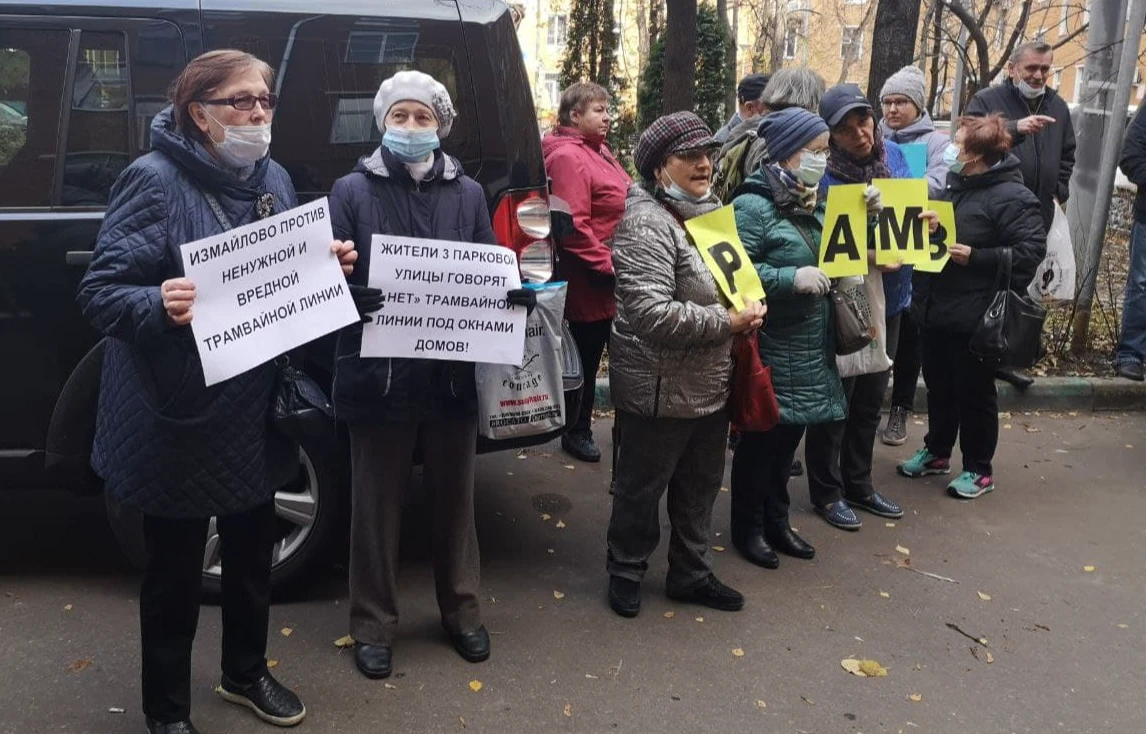
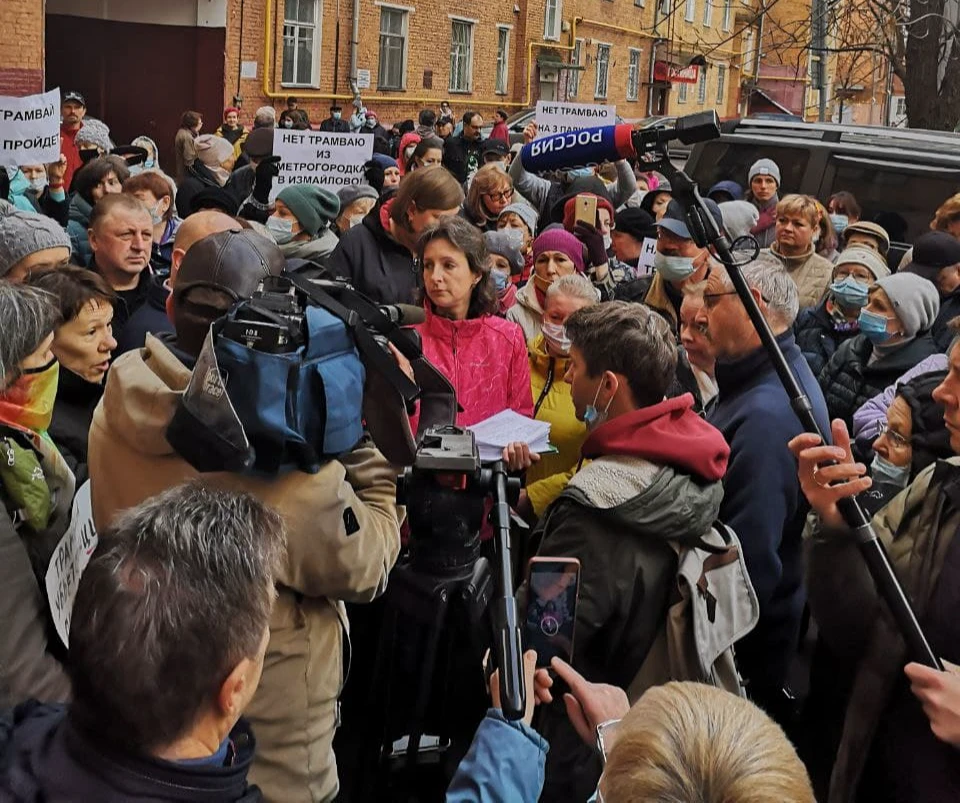
When the journalists of Russia 24 came to take off the plot, the locals met them with bug posters with the same inscription "The tram will not pass!" And gloomy, judging by the photographs, faces. They complain that they were not shown on TV.
It is noted that there are two stations of the red branch metro - “Cherkizovskaya” and “Rokossovsky Boulevard”, as well as the Lokomotiv Mcomotive ”and the Shchelkovskaya station near Metrogorodk.
- Why do you need to take the inhabitants from there to Izmailovskaya, which in the morning and so loaded that you cannot enter the car? - asks Olga Rurikovna. Arrivable to the station, residents say, there will be an additional 2,200 people per hour.
Izmailovo - and truth, a cozy area: many neat five -story buildings made of yellow and gray brick. There are houses with large windows. The trees go alleys along the road, stand everywhere. Local nod: in the summer months, everything is drowned here in greenery. When we learned about the tram, we hung a plate on birches and linden: "I have the right to life."
A man with a short haircut is suitable. It seems: "Mundor Anton Medvedev." Indicates the intersection of the streets: "On their plan, tram tracks go along the roadway." He is sure that because of this there may be systemic accidents: the rails in the winter season are dangerous for tires, because of them strong drifts.
- Tram paths mean cables. For which they will cling - there is nowhere to put the pillars.
Gleb Bokhonov says that he and his wife chose this area for life not by chance: they studied nearby, at Baumanskaya, and then decided to settle here. They chose consciously. He says that a few years ago they "defended their homes from renovation, since they are in good condition." But vibrations from trams, he says, can harm buildings.
He is not going to sell housing, but notes that his investment attractiveness will fall due to the noise and deforestation.
The Committee on Urban Planning and Architecture of Moscow has its own truth in this matter. There, Novaya Gazeta reported that they were designing routes in accordance with the General Plan of the city. To minimize discomfort for residents, they intend to use composite sleepers and vibro -insulating mats.
“The use of composite sleepers allows you to reduce the noise and vibration by 16 dB, the use of vibration -insulating mats reduces the level of vibration by 30%. The use of new technologies in the field of rolling stock and waybill reduces inconvenience for residents of houses near tram tracks, ”said the Moskomarchitecture, noting that they also intend to establish noise -retardant glazing along the paths.
The transport department added that the noise will contribute to the demon -sore paths: "The rails are not fastened with each other, but are welded, and the familiar" knock "of the rails disappears." “According to the results of measurements, the noise level from modern Vityaz-Moscow wagons compared with the previous generation wagons is 20%lower,” Deptrans said. - Along the proposed tram line, multifunctional centers, shopping facilities and office centers, which are independent objects of passenger attraction, will also be built. In addition, the Schelkovskaya metro station is overloaded and located against the direction of movement of the main stream to the center, and therefore much less attractive for trips compared to the unloaded Izmailovskaya. Given the development of the East of Moscow, it is expected that about 65 thousand people per day will be used by the new tram line. ”
The concern of the inhabitants in the fact that due to the proximity of the tram the cost of their housing may decrease, in depotrans replies: “The world and Russian experience in the construction of tram lines allows us to talk about the tendency to increase the cost of real estate located near new objects.”
Moscow is a fast -growing city, even according to official figures, annually receiving hundreds of thousands of new inhabitants. Can it be also cozy for all of them? How to observe interests and development and a comfortable environment? The New Gazeta asked for these questions of the Urbanists.
Kirill Puzanov
Candidate of Geographical Sciences, Head of the Higher School of Urbanism named after A.A. Vysokovsky
- The comfort of living is tied not only on infrastructure, but also on the lifestyle that you want to lead. A common mistake in Russian cities is a conversation about some material values [in the context of comfort], although in fact there are issues of intangible heritage, territorial identity, and in general - a person’s affection for his area.
In the case of Izmailovo, there are plans for the development of the [transport] system as a whole, on the one hand, and residents who also have the right to wish for a better life for themselves, on the other. There is not always a contradiction here. Often in the urban environment we can find a compromise.
There is a concept of advocacy - when the townspeople are included in the process of creating and designing infrastructure: they themselves hire [planners] or call for help from a professional community.
What is obvious to a resident is not obvious to the administration, as well as vice versa.
And here it is very important that professionals appear who could translate from one language to another. The task in working with residents is to identify and correctly formulate a request, to explain the restrictions that exist in the urban environment. Then, correctly transfer this to the language of the administration.
Someone should help. And these are, as a rule, professional city planners, architects-city builders who can correctly translate from one language to another.
We rarely think in the categories of specific infrastructure projects. In this case, it is unprincipled which object we are talking about. Residents protest, saying that this situation will change their life for the worse. You need to figure out what is meant by "the worst side." It will take landscaping, which is used as a recreational zone, residents are afraid that there will be too much stream of people, the road will be loaded - there may be different fears, they need to be sorted out.
Andrey Borisov
Academic Head of the Master's Program "Transport Planning" to the Higher School
-If the city is a strong magnet for the population of not only nearby satellite cities, but, by and large, the whole country-such incidents will arise in one way or another [as in Izmailovo]. Do you need a tram is a question for transporters. You need to see data on passenger traffic, understand where he will go now, where then, and then think. This is not a question that should be addressed to residents from the point of view of "for a tram, or against a tram."
If we are talking about what the city should get from residents - it is to hear from them, and they, in turn, must convey to the city what they need to organize comfortable living conditions. At the same time, the city is obliged to provide residents with these comfortable conditions.
When they tell me that a tram for old areas is bad - this is not bad, especially, if not talking about Izmailovo, but about historical centers of cities.
Europe with its narrow streets: the tram, being very spacious, is almost a panacea there, he drives along the rails, unlike buses, less dimensional, more turning, reaches high speeds, incorporates a large number of passengers.
I repeat once again that the city authorities must convey to people: why a tram is good (if it is really good, maybe now the authorities will understand that there are better ideas). It is necessary to convey and promise that the normative level of noise and the like will be within the permissible values. Then the inhabitants already have one argument against the tram - if from a tasteful point of view I do not like it. But this is already after the state does everything to convince the residents of necessity. If this is really, I repeat, it is necessary.
When there is a broadcast: “We will cut down the trees to make a tram”, then, of course, no one will agree. When they say: “We will cut down, but we will give you, make it better,” and explain why it is better - there is a completely different rhetoric. The question here is not absolutely transport, here the question is how we can negotiate with our residents. Apparently, it turned out badly to agree.