Date
Author
Александра Левинская

Preserved copy
Translated material
Why women kill: how homemade violence creates a convict
Eight out of ten Russians convicted of murder were killed, defending themselves against domestic violence. The endless cycle of violence, from which it is almost impossible to get out, is growing gradually and ends first with a stuck knife, then with a colony, then with social expulsion, stigma and poverty. In the second part of the trilogy, we study the sentences to Perm women who could no longer demolish beatings, beatings, humiliation and rape from loved ones. Baba Nyura accidentally kills her husband with a valek after decades of beatings - but, according to Russian ships, if the husband hits for years, you can get used to it, which means that self -defense is unacceptable.
Research: why women kill and who helps them
I.
Like a crocodile and heroin twice sent Agnia to a colony
II.
The stories of women who planted a knife in their husbands
III.
The opening of the first Center for Assistance to Women's Associated
Among those who congratulated Agniya Urakov on early liberation from the colony-settlement, there was a 74-year-old convicted person-Baba Nyura. She called Urakov “granddaughter” - apparently out of habit, because Baba Nyura had a lot of grandchildren. Every week, one of the six children came to her on a date. Agnia loved to talk with Baba Nyura: she reminded her of her mother, who gave birth to her late. When they met for the first time, Urakova was very surprised: "I did not think that they were planting such old." Agnia knew that Baba Nyura was serving a sentence for murder.
Once Urakova asked her: "Bab Nyur, have you killed your grandfather, or what?" "Certainly. How much could it be? " - she answered and told her story.
The story of a woman of Nyura, in which she kills her husband with a valek
And Anastasia accidentally kills a cohabitant,
who beat his parents
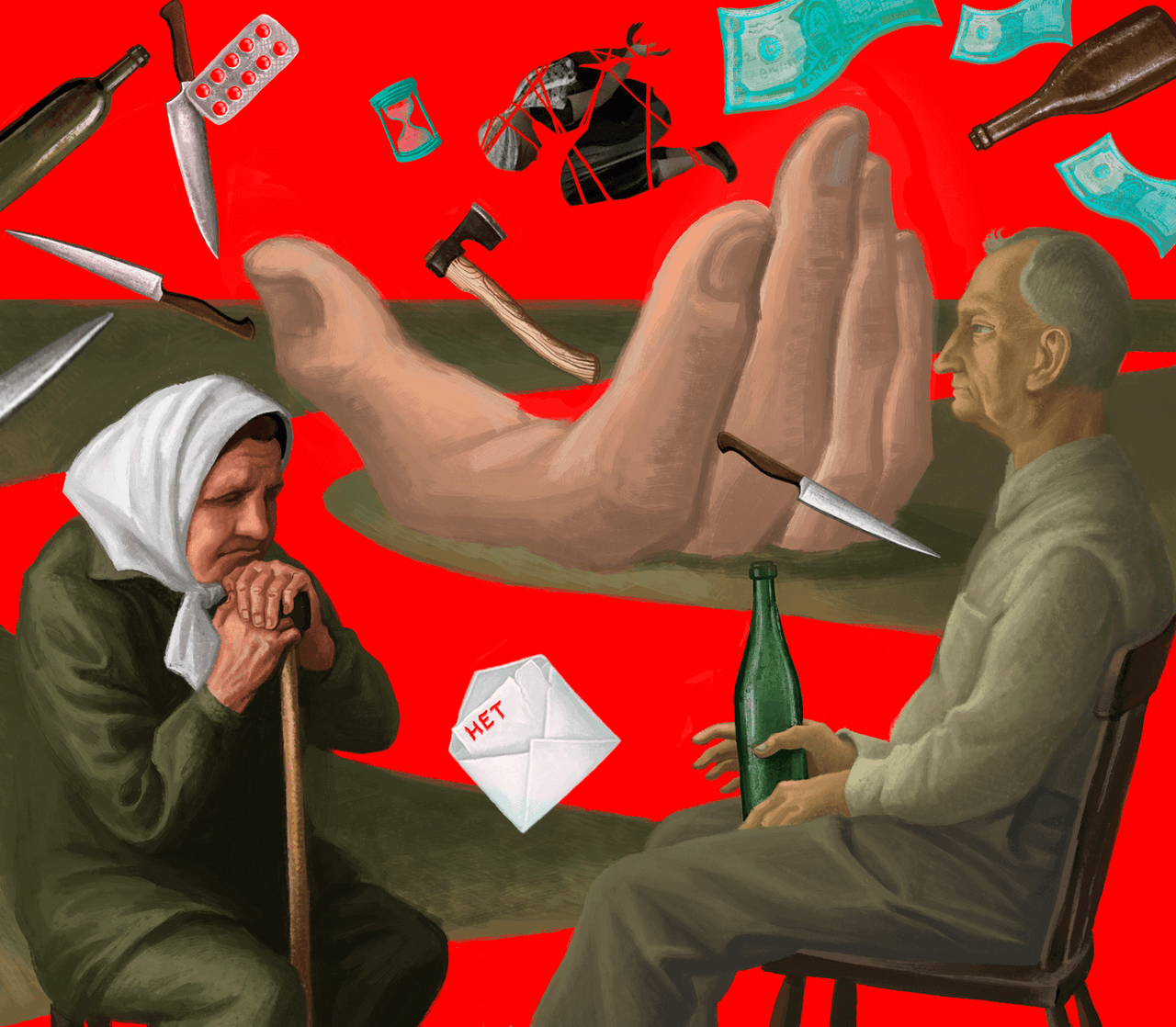
Baba Nyura got married early. There were no other men in her life. After the wedding, the husband began to drink and beat her, but she endured. She believed that everyone lives like that. Beats - means loves. So she suffered and gave birth, endured and gave birth. And he drank and beat, drank and beat. This went on for many years. Children grew up. Grandchildren began. Once, Baba Nyura told her husband: "Once again you will come home drunk, raise your hand at me-I will cut you down." He did not believe. A drunk came and fell asleep. Baba Nyura tied him and put him on a chair. She sat opposite. She began to wait for her to wake up.
He opened his eyes and began to scandal. He demanded to untie. Baba Nyura did not listen. I put on a pillowcase on his head. The fabric was loose, shine through. Baba Nyura took a felt boot. Swung. And he died - from fright. The heart could not stand it. Babu Nyura was sent to prison for six years. Neither the age nor the words of children who confirmed that the father was always a tyrant affected. “She was worried about everything, said that it was not necessary to put on a pillowcase on him, that he was lying in the land now, no one was looking after the grave, I must say that he was erected by another monument, otherwise she would go to bed next to him. This is what a woman who has been hit all her life is thinking, ”says Agnia.
Baba Nyura was one of many women who ended up in the colony, because they were tired of enduring violence, but her story struck Urakov most. “You have no idea how many women pass through it. To tell is one thing, to see is completely different, ”says Agnia.
One of her family, Anastasia Stukova, also suffered from domestic violence. At 29, she moved to her old acquaintance Alexei. These were the third serious relationship in her life. From the previous two, there were a son and daughter who lived with grandmothers. Stukov threw the first man because of his weakness, and the second was sent to prison for robbery, when Anastasia was in the eighth month of pregnancy. Alexey seemed a good option: "And on the face is nice, and calm in nature." Besides, she liked him since childhood. They lived in the village of Novosherbinovskaya, went to the same school and walked together. The couple settled in the apartment of Alexei, which he shared with his mother and stepfather. The man admitted to Anastasia that he had recently freed himself from prison, but did not specify why he received a deadline and spent how many years he spent in the colony. “I tried not to remember the past, not to ask. I believe that if a person considers it necessary, he will tell himself, ”says Stukova. But Alexei never told. In his colony, the hip joint began to collapse, and now he lived on disability. The amount was about 10 thousand a month, but Stukova says that they had enough.
Every day Anastasia saw her son and daughter. “At first, everything was fine with us,” she recalls. Six months later, the relationship between Alexei and his parents deteriorated. The man found fault with his mother, gave her instructions, as, for example, to go to the store, and was angry if she did not fulfill them. From a scream, he quickly moved to the beatings. The stepfather tried to protect his wife, but could not cope with Alexei, as he was physically weaker. Anastasia, too, did not stand aside and stood up for his parents, which was very annoyed by the man. Alexei demanded that Stukov do not interfere in their quarrels, but she was too worried about his mother and stepfather. They constantly walked with bruises. Friends of the couple knew about the situation and more than once demanded to stop beatings - nothing changed. Anastasia wanted to leave, but Alexei's mother asked not to leave them with him. And she did not leave.
On that day, Anastasia called the police: Alexei beat his mother and stepfather again. The police interviewed the whole family and agreed with their parents so that the next morning they came to the examination. The employees were going to take Alexei to the department, but this meant that then one of the relatives would have to take him from there: a man could not walk without outside help. The police were in the center of the village, and the family lived on the outskirts, so I would have to go for more than an hour. Nobody wanted to do this. “If you then bring him back - please take it,” the family said to the police. As a result, they left Alexei at home.
The next day began with a scandal. Alexei was indignant that Anastasia entered his conflicts with his parents, and she proved to him her case. “I replied that I stood up and I would stand up for them, because he is wrong that he rushes at them. Whatever mother, she is your mother, ”recalls Stukova. At some point, the angry Alex threw himself at her and turned her hands out. “It was the last drop,” says Stukova. Nearby, on the table, lay a knife. She burst out, grabbed him and hit Alexei in the chest. After a second, realizing what happened, Stukova pulled out a knife and called an ambulance. Soon doctors and police appeared in the apartment. Mother choked in sobs. Anastasia stood next to a bloodied knife - she could not move away from shock. Everything happened very quickly: she was taken to a pre -trial detention center, Alexei - to the hospital. He died on the way to intensive care. The hit is the hollow of the heart. Doctors said that a man might have managed to save if the knife had not been pulled out of his chest - this provoked an internal hemorrhage. “Everything turned out very spontaneously. I did not want to kill him, ”says Anastasia.
During the investigation, she was placed in a cell, where 20 women were kept. The first few days, Stukova took sleeping pills and slept for a freely, trying to recover after severe stress. But then Anastasia almost did not communicate with cellmates. She tried to abstract from the outside world and go to her senses in order to survive. It was very difficult for her. Stukova considered herself a criminal who deserved the most strict punishment. In addition, she missed children. Anastasia did not even hope for a good outcome. The investigation lasted three months: examination, interrogations, interrogations, interrogations. Stukova told investigators that Alexei beat his parents for several months. Documents confirming that on the eve of the tragedy the family called the police, studied, several bruises on the leg of Anastasia were evaluated as “easy harm”. Stukov was convicted of intentional murder under the 105th article of the Criminal Code of the Russian Federation. The prosecutor requested twelve years in prison, but Anastasia was sentenced to nine. “One thing that the judge considered it necessary to do it,” Stukova sighs. She filed an appeal in which she argued that she had defended her from the attack, but the court decision remained the same.
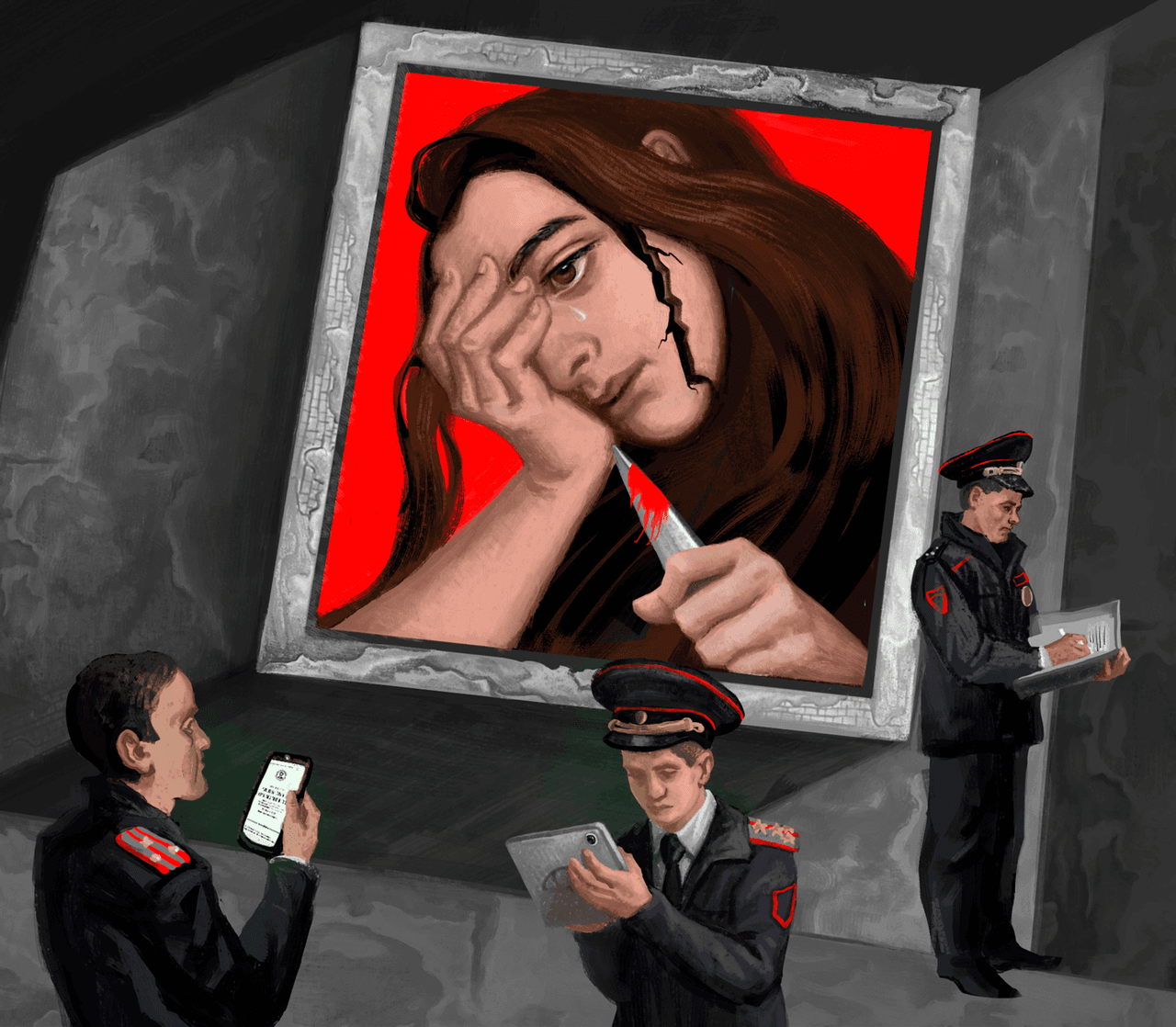
79 % of Russians convicted of murder were protected from domestic violence
Statistics help to roughly evaluate the scale of domestic violence in Russia. On August 13, 2021, the consortium of female non -governmental associations published the results of their study: 66 % of Russians killed from 2011 to 2019 were subjected to domestic violence. In 81 % of such cases, the killers were their guys, roommates and husbands, in the remaining 19 % - relatives. Perm Territory ranks third in terms of domestic violence in Russia. Despite all this, there is still no law in the country that could protect a woman in such a situation. In 2017, the battles in the family for the first time ceased to be considered a criminal offense. Now this is an administrative offense. They are punished for it with a fine of 5 to 30 thousand rubles, with arrest up to 15 days or obligatory work for a period of up to 120 hours. As a result, women are faced with a choice - to die or kill.
According to the study by Novaya Gazeta and Mediazons, 79 % of Russians convicted of murder defended themselves from domestic violence. 97 % of them defended themselves with the help of a kitchen knife - the first, which was at hand at the time of the attack. Most often, such women are appointed heavy criminal articles-the 105th (murder) and the 111st (intentional infliction of grievous bodily harm, which resulted in the death of the victim through negligence). In both cases, the victim of domestic violence can go to prison for up to 15 years. The 108th is less commonly used (murder committed when exceeding the limits of the necessary defense) and the 109th (causing death by negligence) of the article, which provide for up to two years of imprisonment. The main argument in judicial practice is the so -called “naked hands factor”: according to the law, the necessary defense is considered only those situations when the threat and the answer to it are equivalent. Men usually attack with bare hands, and women who are often physically weaker are forced to use a knife and other extraneous objects to protect themselves. Such actions are regarded as murder, since the victim caused the aggressor more harm than him to her. True, the law specifies that a person can protect himself in any way if violence is a danger to his life. Threats also give such a right. An exception is situations when the victim cannot objectively assess the degree of danger due to the surprise of the attack. But all this does not work in the case of domestic violence. According to Russian courts, neither beatings nor threats of murder pose a real danger to a woman’s life. If the husband beat her for years, then she had to get used to violence - in this case, the attack could not be considered unexpected. The version of the murder in a state of affect is also not considered. In addition, it is beneficial for investigators to qualify the self -defense as a murder, since the effectiveness of their work directly depends on the number of open murders.
According to the study of Novaya Gazeta and Mediazons, the Perm Territory is included in 20 Russian regions, where the victims of domestic violence most often receive deadlines for murder. This is how such sentences sound.
Permian. 2017. 105 of the Criminal Code (murder). Eight years of a general regime colony
“At first, the relationship was good, then he began to beat her. He did not allow the police to contact. She was afraid of him, because he beat her, rushed at her. She was at home at Z. A. came there, pulled her out of the apartment, began to beat her with her arms, legs, hammer ... She came home, saw the broken glasses in the apartment, A. was inadequate ... She called the police, but the police said to sort things out themselves. A. left the house. An hour later he came, pounded at the door. She called the police, he was taken away, but after 2 hours he was released. He began to scream under the window that when she goes to work, he would cut her.
...A. He began to insult her for no reason. At home, he began to say that he would kill her, began to push her. She fell on the sofa. A. did not inflict blows to her, he only shouted that he would kill her. Then A. went into the kitchen and began to open the box in which the knives lay. She prevented him, but A. managed to get a kitchen knife with a black handle from the box. With a knife, A. went into the room, and she proceeded after him. At the same time, A. simply waving a knife, he did not make attacks in her direction. She went to the sofa and persuaded A. to stop the scandal. He calmed down, put the knife on the coffee table. When she straightened the sofa, A. again shouted “kill”. She was frightened that he could grab a knife again, and she grabbed a knife from the table, which A. brought to the room. A. At this time stood closer to the door to the room. Holding the knife in the right hand, A. two blows to the abdomen struck up the bottom. She remembers two blows, does not remember other blows. From the blows, A. immediately fell to the floor. On his shirt, she saw blood. She immediately pressed a towel to his wound. After that, she washed the knife and put it in a box with knives. Then she called D. and said that she had stabbed A.
... Shilova T. I. acted deliberately, that is, realized the social danger of her actions, foresaw the possibility or inevitability of socially dangerous consequences and wished for their advance. ”
Permian. 2017. 108 of the Criminal Code of the Russian Federation (murder when exceeding the limits of the necessary defense). 1 year 8 months of restriction of freedom.
“Between her and D. there was a quarrel due to the fact that she could not reassure the crying child. D., sitting on the bed, threw her back on his legs and, grabbing her neck with two hands, began to strangle for a few seconds. She cried, wept. D. stopped pressing his fingers on his neck, but began to pull his head with both hands, while he said that he would tear her head off. It lasted a few seconds, she cried and screamed in pain. D. let her go only after she repeatedly asked him about it. The child was sitting on the bed all this time and cried. She got out of bed, took the child in her arms. D. stood in front of her, blocking the way out of the kitchen, and began to apply her fists. The child was in her left hand, she turned to D. right side, so that D. did not accidentally hit the child. D. inflicted at least five blows to her with fists on the right shoulder, neck, head, back, causing pain, while he screamed so that she reassured the crying child. Wanting to protect himself from D. and stop his actions so that he stops to beat her, she grabbed a knife lying on the countertop, standing next to her with her right hand, and stabbed D. in the chest area with a knife. D. sat on the bed, then lay down and asked to call an ambulance. She was scared, went into the common room, where she put the knife on the table and, waking up D2, gave him the child, she ran to her neighbor D3, whom she asked to call an ambulance. D. died before the arrival of ambulance.
... The encroachment on the part of D. was not fraught with violence that was life -threatening V. Chermyanina, but the latter, in order to defend from his unlawful actions, deliberately inflicted one blow with a knife. ”
Permian. 2019. 108 of the Criminal Code (murder committed in case of exceeding the limits of necessary defense). 1 year 10 months of restriction of freedom.
"U. I saw that there was nothing on the table, he began to be indignant, to say why everything was removed from the table, he began to raise his hands, waved, demanded to bring vodka, set to the table. She did not contact him, talk, went to the kitchen, took a knife from the table, began to cut fruit. He went into the kitchen, flew up to her and began to strike the head, on the face, kick her in the stomach. At the same time, he called her, cursed with a rough obscene abuse. She tried to protect against him. At the time of the attack, she greatly squeezed the knife in her hand so that W. would not take it away. At this time, she was near the windowsill, the table stood on the side, the place was limited. U. squeezed her in the corner with his body and inflicted numerous blows to her. She lost her balance, began to fall into the corner of the window. W. began to hold her head and tilt her to the corner. She closed her eyes, as they became dark from the blows. Her right hand, in which there was a knife, rose up. With this hand, she closed from the blow. She did not even feel that W. contacted a knife, stumbled upon him. U. stopped hitting her, began to fall to his knees, and she saw that the knife in the blood. ... Earlier, he had once attacked her with a knife, so she decided that this time W. could stick a knife into her.
... Shistova resorted to protection against encroachment ... in such ways and means, the use of which was clearly not caused by the character and danger of encroachment, and without the need to deliberately caused U. death that had encroached on it. ”
Punished three times
Four phases of domestic violence: tension increase, violence, reconciliation, “honeymoon”, repeat
When human rights activist Anna Kargapoltseva began to ride in female colonies, all these stories shocked her. She could not believe that for twenty years she struggled with an unfair attitude towards convicted men, not noticing what position the women were in. “I have a shift in consciousness,” says Kargapoltseva. Most of the women whom she met went to prison after the violence experienced - psychological, economic, physical. Many, like Agnia, received terms for drugs. Husbands and cohabitants forced them to buy and sell - sometimes substances, sometimes themselves. A significant part was involved in prostitution to earn money on their body. Others were simply given to friends in exchange for substances. According to Kargapoltseva, the “very large percentage” of the convicts took on someone else's guilt: the men convinced them that for a woman the punishment would be softer, promised to wait, and then they started a new relationship and disappeared.
Some prisoners could not forgive those who used them for years. Вторые не могли простить себя — за то, что защищались. «Такие женщины приходили и говорили: „Но я же человека убила“. Чтобы принять это, они все как одна твердили: „Да, он меня бил. Да, он меня изнасиловал. Но я-то человека убила“. Я всё время это слышала. Может быть, во время следствия им это объяснили», — рассказывает Каргапольцева. Жертвы насилия жили с огромным чувством вины — именно это поразило её больше всего. В мужских колониях ситуация была прямо противоположной: там все считали себя невиновными, какой бы срок они ни получили. Мужчин поддерживали матери, жёны, дети и сожительницы, которые постоянно ездили к ним на свидания. Женщин почти никто не навещал. По закону, супруг может расторгнуть брак без их согласия, если срок заключения составляет более трёх лет. Как правило, спустя месяц женщины, которых встретила Каргапольцева, получали уведомление о разводе и больше никогда не слышали о своих мужьях. Матери ездили первое время, а потом и они прекращали. Женщины сами просили их об этом: не хотели, чтобы они проводили дни в дороге, носили тяжёлые сумки и подвергались обыскам. Жалели. Дети в лучшем случае росли вдалеке. В худшем их забирали в детские дома. Или осуждённые выходили на свободу в таком возрасте, когда заводить своих детей было уже рискованно, а взять приёмных невозможно.

Общаясь с этими женщинами, Каргапольцева заметила, что никто из них давно не мечтал о будущем. За годы в тюрьме они утратили практически все связи с внешним миром. В мужских колониях настроение было иным: там люди жили своими иллюзиями. Большинство мужчин верили, что на свободе их встретит компания друзей, которая найдёт для них и жильё, и работу, и машину. Осуждённые женщины рассчитывали только на себя. Они понимали, что едва ли заработают даже на комнату в коммунальной квартире. Заниматься тяжёлым низкоквалифицированным трудом они не смогут, а на другую работу их не примут. «Когда человек освобождается, он остаётся навсегда с клеймом „зэк“ или „зэчка“. Forever. Из его жизни не уходит справка о наличии судимостей, которую требуют при поступлении на работу. Неважно, двадцать лет прошло или тридцать. Ты уголовница — и это навсегда, — объясняет Каргапольцева. — Женщина не должна быть наказана трижды. Первый раз, пережив страшное состояние совершённого над ней насилия. Второй раз, отсидев за это 6, 8, 10 лет. И третий раз, оставшись навсегда с клеймом „зэчка“».
Насилие — это длительный процесс, говорит психолог Марина Селезнёва, коллега Каргапольцевой, которая уже много лет работает с заключёнными. С насилием может столкнуться любая женщина, но не каждая способна распознать его на ранних этапах. Во многом это зависит от предыдущего опыта. «Чтобы понять, что происходит насилие, нужно знать что-то другое», — говорит Селезнёва. При низком уровне жизни такие отношения могут восприниматься как норма. Согласно теории Ленор Уолкер, цикл домашнего насилия состоит из четырёх фаз: нарастание напряжения, эпизод насилия, примирение партнёров и так называемый «медовый месяц». Потом всё повторяется сначала. Со временем фазы становятся короче, а частота и жестокость насилия возрастают. По словам Селезнёвой, многие женщины осознают проблему, только когда эпизоды насилия происходят непрерывным потоком. Самые распространённые причины, которые заставляют жертв оставаться в таких отношениях, — низкая самооценка и экономическая зависимость от партнёра. На российских женщин влияют и традиционные установки, призывающие терпеть до последнего. Порой насилие в семьях длится годами, но привыкнуть к нему невозможно, утверждает Селезнёва. «Болевой порог, конечно, меняется, но не обязательно притупляется. Никто не может сказать, ударили по старой ране или нет. Порог реагирования также может измениться: если вас обозвали двадцать раз, то вы уже не так болезненно это воспринимаете. Но ассоциативные изменения никуда не уходят. Одно и то же поведение может трансформироваться во что-то новое — тогда на это действие будет совершенно другой ответ. Пока человек жив, у него могут быть непредсказуемые реакции», — говорит психолог. В ситуации нападения любой может взять в руки нож. Так работает физиология — болевой синдром и гормональный выброс. Если женщина, защищаясь, убила агрессора, то произошедшее не делает её преступницей, уверена Селезнёва. «Это лотерея», — говорит психолог.
Когда превращаешься в женщину-изгоя из страшных воспоминаний
Селезнёвой уже доводилось работать с такими женщинами в тюрьме. Одной из первых была 35-летняя азербайджанка, которую психолог встретила в 2008 году. Её звали Гулорам, что в переводе на русский означает «цветок». Сразу после института Гулорам вышла замуж за любимого человека, несмотря на то, что её родители были против этого брака. Вскоре у пары родилось двое сыновей. Уже тогда муж избивал Гулорам — за то, что она не всегда выполняла его требования. После распада СССР семья переехала в Россию. Прежде Гулорам занималась только бытом и детьми, а теперь начала зарабатывать деньги — больше, чем муж. Побои участились и стали более жестокими. Последний раз муж напал на Гулорам в сарае, где она колола дрова топором. Этим топором она и нанесла ему несколько ударов в голову, которые оказались смертельными. Когда Гулорам поняла, что произошло, то испугалась и попыталась спрятать тело. Позже это стало отягчающим обстоятельством, которое позволило осудить её за умышленное убийство по 105-й статье УК РФ. Гулорам никогда не думала, что её судьба может так сложиться. Она вспоминала, что в её родном ауле жила женщина, с которой никто не разговаривал. Маленькой Гулорам запрещали даже играть с её детьми. Однажды бабушка рассказала ей почему: эта женщина убила своего мужа — ударила камнем. Все знали, что он много лет издевался над ней, но с тех пор она стала изгоем. «Одним из её самых ужасных воспоминаний была эта женщина-чудовище. И теперь она в собственных глазах тоже стала чудовищем», — рассказывает Селезнёва.
После произошедшего от Гулорам отвернулась вся семья: двое сыновей, мать, отец, родственники в Азербайджане. Тюрьма навсегда отрезала женщину от родины: «Страшно было представить, что она выйдет и встретит пустырь. У этого человека не было совершенно никаких путей». Селезнёва не знает, что произошло с Гулорам после освобождения. У них было всего несколько занятий. Последний раз Селезнёва видела Гулорам ещё в колонии. «Я не могла ей ничего предложить. Ей некуда было идти. Я даже не представляю, как она выжила», — говорит психолог.
По словам Селезнёвой, такая женщина может восстановиться, но для этого требуется время. Психолог бессилен, если работает в одиночку. Осуждённая женщина нуждается в поддержке семьи и близкого окружения. Помочь может только безопасная среда, где её принимают и не осуждают, других путей нет.
Поэтому Анна Каргапольцева, окунувшаяся в мир женщин, которые убивают, решила создать для них такую среду.
В заключительной части трилогии — как «Нечужие», первый в России центр помощи осуждённым женщинам, пытаются помочь тем, кто убил своих тиранов, после отсидки и с какими препятствиями сталкиваются на этом пути.